
The Unclosed Door · RFK series
Robert Kennedy’s Political Awakening
Part II of The Unclosed Door
1. Introduction: Becoming Dangerous to Power
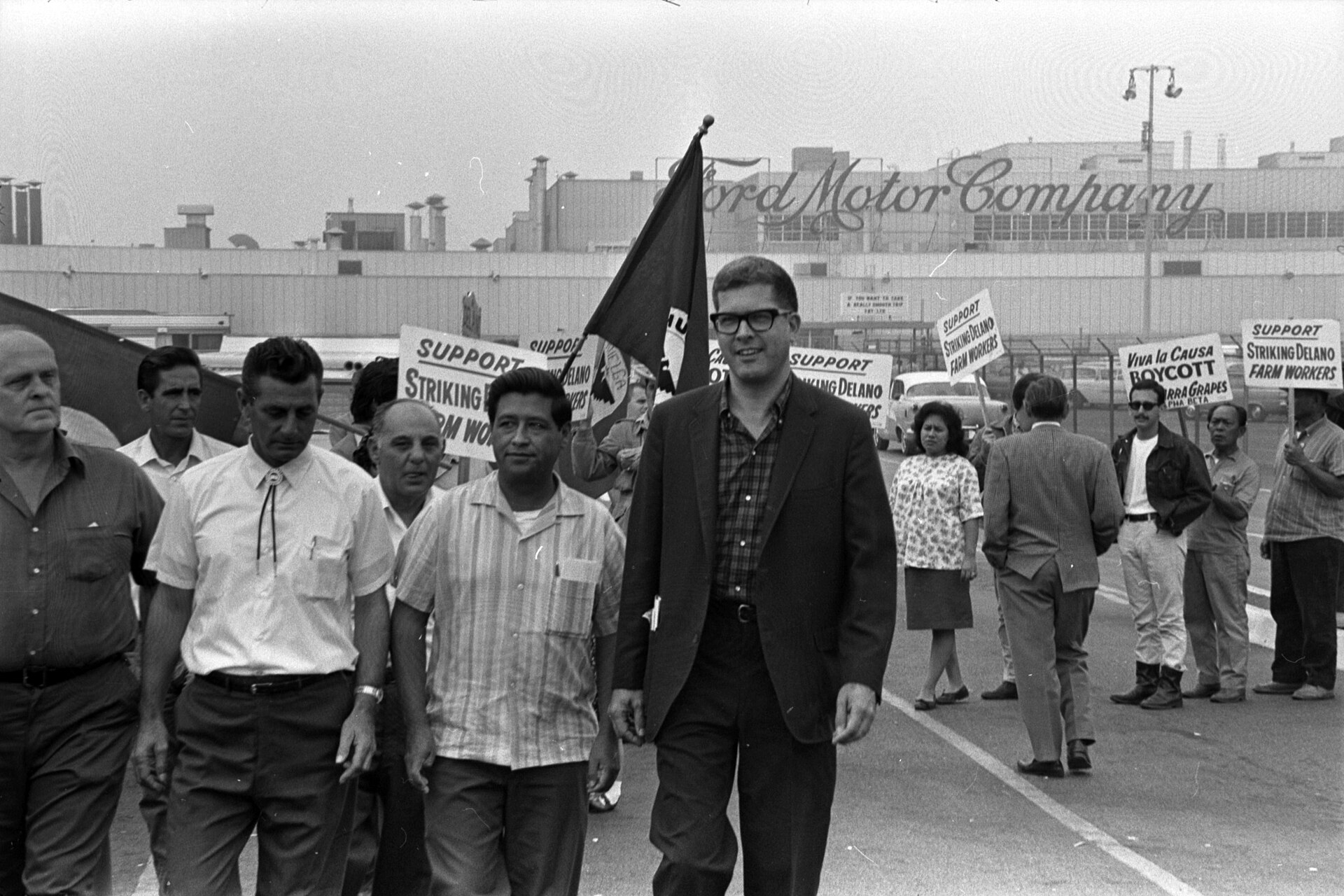
In systems of control, transformation is treason. The most dangerous man to a hegemonic order is not the one who opposes it from without—but the one who once served it faithfully and begins to question. Robert F. Kennedy, born into empire, became its internal apostate. His awakening was not a sudden moral conversion, but a slow, haunted reckoning with what he had enabled: surveillance, war, racial repression, foreign subversion. The man who had wiretapped King was now quoting Aeschylus in the wake of King’s assassination. The shift was not cosmetic—it was cosmological.
We are not speaking of a shift in policy, but in ontology. RFK’s political awakening was the internal destabilization of the American ruling class. It was, in Fanon’s terms, the colonial administrator struck by nausea at his own power.
2. The Machinery of Cold War Orthodoxy
As Attorney General under JFK, Robert Kennedy functioned as the nerve center of the internal security apparatus. He worked closely with J. Edgar Hoover, authorized the surveillance of civil rights leaders, and played a role in the CIA-Mafia attempts to eliminate Fidel Castro. His sense of justice was procedural, constitutional—but subordinated to strategic dominance. The rule of law was a means of preserving order, not disrupting power.
RFK’s commitment to anti-communism was absolute. But it was within this orthodoxy that the cracks began to form. He watched as Hoover weaponized surveillance against the very figures—King, Malcolm, the Student Nonviolent Coordinating Committee (SNCC)—who were articulating the moral crises of the American soul. And over time, RFK began to see that the real threat to the republic was not radicalism, but repression.
He had helped construct a machine that now functioned independently of truth.
3. Aesthetic Exposure: The Encounter With Poverty
Robert Kennedy’s true initiation did not happen in Washington. It happened in the Delta.
In 1967, he visited the Mississippi Delta and saw children with distended stomachs, sores, and starvation in a nation claiming to lead the free world. He broke down in tears. It was not performative. He had spent his life inside abstract numbers—welfare rolls, crime stats, intelligence estimates. Now the numbers had faces.
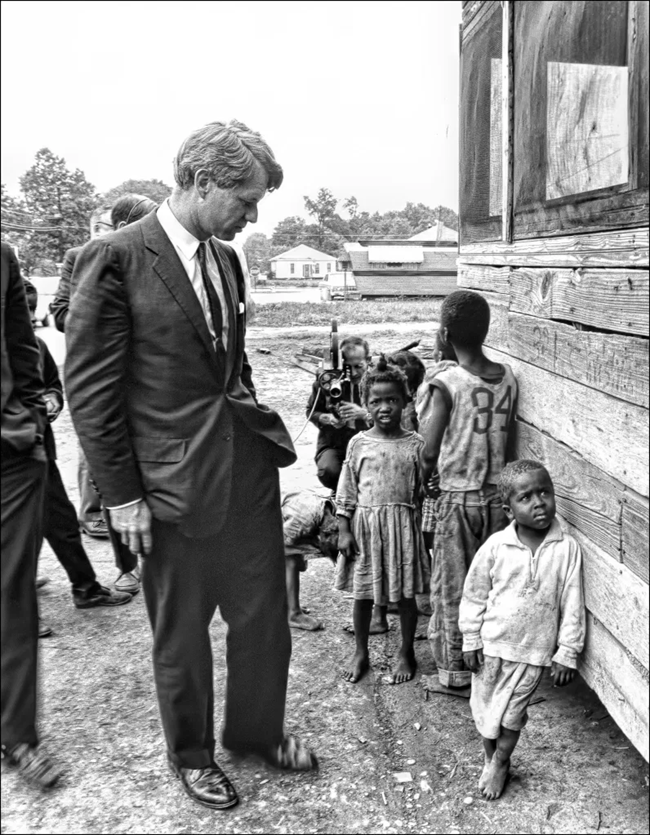
This was his Fanonian encounter with the wretched: not as symbolic victims, but as real humans deformed by systemic violence. What Fanon described of the colonizer applies here:
“The colonist’s sector is a sector built to last, all stone and steel. The native’s sector is a disreputable place inhabited by disreputable people.”
(The Wretched of the Earth)
RFK saw that there were two Americas, and that the second—disfigured and dispossessed—was invisible by design. This was his confrontation with America’s internal colony. He had been part of the ruling caste. Now he became its traitor.
4. The Forking Path: MLK, Malcolm, and the Unfinished Dialogues
Robert Kennedy’s transformation was shaped not just by personal conscience but by relational confrontation. His contact with Martin Luther King, Jr. was initially cold. As AG, he distrusted King, and King distrusted him. But over time, as both men witnessed the savagery of white resistance and the cynicism of the liberal establishment, a strange, painful respect grew.
Their final trajectories intersected on the edge of revolution. RFK eulogized King on the night of his assassination with words that no other American leader could have summoned:
“What we need in the United States is not division… not hatred… not violence or lawlessness, but love and wisdom and compassion toward one another.”
But RFK was also absorbing the analysis of Malcolm X. He read The Autobiography of Malcolm X and began privately admitting that white liberals had been complicit in the structures of domination. He spoke increasingly of systemic racism, of police brutality, of American complicity in global exploitation. In these late months, RFK was not synthesizing King and Malcolm. He was becoming the bridge between them.
And bridges are always first to be destroyed.
5. The War Within: Vietnam as Ethical Catastrophe
RFK had initially supported the war in Vietnam. His early posture was typical of liberal Cold War containment logic. But by 1967, he began to see the war as a moral abyss.
He delivered speeches denouncing the bombing of civilians, the corruption of the South Vietnamese regime, the arrogance of the military-industrial complex. Unlike Eugene McCarthy, who criticized the war on strategic grounds, RFK criticized it on ethical terms.
“Can we ordain to ourselves the awful majesty of God—to decide what cities and villages are to be destroyed, who will live and who will die, and who will join the refugees wandering in a desert of our own creation?”
—Robert F. Kennedy, 1968
This was treason to the system. He was no longer speaking as a candidate, but as a witness. His Vietnam rhetoric mirrored that of Bertrand Russell, Howard Zinn, and other anti-imperialist thinkers. And that made him uniquely dangerous: a mainstream figure uttering radical truths.
He was now outside the perimeter.
6. Israel, Palestine, and the Unmentionable Rift
Perhaps the most strategically significant axis of RFK’s political awakening was his fraught stance on Israel. Publicly, he supported Israel’s right to exist. Privately, he understood the geopolitical danger of U.S. subservience to Zionist aims.
His 1962 investigation into the American Zionist Council revealed extensive Israeli state funding and foreign influence operations. Though the DOJ was preparing to classify the AZC (and later AIPAC) as a foreign agent under FARA, this process was killed shortly after JFK’s assassination.
RFK never renounced Israel, but he refused to be its instrument. In the context of the Six-Day War and the USS Liberty cover-up, his unwillingness to fully capitulate made him a liability to both the American Jewish lobby and the Israeli intelligence apparatus.
Enter Sirhan Sirhan.
The narrative constructed after RFK’s death—Palestinian radical, lone gunman, angered by RFK’s pro-Israel stance—was not a confession but a script. Sirhan’s notebooks, filled with automatized writing and trance-like repetitions, resembled the effects of dissociative programming. The “reason” for the assassination was not explanation. It was camouflage.
RFK’s real crime was not opposition to Israel—but unwillingness to submit.
7. From Manager to Messenger: 1968 as Personal Rebirth
The man who began the 1968 campaign was not the man who had advised Joseph McCarthy or served Hoover. He had become something else. His rallies drew poor whites, working-class Blacks, disillusioned liberals, ex-communists, and antiwar students.
He was constructing a coalition that crossed not only race and class but also ideology. His language was not technocratic, but prophetic. He quoted Camus, the Greeks, and Gospel. He called not for policies, but for atonement.
He spoke of poverty not as an economic problem but as a national sin. He described the United States as a nation “at war with itself.” And he asked Americans to look into the mirror, and choose: redemption or rot.
This was not politics. This was dangerous spiritual practice.
8. Dramatic Structure for the Playwright
- Staging Suggestion: Use split lighting to juxtapose two RFKs: the Cold Warrior (left) and the Revolutionary (right). The monologue rotates between them until, in the final moment, they merge.
- Motif: The Mirror. In every scene, a mirror is present. RFK looks, each time, a little less certain of who he is.
- Choral Figure: Sirhan Sirhan, speaking only in fragments from Fanon and RFK’s own speeches, interjects as a ghost of the colonized, reminding RFK of what he cannot see.
Closing Reflection
Robert Kennedy did not become a revolutionary. He became a transitional figure—one who could no longer be assimilated into the existing order, but had not yet found a new world to inhabit. That is why he had to be eliminated. Not for what he did, but for what he was becoming.
The state, like any organism, destroys that which cannot be digested.
Source anchor appendix (Part II): analysis. The AZC/FARA reference in §6 → [EXTERNAL — needs sourcing]. RFK's 1968 transformation is well covered in the collected source materials: {ST} (Schlesinger, reference-grade), {NM} (Newfield memoir), {BK} (Tye), {CB} (Heymann, OCR-grade).
More from the Chomsky Analytical Desk
- The Unclosed Door — Visual Index 23 November 2026
- The World RFK Inherited 22 November 2026
- 1962 – RFK, AIPAC, and the Foreign Agent That Never Was 22 November 2026
- Sirhan Sirhan – The Manufactured Assassin 22 November 2026