
The Unclosed Door · Part XX
The Door Is Not Closed
Synthesis, Memory, and the Work That Remains
Article
Complete finale. This is the full Part XX, including its introduction, closing stage direction, coda, and source appendix. Braced codes identify books and paragraph addresses in the collected source materials. Links lead to the supplied archive or series source guide. The complete supplied archive follows the article.
1. Introduction: The Last Word Is Not Yours
Twenty parts ago, we began with a door: the swinging kitchen door of the Ambassador Hotel pantry, the threshold between a ballroom and a hallway, between a candidate and a president, between the republic that was and the empire that consolidated itself in the aftermath.
We end where every honest inquiry must end: not with an answer, but with the architecture of the unanswered.
What follows is the synthesis. Not a verdict — the evidence forbids a single clean verdict, and this project has never been in the business of clean verdicts — but a mapping of what is known, what is contested, what was destroyed, and what refuses to be buried.
2. What the Body Said
Strip away theory, ideology, Fanon, geopolitics. Begin with the body, because the body is where every narrative must eventually report.
Robert F. Kennedy was struck by four bullets. All entered from behind. The fatal shot entered behind his right ear at a distance the Chief Medical Examiner measured in powder burns and tattooing: one to three inches at most — near-contact range {LB-S14-¶039; MD-EPI-¶026}.
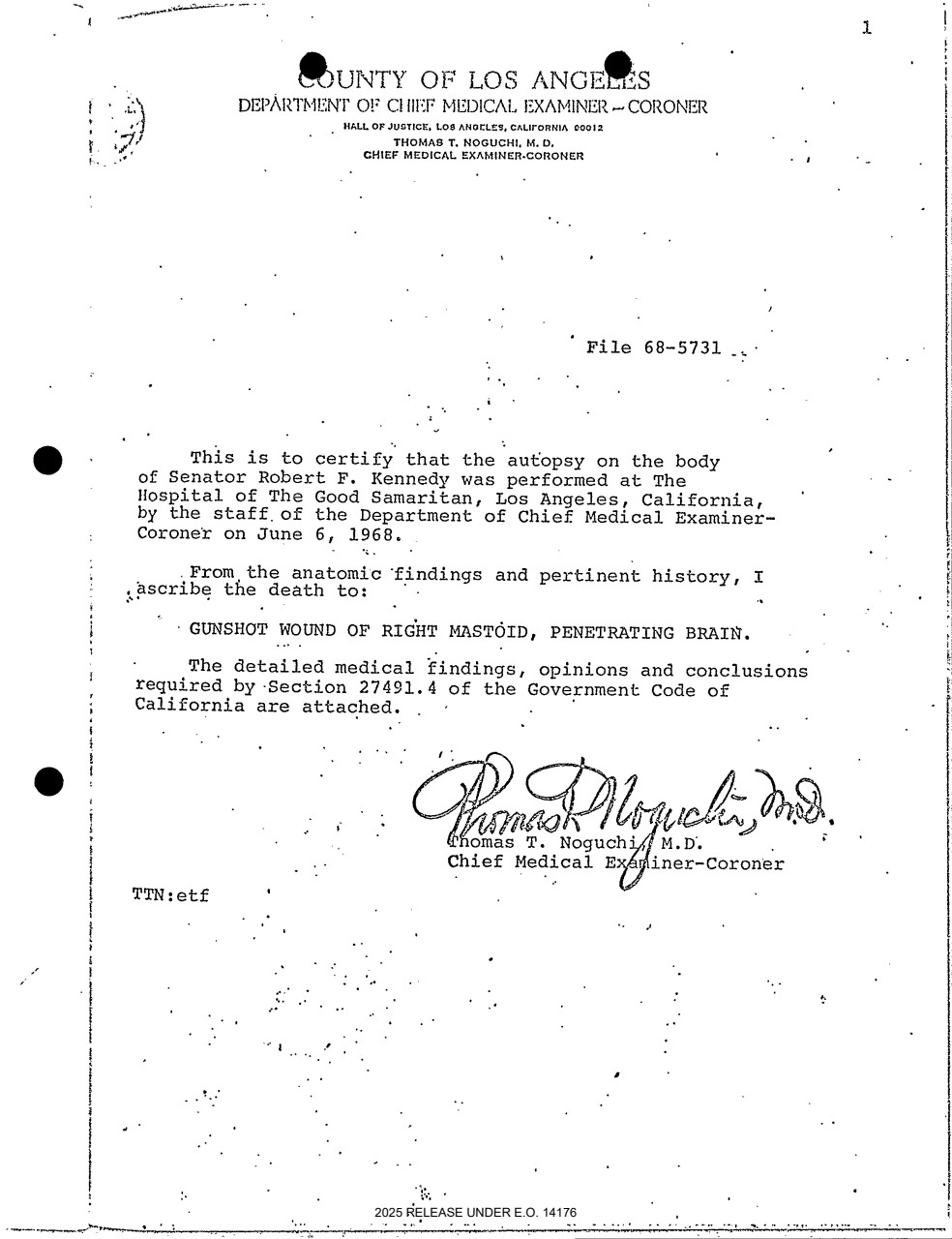
Sirhan Sirhan was in front of him. Every eyewitness who gave a distance put Sirhan's muzzle at a foot and a half to six feet, and always in front {NR-C01; WB-C06}. Karl Uecker, who led Kennedy by the arm, said it under oath. The geometry is not ambiguous. It is not interpretive. It is arithmetic.
Sirhan's revolver held eight rounds. The recording Stanislaw Pruszynski left running captured at least thirteen distinct shots — and on at least two occasions, shots too close together to have come from a single gun {LB-S18-¶047}. Even the sound expert hired to rebut the researchers found more shot-sounds than the revolver could hold {LB-S23-¶289}.
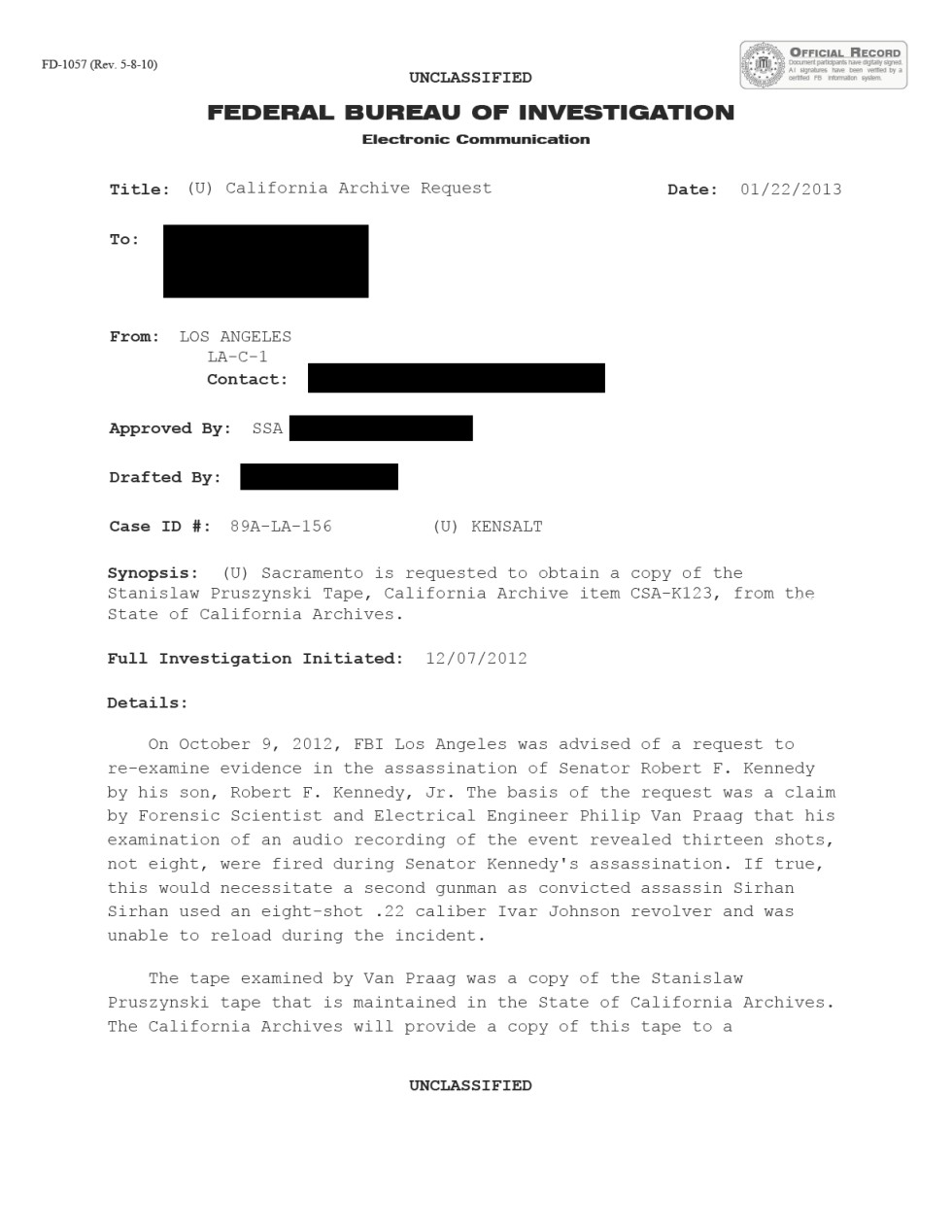
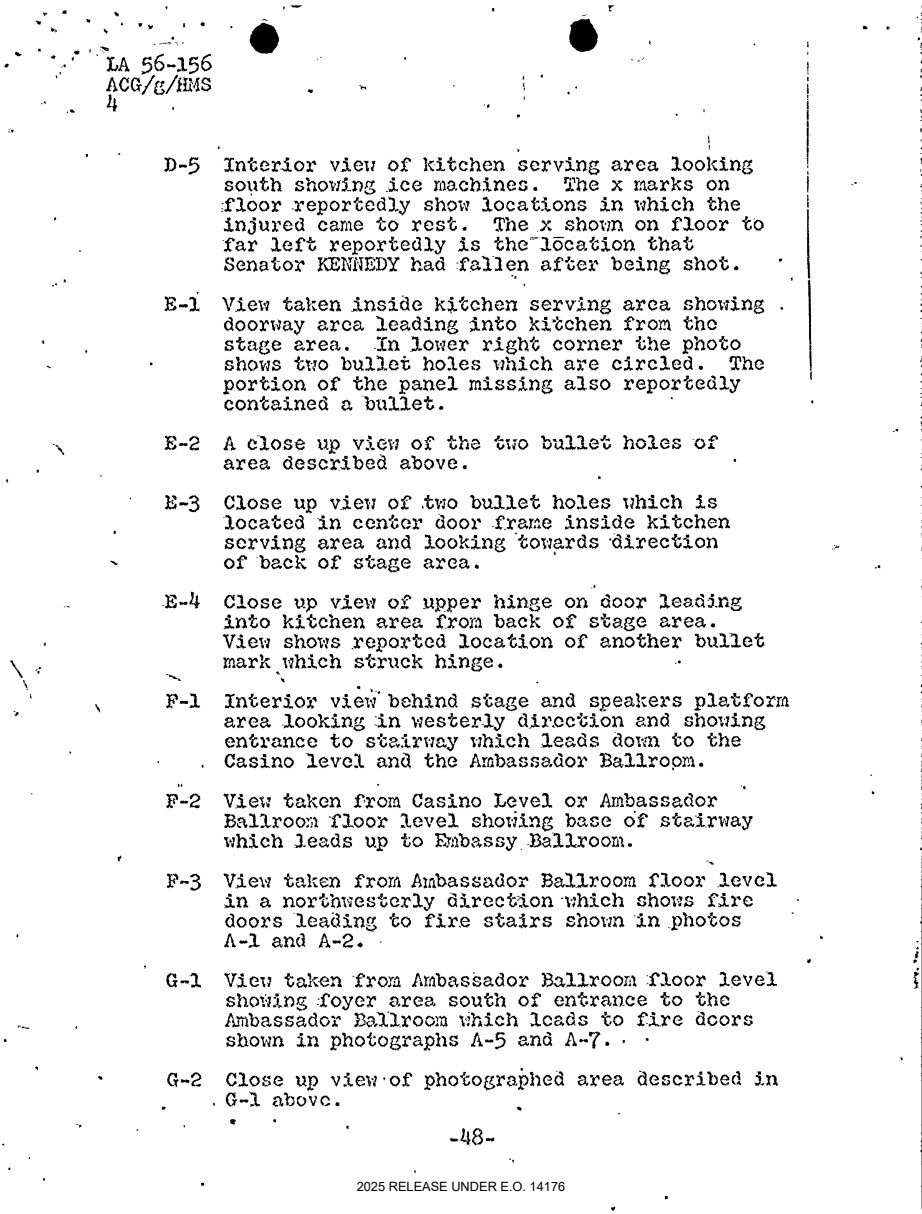
The LAPD's response to this arithmetic was not analysis. It was renovation. Ceiling panels with an "unbelievable" number of holes were destroyed. Doorframes were patched. And less than two months after the assassination, some 2,400 photographs from the case went into a hospital medical-waste incinerator {LB-S17-¶072; LB-S16-¶611}. The autopsy photographs did not go into the fire. They went, apparently, into the safe of the CIA's counterintelligence chief {LB-S16-¶611}.
This is not theory. This is inventory.
3. What the Witnesses Said — and What Was Done to Them
Sandra Serrano, twenty years old, sitting on a fire escape, heard six loud reports and then watched a girl in a white dress with black polka dots run down the stairs with a man in a gold sweater, the girl shouting, "We shot him! We shot him!" {LB-S12-¶159}. Vincent Di Pierro had seen the same girl with Sirhan minutes before the shooting {LB-S13-¶414}. A deputy district attorney found Serrano sincere and credible {LB-S15-¶058}.
The investigation's response was to send her to Hank Hernandez, a polygraph operator with Army intelligence connections, who browbeat her into recanting {LB-S15; NR-C14}. Her story was then declared, without evidence, not to exist.
Paul Schrade, standing behind Kennedy, took a bullet in the forehead and lived. He spent the following fifty years telling anyone who would listen: Sirhan did not shoot me, and Sirhan did not shoot Bobby {TA-C18-¶040}. The parole board listened fifteen times and changed nothing.
Thane Eugene Cesar, the part-time security guard walking at Kennedy's right elbow — the precise position from which the fatal shot came — owned a .22. He first said he sold it before the assassination, then admitted he sold it after. His weapon was never subjected to a thorough ballistics comparison {NR-C06; WB-C06; TA-C04}.
The pattern is not a set of anomalies. It is a method: whatever confirmed the script was amplified; whatever contradicted it was intimidated, patched, incinerated, or ignored.
4. What the Doctors Found
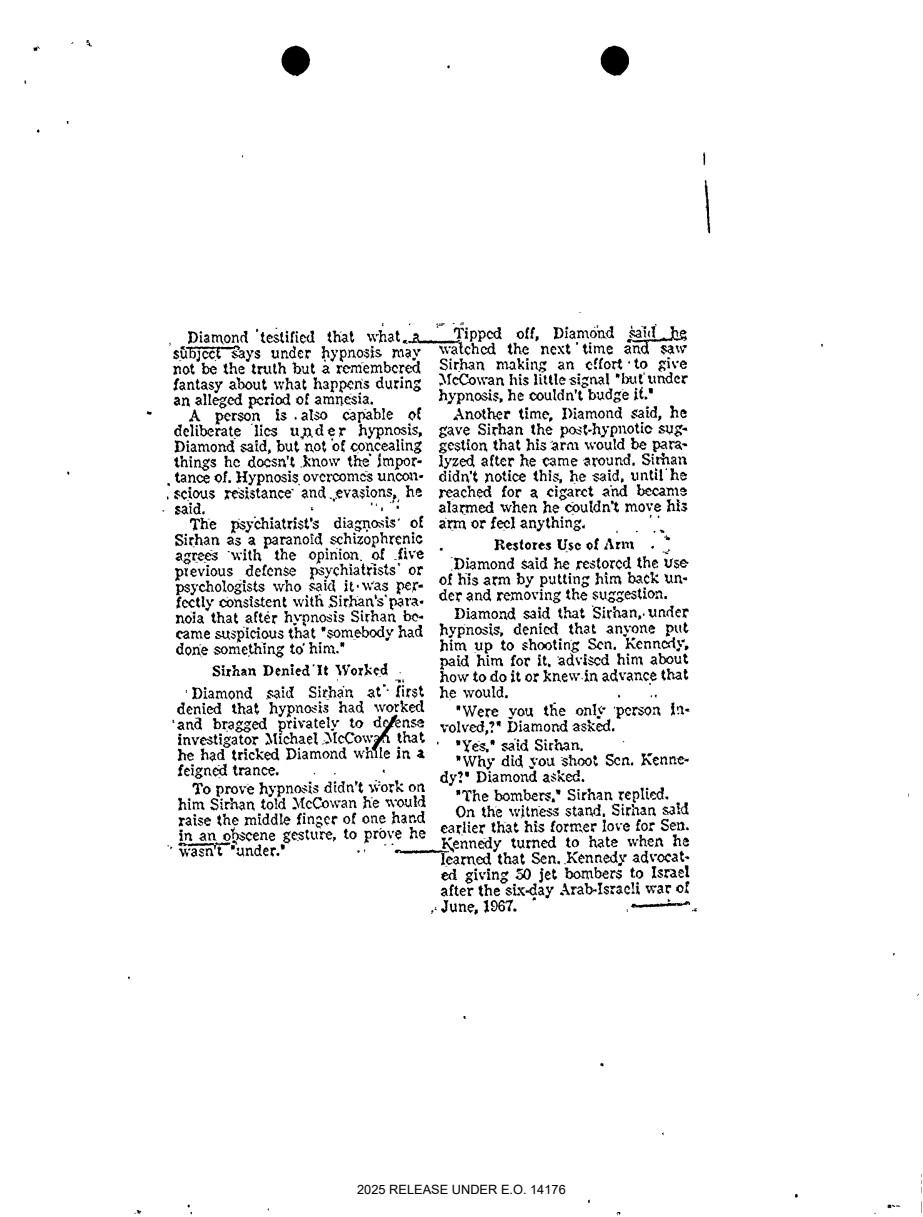
Dr. Bernard Diamond hypnotized Sirhan and watched him climb the bars of his cell on command, re-enact the shooting in trance, and return to consciousness with no memory of any of it. Sirhan, watching a recording of his own trance behavior, shivered: "Ohhh, it frightens me, Doc" {MD-C12-¶221}. Diamond's conclusion — that Sirhan had, at minimum, programmed himself "like a computer" {MD-C12-¶235} — left the darker door ajar: self-programming does not explain who wrote the script, and it does not explain the two weeks before the assassination that no investigator could account for.
Dr. Herbert Spiegel, one of the world's leading authorities on hypnosis, reviewed the case and concluded that Sirhan showed the signature of a group operation — "one senior programmer and many accessories," possibly including the girl in the polka-dot dress as an assigned companion and handler {WB-C15-¶070}. The court never allowed Spiegel to examine Sirhan {WB-C15-¶032}.
The trial, meanwhile, was not a search for any of this. Grant Cooper's defense stipulated the one thing the physical evidence most put in question — that Sirhan's gun fired the fatal shot — and argued only for mercy. The judge barred independent ballistics review and kept the jury from the geometry. The ritual required a lone gunman, and the ritual was completed.
5. What the Collected Sources Actually Say — the Honest Ledger
This project has asserted, throughout, that the official account is a managed fiction. The collected source materials — sixteen books, with paragraph-level references — support the indictment of the investigation far more consistently than it supports any single alternative. The honest ledger:
The investigation was corrupt and the second-gun evidence substantial: Shadow Play {SP}, A Lie Too Big to Fail {LB}, Who Killed Bobby? {WB}, The Robert F. Kennedy Assassination {NR}, R.F.K. Must Die {MD}, and Tate & Johnson {TA} converge here, each from independent research.
The collected source materials also contain their own opposition, and a serious synthesis must shelve it honestly beside the rest: Mel Ayton's The Forgotten Terrorist {FT} prosecutes the lone-gunman case and answers the conspiracy literature point by point; Dan Moldea's The Killing of Robert F. Kennedy {KM} concludes that Sirhan fired the fatal shots even as it documents LAPD's deformities; Godfrey Jansen {WJ} frames the Palestine motive as real and historically grounded — while documenting, in passing, the grip of American Zionist donors on the 1968 race {WJ-C06-¶003; WJ-C08-¶001; WJ-C08-¶003}.
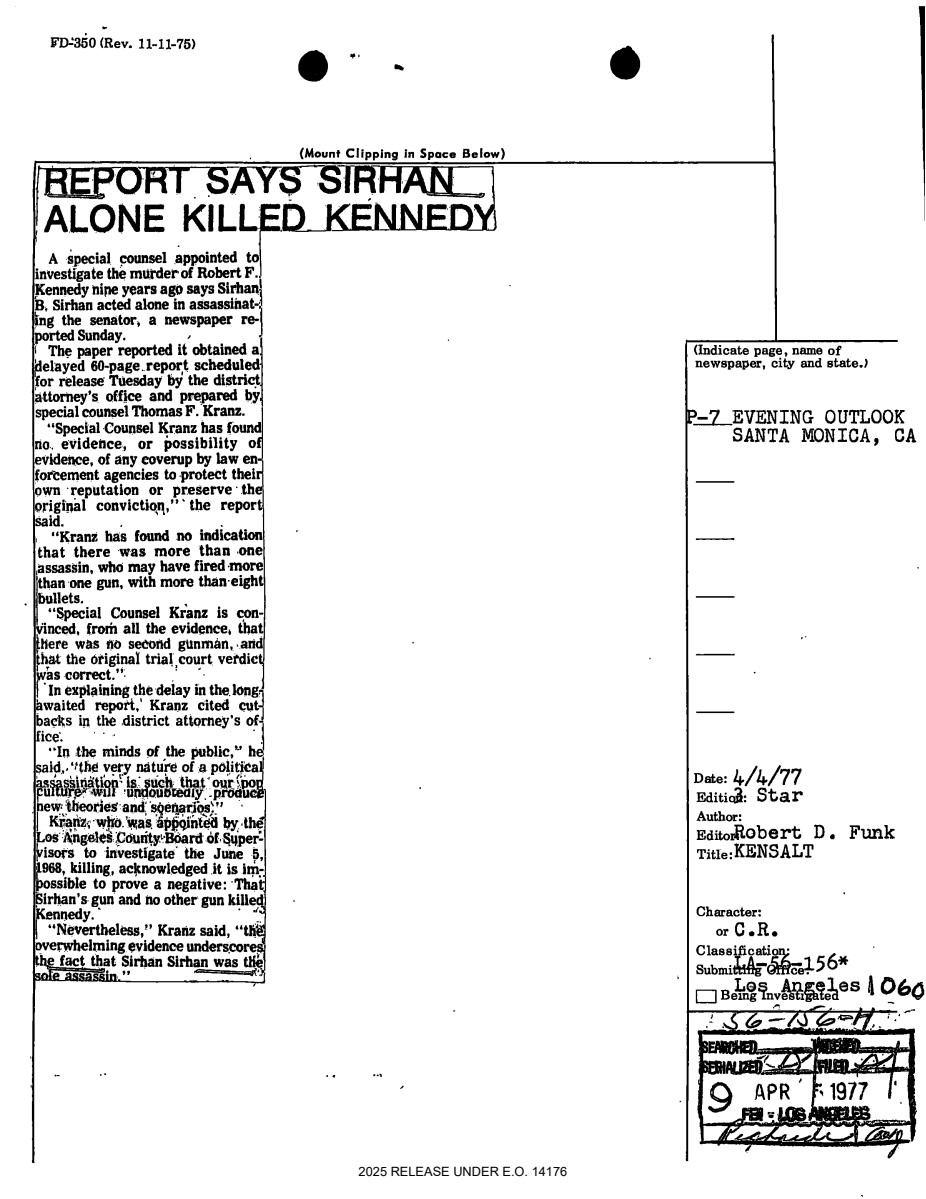
And RFK himself — the subject of all of it — spent his last years privately convinced his brother had not been killed by a lone man either. He checked the CIA himself on the afternoon of November 22 {MD-PRE-2-¶020; MD-PRE-2-¶021; TA-C02-¶004}; he told Schlesinger there could be "no serious doubt that Oswald was guilty" but left open "a larger plot, whether organized by Castro or by gangsters" {ST-C26-¶056}; he believed the Warren Commission had done "an inadequate job" {ST-C26-¶059}; and, in Heymann's contested telling, he once said aloud that he was convinced Lyndon was behind his brother's death — and was talked down {CB-C17-¶066}. O'Sullivan, citing Talbot, names him for what he was: America's first JFK-assassination conspiracy theorist {WB-S01-¶028}.
The man in the pantry was, in this precise sense, killed twice: once by bullets, and once by the same official epistemology he had learned to distrust.
6. The Geopolitical Ledger — What We Know and What We Must Source
The through-line of this project has been the Israeli nexus: the claim that RFK's death served, among its beneficiaries, an emerging U.S.–Israel strategic axis, and that Sirhan's Palestinian identity was weaponized into the perfect motive-script.
What the collected source materials support: the Zionist donor grip on the 1968 race, RFK's pro-Israel but independent posture, and the Palestinian refugee world that produced Sirhan {WJ Parts I–II}; the media's instant fixation on the Arab-fanatic frame {Part VIII; FT}.
What the collected source materials do not contain, and this finale must therefore flag with the same rigor it demands of the LAPD: the 1962 attempt to register the American Zionist Council under FARA, and JFK's 1963 confrontation with Ben-Gurion over Dimona. Neither episode appears anywhere in the sixteen referenced books [EXTERNAL — needs sourcing]. They may well be documentable elsewhere — the FARA file is a real, declassified record — but this project does not launder the unsourced into the authoritative. Where the evidence stops, the sentence stops.
7. Fanon's Final Word
Fanon taught that the colonial system survives by making its violence look like nature — and its critics look like pathology. Every structure this project has mapped performs that inversion:
The coroner who measured powder burns was discredited. The witnesses who saw were made "confused." The psychiatrist who found a programmable mind was excluded. The candidate who read Camus and wept in the Delta was rendered, after death, into a sentimental icon — mourned into impotence, sainted into silence.
And the Palestinian refugee with no memory of the night was made into the perfect negative image of the system's own violence: the colonized body carrying the colonizer's crime.
The counter-evidence is that none of it fully worked. The photographs burned, but the tape survived. The witnesses recanted, but they un-recanted. The son of Robert Kennedy — Robert F. Kennedy Jr. — now says publicly what his family's public silence withheld for fifty years: pursue the evidence, fearlessly {TA-AFT-¶009}.
The door, in other words, never closed.
8. Dramatic Schema: The Finale
Set: The pantry door, center stage, swinging slowly, endlessly, in no wind.
The company assembles — every figure from the twenty parts: RFK, Sirhan, Serrano, Schrade, Cesar, Noguchi, Diamond, Spiegel, the polka-dot girl, Hoover's voice, the Editor, the Judge. One by one they approach the door and speak a single line from the record — only lines that exist in the archive, each projected above them with its citation.
The last to approach are RFK and Sirhan. They hold the door together. Neither speaks.
Above them, projected:
"The body did not lie. The investigation did. The door is not closed."
The house lights rise before the door stops swinging. The audience is not permitted the comfort of closure.
9. Coda: The Work
This project began by asking what kind of world required Robert Kennedy's death to survive. It ends with the reciprocal question: what kind of world becomes possible the moment we refuse to accept that requirement?
The forensic record is reopened. The collected source materials carry paragraph-level addresses, with claims traceable to {BOOK-SECTION-¶} in sixteen books. The witnesses are old, but their testimony is not. The tape still says thirteen shots.
Memory is resistance. But memory, organized, is something more.
It is evidence.
Anchor appendix for this part: {LB-S14-¶039} · {LB-S16-¶611} · {LB-S17-¶072} · {LB-S18-¶047} · {LB-S23-¶289} · {LB-S12-¶159} · {LB-S13-¶414} · {LB-S15-¶058} · {MD-EPI-¶026} · {MD-C12-¶221} · {MD-C12-¶235} · {MD-PRE-2-¶020} · {MD-PRE-2-¶021} · {NR-C01} · {NR-C06} · {NR-C14} · {TA-C02-¶004} · {TA-C04} · {TA-C18-¶040} · {TA-AFT-¶009} · {WB-C06} · {WB-C15-¶032} · {WB-C15-¶070} · {WB-S01-¶028} · {ST-C26-¶056} · {ST-C26-¶059} · {CB-C17-¶066} · {WJ-C06-¶003} · {WJ-C08-¶001} · {WJ-C08-¶003}. External-source flags: AZC/FARA 1962; Dimona 1963.
Complete supplied archive
Archive scope. The article refers to a sixteen-book collection. This page reproduces the complete supplied Kitchen pantry crime scene annotated edition: 876 excerpted paragraphs and 876 citation notes from twelve books. The source table also records additional mentions not shown in this edition; no supplied excerpt or citation note has been omitted. Obvious OCR transcription errors in scan-derived excerpts have been corrected conservatively and logged; one uncertain court-exchange opening is explicitly marked.
Dossier: Kitchen pantry crime scene
1,575 mentions across 12 books. Every excerpt carries its source anchor and print-page reference where supplied. · Annotated edition, 21 November 2026, drawn from the collected RFK source materials.
Bibliography and source key
| Code | Source | Grade | Excerpts |
|---|---|---|---|
| LB | A Lie Too Big to Fail — Lisa Pease | reference | 439 mentions (120 shown) |
| WB | Who Killed Bobby? — Shane O'Sullivan | OCR | 254 mentions (120 shown) |
| TA | The Assassination of Robert F. Kennedy — Tim Tate & Brad Johnson | reference | 180 mentions (120 shown) |
| FT | The Forgotten Terrorist: Sirhan Sirhan and the Assassination — Mel Ayton | reference | 159 mentions (108 shown) |
| NR | The Robert F. Kennedy Assassination: New Revelations — Philip H. Melanson | OCR | 152 mentions (105 shown) |
| SP | Shadow Play — William Klaber & Philip H. Melanson | OCR | 137 mentions (106 shown) |
| KM | The Killing of Robert F. Kennedy — Dan E. Moldea | OCR | 122 mentions (93 shown) |
| MD | R.F.K. Must Die: Chasing the Mystery of the Robert Kennedy Assassination — Robert Blair Kaiser (2008) | reference | 118 mentions (91 shown) |
| CB | RFK: A Candid Biography — C. David Heymann | OCR | 6 mentions (5 shown) |
| BK | Bobby Kennedy: The Making of a Liberal Icon — Larry Tye | reference | 4 mentions (4 shown) |
| WJ | Why Robert Kennedy Was Killed — Godfrey Jansen | OCR | 3 mentions (3 shown) |
| NM | Robert Kennedy: A Memoir — Jack Newfield | OCR | 1 mentions (1 shown) |
A Lie Too Big to Fail — Lisa Pease LB439 mentions
1 The official story is deceptively simple. A young Palestinian immigrant named Sirhan Bishara Sirhan shot Senator Robert Kennedy in front of numerous witnesses in a narrow serving area called “the pantry” at the Ambassador Hotel just after midnight on June 5, 1968. Senator Kennedy had just won the Democratic presidential primary the night before in California and was walking through the pantry on his way to a room where the print media reporters were waiting. He never made it that far. Five other people were wounded during the shooting. Sirhan was tried and convicted in a trial and sentenced to death.
2 But even in the early days after the assassination, conspiracy theories were forming. Weren’t there too many holes in the victims and the doorframes in the pantry to have come from a single gun? A bullet pictured in a newspaper was one bullet too many for the official scenario to work, as a housewife pointed out, to deafening media silence. Witnesses to evidence of conspiracy were told they could not speak to reporters per a judge’s order. A film about a second gun that had entered the case raised numerous questions about the validity of the authorities’ conclusions about the case. A criminalist from Pasadena with a lot of credibility wrote a report demonstrating that two different guns had been fired in the pantry, meaning Sirhan could not possibly have acted alone. Others pointed to the fact that witnesses uniformly put Sirhan in front of Kennedy, but Kennedy was shot from behind.
3 North of the eastern half of the Embassy Room and parallel to it ran a small food preparation area that would become known as “the pantry.” The room contained three steam tables lined up along an east-west axis on the north side and a gargantuan ice machine that covered a large portion of the south side. It was not well guarded. Kennedy worker Judy Royer complained of having to constantly clear the room. Only campaign workers and press people were allowed in that area, but every time Royer entered, unauthorized people were present. Royer was concerned because this room was very close to where Kennedy would be speaking.
4 Michael Wayne, a 5’8” young man in his mid-twenties with dark, curly hair, sideburns and an olive complexion, tried to get into the Embassy Ballroom but was turned away. He walked unchallenged through the kitchen pantry instead and into the press area in the small Colonial Room just across the hall from the east end of the pantry. There, he managed to beg a “Kennedy Election Night Press” pass and a similar badge that read, “Kennedy for President – Press.”
5 Around 11:15 P.M., Murphy moved Cesar from the eastern pantry door to the western one, nearest where Kennedy would soon be speaking. Cesar’s job was to make sure no one without the appropriate credentials got into the pantry. But a number of people who had no business being there would enter the pantry under Cesar’s watch.
6 When Kennedy and his aides left his suite and proceeded to the elevator, Michael Wayne followed. Kennedy asked if the elevator opened to the lobby. He had nearly been mauled by crowds recently and hoped to avoid wading through them. Uno Timanson of the Ambassador Hotel’s staff took Kennedy instead to the freight elevator, which opened into the kitchen area. Wayne and the press went down in a second elevator nearby.
7 Kennedy and his entourage walked through the kitchen into the pantry. There, Michael Wayne got Kennedy to stop and sign one of the two posters he was carrying.35 Kennedy proceeded into the Embassy Ballroom to make his acceptance speech, with his entourage following closely behind.
8 Just steps away in the pantry, Vincent DiPierro, an 18-year-old waiter and political junkie,40 waited. DiPierro had not been scheduled to work that night, but his father, Angelo DiPierro, the senior Maître d’Hotel, had told him of Kennedy’s appearance. Vince had arrived shortly before midnight in the hopes of shaking the Senator’s hand.
9 In the pantry, Vince noticed a person who looked “sick,” a short, Hispanic-looking young man with curly hair holding his hand to his stomach. But Vince’s attention was momentarily diverted by a dark-haired, attractive girl with a good figure and a funny nose in a white dress with black polka dots. The curly-haired man said something to the girl as he stood on a tray rack, and she smiled. Vince thought the girl seemed to be “holding” him.
10 To thunderous cheers of “We want Bobby,” Kennedy started to exit the stage to his right but was called to the left since his next destination, as decided by Fred Dutton during his speech, was the Colonial Room, where the newsmen of the printed press were working. The quickest way from either side of the stage to the Colonial Room was through the pantry. But by exiting to the back of the stage instead of the right, Kennedy was not following his unofficial bodyguard, former FBI man Bill Barry, who was waiting stage right. Barry had planned to walk in front of Kennedy to protect him. But Kennedy was now far ahead of him, unprotected from the front, as Barry pushed through the crowd, trying to catch up.
11 p.16 Karl Uecker, a hotel maître d’, grabbed Kennedy’s right wrist and led him east toward the pantry. As they passed through the swinging double doors at the west end of the pantry, Ace guard Cesar took hold of Kennedy’s right elbow, guiding him forward.
12 Reporters Richard Drew and Boris Yaro were at the door as Kennedy entered. Yaro raised his camera. “Hey, Boris, you missed him,” Drew said as Kennedy walked by. Drew and Yaro followed Kennedy into the pantry.
13 Booker Griffin, publicity director for the Negro Industrial Economic Union, had entered the pantry at the eastern end just before the first shot. He heard two sounds that he didn’t think of as shots until he saw a man with a gun. When he saw Kennedy throw up his hands, Griffin ran forward to help him.
14 p.18 From the Embassy Room, the shots sounded like little more than balloons popping. Suddenly, screams shattered the celebration. People near the pantry door snapped to attention at emerging news. Necks craned and strained, looking in the direction of the pantry. Within seconds, a strange mixture of stunned silence and sporadic screaming ensued.
15 George Green had just entered the pantry from the west end when he heard popping sounds. He saw a girl in a polka dot dress and a tall, thin man running away from him. He noticed them because they seemed to be the only ones intent on getting out of the pantry, while everyone else was trying to get in.
16 Evan Freed, a freelance press photographer, was at the east end of the pantry when the shooting began. As people tried to leave the pantry, he found himself pinned at the east end. He also saw a girl that he thought was wearing a polka dot dress and a tall, dark-haired male companion run through a door to his right, out of the pantry. The door to his right led north into the main kitchen.
17 Ace guard Jack Merritt was near the front doors to the Embassy Ballroom, just outside the east end of the pantry when someone yelled that Kennedy had been shot. He drew his gun and ran into the pantry just in time to see a girl in a white dress with dark polka dots accompanied by two men, a tall, dark-haired man and a “short” male, run out of the pantry through a northern exit, into the main kitchen.
18 From the kitchen there were a number of ways out. One could go downstairs and out the building. One could cut through the lobby, behind or into the Embassy Room or into the Gold Room which connected with the Embassy Room. One could also reenter the pantry at the west end, and from there, enter the Embassy Room, and exit out the southwestern fire escape door. While traveling from the west end of the pantry to the southwestern fire escape exit himself, to ask the guard at the bottom of the fire escape to call an ambulance, 13-year-old Ronald Panda noticed a girl in a white dress with black polka dots and a ruffled collar in the Embassy Room. He wouldn’t have seen her if she was behind him. Clearly, she was in front of him.
19 During the shooting, while pinned at what was likely the southeast end of the pantry, Freed saw a curly dark-haired man run out the door to his left chased by a person who was yelling, “Stop him! Get him!”
20 Joseph Klein and Patti Nelson were just outside the Embassy Room in the main lobby when they saw a man running out of the pantry carrying a package. Patti thought she saw a gun inside what appeared initially to her to be a blue canvas type of cloth that “could well have been a gun case.” She described seeing “about six inches” of “a wooden stock of a rifle or a shotgun” protruding from the blue canvas. She was “quite sure that the wood that protruded from this blue canvas was definitely the stock of a gun.”
21 Inside the pantry, the struggle continued. By the third shot, Uecker grabbed the small gunman and threw his right arm around the young man’s neck. Uecker grabbed the gun hand in his left and tried to point it away from the crowd. Another maître d’, Edward Minasian, grabbed the shooter around the waist. Uecker swung the man around and pushed him down onto the steam table.
22 Barry got the gun out of the shooter’s hand and put it on the steam table, but the gunman grabbed it right back. Someone pounded the gunman’s hand on the table, and the gun fell out. Reporter Boris Yaro reached out and grabbed it, but another man ripped it from Yaro. Amazingly, that gun—or some gun—found its way back into the suspect’s hand, despite the fact that several large men were then holding him.
23 Andrew West, the news director for radio station KRKD, had entered the pantry just as shots were being fired. He instinctively turned on his tape recorder and captured the scene vividly. West would later tell the FBI he couldn’t identify the shooter because his attention had been focused entirely on the gun, as his broadcast made clear:
24 Dr. Stanley Abo, whose wife was a campaign worker for Kennedy, had already made his way into the pantry. He stopped at Paul Schrade, whom he mistakenly thought was Steve Smith, then moved on to Kennedy and knelt down beside him. Kennedy had a problem with one eye, but otherwise seemed “quite lucid,” but his breathing was shallow and his pulse was slow. Kennedy looked around for his wife and called her name several times.
25 Several officers responded to the Ambassador call immediately, including Officers Travis White and the young police academy graduate he was training, Arthur Placencia. When they entered the pantry, they found Rosey Grier lying on the suspect to hold him down. Frank Burns had the suspect’s legs and Uecker had the small man in a headlock. Unruh was keeping people off the suspect so no one could kill him before he stood trial. Officer White asked who had the gun. Somebody indicated Rafer had it, so White asked for the gun, but Johnson refused to turn it over at that point, possibly because he wasn’t sure these were actual policemen. Rosey Grier didn’t want to release the suspect to the police,54 but White and Placencia were finally able to pry the suspect free.
26 Two members of the LAPD’s Intelligence Division tried to segregate witnesses who had seen or heard something in the pantry from the rest of the witnesses. They took Juan Romero, Vince DiPierro, and other pantry witnesses to the Gold Room, a small room adjacent to the large Embassy Room.
27 Confusion reigned. According to a contemporaneous LAPD log, at 12:50 A.M., Lieutenant Sillings said on TV that the suspect, a 6’4” male Caucasian, was in custody.60 The suspect Jordan was interviewing, however, was a foot shorter. Another log item stated the suspect had been shot in the leg. The suspect taken from the pantry had not been pierced by any bullet, although his ankle had been twisted in the struggle.
28 Inside the pantry, Beringer saw a man in a tuxedo “trying to take a bullet out of the wall with … a silver knife,” ostensibly “for a souvenir.”78
29 As the men finished clearing the pantry, LAPD Sergeant Jones recalled seeing what he “thought might have been a bullet hole in a door jamb.”81
30 At the Rampart Station, Calkins and McGann interviewed Dick Aubry, who worked part-time for the Negro Press Bureau. Aubry had been walking in front of Kennedy through the pantry. Aubry saw a short Caucasian male in a dark sports coat, about 25–26 years old, kneeling on the table, getting down as he passed him. Aubry had just reached the end of the first steam table when he heard something. He heard one shot, then five more in a spurt. “I thought it was Chinese firecrackers … it was just a constant … pow, pow, just cracking like a little bag of potato chips or something.” He saw a flash, “like a little spark.”
31 Before Serrano appeared on the television, Vince DiPierro, who had overheard Serrano describe a woman in a polka dot dress, volunteered to Ambrose that he, too, had seen a girl in a polka dot dress in the pantry just as the shooting was starting.87 Serrano and DiPierro had a brief exchange of not more than a few seconds before an officer interceded and said they should not talk to each other.88 Nearly immediately, according to Ambrose, NBC’s Sander Vanocur pulled Serrano aside and put her on camera.89
32 At the Ambassador Hotel, the LAPD criminalist who had presented key evidence at Kirschke’s trial, Officer DeWayne Wolfer, reported to Sergeant James MacArthur in the pantry. Wolfer had called in LAPD photographer Charles Collier and Sergeant William Lee to help him. Collier was assigned to photograph, among p.37 other items, “bullet holes.”94 For the next few hours, Wolfer and his team, on behalf of the LAPD’s Special Investigation Division (SID), scoured the scene of the crime, collecting what evidence they could and photographing anything of significance.
33 p.38 Cesar described that when Kennedy had entered the pantry after his speech, Cesar had grabbed Kennedy’s right elbow with his left hand and stayed with him. As they had reached the first steam table, Kennedy turned to his left. “When he did, my hand broke loose—sort of broke loose from his arm, and, of course, I grabbed it again because people were still all over the place. … I just happened to look up and that’s when I seen—all I could see was an arm and a gun. … And I reached for mine, but it was too late. He had done fired and when he did, I ducked because I was as close as Kennedy was, and from what I can remember, from what I did, I grabbed for the Senator98 and fell back and when I hit—there’s iceboxes right here…and I fell against that and then the Senator fell right down in front of me.”99
34 At 2:15 A.M., the primary suspect was booked at the Central Jail, charged with 217 PC—Assault with Intent to Commit Murder.100 In the nearby police headquarters, Jordan, Howard and Murphy sat down with Jesse Unruh. “I must have been 20 to 30 feet behind him,” Unruh said, as he entered the pantry. “I heard this crackle of what I thought was [sic] really firecrackers, and I don’t really quite remember how many reports there were. I’d guess—it sounded to me like somewhere between five and ten—but there was such a sharp crackle that I couldn’t distinguish the individual reports.” He hadn’t seen the actual shooting.
35 At Rampart Station, Calkins and McGann continued to interview witnesses. Estelyn Duffy had been with her friend Joseph LaHive (whom NBC interviewed earlier) in the hallway between the stage and the swinging doors through which Kennedy entered the pantry. Kennedy entered the pantry just ahead of them, after which Duffy heard what she later learned were shots. “They weren’t real loud, sounded like a whip going.” She told them, “I thought I heard at least ten shots…. It wasn’t one or two. It was a lot of shots.”
36 High school student Scott Enyart had been standing on a table in the pantry, waiting for Kennedy so he could take his picture, when the shooting began. He took pictures “while the shots were being fired” or “maybe a little afterward,” he wasn’t sure. He jumped up on one of the steam tables so he had a good view of the room. Enyart mentioned his friend Brent Gold was there with him, taking pictures as well. Enyart wanted to know if he’d get his pictures back, stressing they were very important to him. He was told he might get back prints or negatives, but the police weren’t sure which. McGann gave him his card and told Enyart to call back “maybe Thursday or Friday” and they’d let him know the status of his pictures. Forty years later, Enyart would win a lawsuit against the LAPD over this film, but as the film was ostensibly being returned to him, it was stolen from the courier’s car.
37 Hotel maître d’ Eddie Minasian told Calkins and McGann he had been standing to the right of Kennedy and slightly in front of him as the shooting began. Kennedy had just finished shaking someone’s hand when a man came up and reached around his left. He fired two or three shots before Minasian and Karl Uecker grabbed him. Uecker had been ahead and to the right of Kennedy by about four to five feet, according to Minasian. He had been leading him through the pantry but Kennedy broke away to shake hands. Minasian said Kennedy “took a step back to shake hands with personnel”101 when Minasian saw someone reach around past Uecker with a gun. He “saw two shots fired” and then Uecker grabbed him. Minasian jumped forward to help but turned to look back. He saw Paul Schrade fall, then Kennedy. He helped Uecker subdue the suspect.
38 Jesus Perez had seen the suspect in the pantry for about a half-hour before Kennedy had walked through there en route to the stage. The suspect had asked several times whether Kennedy would be coming through there, but Perez couldn’t answer because he didn’t know.
39 “When I located him he wasn’t firing.” Grier saw a gun was beside the suspect on the steam table. “I don’t know if it was another weapon, or the same one,” Grier said, raising an interesting issue that neither Chiquet nor Henderson showed any interest in pursuing. Chiquet was preoccupied with another question.
40 McGann and Calkins interviewed Martin Patrusky, a hotel waiter who had been in the pantry when Kennedy came through. He shook Kennedy’s hand and saw him shake the hands of his friend and fellow waiter “Vincent” (DiPierro), a girl in a white dress (Robin Casden), a busboy (Juan Romero), and then “all of a sudden, there was just a matter of maybe four or five feet from us, I heard like somebody throwing firecrackers, and all that I seen was this guy standing from—there’s a tray rack on the opposite side of the steam table and all I seen p.45 was the guy moved over and he looked—there was like two people in front and the guy looked like he was smiling and he looked like he was going to shake hands with him and he reached over like this and then the firing just started and the next thing I know I looked at Vincent and I seen Kennedy starting to go down on his knees and I looked at Vincent and his glasses all of a sudden come up with blood.”
41 As the morning ticked by, the witness accounts continued to paint a strange picture. Sergeants Chiquet and Henderson interviewed Freddy Plimpton, wife of George Plimpton, a famous writer and Kennedy supporter who had become the first editor-in-chief of The Paris Review, a European literary magazine that the CIA had funded in the hopes of persuading the continent to support the American establishment’s point of view on foreign affairs.110 Freddy described hearing “what sounded like yesterday in Chinatown,” referring to the firecrackers that scared the Kennedy group in Chinatown in San Francisco two days earlier. She described how she was ahead and to the right of Kennedy, saw him shake a busboy’s hand, and saw someone push in close and fire a gun, who was then pushed down on the steam table nearby. She thought the suspect might have been Filipino and in his early thirties. She thought he had been wearing white, like so many of the kitchen staff, but she was told by others the shooter had not been in white, and she was “just very confused about that right now.”111 She had not actually seen the shooting, “but from his position and his posture,” she “just assumed that he was the guy that fired.”
42 McGann and Calkins interviewed Michael Lawrence Wayne, the man caught running from the pantry with a rolled-up poster in his hand that some witnesses thought concealed a gun.
43 Wayne described how Kennedy had signed a poster for him when Kennedy had passed through the pantry to get to the stage to give his speech. He was still in the pantry when Kennedy came back through after his speech.
44 “And I heard a sound, I guess like backfires. I wasn’t quite aware of it until I heard some more of them and there was a commotion. ‘He’s been shot. He’s been p.46 shot.’ And I saw the—I believe he was wearing, I can recognize if I saw it, he was wearing like a blue jacket.” Wayne described how a group descended on the suspect and pushed him onto the steam table. “I was in shock for a minute, and then I ran into the Press Room, which was the Colonial Room. … And I tried to call an operator to call the police, what have you, and all the phones had the lights on, you cannot call out, so I ran outside the Colonial Room this way to go ask what happened, you know—so I can’t talk about it so I don’t, you know—in other words, not out of fear, but I just thought it would be best rather than that to cause panic.”
45 McGann asked if he was with Scott—he couldn’t remember the last name, and thought it might have been Egert. He was referring to Scott Enyart, who had taken pictures in the pantry. Wayne remembered speaking to Scott but didn’t know him. McGann asked Wayne if he had taken any pictures. “No, I didn’t. I didn’t have my camera tonight.”
46 “You don’t remember?” Foster asked again, clearly disbelieving him. The suspect had been caught in the act of firing a gun. His leg had been hurt in the struggle. How could anyone not remember that? It’s not like he had anything to gain by lying about that—there were plenty of witnesses to the struggle that injured him in the pantry. Yet, throughout every discussion that night, the suspect evinced a genuine hole in his memory not just for the events of the night, but even, to some degree, about who he was.
47 Back at the Ambassador Hotel, reporter Robert Wiedrich examined the pantry. The Chicago Tribune had flown its 20-year veteran crime reporter Wiedrich to Los Angeles immediately following the shooting. When he entered the pantry in the wee hours of the morning, he found MacArthur and others from the LAPD still examining the scene. To his surprise, the police were uncharacteristically chatty. The police pointed him to Karl Uecker, whom he interviewed.
48 Uecker told Wiedrich how he had led Kennedy through the pantry, how he kept breaking away, and how Uecker kept retrieving his hand to pull him eastward. Just before the shots, Uecker had retrieved his hand and turned to go, “and then it happened. I heard a pop, I saw what looked bits of paper flying [sic].”120
49 No one could have known, at that early point, that had even a single additional bullet been found; that meant at least two guns had to have been fired. No one knew yet that seven bullets would be recovered from six victims and that multiple holes would have to be accounted for in the pantry’s ceiling. So the police told Wiedrich, accurately, that two bullets had been removed from the wood molding.
50 Further down Wilshire Boulevard, LAPD photographer Charles Collier completed his work at the Ambassador Hotel and returned to the SID photo lab. Officer DeWayne Wolfer returned to Parker Center for more equipment. At 10:30 A.M., the floor of the pantry was swept for debris related to the crime.
51 83 For years, Sharaga has maintained that an elderly Jewish couple told him of a girl in a polka dot dress fleeing the scene saying “We shot him.” No evidence exists in the LAPD’s record of this. Phil Van Praag, a sound engineer who examined a tape of the shooting in the pantry that will be discussed later, told me that the police radio was recorded on multi-track drums which would be nearly impossible to alter without some obvious sign. Several tracks were recorded simultaneously, so a splice or edit would have affected all tracks. I believe Sharaga may have confused this event—the report of a tall sandy-haired man escaping—with one relating to the girl in a polka dot dress. Sharaga, years later, told Art Kevin in an interview that he had taken down the name of the couple and handed it over on paper to other LAPD officers. Sharaga associates Powers saying “don’t want to get them started on a big conspiracy” with the polka dot dress story, but on the police radio transmission, Powers’ statement clearly refers to Sharaga’s broadcast of a tall blond man. That said, there is still some backup for Sharaga’s belief that he talked to a man and a woman who alerted him to another man and woman, a point which will be discussed later in this book.
52 Maheu, on behalf of Howard Hughes, also offered Paul Schrade a place at his ranch in Las Vegas to stay while he was recuperating from his head wound from the pantry shooting, an offer Schrade accepted. There, Schrade became friends with one of the few people Hughes trusted and spoke to in person, John Meier (not to be confused with Johnny Meyer, a publicist, who also worked for Hughes).
53 Charles Collier, who had photographed the pantry for Wolfer, photographed the autopsy as well. Years later, copies of these photos would inexplicably turn up in the possession of James Angleton, the CIA’s infamous 25-year counterintelligence chief.140
54 Wolfer received the non-fatal bullet Noguchi had retrieved from Kennedy’s neck in good condition at 3:15 P.M., per his log. He had received the gun the day before. His next step was to do what any criminalist would do: ensure that the bullet he was handed came from the gun in custody. Wolfer fired test bullets from the gun recovered in the pantry. Although it is not noted in his log, we p.67 have to presume he attempted to make a match between the Kennedy bullet and the test bullet. Yet nowhere in his detailed log is such a comparison indicated. Wolfer clocked out at the end of his shift at 4 P.M.
55 Back at the courthouse, Officer Travis White described to the Grand Jury entering the pantry at the direction of people in the hotel and seeing eight to ten people holding down a suspect on a steam table. He guessed there had been between 75 to 100 people in the pantry when he entered.
56 Although it took several people to subdue the suspect in the pantry, Officer White said the suspect gave them no trouble at all once they got to him, and he did not struggle when they put the handcuffs on.
57 The first shooting witness to testify was 17-year-old Irwin Stroll, who appeared in a wheelchair, as he was still recovering from the gunshot wound to his left leg. Irwin had been asked to guard the northernmost of the two swinging doors at the west of the pantry. Sergeant Albert La Vallee had earlier introduced into evidence a diagram showing the layout of the pantry he had made in his official capacity as the officer in charge of the Survey Unit in the Scientific Investigation Division (SID). Howard had Irwin show the Jurors where he had been standing, the northwest door of the pantry, and marked his location S-1. A security guard covered the southernmost of the two swinging doors, marked S-2.
58 Irwin was just outside the northwest pantry door as Kennedy and his party came through. Two press people beat him to the door. As he followed them into the pantry, he heard something “like firecrackers, just pop, pop, pop, all over the place—and smoke.” He pushed Ethel Kennedy to the floor and covered her. He felt “a kick in the knee” but then saw blood, and realized he had been shot. He didn’t see the shooter.
59 p.72 Other pantry witnesses followed. Jesus Perez was so nervous on the stand that Deputy D.A. Fukuto asked him to “relax a bit.” Perez identified a picture of Sirhan as the person he had talked to about half an hour before the shooting. Sirhan had asked Perez three or four times if Kennedy would be coming through that area. Perez had been near the first steam table on the western end, and Sirhan had come and gone from that position.
60 Vincent DiPierro testified that he had stayed at S-2, the southern door at the west end of the pantry, right next to where Stroll was standing. Howard asked if DiPierro had seen a “young chap there though at that time, like a guard,” because Stroll had described talking to a guard there.
61 When Kennedy returned to those doors after his speech, roughly 15 minutes later, DiPierro followed him into the pantry. The Kennedy party walked through door S-1, which was propped open and which opened from the pantry into the hallway between the stage and pantry area. DiPierro pushed through door S-2, which opened from the hallway into the pantry. He was about five feet from Kennedy when DiPierro reached the ice machine. There, he noticed “a girl and the accused person standing on…a tray stacker.… Whether or not the second person was involved, I don’t know.”
62 Howard showed DiPierro Grand Jury Exhibit 7, the gun retrieved in the pantry, and asked if that was the gun he remembered. “The same gun,” DiPierro said, adding, “the reason is it had the funny little corkscrew here.”
63 Howard asked DiPierro how all the non-kitchen staff got into the kitchen, given that there were guards at both ends of the pantry. DiPierro himself had been challenged by a guard, but a fellow worker had said to the guard “He is with the hotel.” DiPierro had no answer, but stated most of the people in the pantry seemed to be press people.
64 Ira Goldstein took the stand next. A young reporter for Continental News, Goldstein had initially entered the pantry because someone said there were sandwiches there. He did not notice Sirhan there. While inside, the Senator entered just as Ira was walking west. The woman he was with, Robin Casden, shook Kennedy’s hand, and then Ira and his companion continued on. He heard shots just seconds after he passed Kennedy. He thought it was balloons popping, but by the second or third sound he realized someone was shooting at Kennedy. He didn’t turn back to look. He stepped over Irwin Stroll, who was wounded already, and felt a bullet graze him. Then a second bullet hit him in his left thigh. Like DiPierro, he heard about five shots, but said there could have been more. Goldstein staggered to the wall and fell against DiPierro.
65 p.75 Next up was Karl Uecker. Howard asked Uecker, who had a noticeable German accent, to slow down a bit when he spoke so the transcriptionist and jury could process what he was saying. Fukuto showed Uecker the drawing of the pantry, and Uecker described taking Kennedy’s hand to lead him into the pantry. Kennedy had turned almost immediately after entering to shake someone’s hand, causing Uecker to lose his grip. Uecker retrieved Kennedy’s hand and led him a few steps further, to the west end of the steam tables, when Kennedy again turned, breaking free to shake a dishwasher’s hand. Uecker grabbed him one last time and turned to walk eastward. Then, said Uecker, “something rushed on my right side. I—at that time I didn’t recognize what it was, paper or white pieces of things.”
66 Uecker heard the first and second shots, felt Kennedy fall from his hand, and noticed a shooter to his right. He threw his right arm around the shooter’s neck and pressed him up against the steam table.
67 “The left hand, yes, and had the right arm around his neck. I was standing there and he was shooting and I could feel when he was turning his hand towards the crowd, that’s why I pushed all over the steam table as far as I could, to almost to the end of the steam table.”
68 Uecker had pushed the suspect down backwards onto the steam table.
69 Fukuto showed him the gun and asked how it compared with the one he had seen in the pantry.
70 Amazingly, at Sirhan’s trial, Uecker was the one asked to verify that Sirhan’s gun was the one used in the pantry. Amazingly, no one on Sirhan’s defense team quoted this back to Uecker on the stand in rebuttal of that identification.
71 Edward Minasian testified next. He told nearly the same story as Uecker, but from a slightly different angle. After Kennedy stopped to shake hands, both Minasian and Uecker turned back also and took a step toward Kennedy. As Minasian turned his head to the left to look back toward the west, he described how through his “peripheral vision” he “noticed someone dart out from this area, dart out and lean against the steam table.”
72 “I doubt it because the Senator at that time was—well, the suspect was shooting from this … end of the table. And I don’t see how he could have been shooting at—and we had him and his arm somewhere on this steam table here. And I doubt if it was in the same direction as the first two shots.”
73 Burba told the Jury that he was in the pantry about 30 minutes before Kennedy came through. Howard asked Burba “What is the first thing that you noticed or heard that was unusual?”
74 Howard showed Burba Grand Jury exhibits 3-A and 3-B, large photos of Sirhan as he was being apprehended. Burba said he had witnessed the man depicted in those photos walk in with Kennedy’s party the first time he entered the p.78 pantry, en route to the stage to speak. Burba said this man noticed his attention because “he appeared to be looking all around him instead of looking ahead, as all other members were.” The prosecution had called Burba because his account suggested premeditation—a key component the County would have to prove to convict Sirhan.
75 p.79 Howard asked if he had noticed how many shells the man had fired and what type of ammunition he had used. “I’d say three to four hundred empty casings,” Carreon replied. (No one ever reported Sirhan buying that much ammunition, ever.) Carreon also quoted David as having asked, “Isn’t that a special type of bullet?” because the man “had just one box aside from all these other—that it’s called the mini-magnum; and this type of bullet, when it penetrates on an object, usually tears and splits out into different directions where the regular bullet of a .22 caliber goes in a hole, and when it goes into an object, it will come out the same size.” While Mini-Mag bullets can shatter on impact, they don’t always. In this case, it’s interesting that of all the bullets fired in the pantry, that the only one that shattered was the one that entered Robert Kennedy’s brain.
76 Why would anyone fire a bullet and then retrieve the bullet and put it in p.81 their car? It’s not like it could be used again, and Sirhan was no bullet collector. Had someone planted bullets retrieved from the pantry doorframes in Sirhan’s car in the hopes of tying him to the shooting?
77 By the time Fernandez took the pantry photos, the wood facing that had been in front of the doorframes had been removed not just from the doorframe but from the pantry altogether, leaving the FBI without crucial evidence.162 Even so, Fernandez took close-up photos of the four holes in the doorframes—two in the center divider and two more on the left side of the southernmost door at the west end of the pantry. The photos were captioned—unequivocally—“bullet holes.”
78 p.92 Hughes went through some of the initial evidence that appeared to suggest a conspiracy. The fact that the key in Sirhan’s pocket fit Gindroz’s car was dismissed as “one of those crazy coincidences.” Sandra Serrano’s story was dismissed primarily on two issues: she had not mentioned the girl in the polka dot dress when she had called her mother right after the crime, and, thanks to Wolfer’s experiment the day before, she couldn’t have heard shots from her distance from the pantry. Based on those points, and the general unbelievability of a woman running out yelling “We shot him,” Hughes concluded Serrano’s story “looks pretty thin, so far.” But, Hughes noted, the FBI had was still interested because another witness, Vincent DiPierro, had placed a girl in a polka dot dress with Sirhan moments before the shooting. “That’s what’s convincing the Bureau” that there might be something to Serrano’s account, Hughes explained.170
79 “I’ll give you all I have … there’s still a lot of work to be done. We’ve been over the kitchen area twice, and we’re going at least one more time. It’s unbelievable how many damn holes there are in that kitchen ceiling.” (A few photographs from the LAPD’s investigation show at least five ceiling tiles had been removed, presumably for further investigation.) “Even the doors have holes in them,” Wolfer continued, “which can be mistaken for bullet holes.”171
80 It must be noted that there is no evidence to support Wolfer’s assertion that the holes in the pantry doorframes were not bullet holes, as the doorframes with the holes in them were destroyed after the trial, and Wolfer kept no notes of the investigations he claimed to have performed on them. He noted in his log that he performed “X-rays of door-jam,” [sic] but no X-rays were ever presented, nor does the log indicate what the results were. This is problematic, because as we’ve already seen, several members of the LAPD and FBI noted bullet holes in the pantry doorframes. One LAPD officer even saw someone dig a bullet out of a hole with a knife. If there was even just one bullet hole in the pantry doorframes or walls, that meant a second gun had been used. Wolfer had already accounted for the eight bullets Sirhan’s gun could hold. Two bullets were found in Kennedy, and five other bullets were removed from the other five pantry victims. Wolfer also had to explain the three bullet holes found in the pantry ceiling tiles. He concluded that two bullets had entered the ceiling, and one of them had hit something and ricocheted back down into one of the victims. But a third bullet had evidently entered the ceiling and stayed there. This bullet was never recovered.
81 If Wolfer told the truth when he said no bullet holes were found in the pantry, then the Sheriffs who had first circled and labeled the holes had been fooled, veteran Chicago Tribune crime report Robert Wiedrich’s account of bullets having been removed from the doorframes—provided to him by experienced members of the LAPD in the pantry immediately after the shooting—had been incorrect, the FBI photo captions that indicated those holes were bullet holes were p.94 incorrect, and the statements of FBI and LAPD officers—who described seeing not just bullet holes but a bullet in one of the holes and a bullet being removed by a man in a suit—were also incorrect. Were all these people, whose accounts were entirely consistent with each other despite having never met or talked to each other, incorrect? Either all those highly qualified witnesses were wrong, or Wolfer was.
82 How, then, are we to assess Wolfer’s credibility, given how all-important his assertion regarding the pantry bullet holes is to this case? Fortunately, we don’t have to. The California Court of Appeals already did that for us. The Court railed against Wolfer’s actions and testimony in the Kirschke case, stating he had “negligently presented false demonstrative evidence in support of his ballistics testimony,” that “Wolfer’s acoustical testimony was false,” and that “his testimony on qualifications as an expert on anatomy was also false and borders on the perjurious.”172 In other words, the Court of Appeals stopped just short of calling Wolfer a liar. I believe the Court chickened out and should have said what the evidence clearly shows. Bear that in mind with everything Wolfer said and did over the course of this case. In the law there’s the principle, “false in part, false in whole.” And given Wolfer’s long tenure with the LAPD, as well as his engagements as an instructor of crime scene forensics, it’s difficult, if not impossible, to argue that if he were wrong, he was simply mistaken. It makes more sense that Wolfer was deliberately lying in the Kirschke case to gain a conviction.
83 Similarly, it’s hard to believe FBI agent Nolan didn’t know by this time that a photographic supervisor and photographer from the FBI had already captioned their photographs of the doorframe holes in the pantry as “bullet holes.” It strains credulity that Nolan would attend a meeting as the official FBI representative without having informed himself as to the core evidence uncovered to date.
84 Another meeting participant who had reason to believe there was more than one shooter was Deputy District Attorney John Miner. When Wolfer mentioned to the group that the shot that killed Kennedy had to have been fired from “less than one inch” from Kennedy’s head, Miner confirmed Wolfer’s conclusions. But what Miner didn’t say, even though he apparently understood, was that no witness had put Sirhan close enough to Kennedy to have fired those shots. Remember how at the Grand Jury hearing, Miner had asked Noguchi if he’d change his testimony to say feet, not inches. Such a change would have brought Noguchi’s testimony in line with that of the pantry witnesses. Miner clearly understood this was an issue. But there is no evidence that Miner brought this issue to the attention of the meeting participants.173 Miner, too, seemed not to want to raise any evidence that could prove a conspiracy had been at work.
85 Similarly, Sirhan’s legal representatives weren’t interested in finding out whether Sirhan acted with others. And Sirhan, for his part, proposed no alternative. He had no conscious memory of events in the pantry. He named no co-conspirators. In the absence of a memory to the contrary, Sirhan accepted what he was told: that he had fired a gun in the pantry and killed Kennedy. As one of his original defense team members would say to me years later, how could a lawyer hope to save his client’s life by arguing he had participated in a conspiracy to kill Kennedy?174 The easier argument was to assert that Sirhan was experiencing some sort of temporary insanity.
86 The FBI report added a twist as well: “The bullet causing the wound to Mrs. Elizabeth Evans cannot be entered into evidence as continuity of the bullet [i.e., the chain of possession] has been lost.”180 Had the chain of possession truly been “lost,” indicating extreme sloppiness in the most important case the LAPD had ever investigated? Or had the chain of possession deliberately been broken to prevent the Evans bullet from being examined? If the Evans bullet had been of a different ammunition type than the bullet retrieved from Kennedy’s body, that would also have been strong evidence that two gunmen had been firing in the pantry and reason enough to swap the “bullet” with “fragments,” thereby preventing future bullet comparisons.
87 After this session, Serrano was taken back to the hotel by FBI Special Agent Richard Burris, Deputy D.A. John Howard and Dan Johnson, another Deputy D.A. She was shown the stage area where Kennedy had spoken, and then shown the route Kennedy had taken to enter the pantry. They informed her there were some 1,100 people in the room between where she had been sitting and where the shooting had occurred and told her the distance was about 170 feet. They then mentioned that she had reportedly heard six gunshots, a few seconds after which a girl in a polka dot dress ran out saying “We shot him.” Burris then asked if she still felt she had heard gunshots. Serrano replied “she had never heard a gunshot in her life and never claimed she heard gunshots,” a true statement.
88 Frustrated and tired himself, Hernandez called Sandra Serrano “Cathy” at this point, by mistake. Serrano thought he was referring to Cathy Fulmer, a 19-year-old girl who had worn an orange scarf with white polka dots on it at the hotel the night Kennedy was killed. Fulmer had been seen by several witnesses emerging from the west end of the pantry after the shooting saying “they shot Kennedy” or “they killed Kennedy.” Fulmer had offered herself up to the police as the possible lady in the polka dot dress the media had mentioned. But a scarf is not a dress, and when Serrano was taken to view Fulmer, Serrano instantly confirmed Fulmer was not the girl she had seen.
89 The police didn’t stop there. They wanted to put the story of the girl in the polka dot dress to permanent rest. DiPierro was shown pictures of various women and had him pick out the one who looked most like the girl in the pantry. DiPierro picked out Valerie Schulte, who didn’t match DiPierro’s original description in any way. She was blonde, not brunette. She was on crutches, something DiPierro would have noticed. And she was wearing a green dress with yellow lemons of increasing size, not polka dots. But Pena and Hernandez told everyone they had “found” the girl in the polka dot dress.
90 When I interviewed DiPierro years later, I showed him his original description of the brunette in the white dress with dark polka dots, which he confirmed. Then I showed him a picture of Valerie Schulte. He readily acknowledged that that was not the dress of the girl he had seen in the pantry. But that’s what Schulte had worn in the pantry. In other words, DiPierro confirmed, clearly, she was not “the girl in the polka dot dress” he had initially reported. He said he picked her out only because her face was similar, and he had been shown only headshots. He said that Deputy D.A. Howard had told him that if he said Schulte was the girl with Sirhan in the pantry, “we’ll stand by you.” DiPierro seemed proud that he had picked out a girl who had actually been in the pantry, saying words to the effect that the other women pictured might have been policewomen, and that he was pleased he had successfully chosen an actual pantry person. But it was equally clear this was not the girl he had originally seen. In fact, when I showed him a picture of an attractive, voluptuous woman from behind, in a fitted white dress with black polka dots, with shoulder-length hair, who much more closely matched his original description, he literally shuddered in front of me, as if recalling something unpleasant. (This photo was staged by journalist Fernando Faura and ran in his paper, the Hollywood Citizen News, with one of his stories. When I showed DiPierro a drawing Faura had made from John Fahey’s description of the girl, DiPierro had no visible reaction at all.)
91 As we discussed the pantry events, he was noticeably shaken, and even teared up a few times. It’s still a difficult moment for him to relive, something I’ve noticed with the other pantry witnesses I have talked to. He had nightmares about the shooting for ten years after the event. The police wouldn’t even let him wash the blood off his hands before they interviewed him. He had to sit for hours with blood caked on him. He expressed a sense of guilt, as if there was something he could have done, should have done, to prevent Kennedy from being killed. I assured him that of course he couldn’t have known what was about to happen, that it was not his fault.
92 Perhaps the most damning evidence against Hernandez is his uncharacteristically friendly treatment of Michael Wayne, the man who had been handcuffed after fleeing the pantry immediately after the shooting.
93 When Hernandez asked if Wayne was running for a phone booth when he made his hasty exit from the pantry, Wayne answered “no” during the test. But after the test, when the polygraph was no longer tracking his responses, Wayne said he answered “no” because he wasn’t looking for a “phone booth,” just a phone. Someone then falsely typed in the transcript of his session that Wayne had answered the question “yes,” which he didn’t, according to the tape of his session.
94 The FBI, too, was not above covering up or simply altering what witnesses had said in their interview summaries. Nina Rhodes-Hughes, one of the pantry witnesses, had told Professor Philip Melanson that her FBI statement was filled with lies. She reiterated this point to me in 2012 when I showed her a copy of her statement at a little café near Beverly Hills. She assured me she had told the FBI she heard 12–14 shots, but her FBI interview summary said she had heard only eight.215 Rhodes-Hughes also told me she had heard shots coming from two different places in the pantry, one ahead of her to her left and another to her right, a point to which we’ll return in a later chapter.
95 Meanwhile, Sirhan’s defense team was still trying to construct a plausible motive. In an attempt to get Sirhan to remember the events of the pantry, Bernard Diamond, a psychiatrist and assistant Dean of Phrenology at the University of California at Berkeley, put Sirhan under hypnosis in a series of meetings to attempt to get Sirhan to reenact the events of the pantry. But even under hypnosis, Sirhan failed to remember exactly what had happened, despite what, as we will see later, were extremely leading suggestions.
96 What happened next was not a trial to determine the truth of what happened in the pantry but a “show trial” staged for the purpose of putting evidence of Sirhan’s culpability into the record, attempting to dismiss any evidence of conspiracy that had already been made public, and providing an appropriate punishment.
97 “Improper forensics” is the generous term to describe what happened in Sirhan’s case under Wolfer’s watch. In fact, less than a month before the trial, the FBI had turned down the request from LAPD to confirm the LAPD’s analysis of the evidence in this case.232 That’s not surprising, given that the FBI’s findings were already at variance with the LAPD’s, notably about the presence of bullet holes in the frames of the pantry doors, which inflated the total bullet count from the LAPD’s eight to at least twelve. By agreeing to reexamine the LAPD’s evidence, the FBI would have been put in the awkward position of having to reject the findings of their own professionals or reject those of the LAPD’s, which would have called the entire case against Sirhan into question. Neither the defense nor the prosecution could have welcomed such a move. In fact, both the defense and the prosecution made sure the jury never learned there was any question about Wolfer’s veracity, or that any of the physical evidence in the case might not have been as presented.
98 The fact is that the truth of what had actually happened in the pantry never had an advocate in that courtroom. The system simply isn’t built to expose conspiracies that benefit neither the prosecution nor the defense. And at some point we have to seriously consider a darker possibility: that the cover-up was deliberate, that one or more people on both the prosecution and the defense fully understood there was a conspiracy, and that those who knew agreed to p.139 keep it concealed. That’s actually the simplest explanation for all that happened at the trial.
99 p.140 To address distances, Fitts introduced a scale mockup of the pantry area of the Ambassador Hotel and nearby areas to help orient the jury to the various positions of witnesses who had seen Sirhan that night at various places in the hotel and in the pantry at the time of the shooting. The exhibit was divided into a grid of two-inch squares, each representing a two-foot-by-two-foot square, so witnesses could specify their positions with a letter and number. Fitts told the jury that most witnesses put Senator Kennedy at about 13-E on the grid.
100 Using this grid made it easy for witnesses to point to where people were in the pantry, but it also obscured distances. Sirhan and RFK could have been placed in the same square by witnesses, but the jury wouldn’t know from that whether they were an inch apart or two feet apart. People in adjacent squares could have been four feet apart. The transcript, too, could not capture where in the squares witnesses pointed to. The transcript was the only record that was, at that point, sure to be made public, and both sides made sure they asked no questions that would expose the distance and positioning issues between Sirhan and Senator Kennedy to the trial jury, although witnesses sometimes volunteered this information. Whether it was intended as such or not, it was a clever trick that apparently worked, as no jurors or, for that matter, journalists, questioned the distance issue during the trial.
101 Fitts told the jury that Judy Royer had shooed Sirhan out of the pantry earlier that night. This was not true, as Royer had provably shooed Michael Wayne from the pantry, not Sirhan, although Royer had shooed Sirhan out of a different area a couple of hours earlier that night. In doing so, Fitts amply demonstrated why judges have to remind people that nothing a lawyer says can be considered a fact.
102 Fitts named several people whose hands Kennedy shook as he crossed the pantry. He described how Sirhan crossed from the serving tray rack by the ice machine across to the serving tables where Kennedy stood, raised his gun and fired. Then Fitts stated something else that was provably untrue, but which the defense team neglected to challenge: that Sirhan shot Kennedy at “point blank range.” No credible witness ever placed Sirhan close enough to get his gun muzzle within an inch of Kennedy’s head. Witnesses who saw a gun close to Kennedy could never identify the shooter as Sirhan, and those who saw both Sirhan and Kennedy made clear they were feet, not inches, apart. Frank Burns said the gun was “very close to Kennedy,” but oddly, while looking at Sirhan to his right, he felt “a burning sensation on my left cheek,” indicating a gun had been fired on his left, where he wasn’t looking.236 Another witness, Lisa Urso, who had seen both Sirhan and Kennedy at the same time, Sirhan fired at “point blank” range. But when the happy police staged a reenactment in p.141 the pantry, Urso disappointed them by making clear that by “point blank” she meant two to three feet away.
103 The People’s first witness was Sergeant Albert La Vallee, who took the jury through the scale model he had built of the Ambassador Hotel so they could get a sense of the layout and pantry area. I drew the picture in Figure 1 (not to scale) to similarly orient the reader.
104 He told the jury how he’d been leading Kennedy by hand, how Kennedy turned, breaking his grip, and that Uecker grabbed Kennedy’s right hand with Uecker’s left and started forward. As he turned forward, he felt someone between him and the first steam table. He heard what he thought was a firecracker and looked back at Kennedy and saw him falling away as he heard a second shot. “And then I realized someone was following me with a gun,” Uecker said. Uecker placed himself “two feet” from Kennedy at this point, which puts Sirhan at least two feet away since Sirhan was parallel to Uecker at the time of the first shot. When Sirhan slid between him and the table and fired his gun, Uecker threw his arm around him in a headlock.
105 H58725. That’s what the official transcript says. Both the prosecution and the defense reviewed these transcripts daily and made numerous, detailed corrections of each day’s testimony. They were especially meticulous with physical exhibits. Did no one notice that the actual gun recovered from Sirhan, according to the contemporaneous police records, was H53725, not H58725? Several witnesses were asked by the LAPD to read, on tape, the gun’s serial number, so we know for certain the gun turned in after the shooting was gun H53725. Three and eight don’t sound the same, nor are they near each other on the keyboard, so it’s hard to explain that as a mere “typo.” Was the number correctly recorded? Had a different gun been used at the trial? Amazingly, Wolfer’s testimony, as you’ll see later, would support that notion. Recall too that Uecker had said he hadn’t paid much attention to the gun. So if the gun at the trial was not the one in the pantry, that would explain why Uecker, who barely noticed it, was asked to identify it instead of Rafer Johnson, who had it on his person for some time before he gave it to the police.
106 p.146 Figure 1: Drawing of the pantry area
107 p.147 By getting Uecker to say it took all his strength to subdue Sirhan, Cooper established something else the defense hoped to prove: subduing the little would-be jockey Sirhan required all of the 190-pound, five-foot-ten Uecker’s strength. In other words, Sirhan exhibited an unnatural level of strength, relative to his small size, in the pantry. Despite laying this foundation with several witnesses throughout, none of the defense team would make this point strongly in their closing arguments, that the fact that this small man could hold off Rosey Grier, a football player, Rafer Johnson, an Olympic athlete, and others much taller and heavier than Sirhan, was a strong indicator that Sirhan was in a hypnotic state. Feats of superhuman strength under hypnosis have been routinely noted.
108 Minasian was not the only witness to have seen someone he thought was the shooter running in the pantry. Virginia Guy, a reporter in the pantry, had her tooth chipped by something in someone’s hand who came running from Kennedy’s direction past her. Both Guy and Minasian assumed this was Sirhan. But this person was not Sirhan, as you’ll learn in a later chapter.
109 Howard questioned tall young Juan Romero next, the busboy who had been captured in a photograph by Boris Yaro kneeling next to the wounded Kennedy in the pantry. He described shaking Kennedy’s hand and then catching sight of a person he thought “couldn’t wait to shake his hand.” But then the person put his arm up and fired. “I seen he was right in front of him,” Romero said. He dropped down to help Kennedy “and put my hand to the back of his head and tried to give him some, whatever I could, aid, some aid; that is about all I could do.”
110 When the two previous witnesses had been asked to identify the shooter from the pantry, both had pointed to Sirhan. But when Juan Romero was asked to identify the shooter, Romero said he didn’t think he saw the shooter in court. Cooper said, “Stand up, Mr. Sirhan,” clearly trying to cue Romero that this was the guy on trial for shooting Kennedy, but Romero held firm. “I don’t believe that’s him.”241
111 “And when you looked around, you saw a man lying on the counter, did you not, on the steam table?”
112 Romero saw a man being held on the third steam table from Kennedy at that point. “This person, Mr. Sirhan, when you saw him there, did he appear to be smiling?” Parsons asked.
113 p.150 No one followed up to ask why, since he clearly recognized Sirhan as the guy under the pile of bodies on the steam table, he hadn’t identified Sirhan as the shooter. Perhaps both the prosecution and defense realized that was a door better left unopened.242
114 Vince DiPierro mentioned how he was stopped at the swinging doors to the pantry by a security guard, but was let in when a fellow kitchen employee told the guard DiPierro could come in. DiPierro crossed through to the little area between the pantry and the stage and waited for Kennedy with Martin Patrusky, his fellow waiter, “and a gentleman with dark glasses” (he likely meant dark glass frames, as he had said in an earlier interview) standing “on the other side.”
115 When Kennedy entered the pantry, he went through the propped-open northern swinging door at the western end. DiPierro pushed his way through the southern door, which opened to the inside and had not been propped open. At some point before he shook Kennedy’s hand, he saw Sirhan on the tray rack at the eastern end of the ice machine.
116 Cooper than quoted Hernandez’s words to DiPierro: “What I think you have told me is that you probably got this idea about a girl in a black and white polka dot dress after you talked to this Sandy Serrano?” “Yes, sir, I did” the transcript of DiPierro’s earlier session read. Cooper seemed as eager as Hernandez to shut down anything that pointed at the suspicious presence of a girl in a polka dot dress in the pantry. Walker allowed Cooper to read the following into the record:
117 “Are you telling us that this appears to be a picture of the girl you saw in the pantry at or near the time of the shooting?”
118 Cooper asked, “Is that the girl you think you saw in the pantry?”
119 Twice, David alluded to Sirhan’s gun holding nine rounds. But the gun Rafer Johnson had taken from the pantry to the police could only fire eight rounds. If Sirhan had used a different gun at the range, that would explain why nearly 40,000 shells from the range could not be matched to the gun with the serial number H53725, the gun Rafer Johnson turned over to the police after the shooting.
120 Michael Saccoman had also been at the range that day, and testified that Sirhan’s gun had a “black plastic grip” and “a cheap paint—very little finish on it.” (Other range witnesses described Sirhan’s gun handle as black or blue.) He identified the gun in court as the gun he had seen at the range. Oddly enough, on color video of the press conference on June 5, 1968, where the gun was shown, the handle of the gun retrieved from the pantry was clearly brown.248
… 1 additional matching paragraph in this book is not reproduced in this annotated edition.
Who Killed Bobby? — Shane O'Sullivan WB254 mentions
121 Instead of heading downstairs for another speech, the candidate was directed into the kitchen pantry en route to a press conference.
122 Moments later, in the pantry, shots rang out. The senator ]av on the floor, mortally,, wounded. Five bystanders were also struck.
123 Author David Talbot notes that Bobby Kennedy became "Alnerica's first JFK assassination-conspiracy theorist» after his brother's death. In turn, the friends of Robert Kennedy have become some of the most vocal RFK assassinationconspiracy theorists. UAW official Paul Schrade, shot in the head while standing behind Kennedy in the pantry, has for nearly forty years led the campaign to get this case reopened. Attorney Frank Burns, off Kennedy's right shoulder, still insists that Sirhan could not have fired the fatal shot described in the autopsy report.
124 According to the LiPD, Sirhan was first sighted at the Rafferty party just before nine, wandering into an electrician's booth adjacent to the Venetian Room. By nine thirty, fire marshals had decided the Embassy Ballroom was full to capacity, and no more guests were admitted without press or staff creden- tials. Kennedy supporters soon started sneaking in the back •..vay, through the kitchen pantry.
125 A short time later, around a quarter to twdve, Sirhan wandered into a narrow serving pantry at the back of the ballroom reserved for Kennedy staff and the press. Kennedy press aide Judy Royer had already chased him out once that evening, but now the security guard on duty was busy chatting with Milton Berle, and Sirhan slipped through.
126 The senator signed a poster for memorabilia collector Michael Wayne, shook hands \'lith kitchen,-vorkers, and held up his left hand to block the lights of the television cameras. As he passed through a narrow serving pantry, he shook the outstretched hand of a tall young busboy, Juan Romero. Ten feet behind the line of waiters, Sirhan waited, balanced on a tray stacker.
127 In the northwest corner of the pantry, just inside the swinging doors, kitchen staff crowded around a TV monitor to listen to the speech. There were about twcnty people in the narrow passageway, half hotel staff and half press and "outsiders." Sirhan balanced precariously on the outside edge of a tray stacker, over by the ice machines. He held on to the side of the stacker with his left hand and stood there waiting, raised four inches off the ground, looking west toward the swinging doors that led to the Einbassy Ballroom.
128 Barry and the rest of the Kennedy entourage rushed to catch up, and emerged into a backstage halhvay as Karl Uecker led Kennedy toward the double swinging doors of the pantry, en route to a press conference in the Colonial Room.
129 "Sl 130 41, Left and bottom left: Two views of the pantry, seen from the west swinging doors through which Kennedy approached. The steam table is on the left, the tray stacker on the right. The Xs on the floor mark where Kennedy and Schrade fell. 131 Below: View from the pantry, looking west toward swinging doors. Ice machines line the wall on the left; Xs mark where Kennedy and Schrade fell; lighted doorway in the distance leads to the backstage area. 132 Karl Uecker leaped onto the man with the gun after the second shot-or possibly the third. He grabbed Sirhan around the neck in a headlock with his right ann and seized the wrist of his gun hand with the other. Uecker slammed the gun hand down on the steam table and tried to divert it away from the crowd. rle chvarfed Sirhan, but the gunman's grip was strong-Uecker could still feel him pumping the trigger as Eddie lvlinasian and Frank Burns grabbed Sirhan around the Waist from behind and tried to push him up onto the steam table. 133 As bullets sprayed around the pantry, Burns and Romero felt powder burns on their cheeks, and Jesus Perez heard a bullet fly past hisear. 134 Continental News reporter Ira Goldstein felt a sharp pain in his hip and threw himself against a wall. Student Irvin Stroll screamed, "My leg!" and hopped from the pantry with a wound to the shin. As NBC associate news director William Weisel was coming through the swinging doors, he saw bodies falling in front of him, and then felt "three thumps" in his side and fell to the floor. Behind him, Elizabeth Evans's shoe came off as what sounded like a string of firecrackers exploded. She leaned down to retrieve it, and when she straightened up, blood was flowing down her face from a wound to her forehead. 135 a. Paul Schrade lies wounded in the pantry. b. Elizabeth Evans is treated for a head wound on a table in the Embassy Ballroom as a Kennedy girl and security guard Thomas Perez look on. c. A pool of blood forms under Kennedy's head, next to Paul Schrade's right leg. d. Busboy Juan Romero holds up his bloodied right hand. 136 p.21 As chaos swirled around the pantry, Wild-eyed memorabilia collector Michael \:Vayne ran,.out through the Colonial Room and into the lobby with a rolled poster in his hand. A {oice called out: "Stop him! He's-·getting atvay!" Several bystanders chased Wayne into a cul-de-sac, and Ace guard Augustus Nlallard handcuffed him. Wayne pleaded innocence-he was just running for a phone. Several witnesses later claimed they saw a black metal object hidden inside the poster, but no gun was ever found. 137 "We've shot Senator 1(ennedy!" The girl seerned so excited about shooting Kennedy, Sandra went back inside in a state of shock. She spotted a guard in a gray uniforrn just inside the door, one floor bdotv the pantry. 138 p.23 12:22 a.m. An ambulance pulled up at the front entrance, and Uno Timanson escorted the attendants up to ·the pantry in a state of panic. l'hey sauntered along behind, refusing to walk up a flight of stairs ivith the stretcher and insisting on taking the elevator. 139 As White entered, the suspect was being held down on his stomach by eight or ten people on top of the third steam table at the east end of the pantry. 140 p.24 Back in the pantry, the uniformed ambulance attendants finally reached the senator. Ethel Kennedy was applying an ice pack to his head. 141 In the pantry, Andre,-v \!Vest was signing off: "Repetition in my speech. l have no alternative. The shock is so great.... At this moment we are stunned. We are shaking, as is everyone else in this kitchen corridor at the Ambassador Hotel, in Los Angeles.... I do not know if the senator is dead or if he is alive. We do not know the name of the other gentleman concerned. This is Andre,-v West, Nlutual News, Los Angeles." 142 At ten thirty that night, floodlights illuminated an open grave at Arlington National Cemetery, and fifteen hundred candles were distributed to mourners as the casket was borne from the train by thirteen pallbearers, including former astronaut John Glenn; fonner secretary of defense Robert NlcNamara; Senator Edward Kennedy; and Robert Kennedy's personal bodyguard) Bill Barry, wrongfooted by a last-minute route change that propelled Robert Kennedy into the pantry to a rendezvous with death. 143 He arrived at the hotel at two a.m. with Officer William Lee and civilian police photographer (~harles Collier. Wolfer asked Collier to take orientation photos of the pantry as Wolfer and Lee searched the crime scene for physical evidence. Collier was instructed to ((photograph everything;' so he set about documenting the numerous holes in doorfranes, door hinges, and ceiling tiles that could possibly be bullet holes. The public wouldn't see these photographs for another twenty years. 144 p.54 The ballistics team continued to search the crilne scene until early afteinoon, s,-veeping the entire floor of the pantry and backstage anteroom for evidence. They left with two ceiling panels and two boards from a doorframe, which,-vere booked into evidence, so they could be checked for possible bullet holes. 145 This p~osecutor immediately realized they had a problem-none of the eyewitnesses tn the pantry placed Sirhan's gun that close to Bobby Kennedy. Five witnesses were called before the grand jury that day-hotel assistant maitre d's K~rl Uecker and Eddie itlinasian, kitchen porter Jesus Perez, waiter Vincent Di Pierro, and shooting victim Irwin Stroll. 146 This gave Wolfer a lot to think about. On Tuesday, June 11, after the tests with the pig ears, he 'went back to the Ambassador pantry with Dr. Noguchi and (.)fficer Lee and spent the afternoon "doing ballistic studies and reconstructing the crirne scene." 147 Ceiling panels had been removed and a lot of time seems to have been spent looking for ricochet marks in the plastered ceiling. In later photos, two rods run frorn the steam table to holes in the ceiling. 148 There are also photographs of Dr. Noguchi holding an LAPD ruler to four holes in the pantry doorframes and Wolfer and Lee holding rods to two possible ricochet marks high above each of the swinging doors and running rods from Sirhan's firing position up to these ricochets. 149 And what of the other holes? Wolfer inexplicably didn't find time to Xray the doorjamb from the pantry until the following Friday afternoon, June 14. Four days later, he returned to the Ambassador for more ballistic tests, and then received more bad news when he examined Ira Goldstein's pants. There were entry and exit holes in the left pant leg where a bullet passed clean through. 150 As Romero finished shaking hands with Kennedy, assistant maitre d' Karl Uecker said he took hold of Kennedy's right hand and was pulling him forward again at the time of the first shot. Here are his three earliest accounts of what happened: To the LAPD: "I saw him shaking hands with one of the dishwashers, and then he came back and I grabbed his hand again, and then at that time it happened." Sirhan suddenly appeared right in front of Uecker, pressed against the steam table, and reached around him and shot with his right hand. "J didn't even realize at the first shot that it was a gun, but by the second shot, I turned around and saw Kennedy falling down out of my hand.... I realized it must have been a gun; then I grabbed him, you know.... He was right in front of rne. He was trying to get a"vay from me and I Was afraid if I let him loose, he's going to shoot me in the stomach, you know·." 151 p.72 To the FBI: "While Kennedy was still observing [ Romero], I took his hand to lead him along, somebody reached around me and before I knew what happened two shots were fired and the senator fell to the ground. I immediately grabbed the gun hand of the assailant and pushed him onto the steam table. 152 To the grand jury: "He shook hands again with one of the dislnvashers. And while I was holding his hand, I was turning to my right towards the Colonial Room. At the same time, something rushed on my right side. 1\t that time I didn't recognize what it was, and I saw some paper flying... paper or -· white pieces of things. Then I heard the first shot and the second shot right after that, and Mr. Kennedy fall out of my hand. I lost his hand. I looked for him, and I saw him falling down. And I turned around again, and I saw the man-right standing next to me [and] pushed the ann down against the steam table." 153 In an interview with the I)A's office three years later, Uecker said that when the shooting started, Kennedy was facing him and he had grasped the senator's right hand around the... vrist to lead him from the pantry. "I took Senator Kennedy's hand again and said, 154 Bottom: LAPD diagram of victim and witness positions in the pantry at the time of the shooting. D, Sirhan; V-1, Kennedy; V-2, Schrade; V-3, Goldstein; 1, Perez; 2, Romero; 3, Patrusky; 4, Uecker; 5, Burns; 6, Lubic; 7, Schulte; 8, Cesar; 9, Yaro; 10, Freed; 11, Minasian; 12, Aubry; 13, Drew; 14, Unruh; 17, Casden; 29, Di Pierro; 41, Freddy Plimpton; 42, Guy; 43, George Plimpton; 44, Kawalec; 45, Urso; 46, Royer. 155 But I repeat now what I told thern then: Sirhan never got close enough for a point-blank shot, never:' ••• Decker's partner, Eddie Minasian, corroborated his story. He told the FBI he was three to four feet ahead of Uecker when he turned around, sensing the senator had fallen behind: "My partner, Karl, Was on the senator's left, one or two steps in front of him. While the senator was shaking hands, I saw out of the right corner of my eyes someone darted behind my partner and reached around him, with a gun in his right hand. Before I could react, he fired two shots. My partner grabbed the gunman in a headlock, and I grabbed him around the waist, and forced him up against a steam table. \/1/e could not con- trol his gun hand until after he fired a number of shots in rapid succession." 156 High school student Lisa Urso told the LAPD she was standing in the mjddle of the pantry, between the first and second steam tables, watching Kennedy shaking hands. A hotel employee was between her and the senator. "A male entered her field of vision three or four feet in front of her, to her left. She observed [him] take his right hand) move it across his body in the area of his Waist and then move his hand back across his body, extend his arm in an upward position and at this time) she observed the gun and the flash of the first shot. She heard three shots. After the first shot, she recalled the Senator move his right hand in the vicinity of his right ear and possibly stagger forward slightly or backward. She was not sure." 157 Lubic told the FBI he heard a voice say, "Kennedy) you son of a bitch," and heard two shots that sounded like a starter pistol at a track meet. He looked up to see a man with a gun on the left side of the pantry, with "his knee on a small table or air-conditioning unit [ who J had lifted himself up on this knee to obtain elevation while shooting." He did not see the suspect's face but saw the gun and the ann of the assailant and noted the jerk of the gun and the arm caused bv the recoil action., p.78 As is often the case with eyewitness testimony, it is hard to distill these state- ments into a definitive picture of what happened, but what can be said is that not one witness placed Sirhan's gun close enough to Kennedy and in the correct firing position to inflict the wounds observed in the autopsy. 158 On November 12 and 13, the D;\'s office and the LAPD set up camp at the Ambassador Hotel as key witnesses were called back to the pantry to reenact the shooting. Eddie Minasian was the only key witness missing from the group discussed above. 159 On Novetnber 14, Wolfer returned to the pantry as Schrade, Goldstein, Stroll,-· and Evans came in to place themselves where they stood as the first shot was fired. Wolfer checked these positions, "verifying his findings as to the flight and direction of the bullets.» Oh) to have been a fly on the wall as he watched Elizabeth Evans bend down to pick up her shoe and tried to explain to Paul Schrade how the bullet that flew up eighty degrees through Kennedy's coat hit him in the head. 160 •"You honestly mean that?" "I honestly niean that, sir.... He looked like a saint to me. I liked him." Two prosecution witnesses testified that they got lost in the hotel corridors and ran across Sirhan in the pantry area that night. 161 "Did you go browsing around looking for the kitchen and the pantry and other places where you might be able to shoot?" 162 The last thing Sirhan remembered before the shooting was pouring coffee for a beautiful girl. Probed by defense psychiatrist Dr. Diamond, he tunneled back into his memory) struggling to recall the sequence of events that led hin into the pantry. 163 The next thing he knew, he was being choked on the steam table. 164 Just before Serrano appeared on television, another witness, Vincent Di Pierro, overheard her talking about what she'd seen and said he'd seen a similar girl in the pantry just before the shooting. Di Pierro later told the FBI> "they did not describe the dress to each other> except to mention... that it was a white dress with black polka dots.', Before they could discuss the girl, a police officer saw them talking and w·arned them not to discuss the case. From this point on, Serrano's fate as a witness was internvined with Di Pierro. 165 He arrived at eleven thirty and was in the pantry talking to his waiter friend Martin Patrusky when Kennedy passed through on his way to the ballroom. Di Pierro shook the senators hand but didn't get to say congratulations, so he thought he'd catch him again on the way out. After the speech, he followed Kennedy into the pantry, about three feet behind. Kennedy walked though the swinging door on the left side, and Vincent took the door on the right. 166 Late that Friday afternoon, nineteen-year-old Kennedy volunteer and belly dancer Cathy Sue Fulmer called Sheriff Peter Pitchess's office to say she thought she night be the girl in the polka-dot dress. At a hastily-arranged press conference with Pitchess, Fulmer told reporters she was at the door to the pantry when she heard the shots and ran into the ballroom, yelling "They shot him!" 167 They proceeded to lead Serrano from the pantry, across the Embassy Ballroom to the doors leading out onto the fire escape "she claimed to be sitting on at the time Senator Kennedy was shot." It was impossible, they said, for the girl and her accomplice to run 170 feet across a croovded ballroom within thirty seconds of the shooting. Did she still feel she heard shots? 168 p.129 On tlie rnorning;of June 20, the LAPD took the "shots-backfires" nonsense to its inevitable conclusion by bringing in prize troubleshooter DeWayne Wolfer to conduct ~ound-level tests in the pantry. These proved, as if it had any relevance, that "it would have been impossible for Serrano to have heard the shots" from the outside stairway. And, if we believe Captain Lynch, she wasn't even on the fire escape. 169 Twenty-one-year-old college student Richard I-Iouston was a few feet awav, from the double doors leading into the pantry when he heard the shots. Elizabeth Evans came running out, followed by another woman wearing a black-and-white polka-dot dress with "ruffles around the neck and front." As she fled, she said, "''We killed him';... then [she] ran out onto a terrace area out- • l " Sl(Je. 170 So, in four separate instances, witnesses saw a girl in a white dress with black polka dots fleeing, saying «we shot him," or "We killed him." Numerous wit- nesses also saw a girl in a polka-dot dress leaving the pantry right after the shooting. 171 Green was just outside the pantry when he heard the shots. Once inside the pantry door, he noticed the same man and woman "running with their backs toward him... attempting to get out of the kitchen area. They seemed to be the only ones ·1.vho were trying to get out of the kitchen.... Everyone else was trying to get in." Green then jumped onto the steam table to help subdue Sirhan. 172 Vincent Di Pierro said the girl caught his attention as he walked through the s'rvinging doors into the pantry 'rvith the senator. Schulte was walking right behind Di ~ierro at the time. She was later pushed forward into his line of vision, but at no point was she standing anywhere near Sirhan. 173 •..:";..:; ~~. •:~ ·~ '>',. Left: Valerie Schulte as she appeared in the pantry-wearing a green dres;~;ith yellow p•o~lk""a dots and carrying a crutch. Right: Police photos of a blond Valerie Schulte. 174 Witnesses in the pantry described Secret Service agents jumping Sirhan when they heard the shots, but there was actually no Secret Service protection for pres- idential candidates until President Johnson ordered it in the early hours of June 5> after the shooting. During the 1968 campaign, Kennedy's security rested with one man alone-his personal bodyguard, William Barry, charged with getting him through thick crowds and running interference. It was an impossible job. 175 ()ne of the most elusive aspects of the assassination is the last-minute route switch that propelled the senator headlong into the pantry toward a waiting gunman. How did Sirhan know that Kennedy would be coming through the pantry after the speech, when the decision was made only five minutes before? And if there was a conspiracy, how was the senator rnanipulated into the "killing zone," a narro,-v, dimly lit, and poorly guarded corridor where press came looking for sand,.wiches, and waiters and an off-guard Kennedy entourage mingled in a euphoric mood? 176 Kline expected a press briefing around nine thirty but the vote count dragged on much longer, so he moved it to the Colonial Room, a space assigned to the "writing press:' a short Walk from the Embassy Ballroom through the pantry. 177 Center: Light spills from the stage through the door to the back hallway. In the distance.. are the swinging doors to the pantry. 178 Bottom: The swinging doors to the pantry, viewed from the backstage hallway. Kennedy walked through these on his way to the stage, and then back through them on his way to the Colonial Room. 179 But after the speech, to almost everyone>s surprise, Kennedy didn't go down-stairs to the Alnbassador Room. Amid confusion onstage, he was ushered through the gold curtain at the back of the platform by Uecker and led lhrough the backstage area to the door into lhe backslage halhvay. Instead of lurning left and p.169 ·walking down a back staircase to speak to the crowd downstairs, he was led to his right thruugh double swinging doors into the pantry, en route to ~n impromptu ·' press conference in the Colonial Room. Within seconds, he was shot. 180 During the speech, Dutton said he and Barry left stage right, "circled around in back of the stage, and went straight down through the narrow halhvay [the pantry] to the press room." They stayed there "for less than thirty seconds, standing just inside the door there, and then walked back until the senator was finished speaking:' Dutton didn't notice Sirhan in the pantry during this trial run and didn't tell anyone else about the change-"Barry and I were really the only ones [ who kncw].... We didn't stand around discussing it. We just walked through. There is no reason, unless Sirhan knew our moven)ents, which I doubt that he did, to let hiin know why we were walking it." Either Sirhan was "entirely fortuitous" or somehow, he knew about the change. Dutton and Barry then returned to their positions at stage left, expecting the senator to leave the same way he had entered. 181 To further muddy the 'waters> three other versions of this 'walk-through were described to investigators, causing some confusion about who did this last--minute route scout. Thirty-year-old Kennedy volunteer Thadis Heath told the LPD he did it 'with Dutton: "I)uring [Kennedy's] speech> Fred Dutton came to me and asked me to go,..,,ith him as he wanted to check a rear halhvay." 'l'hey passed hotel staff in the pantry, "stayed about four or five minutes in the press room, then returned... through the rear door to the stage." 182 Timanson and Gallivan then left the platform and began clearing the way through the pantry. Gallivan said there was no question in his mind as to the safety of the senator-«instead of a spirit of tight security, there was a spirit of relaxation and celebration." 183 Word filtered through to the security guards, and just before the end of the speech, Ace guard Stanley Kawalec was instructed by hotel guard 'lom Perez to clear the crowd in the kitchen area, as the senator would be coming through. 184 But amid the confusion of the route change, a second change concerning how the senator would leave the stage proved catastrophic, catching Kennedy's security team out of position and sending the senator into the pantry fatally exposed. 185 Uecker and Minasian emerged from the doorway at the back of the stage and turned toward the stainway to their left, leading downstairs to the Ambassador Room. '[hen somebody told Uecker, "No, we're not going to go there; we're going to the press room." Uecker couldn't recall Who it was, "but somebody was talking to the senator and to Uno Timanson, and Uno told inc, 'This way; 'Ne will go to the press room:" Uecker took Kennedy's right hand in his left and started down the ramp toward the pantry. 186 The only Kennedy staff with the senator at this point were advance men. Jack Gallivan and Rick Rosen and press aide Judy Royer, all of,-vhon) walked ahead of the senator through the pantry. G-allivan had done the route scout,-vith Timanson and was probably the one,-vho redirected the senator. Gallivan, Rosen, and 'firnanson then led the way into the pantry, with Royer alongside. 187 ()ne key question remains: How did Sirhan know Kennedy would be coming through the pantry? Perhaps he had seen Kennedy come down through the kitchen on his way to the Embassy Ballroom and assumed he would leave the same way. Perhaps he was one of several gl,!nmen, positioned at various exits, ready to fire. Perhaps he just got lucky.:But Sirhan wasn't the only one with apparent foreknowledge that Kennedy would be coming through the pantry. 188 \'Then I've discussed the possibility of a planned assassination with covert operatives, one key question is always asked-how was the senator manipulated into the "killing zone?" 'Was there someone inside the Kennedy party or among the hotel staff wittingly or unwittingly feeding information to the assassins about the senator's plans? The chaos outlined above seems to pre-clude this, but it's equally possible a weil-planned assassination conspiracy would position shooters both in the pantry and downstairs in the Ambassador Room. 189 Remember that Uecker was set to lead Kennedy:.nvay from the kitchen when Timanson and Gallivan, on orders from Dutton, redirected him into the pantry. 190 Two guards \-'/ere screening the inside stairs from the Alnbassador Ballroorn foyer up to the Embassy Ballroom, but it was easy to avoid the guards by going around the back Way-through the Colonial Room and serving pantry. 191 rire inspectors closed the Embassy Ballroom doors at nine thirty> but Kennedy supporters continued to sneak in through the pantry, so Gardner posted Ace guard Thane Eugene Cesar there an hour later. Cesar wasn)t doing a very good job) as witnesses Marcus McBroom and Valerie Schulte described freely walking though the kitchen into the ballroom. Judy Royer chased Sirhan out of the pantry, and other Kennedy staff tried to police the area. When one staff rnember berated Cesar for leaving the doors unattended, he shrugged and said they didn't have enough manpow·er. 192 Cesar later admitted to the police that he)d been having problems"Everybody imaginable was trying to sneak into the Embassy Room to see Kennedy when he come down. And the only ones that I Was actually letting through the kitchen area was the Working press. Also the staff that had staff cards that was working for Kennedy." 193 At nine thirty, Cesar was told that Kennedy would walk through the Embassy Ballroom to the stage. "I asked if We were to be out there to assist him through the crowd and I Was told 'no:» Around eleven fifteen, Fred ivlurphy moved Cesar from the east doors of the pantry to the \-'lest swinging doors, through which Kennedy would eventually enter the pantry after the speech. Cesar was told Kennedy was coming downstairs through the kitchen area, up on the stage and then back from the stage through the pantry to the Colonial Room for a press conference. Soon after, Bill Gardner instructed Cesar to accompany Kennedy through the pantry to the Colonial Room. "He just said, 'Keep the aisle clear. ivlake sure that everybody's out of the way, so that Kennedy's group can Walk through freely:» Fred Murphy could see that unauthorized people were getting into the ballroom through the kitchen, so at 11:50, he stationed hirnself just outside the double service doors leading into the southeast corner of the pantry from the Embassy foyer. As the crowd left after the speech, he could stop them from p.178 coming through these doors and impeding the senator's short walk to the Colonial Room. 194 Then Kennedy entered the Embassy Ballroom from the back hallway, Gardner was at the doorway with hotel guard Thomas Perez. At this point, four hotel guards and three Ace guards were in the vicinity of the pantry. Perez stood by the door to the Embassy Ballroom) Kawalec by the door to the rear of the stage, and Cesar by the west swinging doors into the pantry. Ace guards Jack Merritt and Albert Stowers were on the main doors to the Embassy BaHroomArthur Maddox was at the main entrance to the Colonial Room 1 and Fred Murphy was outside the service doors leading from the Embassy foyer into the southwest corner of the pantry. None of these guards reported seeing Sirhan before the shooting. 195 Perez was told to keep his doorway clear, as Kennedy would leave the same way he came in. "They told us he was supposed to come through this door and leave down these steps, that's the route we had, but the crowd he had went that way through the kitchen;" Near the end of the speech, (;ardner was in the rear hallway behind the stage and told Kawalec to clear the crowd in the kitchen area, as the senator would be coming through. As Karl Uecker led Kennedy tow·ard the swinging doors leading into the pantry, Thane Cesar grabbed the senator by the right elbow. They walked toward the steam tables and the senator stopped to shake hands. 196 \:Vhen Cesar looked up, he saw· a hand with a gun, the shots went off, and he fell back against the ice machines. Stanley Kawalec was up ahead, still pushing the cro,..vd back, when he heard four shots. Tom Perez was being pushed toward the swinging doors and heard seven shots, one after the other. Then everyone went wild, yelling, "Close the doors! Call the police! Call an ambulance!" Elizabeth Evans emerged from the pantry with blood streaming from her head, and Perez helped her onto a table in the ballroom as Kawalec joined hands with two firemen to hold the crowd back in the pantry. 197 Fred Murphy was blocking the service doors leading into the southwest corner of the pantry: «1 Was standing with my back to the door, facing where these people would endeavor to come in and I heard a series of what appeared to be shots"-three at first, then a series. <'I immediately jumped through the door in the direction of where I heard the shots.... l observed several men screaming, 'Kill him! Kill him!' and Women who appeared to be hysterical, yelling." No one p.179 obstructed his entry or walked past him toward the exit. Rosey Grier and Rafer Johnson were struggling with the suspect, and Karl Uecker had his ann around the suspect's neck. Murphy identified himself as a former police lieutenant and tried to get the gun' from Sirhan but was pushed away. Then Rosey got the gun and passed it to Rafer, who put it in his pocket. Murphy then ran for a telephone and called the police and ambulance from the bell captain's desk. 198 Three days after the shooting, in the first of five FBI interviews, Gardner said that shortly after midnight, he was at the bottom of the inside staircase leading down from the backstage area of the Embassy Ballroom, with Ace guard Willie Bell and hotel guard Lloyd Curtis. He was there at the request of a Kennedy aide who said the senator would come down those stairs to go to the Ambassador Room for another speech. Gardner understood that the senator Would then go down the fire escape to his car and leave the hotel. The next part of the report is very strange: "At approximately 12:20 am., a female aide of Senator Kennedy came to where he was located and advised him that there had been a terrible accident. She did not tell him anything about a shooting at that time." Gardner didn't hear any gunshots and estimated it "was probably fifteen minutes after the actual shooting... that he heard Senator Kennedy had been shot." Gardner told the FBl that he didn't walk up the stairs to "the level where the shooting took place until sometime after Senator Kennedy and the other 1,wounded individuals • had been taken from that location." Gardner's statements are simply not credible. What was the terrible accident the Kennedy aide described? If she didn't tell him about a shooting, what did she tell him and What did he do to respond? All he had to do was climb the stairs; the pantry WOuld have been right in front of him. He would be able to command the scene of the "terrible accident" until the police arrived. 199 Clearly, from Curtis's account, Gardner lied to the FBI and was in the vicinity of the pantry at the tiine of the shooting. He knew what happened, Walked a,-vay shaking his head, and by his account, didn't return until Kennedy had left the building. 200 Kawalec told the FBI that while he was standing in the rear hallway behind the stage as Kennedy was completing his speech, c_--;.ardner moved him into the pantry to clear a path for the senator. Gardner told the fell and LA Pl) that near the end of the speech in this same rear halhvay, a female Kennedy aide in her mid-thirties, in a green dress, advised him the senator w·as not going to return via the kitchen, but was going to go directly downstairs and out the fire exit to his waiting car. She asked him to clear a pathway for the senator's exit, so Gardner telephoned his gate man and verified that the car,-vas in front of the hotel. He then added tWO guards and went to the hottom of the stairs himself, to clear the area for the Kennedy party. 201 But the two guards, Curtis and Bell,,-vere already at the bottom of the stairs expecting Kennedy to go to the Ambassador Room. Gardner said he assumed Kennedy would no longer go to the Colonial Room but did not remove any of the guards from the kitchen area. In fact, he had just moved Kawalec into the pantry. 202 p.182 There are only two pages in the investigation files for Ace supervisor Jack Merritt summaries of interviews with the LAPD and FBI. He gets a ten-line suinmary in the LAPD final report, part of which reads, "Ivlerritt drew his gun and ran into the pantry in time to see two men struggling with Sirhan.... He observed two men and a wornan walki ng away from him and out of the kitchen. Thev seemed to be smiling. He added that the woman was wearing a polka-dot, dress:' The guns of lvlerritt and Thane Cesar were never checked by the police on the night of the shooting, and neither man was reintervie,..ved until 1971,,-vhen controversy about Wolfer's ballistics,-vork accompanied allegations that (~esar had fired his gun in the pantry. 203 Merritt thought that after his speech in the Embassy Ballroom, Kennedy \:Vould go backstage, turn left, and go downstairs to the Ambassador Ballroom, to address the overflow crowd. A short time after Kennedy left the stage, a Woman came running out of service doors in the southeast corner of the pantry into the hall outside the main doors of the Embassy Ballroom where Merritt was standing, yelling, "My God we need a doctor, l(ennedy's been killed." 204 Merritt ran into the pantry through the same service doors and drew his gun. He saw Karl Uecker, Rosey Grier, and Rafer Johnson wrestling,-vith the suspect on the steam table and went over and asked Karl what had happened. 205 p.183 lvlerritt stood over Kennedy for about a minute with his gun arm high and his .38 pointed toward the ceiling. There was pandemonium to the,-vest •.> end of the pantry by the fallen bodies of Schrade and Weisel, and to the east, as several men struggled "vith Sirhan. But where Merritt was, for a moment, it was calm. He looked up and sa,-v a girl and t,-vo men standing a few feet north of him, by an opening into the main kitchen. They "vere all smiling, looking do"vn at Kennedy. The girl especially had a big smile on her face and held both hands over her head in a V-for-victory sign and "yelled either, 'We shot him; or 'He shot him,' perhaps meaning Sirhan. lwice. One of the men then took her arm and pulled her away and they all turned and left through the kitchen." 206 As they left, an Ace guard walked up to him and asked, "What happened?" Merritt said Kennedy had been shot and put his gun back in his holster. He told the guard to stand there and went back through the west doors into the Embassy Ballroom to find a telephone. The other guard did not have his gun out, and the interviewers didn't even ask lvlerritt for a description. They knew that the only other Ace guard in the pantry was Thane Eugene Cesar. Cesar told police he ran out of the pantry to alert IVIerritt, but in IVIerritt's account, he seems to disappear from the pantry after the shooting and come back minutes later, asking, "What happened?" 207 "Not at the time. But as the excitement wore off a little bit... I should have tried maybe to ask what they were talking about or why they were going out through the kitchen area." 208 Merritt's statements deepen the cloud over ·rhane Eugene Cesar's movements after the shooting. Cesar claimed he ran out of the pantry lo the main doors of the Embassy Ballroom and sun)moned Merritt into the pantry, but Merritt makes no mcntion of Cesar until he turns up a few minutes later as Kennedy lies on the floor. Albert Stowers, lhe guard stationed with Merritt, was alerted by a Kennedy aide and also doesn't mention Cesar. Stowers did not enter the pantry but stood oulside the service doors with }vferritt until one a.m. to block the crowd from entering-again, he doesn't menlion Cesar, who claims he did the same thing. 209 There did Cesar disappear to in those fi::w· minutes after the shooting? Why did he ask Nlerritt what happened when he returned? Nobody can account for his movements. If he needed to get a gun out of lhe pantry du ring this time, no one was any the wiser. 210 McCowan showed me yellow legal pads where he got Sirhan to write down what he could remember about the night of the shooting and asked him to draw a detailed floor plan of the Lobby Level of the Ambassador. The sketches show the Embassy Ballroom and <=olonial Room but no pantry-illustrating a good memory of the hotel layout up to a certain point in the evening. 211 "I could never go along with the theory that there was a second gun in the pantry," said Kaiser. "Teddy Charach did a whole documentary on the second gun and he found a security guard named Thane Eugene Cesar who had voted for (;eorge Wallace, a conservative Democrat in the prirnary. And) to him, that was ~rima. facie evidence that he must have shot Robert Kennedy, which is absurd. I interviewed Thane Cesar; he was innocent; there was no doubt in my mind." 212 Later,,-vhen Sirhan was brought out of the pantry through the Colonial Room, Grohs jumped up and screamed, "That's the man I talked to!" and Sirhan gave her "the same intense look." 213 [The opening of this exchange is unclear in the OCR.] "That you were standing in the pantry." "That is what I later learned in this court, sir." "That you walked up to Senator Kennedy and put a gun toward his head, possibly within an inch or two, and you pulled the trigger and he eventually died." 214 Sirhan couldn't remember anything between drinking coffee 'with the girl and being choked, but several Wttnesses filled in the blanks. An hour or two before the speech, Kennedy press aide Judy Royer was trying to keep the backstage and pantry areas clear after a fire marshal complained of overcrowding in an area reserved for press and Kennedy staft She saw Sirhan by the double doors at the west end of the pantry leading into the backstage area. He wasn't p.225 wearing a press or staff badge, so she asked him who he,-vas. Without a word, Sirhan tui:ned and W;:ilked back out into the ballroom. She,-vatched him walk.• away and didn't notice anything unusual about his behavior and didn't see anything in his hands:'• Shortly after eleven, Royer's friend Robert Klase was standing backstage by some ABC television cameras, awaiting Kennedy's arrival. Klase,-vas asked to Watch the door to the ballroom. Kennedy would later come through, for a few minutes. While doing so, Klase saw Sirhan trying to pass through. He tapped him on the shoulder and said only ABC staff were allowed in the area. Sirhan turned around and went back into the central area of the Embassy Ballroom.. Klase accurately described Sirhan's clothing and reasoned that "since the shirt and trousers were tight fitting, it was unlikely that Sirhan had a gun in his possession at that time:' Half an hour before the shooting, kitchen staff Jesus Perez and Martin Patrusky remembered Sirhan asking if Kennedy was coming through the pantry. Cooper asked Sirhan if they were lying. 215 Barbara Rubin arrived at the hotel with her husband at 11:55 pm. Rather than go into the Embassy Ballroom through the main doors and fight the crcnvd, they entered through the pantry and came out right next to the stage. On the way through, Rubin noticed Sirhan on her left, leaning against a table by the ice machines. He stood out because "he Wasn't dressed like the rest of the workers and he was standing still Whereas everyone else was moving around." 216 Diamond tried to get Sirhan to remember the shooting, and Sirhan finally remembered when Kennedy came into the pantry, but nothing else. After again suggesting that Sirhan remember more about that night at the Ambassador, Diamond woke him up. 217 "And there was a lot of silver around.... "Possibly the steam tables in the pantry. "She was tired) too. She wanted coffee just as much as I did." 218 "Sirhan, right next to the Teletype machjne is a door, a swinging door. Do you remember a door?" The door led into the pantry. 219 Diamond thought these may weil have triggered the trance. "Are there mirrors also in the other rooms?" asked Pollack. "A lot of lights, a hell of a lot of fuckin' lights.", Kaiser suggested the coffee urn might have been in the pantry itself. Sirhan remembered a lot of cups stacked up by the coffee. He was lying on the table but he couldn't remember what kind of table it was. 220 "He's running at me." "vTho's running at you?" "People:' Perhaps the rush of Kennedy and his party walking swiftly through the pantry toward the Colonial Room. 221 Berman's speech got a good reception in the press. "It promises to be a bizarre trial," wrote George Lardner in the Washington Post. "Only the hashish seems to be missing:' Over the next seven days of testimony, the prosecution put fifty-sjx witnesses on the stand. First, the LAPD's chief surveyor oriented the jury with a three-dimensional scale model of the first and second floors of the hotel. 'l'he pantry model featured miniature steam tables and an ice machine, but the nearby mirrors) which would become a key motif for the defense, 1;vere missing. 222 "Did he seem to be strong?" asked Cooper. "He had very strong muscles because I was hitting the gun on top of the steam table very hard and I couldn't get rid of the gun;' replied Uecker. 223 He first noticed the girl as he walked into the pantry because she was pretty. Then he wondered why the "dishwasher" (meaning Sirhan).vas standing on the tray stand. The girl was wearing a polka-dot dress. He looked at her for "a matter of seconds," then shook hands with the senator and kept his eyes on the senator's head from then on. 224 "Yes, sir." "With a polka-dot dress?" "Yes." The girl Hernandez had claimed didn't exist was back in the pantry. Fitts took out some photos of Valerie Schulte and asked Di Pierro if he recognized her. 225 "Yes, I believe I saw her that night." "Are you telling us this appears to be a picture of the girl you saw in the pantry at or near the time of the shooting?" 226 So Cooper shredded Di Pierro) but to what purpose? Perhaps he was waiting for Valerie Schulte herself to testify the follo,.ving morning. Schulte told Fitts she had walked into the pantry two people behind Kennedy, which would put her just behind Di Pierro. As the senator was shaking hands, she was pushed forward toward the ice machine by people coming in behind her. 227 After this debacle, the prosecution shifted Swiftly through the gears in presenting a fairly straightforward case. 'fhirteen witnesses established premeditation-the purchase of ammunition, Sirhan's firing at the ranges, and his presence in the pantry area prior to the shooting. 228 The last witness called was Richard Lubic, the only defense witness who was actually in the pantry at the time of the shooting. He was on the stand for literally tWO minutes. Cooper established that he was in the pantry and there were a lot of people around. 229 He disrnissed the "intoxication gimmick" used by the detense, and asked the jury to look at the facts. "This guy went out to the Alnbassador on the night of June 4. He parked his car three blocks away... he stuck a gun in his belt and he goes into the Ambassador and he gets into the kitchen area, which is unusual for [a] guest at the Ambassador.... Then he asks people if Kennedy is coming this "way, and Kennedy does corne that way. "He pulls a gun out of his belt and goes up and at point-blank range puts a bullet right through his head... [says] 'Kennedy, you SOB'... then he says 'I can explain, I did it for my country.' Then he refuses to identify himself to the police. lie is alert and oriented, no odor of alcohol and he refuses, when questioned, to discuss his conduct." 230 "Out in the kitchen area?" "But where, I don't remember, sir. I don't remember where I saw it but I remember getting the cup. It was a shining... urn. And there \"las a girl there." 231 Cesar arrived at the hotel at 6:05 p.m. and reported to head of security Williarn (;ardner. Gardner initially posted him at the main doors to the Embassy Ballroom. "At eight-thirty, a quarter to nine, he took me downstairs to the A rnbassador Room... [to] m ingle amongst the crowds and kind of keep an eye on things.... At nine o'clock... he took me back do,.vnstairs to the main entrance... to direct people to the Ambassador Roorn and keep them from going upstairs to the Embassy Room, which was filled up, [so 1 nobody could get in. I Was only there about lwenty minutes. 1\t that point, he came back down and took me up to the kitchen area." 232 p.313 At nine thirty, Cesar was reassigned to the east doors of the pantry, leading to the Colonial Room, and at around eleven fifteen, he was moved to the west, swinging double doors of the pantry, next to the backstage area. \'Then Cesar left the east doors·fo the Colonial Room, nobody replaced him, so anybody could have walked in during the hour leading up to the shooting. As Cesar stood by the west Swinging doors, ABC television conducted interviews in an alcove just inside the pantry. He listened to Milton Berle crack jokes and chatted to Rafer Johnson and Rosey Grier. While he was busy enjoying himself, Sirhan came into the pantry. 233 In his first LAPD interview, Cesar described picking up Kennedy in the backstage halhvay, a couple of feet from the swinging doors. K.:'lrl Vecker 1,was leading the senator into the pantry by the right hand, and Cesar fell in behind Uecker and took ahold of the senator's right ann, just below the elbow, with his left hand, and they started pushing their way through the crowd. Kennedy never looked at him, keeping his eyes on the caineras out in front of him. 234 "I Was right behind h iin all the way down to 1,where the steam table 1,was... on his right side... 1,when we got to the edge of the steam table, he had reached out and sort of turned [ to his left] to shake hands with some busboys... my hand sort of broke loose, away from his ann, and, of course, I grabbed it again because people were all over the place. 235 In his second LAPD interview, Cesar put it slightly differently: "We walked down through the kitchen area with the camera lights in front of us and the camera-crews. I would say five, six, seven people was in front of us.... As we got to the ice-box area and a row of stcam-cabinets, Senator Kennedy stopped and sorta turned and broke away from me to shake hands with a couple of gen- tlemen at the edge of the steam table, I think they were bus-boys. At this time, I was up against the icebox, approximately 12-14 inches, two feet ahead of Senator Kennedy.... I had my eyes on the Senator when he moved up forward a little more to shake hands with thcm. I happened to turn around and look up and just as I looked up, I seen a gun and when l seen it, it went off. 236 Putting all of Cesar's statements together, we can infer that he either fell back and pulled the Senator with him or was knocked to the ground by Uecker. He then either scrambled to his feet or was helped up by Fred Murphy and drew his gun. Murphy then told him to go out the service doors in the southeast corner of the pantry to the outer doors of the Embassy Ballroom "to get the other security guard to keep the crowd out." 237 The Ace guard that Cesar supposedly went in search of, Jack lvierritt, did not mention and was never asked about Cesar in his police statement. Cesar claimed he and Merritt stood outside the southeast doors to the pantry, keeping the crowd out "for the next forty, forty-five minutes but Ivlerritt and Stowers told police they stood guard there, never mentioning Cesar. 238 Cesar got one sentence in the LAPD final report: "'lwo other guards, Stanley Kawalec and Thane Cesar, Waited for and accompanied Senator Kennedy through the pantry." There's no mention that Cesar had a gun, pulled p.317 a gun, or was in a position behind and to the right of Kennedy, which matched the bullet ttajectories,:described in the autopsy. 239 When one witness said he saw a security guard pull his gun in the pantry, the police told him' there were no other guns pulled in the pantry; he was -..vrong. The name of that witness was Don Schulman, and over the next several years, Cesar and Schuhnan would be intertwined in the maverick reporting of the Father of the Second Gun Theorv, Theodore Charach., 240 On June 4, Don Schulman was a nineteen-year-old film runner with KNXT, the local CBS affiliate, and a Kennedy fan. He'd been assigned to Alan Cranston's party at the Arnbassador but that finished early, so he and his camera crew went over to check out the Kennedy celebrations. He hadn't eaten all day, so he went into the pantry in search of some sandwiches, as huge crowds awaited the senator's arrival. The crew were tired of humping their cameras around, so they took a break in the ballroom and asked Schulinan to cue them when the senator carne down to speak. … 1 additional matching paragraph in this book is not reproduced in this annotated edition.
The Assassination of Robert F. Kennedy — Tim Tate & Brad Johnson TA180 mentions
241 In May 2020 my co-author, Brad Johnson, passed away unexpectedly at his home in Atlanta, Georgia. In addition to the terrible shock and sadness for his family and friends, Brad’s death leaves a sizeable hole in efforts to investigate the Kennedy case. As Chapter 11 shows, his ground-breaking examination of the Pruszynski tape – the only recording to have captured the sounds of the murder – was one of the most important forensic advances in understanding exactly how many shots were fired – and from where - in the pantry of the Ambassador Hotel, Los Angeles, on the night of June 4/5, 1968.
242 Their call for action is backed by one of the last survivors of the shooting in the Ambassador Hotel pantry, Paul Schrade: a brave and honourable man who both Brad and I have been privileged to know, and whose remarkable quest for justice is detailed throughout this book.
243 12.15am Flanked by his wife, aides and reporters, Kennedy leaves the speaker’s platform and makes his way through an anteroom behind the stage curtains and into a narrow backstage corridor. Escorted by two hotel staff members, Karl Uecker and Edward Minasian, he heads toward the swinging double doors of the Ambassador’s kitchen service pantry.
244 12.16am As Kennedy walks through the pantry a small, dark-haired young man climbs down from a tray stacker, steps forward and, raising his arm, fires a cheap, small-calibre revolver.
245 After the second shot, Uecker grabs the gunman’s arm, pinning it down on a steam table. But the shooter continues firing wildly, emptying his revolver of all eight bullets in its chamber.
246 Twelve seconds after the first shots, a CBS TV cameraman captures the first images of the chaos inside the pantry. They show Kennedy spreadeagled on the floor, blood pumping from a lethal wound in his head, a hotel busboy kneeling beside him. As members of Kennedy’s entourage struggle to disarm the shooter, the cameraman films the fallen candidate; audio recordings capture his sobs amid the screams and shouting of others – “Christ no!”.….“Get away from the barrel, get away from the barrel, man!”
247 Five other people were hit by gunshots in the pantry: each was walking or standing behind Kennedy when the shooting began. They were treated in hospitals across Los Angeles: none had life-threatening injuries and all would all survive.
248 By contrast, the second Kennedy assassination almost five years later has attracted much less scrutiny. Unlike the killing of JFK, the shooting of Robert Francis Kennedy in a hotel pantry in Los Angeles was not examined by a successor to the Presidential Warren Commission, nor even by the subsequent Congressional inquiry, the House Select Committee on Assassinations. And yet the scientific facts of the RFK assassination – logistical, pathological and ballistic – have always been much more problematic than those surrounding the killing of John Kennedy. So, too, the politics.
249 For those political reasons the shooting in the Ambassador Hotel pantry was a crime which demanded a thorough and honest enquiry.
250 Fifteen years later, Brad’s documentary for the Discovery Times Channel presented scientific proof of that second gunman: forensic audio analysis of a tape Brad uncovered – the only recording to have captured the sounds of the shooting in the pantry – demonstrated unequivocally that at least 13 shots were fired; many more than could have come from Sirhan Sirhan’s 8-shot revolver.
251 This book, then, is the product of more than a quarter of a century’s patient investigative journalism. What is most striking about the Robert Kennedy assassination is that the fundamental evidence – eye-witness, ballistic, p.18 forensic and, above all, scientific – points unequivocally to the conclusion that Sirhan Sirhan did not fire the fatal bullets in the pantry. Which raises two more troublesome questions: who did – and why?
252 In theory, only accredited Kennedy staffers and working press were allowed into the Embassy Room through its main entrance doors. But the ballroom was surrounded by numerous corridors, adjoining rooms, the hotel’s main kitchen and a service pantry: all had access doors into the ballroom and revellers were easily able to avoid Gardner’s men. When a campaign worker warned one of them that “numerous persons [were] entering the Embassy p.83 Room via the pantry”, the guard explained that security was “unable to do anything about it as they did not have enough men.”123 At 9.30pm the Embassy Room was dangerously overcrowded; fire marshals ordered that only those wearing red Kennedy staff badges, and accredited journalists with green or yellow press passes would be allowed to enter – and then only on a ‘one in, one out’ basis. But it was not difficult for those without a pass to get into the ballroom and surrounding areas. Conrad Seim, a 50-year-old press photographer, was approached twice by a “very persistent” young woman wearing a white dress with blue polka dots, who asked to borrow his press badge124. He refused, but a little while later campaign worker Susanne Locke spotted what appears to have been the same woman, expressionless and “somewhat out of place” amid the exultant mood inside the Embassy Room: she “observed that the girl was not wearing a yellow press badge and thought this to be very unusual since it was necessary to have such a badge to gain entry”.125 Booker Griffin, wandering down from the ballroom to the Ambassador Room on the floor below, noticed a short, dark-skinned young man who seemed out of place: unlike most of the smartly-suited crowd, he was “shabbily dressed with baggy pants”. Griffin also noticed that the man appeared to be “together with” a young woman standing next to him.126 After exchanging stares with the man, Griffin, who wrote occasionally for the Los Angeles Sentinel community newspaper, went to collect a press pass. Between 10.45pm and11.30pm he moved easily between the Embassy Room – now made oppressively hot by the TV cameras and lights – and the nearby – and much cooler – Colonial Room.127 By 10.50 the Embassy Room was so overcrowded that the situation was becoming impossible to police. Thane Eugene Cesar, a 26-year-old plumber for the Lockheed Aircraft company guard who also worked part-time for Ace p.84 Security, was assigned to the kitchen area behind it with orders to stop unauthorised entry into the ballroom. By his own account, Cesar had not expected to be on duty that night: he had been at home in Simi Valley when summoned to supplement security at the Ambassador. Wearing his grey Ace uniform with, he later said, a .38 calibre revolver in a holster at his hip, he stationed himself inside the pantry, noticing that “false press badges and staff buttons were prevalent” on many of those already inside.128 Meanwhile the candidate himself was back in the suite after shuttling between the fourth and fifth floors for live interviews with NBC, CBS and ABC television, and a radio Q&A with Metromedia. The conversations had been good natured, some even jocular, and Bobby seemed confident that he had won the election. But by the time he returned to his suite there was still no clear-cut consensus among the networks. NBC eventually joined CBS in predicting victory, but ABC was uncertain.
253 Vincent di Pierro, a 19-year-old student and son of the hotel’s head maître D, drove down to the Ambassador hoping to catch a glimpse of Bobby: as a part-time waiter at the hotel – he was off duty on June 4 – he had little trouble getting into the service areas behind the Embassy Room. As the clock ticked closer to midnight, he stood chatting with other kitchen workers just inside the double doors between the pantry and the corridor behind the ballroom.
254 Around 11.45pm, Bobby decided to head downstairs and claim victory in the California Democratic Primary. Surrounded by a group of journalists, aides and union officials, and protected by Bill Barry, Roosevelt Grier and Rafer Johnson, he and Ethel took a service elevator down to the Lobby Level. At 11.58pm ABC broadcast live pictures of their arrival in the main kitchen, p.85 following as they walked through into its adjacent pantry, then entered a hallway leading to the Embassy Room: Vincent Di Pierro got to shake the candidate’s hand.
255 p.86 Bobby was expected to go down to the Ambassador Room to greet supporters who had been unable to get in to the Embassy Room. But less than five minutes earlier, senior campaign aide Fred Dutton had decided the crowds were “too rowdy and congested”; instead Dutton gave instructions to direct Bobby to a hastily-arranged press conference for non-broadcast journalists in the Colonial Room.130 Surrounded by reporters, photographers and aides, Bobby stepped through the platform’s rear curtains and off the back of the stage, walked quickly through an anteroom to its back door, turned right, then walked down the incline through a vestibule and into the pantry.
256 Paul Schrade, following the candidate in the pantry, recalled: “Bob stopped to shake hands with a couple of kitchen workers. I can remember the joy I felt at that point: I felt this was symbolic of the campaign and that now we were going to have a President.”131 The campaign’s official bodyguard Bill Barry and one of his unofficial security recruits, Olympic gold medallist Rafer Johnson, had become separated from the candidate. Instead, hotel staffers Karl Uecker and Edward Minasian flanked Bobby, with Ambassador security officer Stanley Kawalec in front of them and Ace Guard Thane Cesar immediately behind. At 12.15am, with Uecker grasping Bobby’s right wrist, the crowd pushed through the double swing doors into the pantry.
257 ….kind of down, like if he were trying to protect himself from something.”132 p.87 A second before 12.16am Lisa Urso saw, to her horror, that the man in the blue jacket was now standing upright next to a steam table and was pointing a revolver at the oncoming crowd: then two shots rang out in the pantry. Paul Schrade, a few feet behind Bobby, was hit in the head. “I thought I had been electrocuted. I just passed out.”133 Schrade’s blood spattered over Vincent Di Pierro’s face and glasses. Then, after a very brief pause, a rapid succession of further shots erupted.
258 Lisa Urso, standing near the track stacker, saw Bobby react. “The Senator move[d] his right hand in the vicinity of his right ear and.….staggered.134” Thane Cesar was inches behind Bobby’s right shoulder. “I threw myself off balance and fell back.….and then the Senator fell right down in front of me, and then I turned and.….seen blood coming from this side of his face135.” Stanley Kawalec, who turned back towards Bobby, thought he felt shots flying past his ear from behind.136 Karl Uecker had been the first to react decisively, wrestling with the gunman at the steam table. “I heard a shot [and] a second shot.….I was right in front of the man who had a gun in his hand. I started grabbing for the gun. ….I got my right arm round his neck.….in a headlock and bent him over the steam table.…”137 But the gunman was unexpectedly strong and kept firing. All Uecker could do was to slam the shooter’s arm against the steam table counter and re-direct his aim as the man kept pulling the trigger. For just over five seconds bullets flew around the pantry, striking more bodies. Bill Barry, frantically pushing towards the steam table, recalled what happened in the seconds before he got there and helped subdue the gunman.
259 “I saw the susp[ect] holding the gun in his right hand, his arm was extended and the gun was about 12 inches from the Senator’s head.….I took the gun away from him and put the gun on the counter.… and then [Rafer] Johnson p.88 and Roosevelt.[Grier] helped me subdue the susp[ect] again”.138 Twelve seconds after the shooting began, CBS TV cameraman Jim Wilson – who had managed to barrel his way into the pantry upon hearing the first two shots – switched on his camera and began capturing the first film images of the carnage: first Paul Schrade, face up on the pantry floor, wounded in the forehead and deathly still, then Bobby, lying on his back, his arms stretched out wide, as if on a cross. Hotel busboy Juan Romero, kneeling beside him, said ‘”Come on Senator, you can make it”139. Bobby was able to respond, asking “Is everybody ok? Is Paul [Schrade] all right?”140 At the steam table Barry punched the shooter twice in the face: the man dropped the gun but, moments later, somehow grabbed it back. Fire Department photographer Harold Burba shot still pictures as aides and onlookers piled on top of the gunman. At 12.17am Andrew West, a reporter for KRKD audio, recorded himself warning by-standers in the pantry “get away from the barrel, get away from the barrel, man!” Twenty seconds later, as Roosevelt Grier wrenched the revolver out of the shooter’s hand for good, West gave the all-clear: “Ladies and gentlemen, they have the gun away from the man.”
260 Looking back down the pantry Grier saw Bill Barry kneel beside Bobby on the floor: he could see “blood on the right side of [Bobby’s] head.141” The Senator’s left hand grasped a rosary – placed there by Juan Romero. Then, with the gunman subdued and disarmed, Ethel Kennedy was allowed into the pantry. When she arrived at her husband’s side, Bobby was not only still awake but called out her name several times.
261 As the commotion spread out to the Embassy Room, KTLA TV microphones captured one of the station’s newsmen shouting “Bobby’s been shot”. Moments later, live pictures showed two young men climbing on to the stage and appealing for a doctor. Radiologist Dr. Stanley Abo was among the p.89 first to respond: he identified himself to a staffer who “pushed him through the crowd and towards the kitchen area”. Such was the panic and confusion that Dr. Abo’s jacket “was ripped off by the time he reached the kitchen.”142 He first checked on Paul Schrade and found a glancing scalp wound; satisfied that this posed no imminent danger, he moved over to examine Bobby.
262 Pressing his ear to the candidate’s chest he heard a strong heartbeat and found a decent pulse, registering between 50 and 60; but Bobby’s breathing was shallow and while his left eye was closed, the right was open and staring in a manner which indicated possible brain damage.143 Reaching gently behind Bobby’s head Abo found “a small entry wound, just back of the right ear. There was a mass of clotted blood around the wound, with a small amount of blood oozing out of the back of the neck.”144 Ambulance Unit G-18 arrived at the Ambassador at 12.23am: its two-man crew, driver Robert Hulsman and attendant Max Behrman, forced their way into the pantry and lifted Bobby on to a gurney. “As they did this,” Abo reported, “the Senator.….moaned loudly ‘no, no, no’145” At 12.26am CBS and NBC TV broadcast live pictures of uniformed LAPD officers rushing the suspect through the hotel. A few minutes later, away from live television cameras, Bobby was lifted into G-18. The police described the scene as “chaotic, as individuals attempted to board the ambulance.”146 Hulsman himself recalled the vehicle being surrounded and having to get out of the cab, twice, to re-lock its doors which people had opened.
263 In the meantime, five other victims of the shooting in the pantry arrived for emergency assessment at Central Receiving. Thirty-year-old William Weisel, Associate News Director for ABC, had taken a bullet in the stomach as he followed the candidate into the pantry. Elizabeth Evans – a 42-year-old Californian artist – had been standing beside Weisel: she and Paul Schrade, 43, the United Auto Workers Union official who had been a few feet behind Bobby, both had gunshot wounds to the head. Irwin Stroll, a 17-year-old p.96 student campaign worker, and Ira Goldstein, a 19-year-old reporter for Continental News Service, had less serious wounds: Stroll had a bullet in his left calf, while Stroll – who had been behind him when the shooting started – had one in his left buttock. By 1.30am each had been examined and transferred out for surgery at different hospitals across the city.
264 Across town, at Midway Hospital on San Vicente Boulevard, Dr. Nathan Cozen operated on Irwin Stroll, removing a small bullet from his lower leg. It was the first of the rounds fired in the pantry to be recovered, but its evidential value was limited: the doctor noted that the slug was “flattened, deformed and its calibre could not be determined” – possibly the result of having ricocheted off the pantry floor.160 Then, at 1.45am Rafer Johnson walked into Rampart station and handed over the gun seized from the suspect during the struggle in the pantry. It was a cheap .22 calibre, eight-shot Iver Johnson revolver – a junk weapon commonly used by low-rent criminals and which police referred to as “a Saturday Night Special”: empty shell casings occupied all eight chambers in the cylinder. The gun bore the serial number H53725, enabling LAPD detectives to check firearms records for the registered owner. It would turn out to be a long and complicated search.
265 Paul Schrade’s condition was more serious. The bullet which felled him had entered just below the hair line and shattered as it passed through his head. Xrays showed that fragments of the slug had lodged in the bone, and splinters had been forced into his skull. Dr. Kasper Fuchs performed delicate cranial surgery to extract them; he also managed to remove small pieces of the bullet. These brought the total number of slugs, or slug fragments, recovered from the victims to three.164 The bullets offered the best hope for LAPD’s investigators to piece together what had happened in the pantry – not least because the suspected gunman continued to give them no assistance. The entire interrogation process – and particularly his new ‘John Doe’ identity – seemed to amuse him: back in the interrogation room, a detective tried once again to prise a name from him. “One of the interesting things is to find out exactly who John Doe is,” the officer mused. “That’s what I’m interested in.” The suspect replied: “You know that’s beautiful, beautiful. Maybe we should keep it interesting”.165 By 3am television and newspaper reporters were clamouring for information. Los Angeles Chief of Police, Tom Reddin, held an impromptu press conference, but other than confirming that the suspect’s .22 Iver Johnson had been seized, he had few hard facts to impart. The presumed gunman’s identity was unknown and the best Reddin could offer was that the man had “a slight accent”: he speculated that the suspect “might be Cuban or Jamaican”.166 As Reddin was speaking, his officers woke up the registered purchasers of the .22 revolver. Albert Hertz had bought it three years earlier at a gun shop p.99 in Pasadena, but his wife told the police she had given it to her daughter, who lived some distance away in Marin County. The detectives sent an urgent request to the local Sheriff’s Department to knock on the young woman’s door.167 At 3.10am, surgeons at Good Samaritan began the long and difficult attempt to save Bobby’s life. He was comatose and “so far down that he would not respond to any type of painful stimulus”; only a respirator kept him breathing. After shaving the right side of his head, Dr. Nat Reid used an air saw to cut away a section of scalp, allowing Dr. Cuneo gently to probe the wound: Cuneo discovered that a bullet had shattered inside the skull, forcing bone fragments deep into Bobby’s brain. Working slowly and cautiously, the surgeons picked them out before moving on to locate and lift small pieces of bullet and metal fragments from the tissue.
266 Despite the damage, the doctors observed some hopeful signs. Although Bobby remained comatose, his blood pressure improved and occasionally his respiratory system fluttered into life, allowing the anaesthetist to disconnect him from the artificial breathing apparatus. But the respite was temporary and unpredictable: as the hours passed, Bobby was frequently reconnected to the respirator. At 6.20am, the surgeons had done everything possible: all they, and the Kennedy family, could now do was wait – and hope.168 LAPD’s detectives had also reached a dead-end. The suspected gunman had been interviewed for almost two hours, seemingly cheerful and willing to discuss almost any subject they raised; but he still refused to answer their two most urgent questions – why he had opened fire in the pantry and who he was. Sgt. Jordan came to the conclusion that “he was playing a game and enjoying it.….He wanted to talk and was happy to talk about anything other than the Kennedy case.….He appeared less upset to me than individuals arrested for a traffic violation.”169 p.100 At 6.45am the officers led the suspect down an internal stairway to the jail yard: from there, and surrounded by a phalanx of protective officers, determined that there would be no repeat of the murder of John Kennedy’s alleged assassin in Dallas, he was rushed to the 7th floor of the Hall of Justice for an arraignment hearing. At 7.25am, under the name “John Doe” he was formally charged with six counts of assault with intent to commit murder.
267 There was no sign of “Joe” when they arrived at Nash’s Department Store at 8am, but one of the staff said that a fellow-employee called Munir Sirhan had been in earlier that morning and had said that he believed his brother might be the man suspected of the pantry shooting. Then, as the detectives prepared for the next leg of this seemingly-endless search, Munir Sirhan (who was known to staff as “Joe”) returned to the store: the detectives put him in the back of their squad car and set off for Pasadena Police station. In an extraordinary twist, their arrival coincided with that of Munir’s elder brother, Adel: he had come to tell the police that he believed one of his other siblings had shot the Senator.
268 “My mother was to one side of the bed, holding his hand, and we took turns – me and my brothers and sisters – sitting on the other side of the bed and holding his other hand. My father was 5’10, so he was short compared to all of his children [as adults], but he had huge hands: he had big, wrestler’s hands – and that’s one of the things I remember, holding that big hand.”171 Kennedy campaign staff had asked Dr. James L. Poppen, a neurosurgeon at New England Deaconess Hospital and an old family friend, to fly out and act as a consultant to the Los Angeles medical team. At 10am he examined Bobby and knew immediately that, even if he survived, the brain damage was devastating and irreparable. Although Bobby had reflexes in both eyes, arms and legs Dr. Poppen noted that “the eye pupils were wide and did not react to light, which is pretty serious business.”172 Fifteen miles away, Adel Sirhan led a team of officers from LAPD, the FBI and the Sheriff’s Department to the family’s single-storey home on East Howard Street, Pasadena. At 11.15am the detectives began methodically p.102 searching the house and garage: on the garage workbench, the officers found three .22 bullets and two empty shell casings, and in Sirhan Sirhan’s bedroom they located a further bullet and a box of gun cleaning patches. But it was evidence discovered in the drawer of his dresser which seemed, beyond all reasonable doubt, to confirm Sirhan as the shooter in the pantry. A cheap, green, wire-bound notebook and a used US Treasury Department envelope were the most damning: the envelope bore a handwritten statement – “RFK must be disposed of like his brother.….Reactionary”, while, amid what appeared to be handwritten college homework, the notebook contained a handful of scrawled pages setting out the writer’s intention to kill Bobby.
269 One, dated May 18, 1968, read: “My determination to eliminate RFK is becoming more the more of [sic] an unstoppable obsession”. Below this incriminating declaration, was a bizarre jumble of unpunctuated sentences: “RFK must die. RFK must be killed. Robert F. Kennedy must be assassinated.…” The scribbles were repeated, over and over, down to the bottom of the page.173 The evidence against Sirhan Sirhan, aka “John Doe”, now appeared overwhelming. He had been arrested in the pantry, minutes after the shooting, with – quite literally – a smoking gun, and eyewitnesses described restraining him as he fired the weapon. The gun itself, now in LAPD’s possession, had been owned by his brother: it had evidently been recently fired and all eight chambers held spent shell casings. The case seemed open and shut.
270 At the moment Bobby’s death was officially pronounced it was 25 hours and 28 minutes since the shooting in the pantry. And now the charge was murder.
271 LAPD had begun its investigations in the early hours of June 5. It established a Command Post at the Ambassador Hotel within seven minutes of the shooting, but it took two more hours to clear the crowds from the hotel and to secure the pantry area. During that time, its officers, accompanied by representatives from the LA Sheriff’s Department, the Fire Department and FBI detectives searched for evidence. Then, at 2am the Police Department’s chief criminalist, DeWayne Wolfer, accompanied by police surveyor Albert Lavallee and photographer Charles Collier, arrived to begin a formal examination of the crime scene.
272 The first order of business was to establish the number of bullets fired, and where they had ended up. Lavallee made a detailed diagram of the kitchen pantry while Collier shot “orientation” photos showing Wolfer examining the pantry ceiling and the double doors through which Kennedy had passed en route from the ballroom. One showed Wolfer pointing at an apparent bullet ricochet mark near one of the doorframe’s upper hinges; others showed two bullet holes in another part of the doorframe and two more bullet holes in the p.113 doorframe’s centre divider189. Wolfer also examined the ceiling, removing several of the tiles and taking them away for forensic testing.
273 Nor was the LAPD team alone: the FBI sent Special Agent William Bailey to the pantry where he observed “at least two small calibre bullet holes” in the same doorframe centre divider that Wolfer’s men photographed190. He would later testify that “I definitely recall closely examining those two holes and they definitely contained bullets”191. When an FBI photographer also took a series of pictures and captioned them “bullet holes”192, Sheriff’s Deputy Walter Tew drew a circle round them, inscribing his badge number inside the circles as confirmation193.
274 Throughout June 5, press cameramen and interested by-standers were also allowed to walk in to the crime scene and take pictures. Amateur photographers John Shirley and John Clemente photographed the bullet holes in the centre divider, with Walter Tew’s initialled circles around them. A photographer from the Associated Press also gained access and snapped pictures of two uniformed LAPD officers pointing at yet another bullet hole in the jamb of a different doorframe, located up the hall from the pantry at the backstage double doors of the anteroom: one of them, Patrolman Robert Rozzi, stated that he “observed [the] hole in the door jamb and the base of what appeared to be a small caliber bullet lodged in the hole”194. Added together, the photographs and evidence indicated the presence of at least 14 suspected bullets that struck the six victims and the crime scene woodwork, with the ceiling tiles still to be examined.
275 As head of LAPD’s Scientific Investigation Division, Wolfer’s primary task was to produce a trajectory study, tracing the paths of all the bullets fired in the pantry. Sirhan’s revolver could hold a maximum of eight rounds and, since its chamber held eight spent shell casings, he appeared to have fired them all. Seven bullets, or bullet pieces, had been recovered from the six p.114 victim, five of whom had survived their wounds: entire slugs from Bobby, Ira Goldstein and William Weisel, as well as fragments from Bobby, Elizabeth Evans, Irwin Stroll and Paul Schrade. On June 11, accompanied by Coroner Noguchi, Wolfer returned to the pantry to recreate the trajectory of each shot.195 Back in his office, he put together a report which sought to explain how the shooting in the pantry unfolded.
276 Wolfer could not be absolutely sure of “the exact order in which shot was fired”196, but his report theorised that the first bullet hit Bobby in the head, while the second passed through his jacket and hit Paul Schrade; the third bullet lodged in Bobby’s shoulder and the fourth passed through him and up into the ceiling, where it was presumed lost. Bullet Five hit Ira Goldstein; number Six ricocheted off the floor into Irwin Stroll; the seventh hit William Weisel and the eighth ricocheted downwards off the ceiling into Elizabeth Evans.197 There were several flaws in this theory, not the least of which was an absence of any explanation for the bullets or bullet holes apparently found – and photographed – in the pantry woodwork. But no-one inside LAPD or the DA’s office questioned them.
277 For the next six years the family lived quietly and – apart from a two minor incidents in which they were victims of petty crime – uneventfully. None became US citizens. Sirhan went to local schools where his academic career was undistinguished: the most common description by teachers and classmates alike was of a “quiet, well-mannered” boy221. He graduated from John Muir High School in June 1963, ranked 558 out of a class of 829 students, and went on to Pasadena City College. He stayed for two years, but – partly because his sister, Ayda, developed terminal leukaemia222 – he had a poor attendance record and generally achieved mediocre results in his studies. LAPD found nothing to shed light on what had prompted a young man “who left little or no impression on his instructors”223 to open fire on a prospective candidate for the White House in the Ambassador Hotel pantry.
278 Donna was careful to point out that she had not been present on June 1 and therefore could not confirm that the men with Sirhan in April were the same as those described by Larry Arnot; Frank made clear that he was unwilling to absolutely guarantee that Sirhan was the customer on June 1 because “I have seen his photograph in the papers and on TV, and cannot now state that I am p.132 identifying him from being in my store or from seeing his picture in the news media.” 237 LAPD’s response was to bring Donna Herrick in for a polygraph: on August 7, after he had “interrogated her for a period of approximately one hour”238 Hernandez wired Donna up to his machine and asked her four questions about Sirhan and his visits to the store. “Upon conclusion of the polygraph examination” Hernandez recorded in a memo, “Mrs. Herrick was informed that her responses clearly indicated that she was either mistaken or that she was being deliberately untruthful, but that she could not honestly say that she remembered seeing Sirhan or talking to him in person. “She was informed that her answers to the above questions were clearly indicative of deception”. When Donna disputed this, Hernandez simply told her the machine proved she was being untruthful.239 Sirhan himself seemed to have made a point of conspicuous appearances in and around guns. At between 11 and 11.30am on June 4 – little over 12 hours before the shooting in the pantry – he arrived at the San Gabriel Valley Gun Club, in the small semi-rural city of Duarte.
279 In truth, the detectives were drilling a dry hole. Sirhan’s closest friend, Ivan Garcia, had explicitly told them that “Sirhan did not appear to be particularly p.139 aware of any political party, was not interested in groups or being a leader, and was not openly fanatical about politics.” Nor could he understand the suggestion that a hatred of the Kennedys or anti-Israel fanaticism might have motivated him. “Sirhan never discussed Senator Kennedy, the Arab-Israeli dispute, or racial recriminations which might have arisen out of such a dispute.”263 By the end of the summer, Special Unit Senator was no closer to understanding its chief suspect or his motivation. Sirhan had been caught, quite literally, with a smoking gun and his notebooks suggested that he had planned to assassinate Bobby. Yet all the investigations had truly revealed was that he had no criminal record, with just two minor traffic tickets on file; that he had a mild interest in Rosicrucianism, but no history of affiliation with political – much less with radical – organizations. LAPD’s profile could not offer any clear motive for Sirhan’s actions: it would be up to a succession of psychiatrists and psychologists to try and understand what inspired him to open fire in the Ambassador Hotel pantry.
280 Three fundamental factors combined to steer the defence team towards this strategy. The first was that Sirhan had been caught, red-handed in the act of firing a gun, in the pantry; the second was additional pressure stemming from the decision by the lead prosecutor, Chief Deputy District Attorney Lynn D.
281 “Your Honor, I am sure, doesn’t want anybody to think that there was any hanky-panky going on if we do this, and if the recommendation is accepted, it would be our intention to.….put into the record all pertinent materials, including statements of witnesses and.….the psychiatrists’ reports.”270 Judge Walker, however, wasn’t buying. “I appreciate the cost. I appreciate the sensation,” he told the lawyers, “but I am sure it would be opening us up to a lot of criticism.….by the people who think that the jury should decide this question.” He ordered both sides to prepare for a full trial.271 But if the plea deal had failed, the substantial accord between prosecution and defence over the facts of the shooting ensured that Sirhan’s trial would not question or investigate the evidence suggesting he fired the fatal bullet. The court was told, from the outset that the defence accepted Sirhan had killed Bobby in the throes of mental illness. “The killing,” Berman said in his opening statement, “was unplanned and undeliberate, impulsive and without premeditation or malice, totally a product of a sick, obsessed mind and personality.”272 As a result, throughout the trial’s nine weeks, the defence attorneys would not challenge any of the prosecution’s evidence about the events in the pantry.
282 On February 26, Coroner Thomas Noguchi testified that his autopsy and the subsequent gunshot residue tests showed that the fatal bullet had been fired from behind Bobby “very close to the edge of the right ear.….between one inch to one and a half inches from the edge”. The other two wounds, on p.147 Bobby’s back, were consistent with the same “close range” finding: the gun’s muzzle had been no more than one inch away when it was fired.273 This conflicted with every statement, taken by LAPD, from eyewitnesses in the pantry: each had clearly placed Sirhan not behind but in front of Bobby – and at a distance of several feet. Yet, rather than examining the conflict between their testimony and Noguchi’s forensic evidence, the defence team seemed anxious to get the coroner off the stand as fast as possible.
283 Schorr also delved into Sirhan’s claim that he could not remember firing his gun in the pantry. He used the Minnesota Multiphasic Personality Inventory – a standard assessment based on 566 questions, designed to unearth genuine mental illness and expose anyone trying to fake amnesia. The results suggested “a paranoia scale and a hypomania scale well above the levels of significance” which re-enforced “the concept of a paranoid mechanism in this personality”280 Schorr’s conclusions were supported by all the other defence psychiatrists and psychologists who examined the raw test data; the verdict of Dr. Orville Richardson, a highly-experienced clinical psychologist summed up the consensus. “The overall diagnostic impression,” he told the court, “is a schizophrenic process, paranoid type, acute and chronic.”281 Even one of the prosecution’s experts – Dr. Georgene Seward, Professor of Psychology at the University of Southern California – testified that on Rorschach test alone she would have no hesitation in diagnosing Sirhan as a paranoid schizophrenic.282 Sirhan’s inability to recall the assassination was also found to be genuine. The tests, Dr. Schorr testified, showed that he “consciously does not p.149 remember” the shooting and that there was “nothing in any of the tests to indicate a malingering, sociopathic or problem-denying personality of an individual who is trying to claim an amnesia that did not in fact exist.”283 But despite this testimony, two weeks after the trial began the defence faced a major problem. On February 28, apparently angered by a procession of medical testimony about his limited intellectual abilities and damaged mental state, Sirhan interrupted the trial and demanded to change his plea.
284 He examined Sirhan eight times, spending almost twenty-five hours with him in his cell; he also studied all the other doctors’ reports, the post-arrest interrogation transcripts, and Sirhan’s books and correspondence, as well as interviewing his family. His overall conclusion was that “Sirhan was suffering from a chronic paranoid schizophrenia, a major psychosis at the time of the shooting” – the product of his traumatic childhood in Palestine where he witnessed extreme violence and death. This explained the roots of the mental illness, and Diamond argued, led to Sirhan having been in a type of hypnotic trance on the night of the assassination – “a highly abnormal dissociated state of restrictive consciousness as a direct consequence of this psychotic condition.”291 This “dissociated” state also explained Sirhan’s inability to remember opening fire in the pantry. And since the amnesia was central to understanding how the trance came about, Diamond wanted to find a way to p.153 unlock Sirhan’s frozen mind. Normally, as he told the court on March 21, he would have administered intravenous injections of the so-called ‘truth drugs’ Sodium Amytal or Sodium Pentothal. The prosecution had agreed to this, but there was a “remote possibility of risk” which required that the drugs be administered under hospital conditions – and the Sheriff refused to allow Sirhan to be moved from the County Jail.292.
285 “In the hypnotic state Sirhan went into a sort of convulsive rage, in which his fists clenched, his arms tightened up and he got a most dramatic contorted rage expression on his face and sobbed. The tears poured down his face. For the first time I had a glimpse or image of a completely different Sirhan than I had previously observed.….This was repeated.….and repeated again. And it comes out in two kinds of questioning. One, any kind of question, even just a hint is enough to trigger it off, concerning his people, the Arabs, and their unfortunate plight and any talk about the Jews, the bombs and what has happened to Jerusalem.”296 But that rage was the limit of what the session revealed: it brought Diamond no closer to understanding what happened on primary election night – much less why Sirhan had opened fire in the pantry.
286 “I questioned him at great length under hypnosis as to what his thoughts and his feelings were at this time, whether he was thinking of the gun in p.157 relationship to Senator Kennedy with the thoughts of killing.….and he was absolutely consistent as he has been under all of these hypnosis experiments in denying.….that there was any thought of doing anything with the gun and that all he was thinking of was the girl and coffee.”303 But still Diamond could not get Sirhan to recall shooting Bobby: he pushed further, ordering Sirhan to see himself opening fire in the pantry. “He did not re-enact or re-live the experience [so].….I gave him instructions. ‘Do it over again. Now, I want you to be there. You are right in the kitchen now, Sirhan, look, Senator Kennedy is here, he’s coming towards you’.”
287 Nelson and Castellano’s photographic evidence was the pictures shot on June 5, 1968 by John Clemente, showing what appeared to be bullet holes in the centre divider of the swinging doors at the west end of the pantry. Since LAPD’s criminalist, DeWayne Wolfer, claimed to have accounted for all eight shots from Sirhan’s revolver without mentioning these apparent bullet holes, the implication was clear – there must have been a second gunman who also fired his weapon.
288 “It appeared that an attempt had been made to dig the bullets out from the surface. However, the center divider jamb was loose, and it appeared to have been removed from the framework so that the bullets might be extracted from behind. It was then replaced but not firmly affixed.”319 Nelson and Castellano also found a second photo, taken by an Associated Press cameraman in the hours following the shooting, in which an unnamed LAPD officer pointed to a hole in a separate door frame several yards up the p.167 hall from the pantry; the caption read “A police technician inspects a bullet hole discovered in a door frame in a kitchen corridor of the Ambassador Hotel in Los Angeles near where Sen. Robert F. Kennedy was shot and critically wounded early today”. The AP photo brought the bullet count to eleven.
289 “The only reasonable conclusion from the evidence developed by the police, in spite of their protestations to the contrary, is that two guns were being fired in the kitchen pantry of the Ambassador Hotel at the time of the shooting of Senator Kennedy.”333 Harper’s investigations overlapped with an appeal by Sirhan’s new lawyers: their voluminous 740 page brief, filed on November 12, did not challenge the facts of the case against him, but instead sought to have his death sentence commuted to life in prison. The appeal was rejected, but within 18 months California’s Supreme Court declared capital punishment unconstitutional, sparing the lives of 105 death row inmates including Sirhan.334 Although Harper’s forensic findings and analysis could not be ignored, the response by the Los Angeles authorities was not as the respected p.172 criminologist might have expected. Instead of ordering a review of Wolfer’s claims, the Los Angeles District Attorney summoned a Grand Jury to accuse Harper of tampering with the bullets. There was not a shred of evidence to support this and the Grand Jury issued no indictments; but – for a time, at least – the tactic took media heat off the D.A.’s office.
290 “It was point blank, right in the ear of the Senator. The gun was right there. ….and we can show it.” When Lowenstein fired back: “Who has said they saw it? Just name one witness that said they saw a gun, point blank, fired into Senator Kennedy’s ear”, Busch responded “Would you like Mr. Uecker, the man that grabbed his [Sirhan’s] arm?”343 In the moments before the assassination Karl Uecker, the Ambassador Hotel’s assistant Maître D’, was holding Bobby’s hand and leading him through the pantry; as the closest witness, and the man who pinned Sirhan down on the steam table, he had been the prosecution’s star witness at trial. In the intervening years he had returned to his native Germany; when Lowenstein tracked him down there, Uecker was adamant that Busch was lying. “I told the authorities that Sirhan never got close enough for a point- blank shot: never,” he said.344 But, with all the original witness statements still locked away in LAPD’s files, it was impossible to verify Uecker’s claim, and Lowenstein’s efforts received little coverage. They did, however, prompt further falsehoods from LA law enforcement. The morning after the Tomorrow show aired, Lyn D. Compton, the lead prosecutor at Sirhan’s trial, wrote to the Los Angeles Times on the headed notepaper of his new employers – the California Court of Appeal.
291 Questioning Lowenstein’s motives as “suspect”, and denouncing his suggestion of a possible second gunman as “absurd” and “a disservice to the country”, Compton pronounced that “not one single witness has ever testified to seeing anyone else firing a gun in that pantry.”345 This, as Compton knew well, was simply untrue. Less than 25 minutes after the assassination, Don Schulman, the young film-runner for KNXT p.176 television, had been interviewed on tape by Continental News Service. He told reporter Jeff Brent that he saw a security guard draw his weapon and shoot back at the suspected assassin. He had repeated this story to Ted Charach, in an interview for Charach’s 1973 feature-length documentary The Second Gun.
292 “I was in the pantry-way following the Senator.….The Senator had just finished shaking hands with someone and.….the Maître D’.….took his hand. As we were slowly pushed forward, another man stepped out and he shot. Just then the guard, who was standing behind Kennedy, took out his gun and he fired also.”346 Since Charach’s film was then playing in movie theatres across the country, and had attracted reviews (both good and bad) in major newspapers, Compton’s claim was as inexplicable as it was false. The former prosecutor must also have known that Schulman had been interviewed by Special Unit Senator: but his statements remained locked in the files which LAPD and D.A.’s office still refused to release.
293 Some indication of what was – or at least had been – in those files emerged in the wake of two law suits brought by Paul Schrade in the summer of 1975. As a surviving victim of the pantry shooting, Schrade had good reason to seek the truth, but he had initially been reluctant to join the growing calls for a new investigation. “It wasn’t an easy decision for me,” he recalled later. “I agonized over it, but after speaking with Allard Lowenstein and looking at the material Lillian Castellano and Floyd Nelson had developed, I agreed to get involved.”347 On August 4, Lowenstein and Paul Schrade, supported by CBS TV, filed suit demanding a review of all the evidence. The case was unsuccessful, but a second attempt by Schrade, together with Baxter Ward and the Board of Supervisors, led the California Superior Court to order a re-inspection of the p.177 ballistic evidence. Seven independent firearms experts examined the bullets recovered from the shooting victims: the consultants unanimously concluded that it was not possible to match them with Sirhan’s Iver Johnson revolver – thus directly contradicting Wolfer’s findings. Their report was careful, however, to stress that the panel’s tests did not provide “substantive or demonstrable evidence to indicate that more than one gun was used to fire any of the bullets examined”.348 LA law enforcement immediately put a misleading spin on this careful scientific statement, prompting newspaper reports that the panel of experts had conclusively ruled that “there was no second gun in the assassination of Senator Robert F. Kennedy”.349 This misdirection infuriated one of the experts: veteran criminalist and forensic scientist Lowell W. Bradford issued a statement denouncing the “improper” interpretation of the panel’s report and stressing that “the firearms examination simply closes one episode of the evidence evaluation and should not constrain further efforts to resolve valid questions concerning the possibility of the firing of a second gun at the assassination scene”.350 LA’s law enforcement bodies, however, seemed determined to prevent any such enquiries.
294 On August 21, LAPD announced that immediately after the shooting it had removed the pantry ceiling panels and door frames – including the centre dividers in the swinging doors which Bobby had passed through. Both the tiles and the woodwork bore apparent evidence of bullets or bullet holes – evidence which had been photographed within hours of the shooting. Yet, according to LAPD’s statement, it had destroyed all of these crucial materials, together with all records of what tests had been performed on them; it described the destruction as “routine”.
295 In support of his law suits Schrade’s attorney, Vincent Bugliosi, had tracked down the two LAPD officers shown, in the AP photograph taken on June 5, 1968, inspecting apparent bullet holes in the pantry woodwork. One, Sgt. Robert Rozzi, swore an affidavit for Bugliosi.
296 Bugliosi, a former prosecutor with a formidable reputation – he had won 105 of his 106 jury trials and had successfully brought Charles Manson and his murderous ‘family’ to justice – was undeterred. He quickly traced further witnesses who had seen evidence of bullets or bullet holes in the pantry woodwork.
297 On December 18, Van de Kamp obtained a court order to mount a full search and examination of the Ambassador Hotel pantry with a view to locating any bullets or bullet holes in its various doorframes. Since he already knew that LAPD had removed all this woodwork immediately after the shooting – and indeed subsequently destroyed it – the search would plainly be futile. To cap the absurdity, Van de Kamp provided the court with statements taken two days earlier from hotel carpenters Dale Poore and Wesley Harrington in which they described removing the doorframes at the request of LAPD in June 1968.
298 According to a federal investigator who had been in the pantry in the hours following the shooting that claim was “completely false and erroneous”.357 p.181 From 1966 to 1971 William A. Bailey was an FBI Special agent based in Los Angeles: on the night of the assassination he was dispatched to the Ambassador Hotel to interview eyewitnesses and examine the crime scene. According to an affidavit Bailey swore for Bugliosi in November 1976: “At one point during these observations I (and several other agents) noted at least two small calibre bullet holes in the center post of the two doors.….there was no question in any of our minds as to the fact that they were bullet holes.”358 Bailey was a solid and professional witness. After he left the Bureau, he was appointed assistant professor of police science at Gloucester County College, New Jersey; several weeks after he signed the affidavit, investigators working for the District Attorney questioned him there.
299 “I told them,” he later recalled, “exactly what I saw. There were two bullet holes in that center divider. And you could actually see the base of a bullet in each hole. Anyone who says anything else does not know what they are talking about. And the importance of them is that they indicate the presence of two more bullets than Sirhan’s gun was capable of firing. LAPD said it had accounted for all eight bullets in Sirhan’s gun – and in that account, those two bullets in the center divider do not figure. What that meant was pretty simple: there was another gun in the pantry and it was fired. Sirhan’s gun and the bullets fired from it are responsible for wounding five other people, but it did not fire the bullets that killed Bobby.”359 Despite this, and although Bailey never wavered from his statement, the D.A. made no further enquiries. It simply buried his interview amongst all the evidence it still refused to release publicly.360 In private, however, the District Attorney’s office was working on an attempt to dismiss, once and for all, the claims that there had been a second gunman in the pantry.
300 The decision overrode objections from police chief Daryl Gates, who argued that “there are still people around who would be harmed” by disclosure367, and it was qualified by the Commission’s insistence on censoring the report prior to publication: the District Attorney’s office was instructed to redact information “with due respect to issues of privacy and national security.” But, seventeen years after the shooting in the pantry, it was the first crack in the previously impenetrable walls of official secrecy.
301 What made this more remarkable was that the incineration took place one day after the head of S.U.S. formally instituted a policy for the retention of photographs: a memo from Captain Hugh Brown ordered that “all photographs received from outside sources shall be dated and initialled by the person accepting.….Pictures of no value at this time shall be filed alphabetically by contributor and shall be indexed in the master card file.”376 Nor was this the only unexplained destruction of evidence. In addition to disposing of the ceiling tiles and pantry door frames, in July 1968 S.U.S. had sent two of its “student workers”, Richard Groller and Thurston Best, to the General Hospital to “burn important papers”. There was no explanation of what these documents were: only the fact that the pair had a traffic accident, and had to write up an explanation of the damage to their police cruiser, preserved any record of the decision to destroy “important” S.U.S. papers.377 According to former FBI Special Agent (and assistant professor of law enforcement) William Bailey, LAPD’s burning of photographs, documents and physical pieces of the crime scene evidence ran contrary to the fundamental tenets of policing. “There’s no good reason to have destroyed, at such an early stage, all that evidence. I cannot come up with a reason – not a logical reason – for why they would have done that.”378 But the most surprising act of destruction concerned the Iver Johnson revolver with serial number H 18602 – the weapon which, according to LAPD criminalist DeWayne Wolfe’s notes, had been used to fire test bullets for comparison with those recovered from the victims. Throughout his various court appearances in the 1970s, Wolfer had never been able to resolve the question of whether he had used this gun for the tests or whether he had actually fired Sirhan’s revolver, serial number H 53725, and simply p.192 made a clerical error in recording the serial number. LAPD’s decision to destroy H18602 in either July 1968 or 1969 – the files disclosed two contradictory dates for this – prevented new tests to establish once and for all which revolver Wolfer had used for bullet comparison.
302 The files also included the criminalist’s analysis of the shots fired in the pantry – including photographs and a diagram – which purported to explain the trajectory and flight path of all eight bullets from Sirhan’s gun. None of this had been addressed in the murder trial, since the defence team had chosen not to examine, much less challenge, any of the crime scene evidence. The 1987 release of the S.U.S. papers would reveal Wolfer’s thesis to be physically impossible.
303 “I would have to be around nine feet tall – and to have somehow put my head down on Bob’s shoulder – for that to be possible,” Schrade said. “It was completely absurd.”380 It was also contradicted by LAPD’s own evidence elsewhere in the files. The detectives had drawn up a schematic diagram – based on all the eyewitness testimony – which showed the position of each of the shooting victims in the pantry: it placed Schrade several feet behind Bobby.
304 What made it even more dubious was the diagrammatic sketch the criminalist had produced to support his thesis384. This showed “bullet #8” being fired from a point well to the rear of all the other shots, before passing through a ceiling tile and ricocheting downwards to hit Ms.Evans. There was no evidential basis for this alleged firing position – indeed all the eyewitness testimony about Sirhan’s position directly contradicted it. Instead, the drawing appeared to have been an attempt to account for the maths of the pantry. Its dimensions, and the height of the ceiling meant that had he placed the gunman accurately it would have been impossible to line up “bullet #8” with Ms Evans; only by artificially putting Sirhan further back – for this shot alone – could Wolfer make the angles work.
305 The files also revealed that LAPD had suppressed eyewitness evidence p.194 which conflicted with the autopsy findings. S.U.S. officers had identified 71 people (in addition to the six victims) in the pantry at the time when Sirhan opened fire385: not one placed him in a position to fire the shots which Coroner Noguchi identified as coming from behind at a distance of no more than one to three inches. Instead, all those who saw the shooting placed Sirhan between one and a half and six feet from Bobby – and always in front of him.
306 In particular, of the five eyewitnesses designated as “best” by the District Attorney’s Office because they were physically closest to Bobby, four gave accounts which could not be reconciled with the fatal wounds (the fifth was never asked about Sirhan’s position when he opened fire). Karl Uecker, who had been leading Bobby through the pantry was interviewed, on tape, at Rampart station on June 5, 1968. He repeatedly told the detectives that Sirhan was “right in front of me.….right in front”386. This indicated that Uecker was physically between Bobby and Sirhan’s gun – which would have made it impossible for Sirhan to have fired the fatal shots. The officers didn’t question Uecker about the distance between Sirhan and Bobby, but at the Grand Jury hearing, held behind closed doors two days later Deputy D.A. Morio Fukuto specifically asked him: “How far was the suspect from Senator Kennedy and yourself at the time that the first shot took place?”. Uecker replied: “How far? As far as my left hand can reach.…”387 Hotel bus boy Juan Romero was possibly the last person to shake Bobby’s hand before the shooting and, according to LAPD’s log of his interview in the early hours of June 5, had been close enough to receive facial powder burns when the gunman opened fire.388 Two days later he was interviewed by the FBI and told the Agents that he “noticed that the gun was approximately one yard from Senator Kennedy’s head”.389 LAPD’s card index recorded that S.U.S. received a copy of this p.195 interview.390 On the same day that Romero gave his account, the FBI also took a statement from Vincent DiPierro. He was just behind Bobby at the time of the shooting and said that “the revolver was about three to five feet from Senator Kennedy’s head.”391 Attorney Frank Burns, a senior campaign official who was standing behind Bobby when the shooting began, gave a written statement to LAPD in the form of a letter, dated June 12, 1968. In it he described seeing an “extended arm holding a gun” in front of him and that he estimated “the gun would be about even with the front edge of the serving table.”392 Burns later told Dan Rather, in an interview for CBS TV, that Sirhan’s gun was “never closer than a foot and a half to two feet” to Bobby; when Rather questioned whether the muzzle of the gun could have been closer, Burns insisted “No way”.393 LAPD attempted to square this circle of conflicting evidence by claiming, in its Summary Report, that Sirhan had “lunged towards the Senator with his right arm fully extended” and that this – somehow – enabled him to fire his gun at “point blank range” from behind Bobby’s right ear.394 But the full files showed that it had manipulated and distorted the fragmentary evidence on which it based this suggestion.
307 The first, on November 12, 1968, featured Juan Romero, Karl Uecker, Vincent DiPierro and his father Angelo, waiter Martin Patrusky and Lisa Urso, standing in the positions they had occupied in the pantry when the shots were fired.
308 Between 1988 and 1990 journalist Dan Moldea, working with the Assassination Truth Committee, used LAPD’s internal memos and reports to track down police officers and Los Angeles County Sheriff’s deputies who had examined the pantry and surrounding corridors in the hours after the shooting. Some refused to speak, while others could not remember anything in detail; but seven lawmen gave tape-recorded interviews in which they unequivocally said they had seen clear evidence of more than one gun being fired.
309 “We were looking for bullet fragments and stuff in the kitchen where the shooting occurred,” he said. “There was more than one bullet found: there was one on the floor by the wall: it was either a bullet hole or a piece of bullet by the floor. And there was at least one bullet hole in the ceiling – high.” 401 Charles Collier was LAPD’s civilian photographer. In 1968 he was 51 and a veteran of the US Army’s 101st Airborne Division during World War Two: he had been with LAPD since 1952 and had risen to supervisor in the photo lab at Parker Center. In the early hours of June 5 he arrived at the crime scene with DeWayne Wolfer and was assigned to take “orientation photos”. “They told me.….‘we want all of the bullet holes and all of the blood and everything’.”. Collier saw, and photographed, “six or seven” bullet holes “in p.199 the walls in the pantry of the kitchen”, and was certain of what he had observed through his camera lens. “I remember taking lots of pictures of bullet holes.….and a bullet hole looks like a bullet hole if you’ve photographed enough of them.”402 Wolfer and his men, according to another LAPD officer, recovered slugs from the centre divider which held the pair of swinging doors though which Bobby had entered the pantry. Robert F. Rock was an inspector in the Patrol Bureau and, in the aftermath of the shooting, was put in charge of press liaison at the Ambassador Hotel.
310 At one point, he said, the criminalist “took the two bullets out of the wall”; he then clarified that it was the centre divider, rather than a wall, explaining that the SID team “tore” the divider out because “we had to disassemble it to find the bullets”. When Moldea asked him whether they had found bullets, Butler answered “yes”. “Basically we knew the bullets were in the walls or in the mouldings. We knew we were going to have to come back and get them. …” For good measure Butler also confirmed that he had been present when the bullets were dug out of the divider.405 Butler also recalled finding bullet fragments beside the steam table in the pantry. He explained that these were the result of ricochets – “When bullets hit concrete they shatter”, 406 he told Moldea. But, since none of Sirhan’s bullets (not even the Evans bullet) struck the hard pantry ceiling nor even hit the ceiling’s softer drop tiles, the only concrete his bullets could hit would have been many feet from the steam table and further down the pantry.407 The logical conclusion was that the fragments Butler found came from a second gun firing towards the steam table and from behind Bobby.
311 “The release of official police and FBI records409 which was expected to answer the major questions about the RFK assassination, has instead thrown many of them into greater doubt,” they argued. “What is unmistakable is that impartial efforts are now essential in order to clarify the facts of this case.”410 But the key to uncovering the truth of what really happened in the Ambassador Hotel pantry on the night of June 4-5, 1968, was a single audio tape, turned over along with other materials to the California State Archives by LAPD and filed away in the mass of storage boxes in Sacramento. What was recorded on it was scientific proof of a second gun being fired: yet despite the official opening of the police investigation files in April 1988, the audio recording’s monumental importance would go unnoticed for another sixteen years.
312 p.203 The Iver Johnson .22 calibre revolver, serial number H53725, wrestled from Sirhan in the pantry. The serial number would come back to haunt Los Angeles Police Department.
313 p.204 Bystanders and Kennedy aides restraining Sirhan in the pantry, seconds after he began shooting. Hotel assistant Maître D Karl Uecker (in bow tie) looks on.
314 p.205 Robert Kennedy lies, mortally wounded, on the pantry floor.
315 p.206 Los Angeles Police Department’s diagram of the pantry layout and surrounding areas.
316 p.210 “Now it’s on to Chicago – and let’s win there.” Robert Kennedy speaks to his supporters at the Ambassador Hotel. Less than a minute later he would be shot in the hotel pantry.
317 p.213 LAPD criminalist DeWayne Wolfer pointing to apparent bullet holes in the centre divider at the back of the pantry. The existence of additional bullet holes disproved the case against Sirhan, and this photograph was suppressed p.214 for two decades.
318 It arrived at the California State Archives in Sacramento in the huge volume of material turned over by the Los Angeles Police Department on August 4, 1987; but it was not catalogued and made available to the public – as Tape #CSA-K123 – until May 31, 1990. Even then, the Archives’ description of the audio recording was bland and gave little clue to the true importance of its contents: “CSA-K123 Pruszynski, Stus I-4837 June 4-5, 1968 At Ambassador Hotel on June 4; tape is his recording of events at the hotel. Includes end of RFK’s speech, possible shots being fired, post-shooting hysteria in kitchen, and interviews with a man who claims Sirhan was not alone. Pruszynski narrates what he is seeing.”411 Perhaps because of this unexciting label, or due to the delay in processing it, the release of the single audio recording would pass completely unnoticed for many years. And yet Tape #CSA-K123 is the single most important piece of evidence in the assassination. It is the only recording to have captured the sounds of the shooting in the Ambassador Hotel kitchen pantry: and it would, in time, provide scientific proof of more than one gunman.
319 “I went over to the podium and I detached my tape recorder.….and then as I walked with the crowd following Bob Kennedy, I suddenly heard a cry, lots of people shouting.”417 p.226 Pruszynski had turned off his machine with a flip of his microphone switch. But in his haste to follow Bobby, he had unknowingly flipped it back on; as a result, his cheap cassette recorder captured the gunfire in the pantry, from a range of approximately 40 feet. But it was only later that he realised what he had recorded. “When I was there I didn’t hear it. I mean I heard them [the shots], but of course it didn’t register. But once I played the tape, the shots were very clear.”418 Stash Pruszynski returned to Montreal a few days later and abandoned his dreams of writing a book about the campaign. He put away the cassette and forgot about it, until the Royal Canadian Mounted Police knocked on his door and asked, on behalf of the FBI, to borrow the tape. RCMP then dubbed a major portion of Pruszynski’s cassette to a reel-to-reel tape and sent the open reel to the Bureau, which forwarded it on to its specialist laboratory in Washington D.C. for analysis.
320 He painstakingly sought out audio recordings, film footage and video, eventually acquiring the videotaped live feeds from the TV cameras covering primary election night at the Ambassador Hotel. In time these enabled him to put together a unique synchronised timeline of the June 4-5, accurate to fractions of a second, and to identity the exact moment that the shooting was under way in the hotel’s kitchen pantry. The materials were essential because only the immediate aftermath of the shooting – not the assassination itself – had been captured on camera and, three decades later, there was still no confirmed audio recording of the gunshot sounds.
321 By studying the recording and the videotaped live feeds together, Brad was now able to add to his timeline by pinpointing the moment the shooting began – 12:15:59am – and the time it concluded just over five seconds later as an unidentified woman gave a long high-pitched scream from somewhere p.228 inside, or just outside, the pantry.
322 In late July Brad took the CSA copy of the Pruszynski recording to a top sound technician at Paramount Studios in Hollywood: his informal opinion was that more than eight shots could be detected in the recording. Next, Brad asked P. Spencer Whitehead, an audio expert at Georgia Institute of Technology to undertake a more thorough analysis; after several months Whitehead determined that there were between nine and eleven shots captured on the tape.421 The implication of these two assessments was enormous: any more than eight shots meant that a second gun had been fired. If the experts were right, p.229 the Pruszynski recording was scientific proof of someone other than Sirhan shooting in the pantry. With the stakes so high, Brad knew he needed additional opinions as well as a formal and unimpeachable forensic analysis of the recording.
323 After a general examination of the entire recording (which included material recorded before, during, and up to half an hour after the assassination) Van Praag started work on the crucial period: from the moment Pruszynski inadvertently flipped his microphone back into recording mode while removing it from the ballroom’s stage lectern to the noisy and chaotic aftermath of the shooting backstage in the kitchen pantry. He found that this section of the recording was “contiguous” – in other words, that it contained no additional stop-and-starts, had not been edited and that it had captured the event exactly as it had happened. Then, using sensitive filtering equipment, he screened out background hum to create a cleaner ‘picture’ of the sounds Pruszynski had recorded.
324 “Given the recording equipment limitations, together with the general noisy crowd environment, and Pruszynski’s distance from the area from which the shots emerged, it was not possible to definitively determine the exact total number of shots fired. However, thirteen shot sounds were identified.….[and] it is possible that the total number exceeds thirteen, in view of the fact that loud screams emerged within seconds from the people closest to the shooting scene as they became aware of what had just occurred. These emerging screams and loud shooting may have obscured the capture of discernible additional shot sounds.”424 Van Praag realised the significance of what his tests revealed. Sirhan’s one and only gun held just eights bullets and he had no opportunity to reload. Thirteen shots meant that a second gun held by someone other than Sirhan p.231 had also opened fired in the pantry. But that was only the first discovery.
325 By matching and syncing the Pruszynski recording to the multiple television live feeds Brad had unearthed, and studying maps of the ballroom, backstage hallway and the pantry, Van Praag was able to determine the distance between the reporter’s microphone and the gunfire – 40 feet – and to plot its movement towards the shooter.
326 To replicate this, he conducted a further experiment using two .22 calibre revolvers – one an Iver Johnson Cadet 55SA, identical to Sirhan’s weapon, the second a very similar Harrington & Richardson 922. Van Praag chose this second weapon because, from evidence contained in the LAPD files, one of the security guards in the pantry had owned exactly this weapon at the date of the assassination.
327 The first – indicated by tell-tale trailing edge wave-form patterns – was that the Pruszynski tape captured two different weapons being fired in the pantry. One was that of Sirhan’s .22 calibre Iver Johnson revolver, the second – present in five of the thirteen shot sounds – matched the characteristics of the H&R 922.
328 But the second finding was, if anything, even more significant. The data showed that the gunshots on the tape came from two opposing directions. “From a preponderance of witness accounts,” Van Praag recorded in his sworn declaration, “Sirhan was firing in a westward direction. Pruszynski, and the microphone he was holding, was moving in an eastward direction, toward the kitchen pantry and therefore toward the source of the shots.
329 Van Praag summarised the results of his tests in unequivocal terms: “That 13 shots, or more, were fired in the pantry during that brief five second period of time; that five of those shots were fired from a.….direction opposite to the direction that witness accounts report as the direction in which Sirhan was firing.….and that in two instances within those five seconds there were virtually simultaneous, or ‘double’ shots.….In my opinion the conclusion is inescapable that there was a second gun fired by a second shooter during the shooting that resulted in the death of Senator Robert F. Kennedy.”432 This detailed and sophisticated succession of tests was the first scientific proof that someone other than Sirhan had assassinated Bobby. Because of its fundamental importance, Brad arranged for it to be evaluated independently by two other audio experts. As part of a documentary for the Discovery Times television channel433, two engineers from Audio Engineering Associates in Pasadena, were brought in to assess Van Praag’s findings. Separately, Eddy B. Brixen, a renowned Danish authority on acoustics, double-checked AEA’s assessments.
330 Over a period of two days, Dooley and Pegas subjected the material to their own rigorous testing. At the end of their two allotted days, Dooley reached the conclusion that Van Praag was right, and Eddy Brixen reviewed and confirmed Dooley and Pegas’ analysis in his Copenhagen studios. “So he felt there’s ten different places where it looked like there were shots,” Dooley told the programme-makers. “So we’re getting very similar results.” 434 Nor did the experts rule out the possibility of more than ten shots in the pantry: once AEA’s analysis showed the presence of more bullets than Sirhan could have fired, the producers, operating to a strict budget, ceased funding new work for the documentary.
331 Barber “largely relied upon listening to a copy of one of my masters for his conclusions.….the question begs to be asked as to exactly what scientific process(es) did he use to categorically rule out the possibility that there could have been more than eight shots fired?” 444 Harrison’s analysis, meanwhile, “was conducted without the examiner knowing where Mr. Pruszynski was standing and, most significantly, what was the location of his microphone, and how was it moving towards the pantry as the shots were fired.….These deficiencies, contrasted with the mandatory standards.….that I employed, bring into question the credibility of Harrison’s opinion.”445 But the biggest hole in Ayton’s assertions – which California’s Attorney General would subsequent cited as solid evidence446 – lay in what Dr. Phillip Harrison actually told him. For a start he was unable to explain the ‘double shot’ phenomenon which Van Praag had identified, determining only that these were unlikely to be mere echoes of the bullets exploding from the muzzle of Sirhan’s gun. And far from unequivocally stating that Stash Pruszynki had captured “no more than eight shots”, the British analyst had, in fact, carefully hedged his bets by reporting the existence of other unexplained “impulse sounds”.
332 “The implications and allegations that the crime was an international or subversive plot were obvious and numerous,” LAPD’s Summary Report noted.448 The first such reports reached the police within hours of the shooting in the pantry, even as Bobby still clung to life in the Good Samaritan Hospital. Over the following days and weeks LAPD was contacted by dozens of individuals claiming to have knowledge that Sirhan had been involved with communists, Arab nationalists or anti-Castro Cuban activists, or that he had been overheard discussing the assassination of Bobby Kennedy in the days leading up to California’s primary election night. Many of these were untrue or inaccurate, though most were probably well-intentioned. Nevertheless, Special Unit Senator devoted hundreds of detective man-hours to investigating (by its own count) 20 separate alleged conspiracies.
333 He claimed that two days earlier he had been driving through downtown Los Angeles; when he stopped at a traffic light two young men and a woman asked him for a ride. One, he told the detectives, looked like the photo he had seen in the newspaper of the man arrested with a smoking gun in the pantry at the Ambassador Hotel.
334 In the interim, he had written a series of articles, attacking the FBI and Director J. Edgar Hoover, and had worked with the New Orleans DA Jim Garrison’s investigations into an alleged conspiracy behind the assassination of President John Kennedy. Throughout the summer of 1968, Christian and Turner doggedly pursued private investigations into Owen’s story, claiming to have found witnesses who remembered seeing the preacher with Sirhan at various times and places in the months before the shooting in the pantry, as well as evidence indicating a conspiracy to kill Bobby “because he would stop the Vietnam War”457. Some, if not all, of this was good, solid journalism: but their habit of summoning detectives to listen to Christian’s long and rambling monologues, coupled with their unashamed attempts to drum up support from city and state politicians, as well as Turner’s p.250 involvement with Jim Garrison, led to LAPD disregarding almost everything the pair unearthed: one internal file note denounced Christian for “established phoniness”.458 The journalists came to believe the police were harassing and threatening them, and claimed that LA law officers were involved in an attempt by Owen to have Christian arrested for alleged libel459. Christian went into hiding and, for the rest of his life claimed to be in fear for his life. By the early 1990s he was suffering from severe alcoholism, and was living, near-destitute, in a remote shack in the Mojave Desert.460 Despite the genuine and troubling evidence that Owen had known Sirhan – and had probably met him and a male and female companion sometime before the night of the assassination – after a polygraph test administered by Lt. Hank Hernandez indicated “he was being untruthful.….[and] cannot honestly say that he picked up, talked to or saw Sirhan Sirhan on June 3, 1968”461, LAPD eventually abandoned the investigation into his association with Sirhan.
335 On July 17, 1968 detectives interviewed Richard Lubic, a 31-year-old television producer who had been standing next to the pantry’s ice machine a few feet to the right of Bobby, and who was designated as “a pertinent witness in that he actually witnessed the shooting”.462 However, the focus of the tape-recorded session was not his recollection of the event but rather his involvement with a team of researchers, sent to Los Angeles by New Orleans p.251 D.A. Jim Garrison, to investigate alleged links between Bobby’s murder and the assassination of President John Kennedy.
336 Roy Donald Murray was a “prosperous cotton rancher” who owned 900 acres of land around the small northern California town of Earlimart. The community lay in Tulare County and was just 10 miles from Delano – the seat of Cesar Chavez’ struggle of behalf of migrant farm labourers where Bobby had challenged the local sheriff over his unlawful policy of locking up striking workers. In May 1968 – just after the assassination of Dr. Martin Luther King, and approximately five weeks before the shooting in the pantry, Murray was drinking with friends in the Earlimart Elks Club; their conversation was overheard by Lt. Ed Combs, from the Delano Police Department, who later reported it to the FBI.
337 LAPD knew that at least two other guns were drawn in the pantry at the time of the assassination. They also knew that one eyewitness had reported seeing one of them being fired.
338 When Bobby finished his victory speech, there were five guards in the vicinity of the Embassy Room, the kitchen pantry or the corridors nearby. Thomas Perez, an Ambassador security man, was in the anteroom behind the stage and to the east of the pantry; his plain-clothed superior, Fred. A Murphy, was outside the kitchen doors at its west end; and Ace supervisor Jack Merritt was guarding the main doors to the Embassy Room. As Bobby began moving towards, and then into, the pantry, Ambassador officer Stanley Kawalec and Thane Eugene Cesar, wearing Ace uniform, accompanied him – Kawalec in front, Cesar following just behind the candidate.
339 Merritt and Cesar were the only two of these five guards authorized to carry weapons. Merritt told S.U.S. investigators that when the shooting broke out “he drew his gun and ran into the pantry in time to see two men struggling with Sirhan.”509 The LAPD files contain only a brief and undated summary of his statement which makes no mention of the type of gun he carried, or what he did with it once he had drawn it. There is no evidence that the detectives seized or examined the gun.
340 The FBI’s account of its interview with Merritt, conducted on June 13, 1968, is equally sparse. It contains no reference to him brandishing his gun and, like the Los Angeles Police, the Bureau seems to have evinced no interest in establishing its type, calibre or whether it had been fired.510 p.271 This might – perhaps – have been excusable, given Merritt’s apparent arrival in the pantry after the shooting began. But there was no such justification for the disinterest shown by LA law enforcement in the other armed guard: as a result, Thane Cesar would, in the minds of many researchers, become a prime suspect for the role of the second gunman. Ultimately, his story would exemplify the contradictions and controversies which remain unresolved fifty years after the assassination.
341 Neither LAPD nor the FBI had asked about the gun he was carrying in the pantry; but in his interview with Charach Cesar said he was carrying a .38 calibre revolver – a substantially more powerful weapon which used much larger bullets than the .22 calibre slugs recovered from the shooting victims, and whose characteristics ensured it could not have been fired accidentally.
342 Towards the end of the meeting the DA’s detective, De Witt Lightner, made Cesar repeat his account of drawing his gun after he got up from the pantry floor – “maybe for five seconds and then [I] put it back”- before asking directly “did you ever fire a shot?”. Cesar said he did not. Shortly afterwards, the transcript records a decision by the assembled law enforcement officials to take a break so that a polygraph operator could be brought in to administer a lie detector test.
343 But the question of whether he – or any other security guard – had fired his p.276 weapon in the pantry would not go away. On July 6, 1971 – eight days before Cesar’s interview in the DA’s office – KHJ News Channel 9 broadcast a new interview with Don Schulman. “I saw the security guards draw their weapons out and I assumed that they were security guards because – well, as I said it was an assumption, they would be the ones with weapons,” he told the station’s Baxter Ward.
344 This was blatantly misleading: Cesar’s answers were the polar opposite of “straightforward and honest”. Nor was it the document’s only falsehood: “In addition,” the writer, Lt. F.J. Patchett, reported, “no-one in the pantry was given a polygraph examination.”528 LAPD knew its own records showed that at least one of the pantry witnesses, Vincent Di Pierro, had been polygraphed because his original testimony exposed another flaw in the S.U.S. investigation.
345 Perhaps as a result of the fundamental problems Lt. Patchett’s report identified, LAPD made a belated attempt to investigate at least one of the weapons Cesar had owned. It tracked down Jim Yoder in Blue Mountain, Arkansas, and asked about the .22 he had bought. Unfortunately, by the time it did so – December 1974 – the gun was gone, stolen in an apparent burglary on Yoder’s home.529 There was, therefore, no prospect of testing it for comparison with the bullets recovered from the pantry shooting. It would be another year before the District Attorney’s Special Prosecutor, Thomas Kranz, picked up the issue and questioned Cesar again.
346 Kranz’ report showed that when he met Cesar, in his lawyer’s office in November 1975, the now ex-guard insisted that he “did not fire his gun [and] was never questioned regarding this action by either LAPD or FBI officials in the weeks following the shooting of Senator Kennedy.”530 When the Special Counsel asked “.‘Why didn’t you fire your gun? You were here to protect Kennedy’, Cesar replied “simply and quickly, ‘I was a coward’.”.531 p.278 This apparently self-deprecating explanation was yet another variation in his account: nor was it the only one. Evidently conscious of LAPD’s glaring failure to secure the gun Cesar admitted having drawn in the pantry, he and the police now offered an entirely uncorroborated claim that they had done so within hours of the shooting.
347 “In hindsight,” he noted, “it seems obvious that the LAPD should have seized the .38 weapon that Cesar was carrying.….the very fact that he had been inside the pantry, and had held a weapon in his hand during some of the confusion, and the fact that at least five victims in addition to Senator Kennedy were involved in the mass shooting, should have given notice to the LAPD to seize the weapon, if only for precaution’s sake.
348 “Additionally, it was proved by the very determined and thorough investigative research conducted by Ted Charach that Cesar owned a .22 caliber revolver at the time of the shooting. Cesar was somewhat vague as to when he had sold the weapon… “Such inconsistencies in the statements of the security guard, and the fact that he had been carrying a weapon in the pantry, suggested that good judgment required the LAPD to at least inspect and test the weapon beyond a cursory search at the Rampart Division.….It can be expected that continued accusations will be made by conspiracy buffs, and the misinformed, concerning Thane Eugene Cesar and his .38 caliber revolver.”532 Journalist Dan Moldea conformed to the first of those characteristics. As a p.279 celebrated organized crime reporter – the evidence detailed in his 1974 book on Jimmy Hoffa533 helped persuade the U.S. House Select Committee on Assassinations that the Teamsters’ leader and Mafia bosses Carlos Marcello and Santos Trafficante played a role in the John Kennedy assassination – Moldea cheerfully acknowledges that he dealt, by definition, with crimes of conspiracy.534 In March 1987 Moldea, then working simultaneously for Paul Schrade and Philip Melanson’s Inquiry and Accountability Foundation and on a forthcoming magazine feature, tracked down Cesar in California and persuaded him to agree to an interview. The transcript of their three-hour meeting, stored in Melanson’s Robert F. Kennedy Assassinations Archive at the University of Massachusetts, Dartmouth, began with the reporter putting his interviewee at ease, saying that he believed Ted Charach had “set him up pretty good”. Cesar replied that he had “learned to live with” news stories implying he had killed Bobby: “basically, I ignore people like you,” he explained, because LAPD had told him he had nothing to worry about.
349 “The police department.….told me: ‘There’s no way we’re going to prosecute you. We know you didn’t do it. We’ve got the man that did it. We’re happy with it.’.….In fact, they told me that they had to spend a lot of time and money to prove that I didn’t. That’s what they were doing and that’s what they did. They felt they proved conclusively that I had nothing to do with it.”535 He went on to re-iterate his right-wing political views and dislike of the Kennedys. “I wasn’t ashamed of what I said [to Charach].….I mean there’s nothing wrong that I liked Wallace. I still like Wallace. I’d still vote for Wallace.….Wallace had a lot of good ideas.….I’ve never cared for Democrats since John F. Kennedy..….I had no use for the Kennedy family, you know (laughing); none of them.….I mean I’ve read a lot of history on the p.280 Kennedy family. I think they’re the biggest bunch of crooks that ever walked this earth. And I’m not ashamed to say it today.…” However, he went on to qualify this, adding: “I felt bad about the fact that he [Bobby] got shot. I wouldn’t want anyone to get shot.….I didn’t like him as a politician. But, as a human being, he was fine.….Just because I don’t like Democrats don’t mean I go around shooting them.”536 But what disturbed Moldea most were the repeated inconsistencies in Cesar’s story about when he sold his Harrington & Richardson .22. During the interview, he reverted to his claim that he had shown the H&R to LAPD during his June 24, 1968 interview at his home. “That guy, when he came out, I even showed him my .22 pistol that I owned. Because we were talking in depth about how easy it is to conceal a weapon like that and how Sirhan did it.….And so I brought this .22 out, and I says, ‘His is just like mine, except for it was a different brand.’.….So they knew about this gun, this .22 pistol.”537 Towards the end of the meeting, Moldea asked, point–blank, whether he had shot Bobby “intentionally or accidentally”: Cesar said he had not, and agreed to take a polygraph test if the reporter arranged one.538 Moldea’s resulting feature was published in Regardie’s – a Washington-DC based monthly business magazine – in July 1987. It set out a detailed case, based on the evidence then available, that there had been a second gunman in the Ambassador Hotel pantry, and concluded that “the evidence to support Cesar’s possible role in the shooting is extensive and clearly demonstrates means, opportunity and motive”; but, struck by the ex-guard’s apparent openness, the reporter also sounded a note of caution. “Gene Cesar may be the classic example of a man caught at the wrong time in the wrong place with a gun in his hands and powder burns on his face – an innocent bystander caught in the crossfire of history.”539 p.281 In 1992, Moldea secured a commission to write a book about the assassination. “My proposal was a complete pro-conspiracy proposal,” he later recalled. “They attached my proposal to the contract, for which I received $75,000. And I said ‘two guns in the room, probably Cesar who did it – intentionally or accidentally’.”540 The publishing deal enabled the reporter to revive his ambition to set up a lie detector test. Cesar was willing, and Moldea had a very clear idea of its purpose. “The reason for the polygraph on Cesar was not to determine definitively whether he was innocent or guilty. I’ve seen the polygraph used enough to see that it should get a person off the hook but it shouldn’t necessarily get a person on the hook.
350 “To be sure, almost all of them want to talk with Cesar, who is simply tired of this nonsense and has told me that if anyone wants to waste his time, it will cost $50,000.”551 Was Thane Eugene Cesar the second gunman in the pantry? Certainly, Phil Van Praag’s audio analysis, revealing the sound signature of a nine-shot .22 H&R – the very model of gun which Cesar owned and then lied about – raises questions which need to be answered. Or, as Moldea suggested, was Cesar merely “the classic example of a man caught at the wrong time in the wrong place with a gun in his hands and powder burns on his face – an innocent bystander caught in the crossfire of history”552? The Gelb polygraph test would appear to suggest the latter. But that report has never been formally published: although Moldea has promised to open it to public p.284 scrutiny553, a quarter of a century after it was conducted he decided against doing so. “With regard to the Cesar-polygraph paperwork, I have no plan to release it,” he wrote in May 2017. “It has some value, and I can use it for bargaining power when and if the occasion arises.”554 Without this – and in the absence of an honest and thorough inquiry by LA law enforcement – the troubling flaws in LAPD’s original investigation remain unresolved. One issue in particular – its handling of eyewitness evidence describing the escape of self-declared assassins – seems to point to the existence of a carefully-planned conspiracy.
351 “He described this girl and he did not know who she was, Sirhan did not know her name and she never told him her name.….he was really planning whether or not he could persuade the girl to leave the hotel with him.….all he was thinking of was the girl and coffee.”556 After drinking the coffee, Sirhan’s next conscious recollection was of being “choked” on the steam table in the kitchen pantry immediately after the shooting. Then, in a bid to unblock memories locked in his unconscious, Diamond put Sirhan into a hypnotic trance: when the psychiatrist asked “Who was with you when you shot Kennedy?” Sirhan mumbled “Girl the girl the girl.…”557 Though Sirhan could not have known it, his fragmented story of the girl with whom he shared a coffee bore several similarities to the police statements of twenty-five eyewitnesses. Each described a girl wearing a striking polka dot dress, and thirteen of them reported seeing her with a man matching Sirhan’s description.
352 Serrano also told Chiquet and Henderson that the girl was wearing a kneelength white dress with black polka dots and a bib collar; and that she a had a “funny nose.….turned up like, you know, like.….a pixie.”576 At 2.55am, Chiquet ended the interview, turned off the tape recorder and sent Serrano back to a holding room to wait for further instructions. At some point during the hour that followed she sat with a witness to the shooting in the pantry, 19- year-old student Vincent DiPierro. The two – who had never met or spoken before – spent less than an hour together, and Serrano denies that they discussed the assassination in any detail.
353 At 4.25am, Patchett, Melendrez and Howard called student Vincent DiPierro into Room 318. DiPierro’s father, Angelo, was head Maître D at the Ambassador and got his son casual shifts as a waiter. DiPierro Jnr. had arrived at the Ambassador at 11.15pm on June 4 and, after spending some time in the Ambassador Room, walked up to the first floor pantry behind the Embassy Room. At a quarter past midnight, as Bobby left the Embassy Room stage and walked towards the pantry, Vincent was waiting just outside the doors.
354 “I stuck my hand out and he shook my hand,” the young student told the detectives. “I tapped him on the back and said ‘Congratulations Mr. Kennedy’. And I walked with him as far as I could.….I was just so happy that he was winning.”580 As they entered the pantry, DiPierro noticed a couple of people standing p.298 beside a tray stand next to the ice machine. One of them, a young man, seemed to have climbed on to the tray stacker itself. He “looked like an ordinary Latin.….he was in a kind of funny position, because he was kind of down – like if he were trying to protect himself from something.….and.….I thought he was going to go and shake his [Bobby’s] hand ’cause he had his hand down.….like if he had a sore hand or something, and then he kind of swung around and he went up on his – like his tiptoes – and he stuck over with his gun and he shot”.581 The detectives realized that DiPierro was a key eyewitness: he had been so close to Bobby when the shooting started that he was splattered in blood – either from the Senator or from Paul Schrade, who had been hit in the forehead by a bullet, and literally fell into the young man’s arms. His testimony would therefore potentially form a vital part of the case against the suspected shooter. Sgt. Patchett then questioned DiPierro closely about the gunman and why he had noticed him in the seconds before the shooting. The transcript of the interview shows that DiPierro clearly described the gunman as “together” with an attractive girl.
355 Booker Griffin, co-chair of the African-American New Images community organization, was also in the pantry when the shooting started. Within 24 hours he published an article in the Los Angeles Sentinel newspaper.
356 “There is no doubt in my mind that on several trips past the trio that they were together. I tried to get through to pursue them down that corridor but couldn’t get through. I was pushed and shoved by newsmen and Kennedy staff. I kept yelling ‘they’re getting away’.”583 On the day Griffin’s article appeared, Kennedy field worker Darnell Johnson was interviewed in Rampart Station by LAPD, the FBI and an official of Los Angeles County Human Relations Commission. According to an S.U.S. report: “He stated that as Kennedy finished talking and started towards kitchen area, he entered kitchen area by another entrance and as Kennedy and party were approaching him down the kitchen aisle he observed a group of five people between he and the Kennedy party.
357 “The group was standing close enough that there was physical contact between the five people and they all appeared to be talking with the exception of the suspect that was taken into custody. The suspect did not appear to be engaging in the conversation.…”584 Johnson was shown the police mug shot of Sirhan and identified him as ‘the suspect’; he also gave the detectives a description of his apparent companions. The next day he was re-interviewed at his office and gave a more detailed account of one of them: “A white female wearing a white p.301 dress, with 25¢ size black polka dots; the dress was fitted, was not miniskirt but was above the knees; was not a loose shift but was fashionable for the time. She was 23-25 years of age, tall, 5’8”, medium build, well built, 145 pounds, long light brown hair, carrying an all-white sweater or jacket, pretty full face, stubby heel shoes in the fashion of the time.”585 The FBI also interviewed another polka dot dress girl witness on June 7. George Green was Booker Griffin’s New Images co-chair, and was on his way into the pantry when Kennedy was shot. Its report recorded that: “Green stated that once inside the kitchen door he noticed a woman in her 20s with long blond free-flowing hair in a polka dot dress and a light colored sweater, and a man 5’11”, thin build, black hair and in his 20s.
358 “Green stated that this man and woman were running with their backs towards him and they were attempting to get out of the kitchen area. Green stated that the reason he noticed them was that they were the only ones who seemed to be trying to get out of the kitchen area while everyone else seemed to be trying to get into the kitchen area.”586 Green’s description of the polka dot dress girl differed slightly from the other sightings: he reported her hair as blond, not brown, but like Johnson he said she was wearing a light coloured sweater. And it substantially matched the account given by one of the security guards on duty on the night of June 4/5. On June 13, the FBI interviewed Jack Merritt at his home in Sepulveda: he told the Agent what he observed when he ran into the pantry just after the shooting began.
359 Pena and is dated June 10.607. Another file note – not clearly dated608 – shows that the young women from ‘Youth For Kennedy’ were to be pressured to retract their statements about seeing the polka dot dress girl and her p.308 companions with Sirhan. “Re-interview all persons named in this interview. Inform that Serrano story (false). Offer tactful opportunity to correct statements. Re-interview 8/5/68”609 These notes may also explain the treatment meted out by LAPD to other prominent polka dot dress girl witnesses. Darnell Johnson was dismissed as “extremely unreliable” because he had “made statements which contradict fact” about the respective positions of Ethel Kennedy and Rafer Johnson in the pantry.610 Meanwhile, Booker Griffin was alleged to have retracted his story of seeing the polka dot dress girl and her companion fleeing the scene of the crime. An internal Progress Report – again signed by Lt. Manny Pena – stated: “Booker Griffin.….was re-interviewed.….As a result it was determined that the statements made by him were a projection of incidents and people seen at other times, rather than fact. This he acknowledged in a transcribed statement on 7-25-68”.611 The “transcribed statement” referred to by Lt. Pena does not bear out this assertion. Instead, it shows that although LAPD’s interviewers repeatedly told Griffin that he had not seen the polka dot dress girl and her companion with Sirhan – or witnessed her subsequent escape from the pantry – he said only that while he could not be absolutely definite, he was sure that the incident happened as he had described it612. “They really tried very hard to break me down and lead me rather than listen to what I was telling them,” he said later. “They were trying to embarrass me and question my sanity and question my intent”.613 The evidence given by Griffin, Green and the Youth For Kennedy girls’ was not made public. By contrast, the stories Vincent DiPierro and Sandy Serrano told received widespread press and television coverage. S.U.S knew that to dispose of the mysterious girl in the polka dot dress girl, it needed to p.309 discredit them and their testimony. And, according to Chief of Detectives Robert Houghton, Serrano was the key.
360 Since the dancer bore absolutely no resemblance to Serrano’s description of the polka dot dress girl, this amateurish identification parade was a waste of time: Serrano began to suspect that the detectives were playing mind games with her. “You would have had to have been blind to think that was the girl – she didn’t fit the description in any way.”616 617 LAPD’s unsettling behaviour continued. On June 10, chief criminalist DeWayne Wolfer carried out sound tests at the Ambassador Hotel. Using a .22 calibre revolver he had drawn from the police evidence room, he fired a succession of shots inside the pantry, while another officer recorded the sound levels on the outside stairway where Serrano had been sitting. The ostensible purpose was to establish whether the noise of Kennedy’s assassination could have carried that far. The real aim was to portray Serrano as having lied in her throwaway recollection of hearing “six shots, six backfires”.
… 1 additional matching paragraph in this book is not reproduced in this annotated edition.
The Forgotten Terrorist: Sirhan Sirhan and the Assassination — Mel Ayton FT159 mentions
361 Sirhan is observed in the Ambassador Hotel pantry area. He asks a hotel busboy if RFK will be coming through the pantry.
362 RFK concludes his victory speech and is led behind the stage to the kitchen pantry. Sirhan meets the Kennedy party in the pantry, where he fires eight shots. Kennedy and five others are wounded.
363 After Kennedy finished his victory speech on the night of the California primary election by thanking everyone who assisted in the campaign, he stepped down from the podium and walked through a kitchen pantry on his way to the Ambassador Hotel’s Colonial Room, where the nation’s press were waiting.
364 p.5 The principal incongruity in the investigation turned on the number of shots fired. Sirhan’s .22-caliber revolver held eight bullets, and all were thought to have been discharged in a few moments of pandemonium. Three hit Kennedy and one passed through his jacket; the shot to the head was fatal. The remainder struck other members of Kennedy’s entourage, and a couple of shots hit the ceiling, one of which was lost in the ceiling interspace. But the photographs of the crime scene and the recollections of some of the police officers involved in the investigation immediately afterward identified two additional bullet holes or bullets lodged in the wooden frame of the pantry’s swinging doors, meaning ten shots could possibly have been fired and thus another gun—and another killer—must have been involved. There were also allegations that the assailant, Sirhan, had been hypnotized when he carried out the murder, and critics questioned why the LAPD destroyed the doorframes and other physical evidence following Sirhan’s trial.
365 In 1995 investigative reporter Dan Moldea, a former conspiracy advocate, published the results of his investigation into Kennedy’s murder in The Killing of Robert F Kennedy: An Investigation of Motive, Means, and Opportunity. Moldea pored over the mountain of evidence in the case. He studied the forensic and ballistic reports and interviewed scores of witnesses, including many of the police officers involved who had not been interviewed previously. What he found suggested a botched investigation involving the mishandling of physical evidence, the failure to correctly interview some witnesses, the premature destruction of key pieces of physical evidence, and the lack of proper procedures in securing and investigating the crime scene. p.6 Earlier efforts to clear up the mystery suggested an accomplice, Thane Eugene Cesar, a part-time security guard who carried the only other pistol in the pantry that night. But Cesar was never a serious suspect. Moldea tracked him down and eventually persuaded him to take a polygraph test, which he passed. Moldea also questioned Sirhan in California’s Corcoran Prison and concluded that the assassin had been lying when he said he could not remember shooting Kennedy. Moldea’s research was truly a tour de force, and ultimately cleared up the many inconsistencies in the evidence and provided sufficient answers to establish what is likely the best understanding of what happened on the night of June 5, 1968.
366 p.22 On the first floor, RFK aides James Lowe, Pierre Salinger, and Frank Mankiewicz checked newspaper credentials and issued press badges at a desk inside the foyer behind the Embassy Ballroom, where RFK planned to give his victory speech. Aide Judy Royer was in charge of the area behind the stage—the Embassy Ballroom anteroom and the kitchen/pantry; her responsibility was to keep the area clear of people who weren’t supposed to be there. In the fifth floor presidential suite, California Democratic Party boss Jesse Unruh and the California delegation were assembled.
367 Meanwhile, Kennedy volunteer Susan Harris had befriended reporters Jon Akass and John Pilger. She delivered drinks to them and, to avoid the crowd in the ballroom, found a shortcut through the pantry. Returning to talk to the reporters she told them, “There’s a little guy in there [the pantry] who keeps looking at me kind of funny, just staring as if he’s waiting around for something.” She later identified “the little guy” as Sirhan Sirhan.[n:21]
368 RFK, Frank Mankiewicz, Fred Dutton, Dick Tuck, and Bill Barry left RFK’s fifth floor suite at 11:45 p.m., to take a service lift to the kitchen area. They were followed by Rafer Johnson, Rosey Grier, union organizers Dolores Huerta and Paul Schrade, and Budd Schulberg. On the way to the lift Kennedy told a LIFE magazine reporter to meet him in the Colonial Room after his speech. A vice president of the Ambassador Hotel, Uno Timinson, led RFK and his entourage to the Embassy Ballroom. RFK told Mankiewicz he didn’t want to go through the crowd to get to the stage so Timinson showed the men to the freight lift. Reporter Constance Lawn ran down the stairs and through the kitchen. As she passed through the pantry, which was lit by three blue fluorescent tubes slotted in the ceiling, someone called out asking if RFK was coming that way. Lawn answered in the affirmative and also remembered catching a glimpse of a swarthy looking young man who she later identified as Sirhan Sirhan.[n:22]
369 As he walked through the kitchen corridor Kennedy stopped to shake hands with a few cooks and waiters. Then he moved through the pantry double doors to the anteroom behind the Embassy Ballroom before walking up to the curtained stage at 12:02 a.m. The corridor he had walked through was a narrow lane with steam tables. Trellis fences with artificial leaves, which had been used to fence the dance band off from the floor, had been stacked up against them. As Kennedy reached the anteroom, he briefly stopped to sign a Kennedy campaign poster for supporter Michael Wayne. As RFK approached the lectern to give his victory speech, a roar of cheers swept the room and supporters chanted “We want Bobby!” Kennedy, unable to begin his speech until the cheers subsided, had to wait a minute after he arrived on the podium. Finally a hush descended on the ballroom, and RFK began to thank his friends and supporters for giving him the final and most important primary victory of the campaign. It was now approximately 12: 13 a.m., on June 5, the first anniversary of what the Arab world called the Second Battle of Palestine and what the West referred to as the Six Days’ War.
370 Following his speech, RFK heard a voice say, “This way, Senator.”[n:24] As he left the podium, radio news reporter Steve Bell shouted at him, “Senator, Senator, is there anything you would like to say to Senator McCarthy?” Kennedy turned, looked at Bell and gave an “Are you kidding?” look.[n:25] According to the original plan, RFK was supposed to leave the Embassy Ballroom and go down a back stairwell to a room where another group of supporters was waiting. The plan was changed. Look journalist Warren Rogers had arranged a question and answer session with members of the print media. RFK’s advisers agreed to the session, saying that, because it was already so late, the East Coast reporters might miss their deadlines if Kennedy didn’t first meet with them in the Colonial Room, situated at the far end of the kitchen pantry. Kennedy made his way behind the stage to the anteroom, where he shook hands with waiters Martin Patrusky and Vincent DiPierro and supporter Robin Casden. The hotel’s assistant maitre d’, Karl Uecker, took the senator’s hand to guide him along the route to the Colonial Room.
371 Mel Stuart and Vilis Lapenieks had been filming RFK for a television special, “The Making of the President 1968.” Stuart and Lapenieks had been upstairs with Kennedy and filmed him coming down through the kitchen p.25 and out into the ballroom. If they had gone before him into the pantry, they would have been able to block any potential assassin.[n:26]
372 Kennedy had asked Bill Barry, who always led Kennedy through the crowds, to take Ethel back to the hotel room. Barry had entrusted Ethel to another aide and was fighting his way back through the crowd to join the senator. A surge of people surrounded RFK. Timothy Rich handed Kennedy an envelope of photos he had taken of the senator in April, hoping RFK would autograph one for him. RFK didn’t stop but proceeded through the double doors leading to the pantry.
373 RFK entered the pantry, where a line of kitchen workers stood on his left side. As Uecker led Kennedy by the right arm, Kennedy girls shouted, “We love you!” RFK proceeded to shake hands with kitchen employees. As Jesus Perez shook RFK’s hand, he said to the senator, “Sefior Kennedy, mucho gusto!”[n:27] Kennedy moved on to shake hands with some cooks and busboy Juan Romero. At that moment, a young man moved from the vicinity of the ice machine toward the steam table where Kennedy was shaking hands.
374 Earl Williman, an electrician at Desilu Studios, jumped onto the steam table and stomped on Sirhan’s hand, releasing the gun from his grip. As Bill Barry exhorted Grier to “Take him!” Sirhan retrieved the dropped gun and continued firing. Johnson grabbed the gun by the barrel; Grier held the butt. Incredibly Sirhan still had his finger on the trigger housing and eventually managed to squirm away from Grier. “That’s when I ran into him,” recalled Warren Rogers. Rogers was headed for the kitchen to escort Kennedy to the Colonial Room when he heard five shots. Rogers “pushed p.26 open the doors, ran smack into [the assailant]. I got him under his right leg, and he had the gun in his left hand. His face was against mine.”[n:29] Finally, Johnson and Grier managed to pry the gun from Sirhan’s hand.
375 p.75 Following Kennedy’s speech in the Palm Terrace Room, RFK passed through the kitchen area. Miriam Davis, a hostess for the event that evening, walked around the hotel for twenty minutes following the senator’s speech. She saw Sirhan sitting in the pantry area. Either Sirhan had missed Kennedy’s journey through the pantry or he had lain in wait but was unable to either observe him or shoot him. William Blume said he recognized Sirhan. Blume had worked in the liquor store next to Weidner’s health food store, where Sirhan had worked. He observed Sirhan in the lobby area adjacent to the Palm Terrace Room.[n:7]
376 Sirhan moved to the Colonial Room, situated between the ballroom p.79 and the serving pantry that led through a passage right into the Embassy Ballroom. The Colonial Room was almost empty, had a small private dining area, and had been designated as the next call for RFK following his expected victory speech in the Embassy Ballroom. It was fitted up as a small, extra-writing pressroom, and about a half dozen female telegraph operators and a dozen or so people were hanging around. It held three teletype machines, which were situated against the long north wall of the room. The reporters watched RFK’s speech from a television monitor in the northwest corner of the room. The main exit and entrance on the south wall opened on to the lobby. No security guards were posted on the swinging entrance door to the Colonial Room. Western Union operator Mary Grohs, who was stationed in the room, was startled to see Sirhan staring over her shoulder at her teletype machine.
377 At 9:30 p.m. fire inspector Cecil Lynch decided the Embassy Ballroom had reached its capacity and told security guards Albert Stowers and Jack Merrit to begin letting people in according to a one-in, one-out system. Supporters in the lobby complained as the doors were shut. Disappointed at not being able to secure a place in the ballroom to watch Kennedy give his speech, some decided to gain access by surreptitiously going through the kitchen pantry.[n:26]
378 At around 10:30 p.m. Dr. Marcus McBroom saw Sirhan in the pantry area. Sirhan had been leaning against a steam table. McBroom at first believed he was a hotel worker but then noticed he was not wearing a white uniform. According to McBroom, Sirhan looked “out of place.”[n:28] Minutes later Sirhan attempted to enter the anteroom behind the stage where RFK was due to give his speech. Kennedy worker Judy Royer approached him and asked if he had a pass. Later, she asked him again to leave the pantry area. Sirhan told her he didn’t and then returned to the pantry area where he asked a hotel busboy, Jesus Perez, “Is Kennedy coming through here?” Perez told him he didn’t know and observed that Sirhan seemed nervous and was twisting a piece of paper in his hands.[n:29] Sirhan had entered the pantry from the Colonial Room and followed a girl he had seen drinking coffee. Robert Klase, another Kennedy helper, asked Sirhan to leave the anteroom behind the stage at about 11:00 p.m.[n:30]
379 The kitchen staff had suspected RFK might go to the Embassy Ballroom stage through the pantry because the passageways there had been lined with trellis-covered green and white wooden barriers and some of the p.80 counters had been covered with white tablecloths. Also, a three-man television crew had set their equipment up in the anteroom just beyond the pantry. Both Jesus Perez and twenty-eight-year-old waiter Martin Patrusky saw Kennedy when he passed through the pantry on his way to give his victory speech. They both observed Sirhan in the pantry area. Sirhan remained in the pantry standing close to Perez at the corner of a serving table.[n:31]
380 According to a United Press International (UPI) report Perez said Sirhan waited in the kitchen area for about thirty minutes and asked “three or four times” if Kennedy would pass through the pantry. Perez said Sirhan looked “worried” but “not nervous” and the waiter “did not see anyone with [Sirhan].”[n:32]
381 Some hotel staff, unaware of the change in plans, thought RFK was going to go to the downstairs ballroom. However, to accommodate the new plan, Kennedy aides Fred Dutton and Bill Barry mapped a route to the Colonial Room. An Ace guard suggested Kennedy and his entourage move through the crowd in the Embassy Ballroom, but RFK had asked to go the “back way.”[n:33] Security guard Thomas Perez was stationed in the anteroom behind the podium. The anteroom led to the pantry. Two guards were assigned to escort RFK through the pantry: Stanley Kawalec, who was ahead of the senator, and Thane Eugene Cesar, who was behind.
382 Before RFK had finished his speech, aides Fred Dutton and Bill Barry checked the shortcut to the Colonial Room. Walking across the pantry, which was less crowded than any other passageway, they both agreed it would be the safest route. Barry and Dutton returned to the stage from the Colonial Room through the swinging pantry doors to the anteroom and up the inclined hallway at the back of the stage. They stepped through the stage drapes to the senator’s retinue, which surrounded RFK as he finished his victory speech.
383 Following the speech, security guard Thane Cesar approached Kennedy as he came through the swinging doors. He began pushing people back away from Kennedy as he was having difficulty moving forward. RFK and Cesar reached the ice machine shortly before Karl Uecker, who was holding Kennedy’s right hand, leading him through the pantry. Cesar moved behind Kennedy and took his right arm at the elbow. He let go as Kennedy shook hands with a kitchen worker, eighteen inches from the first steam table.
384 At 12:15 a.m. on June 5, as Kennedy moved through the pantry, Sirhan approached from the area of the tray rack and ice machine. About twenty people were in front of Kennedy, and the senator was in the midst of a group of p.81 about fifty people. Perez and Patrusky both saw a “smirk” on Sirhan’s face as he fired his gun.[n:34] Vincent DiPierro remembered the “stupid smile [Sirhan] had on his face …. It was kind of like an envious smile, like, you know, villainous.”[n:35] George Plimpton’s wife, Freddie, said, “His eyes were narrow, the lines on his face were heavy and set and he was completely concentrated on what he was doing.”[n:36] Sirhan had darted out, leaned against a steam table, and extended his hand with the revolver toward RFK. The first two shots were deliberate with a slight pause between, followed by wild rapid firing. As he aimed his gun, witness Richard G. Lubic heard Sirhan shout, “Kennedy, you son of a bitch!”[n:37]
385 According to Rafer Johnson, “Once I saw … I thought it was a balloon, the first shot, because I didn’t see anything. I looked, and then the second shot, I saw smoke and I saw something like … the residue from a bullet or cap, looked like a cap gun throwing off residue. And when I saw that, I started … I fought my way through, and … by the time I got there, he had—the fellow had—I don’t know how many shots, I couldn’t count them to tell you the truth, but I know it was like foul’ or five. And when I saw the senator … I saw the senator down, and I saw someone else down there, but I really just glanced at them because I wanted to get the guy with the gun.”[n:38] There were seventy-seven people in the pantry when the shooting occurred, and eighteen were later designated by police and investigators as “key witnesses.”[n:39]
386 Edward Minasian, a hotel employee, was standing within five feet of Kennedy when the senator was shot. Minasian “could tell [Kennedy’s] right shoulder was very close to my left shoulder …. In my peripheral vision I observed someone running in the direction … from east to west …. I saw p.82 a revolver extended …. I saw the arm extended with the revolver and he had reached around Mr. Uecker …. [Sirhan] reached between the steam table and Uecker, with his arm extended, and I saw the explosion of the shells and I saw the Senator raise his arm practically in front of his face and then the second shot went off.”[n:43] Witness Valerie Schulte said, “The Senator turned something more than [a] 90 degree angle [and was] facing roughly something west of north where there were people standing.”[n:44] She told investigators she saw Sirhan pushing a small gun toward the senator; the gun was to the side or back of Kennedy’s head when Sirhan began firing.[n:45] Boris Yaro said, “The suspect appeared to be lunging at the Senator.”[n:46] Los Angeles attorney Frank Burns testified that Kennedy was facing “directly west of north looking about that way.”[n:47] Sirhan’s firing position was to the right and to the rear of Kennedy,[n:48] and according to Karl Uecker, Sirhan was “right … standing next to me.”[n:49]
387 Richard Lubic observed an arm and a gun pointed at Kennedy’s head. According to witness Boris Yaro, “All of the sudden the firing stopped and some men jumped onto the suspect and there were cries of ‘get him, get him, get the gun.’”[n:51] Uecker told the Grand Jury, “The arm [he] was holding the gun in, [I] pushed the arm down on towards the steam heater, and my right arm I took around his neck as tight as I could, and pressing him against the steam heater. The guy in front of me couldn’t get loose. While I was holding the hand where he had the gun in, I was trying to get the point of the gun as far as I could away from the part where Mr. Kennedy was laying. From the left side, I was trying to push the gun away to the right side where I didn’t see too many people, while he was still shooting …. The people behind me were pushing against the steam table.”[n:52] Uecker’s description held clues as to the dynamics of the shooting and was a jumping off point for assassination conspiracy theorists (see chapter 5).
388 Meanwhile, Kennedy lay dying on the pantry floor. Twenty-one-year-old student, Paul Grieco, told Kennedy that “everybody was okay” and “you are going to be okay—just lie still.” Grieco then held Kennedy’s head, “because I thought he shouldn’t be lying down like that. I thought he would bleed less if I held his head up a little.” Grieco said Kennedy was at “the height of his consciousness” when he asked, “Is everybody okay?”[n:59]
389 Kneeling next to Robert Kennedy was busboy Juan Romero, an eighteen-year-old whose stepfather, a waiter, had gotten him the job at the Ambassador. Romero was a Kennedy admirer and had persuaded a friend earlier in the evening to let him answer Kennedy’s request for room service. When a Kennedy aide answered the door to the room, Romero pushed the food cart in and found himself standing next to Kennedy, who shook his hand. Later he observed Kennedy moving through the kitchen pantry following the speech in the Embassy Ballroom. Romero moved close enough to stick out his hand for the senator to shake once more. As Kennedy grabbed it, Juan heard a bang and felt a flash of heat against his face. He saw “the guy put out his hand to the Senator’s head …. Then I see the guy put a bullet in the senator’s head. I thought it was just firecrackers at first,” Romero said thirty-five years later, “or a joke in bad taste.”[n:60] But then he saw Kennedy p.84 sprawled on the floor. “He was looking up at the ceiling, and I thought he’d banged his head,” Romero remembered, “I asked, ‘Are you okay? Can you get up?’ One eye, his left eye was twitching and one leg was shaking.” Romero lifted Kennedy’s head and felt warm blood spilling through his fingers. He said Kennedy was “chewing something and somebody said, ‘Throw that gum away? I was going to do it, then I changed my mind—I just couldn’t do it.” Ethel pushed the busboy out of the way but moments later allowed him to press some rosary beads into her husband’s hands.[n:61]
390 At the Ambassador stark reminders of the tragedy that had just occurred remained. In the pantry lay a blood-soaked “Kennedy for President” p.86 hat. On the wall, five feet from where the senator fell, someone had already taken a crayon and scrawled “The Once and Future King.” Mayhem continued in the hotel until well after 1:00 a.m. as between three and four thousand people were herded into the lobby, Embassy Ballroom, Gold Room, Dolphin Court, and Colonial Room. Kennedy supporters wandered aimlessly, unable to make sense of what they had witnessed. Some were crying, others screaming. All wondered what condition Kennedy was in.
391 Prosecutors called a number of witnesses to the assassination, beginning with California Democratic Party Chief Jesse Unruh and the two famous African-American sportsmen who had served as Kennedy’s unofficial bodyguards, Rosey Grier and Rafer Johnson. Each told his poignant story of accompanying RFK to the kitchen pantry on their way to the Colonial Room.
392 The Embassy Room lobby was crowded, the lights were hot and blinding, and Sirhan Bishara Sirhan—transfixed by his own image rebounding to infinity in the walls and mirrors—slid from a half-drunk high into some hypnotic twilight all his own. And suddenly he was in the serving pantry between ballrooms at the Los Angeles Ambassador Hotel, with a triumphant Bobby Kennedy bearing down on him at the head of a crowd of followers. He wants to shake hands, Sirhan thought dimly. But when Kennedy got close enough to touch, Sirhan—too entranced to know what he was doing or why—yanked a pistol from his belt and yelled, ‘You son of a bitch!’ and fired again and again.[n:24]
393 Diamond hypnotized Sirhan to experience a psychic reenactment of the murder. Sirhan did not say anything about why he had been in the pantry, but he did act out the moments before he pulled the trigger. Jumping up from his prison cell bunk Sirhan “pulled an imaginary gun out of his belt … and he fired it convulsively…. It was very dramatic, very real. … ‘You son of a bitch.’ A momentary pause and then he started to choke. He was actually re-experiencing the choking when they took away the gun…. He was gasping for breath, actually turned blue a little bit. I became fearful myself.”[n:26]
394 Following the trial, researchers into the assassination found much to criticize. They faulted Sirhan’s lawyers for not questioning much of the evidence put forward by the prosecution and the Los Angeles Police Department for not following up reports that co-conspirators might have accompanied Sirhan. As the years passed the RFK case, like the JFK assassination, was picked apart to reveal a number of highly controversial discrepancies in the evidence. The Los Angeles Free Press, in an article written by Lillian Castellano and Floyd Nelson, said “photographic proof” showed that two extra bullets were lodged in the wooden divider between the sets of swinging doors at the western end of the Ambassador Hotel pantry. Others pointed to alleged eyewitness evidence that a second gun had been used in the assassination and that co-conspirators had accompanied the assassin. Despite repeated reinvestigations over the years, the critics refused to accept the conclusion that Sirhan alone had committed the murder.
395 In the years following the assassination, critics of the investigation identified issues that persuaded them that Robert Kennedy had likely been killed as the result of a conspiracy. They also accused the Los Angeles Police Department (LAPD) and the FBI of covering up the true circumstances of the shooting. Important questions were raised about the scientific analysis of physical evidence in the case centering on the gun used by Sirhan, the position of RFK when he was shot, the possibility that a second gunman had fired the fatal shots, the discovery of purported “bullet holes” in the pantry doors, and the allegations that the LAPD had falsified and/or destroyed some important physical evidence. The critics of the official investigation raised questions about the crime that were subsequently widely reported in the U.S. media:
396 Were bullet holes or bullets found in the pantry doorway divider, as eyewitnesses claimed? There is a famous photograph showing police officers and Dr. Thomas Noguchi pointing to two apparent bullet holes. The presence of extra bullets in the door divider meant that more than one gunman was involved.
397 Why did the Los Angeles police destroy the pantry door dividers and ceiling tiles that allegedly showed bullet holes?
398 Many researchers dismissed the police reports and instead relied on eyewitness testimony to reach a contradictory conclusion. The researchers argued that information provided by the witnesses indicated that Sirhan’s position in the pantry made it impossible for him to shoot the senator in the back of the head from a distance of an inch or so. No witness testified that the assailant had been less than a few feet away from Kennedy. Criminalist William W. Harper, a critic of the LAPD investigation, concluded there had to be at least two firing positions to account for all of the bullets and all of the wounds.[n:8] According to conspiracy writer Lisa Pease,
399 Three ceiling tile holes are accounted for in the above scenarios. The alleged bullet holes in the pantry door divider were too small to be made by .22-caliber bullets. In fact, they were not made by bullets at all, as Moldea discovered.
400 Dan Moldea believed the anomalies in the ballistics evidence could be explained logically without resorting to tortuous theories. Moldea discussed how the pantry crowd’s reactions to the shooting could account for the divergent angles of bullet entries and the fact that none of the eyewitnesses placed Sirhan’s gun next to RFK’s head.
401 Ambassador Hotel maitre d’ Karl Uecker led Kennedy through the pantry, and Ace security guard Thane Cesar met the entourage at the double swing doors. Uecker led Kennedy by the right wrist through the crowd that filled the pantry passageway. Cesar moved directly beside Kennedy. He was on his right side all the while pushing people away from the senator. He took Kennedy’s right arm at the elbow while Uecker held RFK’s right wrist. Both let go as RFK shook hands with the crowd.
402 Kennedy moved through the pantry shaking hands with excited supporters and hotel workers, occasionally breaking loose from his guides. Uecker said, “I took the Senator behind the stage. I was going to turn left to go to the Ambassador Ballroom and somebody said, ‘No. We’re going that way. We’re going to the press room [the Colonial Room]: I said, ‘This way, Senator: It was a last-minute decision. I don’t know who made it…. The p.117 Senator was really happy, and he stopped again and again to shake hands …. I got his hand, his right hand and I said ‘Senator. Let’s go now.’ [A split second later I] felt something, somebody, moving in…. The next thing I heard was a shot. It sounded like a firecracker. Then I heard a second shot. Senator Kennedy’s right arm flew up and he was turning [emphasis added] .…It looked like the Senator saw what had happened.”
403 About twenty people were in the pantry in front of Kennedy. Kennedy was in the midst of about fifty people. As Cesar approached Kennedy as he walked through the pantry doors, people began pushing and shoving toward the senator. Cesar began to push them away, as they made it difficult for the senator to move forward.
404 Cesar was in shock. He also had powder burns in his eyes. He ran out of the pantry when he saw Sirhan struggling with Kennedy’s aides and returned with other Ace guards, Jack Merrit and Albert Stowers, who had been in the Embassy Ballroom. Merrit entered the pantry with his gun drawn.[n:20]
405 All twelve of the eyewitness’ statements about muzzle distance are based on—and only on—their view of Sirhan’s first shot. After the first shot, their eyes were diverted as panic swept through the densely populated kitchen pantry. The seventy-seven people in the crowd began to run, duck for cover, and crash into each other …. No one saw the muzzle of Sirhan’s .22 get that close—but no one saw the Senator get shot either. All of the eyewitness testimony is based on Sirhan’s location, relative to Senator Kennedy’s, at the moment of the first shot—which, I believe, missed the Senator and struck Paul Schrade, who was standing several feet in back of him. Therefore, in my opinion, the issue of muzzle distance for that first shot is moot. After the shooting started, the crime scene became chaotic. The eyewitnesses were busy covering up and falling all over each other. Yet, we know from Noguchi’s excellent autopsy—not from any of the eyewitnesses—that the Senator was hit three times by contact or near-contact shots, along with a fourth shot that went harmlessly through the shoulder pad of his suit jacket.[n:22]
406 One of the most reliable witnesses, Lisa Urso, who was able to see both Kennedy and Sirhan, saw Kennedy’s hand move to his head behind his right ear. As the distance from Kennedy to the gun after the first “pop” was three feet, it is likely he had moved his hand simply as a defensive reaction p.119 to the first shot fired. Urso described Kennedy’s movements as “[jerking] a little bit, like backwards and then forwards.” Moldea believes the backward and forward jerking occurred when Kennedy recoiled at the explosion of the first shot. RFK was then accidentally bumped forward, toward the steam table, which was bolted to the floor, and into Sirhan’s gun, where he was hit at point-blank range.[n:23]
407 Moldea believes the first shot hit Paul Schrade because the labor activist’s last memory was of the senator smiling and turning toward the steam table. Furthermore, in support of his thesis that the first shot hit Schrade, Moldea quotes Edward Minasian as saying, “I saw the fellow [Schrade] behind the Senator fall, then the Senator fell.”[n:24] Kennedy probably saw Schrade hit because when he himself lay dying on the floor he asked, “Is Paul all right?” If Kennedy had indeed been hit by the first shot he would not have been standing, observing Schrade. The injury to Kennedy’s head was so severe he would not have been able to observe anything once the bullet struck.
408 I had just caught up with him [in the pantry]’ and was a step or so past him. And I’d turned around facing the same way as he toward the busboys—I was just off his right shoulder, a matter of inches behind him …. The noise [from Sirhan’s gun] was like a string of firecrackers going off, it wasn’t in an even cadence. In the process, a bullet must have passed very close to my left cheek because I can remember the heat and a sort of burn. I remember an arm coming towards us, through the people, with a gun in it. I was putting together the burn across my cheek, the noise and the gun and I was thinking, “My God, it’s an assassination attempt.” I turned my head and saw the gun and quickly looked back to the Senator and realized he’d been shot because he’d thrown his hands up toward his head as if he was about to grab it at the line of his ears. He hadn’t quite done it. His arms were near his head and he was twisting to his left and falling back. And then I looked back at the gunman, and at that moment he was almost directly in front of me. He was still holding the gun and coming closer to the Senator, pursuing the body so that the arc of the gun was coming down to the floor as the body was going down. (Emphasis added.)[n:26]
409 Moldea believes much of the misunderstanding about the shooting is the result of a general lack of knowledge about how crowds react during violent incidents. Both conspiracy advocates and official investigators did not factor in the dynamics of crowd movement and how crowds can rapidly change direction and positioning in an instant. Crowd dynamics are especially relevant in the Kennedy case because after the first shot people reacted with fear, shock, and perhaps defensiveness. People in the pantry were also turning their heads to look for the source of the sounds; on realizing a gun had been fired, some would have stumbled, fallen, and crashed into objects around them and clashed with others in the crowd. In such circumstances it is easy to see how only a few witnesses placed Sirhan’s gun within a foot or two of Kennedy’s head. It should be remembered that none of the LAPD’s “most credible” witnesses actually saw Kennedy shot.
410 It is unlikely that other shooters in an elaborate conspiracy would have remained undetected. In addition, conspirators could not have known which route Kennedy was to take when he left the Embassy Ballroom stage and entered the kitchen pantry. An aide directed him along that route. A number of other routes could have been taken. Sirhan had been stalking Kennedy. As this was likely his third attempt to shoot the senator, he simply got lucky and likely deduced that as RFK had used this route on his way to the ballroom stage he would return this way. Conspiracy advocates find these facts irrelevant. They believe that multiple assassins might have been waiting at various locations on the possibility that RFK chose another route. However, there is a central weakness in their thesis: no evidence has surfaced to support it.
411 The morning after the shooting the Associated Press published a photo of two police officers near the doorframe of the pantry’s swinging doors. A photographer had asked them to pose showing purported bullet holes in the frames. The frames were destroyed by the LAPD one year after the shooting and some months after Sirhan’s trial ended. During the 1970s a number of conspiracy writers and investigators interviewed witnesses, including police officers and shooting eyewitnesses, who also testified to having seen bullet holes and/or bullets in the door frames of the pantry’s swinging doors. These additional bullets or bullet holes would have indicated that more than eight shots had been fired in the pantry and, accordingly, that more than one shooter had been involved in Senator Kennedy’s murder.
412 The issue became controversial in 1975 when the coroner, Noguchi, told attorney Vincent Bugliosi, “He [LAPD criminologist Wolfer] pointed, as I recall … to several [circled] holes in the door frames of the swinging doors leading into the pantry. I directed that photographs be taken of me p.123 pointing to these holes.”[n:32] Years later Noguchi put his comments into the proper perspective when he stated that he simply believed he had been pointing at bullet holes but he did not know whether they were actual bullet holes or not. Others with him when the photo was taken believed Noguchi was identifying bullet holes. He was directed to them by Wolfer, who had only been exploring the possibility that bullets had created the holes in the center divider.[n:33]
413 Wolfer was the LAPD official in charge of the crime scene. On Sunday, June 9, 1968, he told Special Unit Senator (SUS) investigators, “We’ve been over the kitchen area twice, and we’re going at least one more time. It’s unbelievable how many damn holes there are in that kitchen ceiling. Even the doors have holes in them, which can be mistaken for bullet holes. At any rate, we have three bullets that definitely come from the gun taken from Sirhan, one from Kennedy’s sixth cervical vertebra, one from [victim] Goldstein and one from Weisel.”[n:35]
414 It was also claimed that photographs taken in the pantry that night by fifteen-year-old Scott Enyart disappeared. This disappearance provoked conspiracy theorists to hypothesize that Enyart’s photos would have revealed a second shooter had they not been destroyed. Critics concluded that the police confiscated the photos to hide evidence of a conspiracy.
415 On June 5, 1968, Enyart was taking photos for his school newspaper, the Fairfax High School Gazette. When RFK finished his speech in the hotel ballroom, Enyart followed Kennedy into the kitchen pantry. He said he raised his camera over his head and pressed the shutter repeatedly, then climbed up on a steam table and took even more photographs. Minutes later he returned to the ballroom to record the chaos there. Enyart claimed police confiscated his photographs—on three thirty-six exposure rolls—as evidence and said he was interviewed at Ramparts Police Station.
416 The verdict in the Enyart case was a blow to the LAPD, which had come under constant accusations that they had covered up an RFK conspiracy. Skip Miller, who argued the case for the district attorney’s office, however, said that Enyart’s claim that he took important photographs in the hotel pantry at the time RFK was shot “was just wishful thinking.” Miller said that Enyart took only one roll of film and, more important, he was not in the pantry in the first place.[n:61] To prove his allegations, Miller called as a witness one of Enyart’s two friends who had been with him on the night of the shooting. Brent Gold, who later became a psychotherapist, said Enyart never walked in the pantry following RFK’s speech but instead was with him in the hotel lobby when the shooting occurred. Gold said, they both “walked out to the front” of the hotel “to the lobby” and then they both p.132 responded to screams and commotion indicating something was wrong inside. Gold said both of them went back inside the Embassy Ballroom and insists, “I knew we were both outside in the lobby area when Kennedy was shot and he [Enyart] wasn’t in the pantry.” Furthermore, said Miller, Bill Eppridge, a Life photographer, said Enyart’s claim that he was the person in his photographs was untrue and that the person standing on the steam table was instead Harry Benson.[n:62]
417 Many years following the assassination, critics of the official version of the RFK case said some audio recordings provided evidence that more than eight shots were fired in the Ambassador Hotel pantry. If more bullets than Sirhan’s gun could hold were fired, then the existence of a second gunman could be proved. The claims of extra shots fired originated from two audio recordings made of the events in the hotel’s pantry and Embassy Ballroom: the “ABC News tape” and the “Pruszynski tape.”
418 The present author sent Barber an audio tape recording of live broadcasts compiled by JFK researcher and author Larry Sneed. The tape is a collection of the live news broadcasts on the night RFK was shot; none of the recordings were made in the pantry. Part of the recording contains the broadcast made by ABC News, which was stationed in the Embassy Ballroom. After examining the tape Barber concluded,
419 In 2005 another “acoustics controversy” arose: the “Pruszynski tape” mentioned earlier. A CNN journalist approached Dan Moldea and told him about a tape recording that supposedly captured the sounds of more than eight shots fired in the Ambassador Hotel pantry. Stanislaw Pruszynski had made the recording. He had told the LAPD that he was in the pantry at the time of the assassination and claimed his cassette recorder was running all through the shooting.
420 The LAPD files state, “Pruszynski, Stus—At Ambassador Hotel on June 4th; tape is his recording of events at the hotel. Includes end of RFK’s speech, possible shots being fired, post-shooting hysteria in kitchen, and interviews with a man who claims Sirhan was not alone. Pruszynski narrates what he is seeing.” The tape was eventually lodged with the California State Archives.[n:69] It is the only recording in existence that was taken in the pantry and records all of the shots fired from beginning to end.
421 Accordingly, this new acoustics research by Barber, Zimmerman, O’Dell, and Harrison proves, to a high degree of probability, that when Sirhan shot RFK he was unaided and that a “second shooter” who purportedly fired extra shots was not present in the Ambassador Hotel pantry. This new evidence also invalidates claims that extra bullets were found in the pantry doorframes.
422 Furthermore, allegations made by the Discovery Channel in 2007 that up to 13 shots were fired in the pantry has proven to be flawed by Harrison and Barber. (http://hnn.us/articles/44466.html)
423 Additionally, earwitness testimony had never established a scenario in which 13 shots had been possible. FBI files show that the majority of pantry witnesses never heard such a large number of shots fired. The FBI files, furthermore, show that no one who had been in the pantry when Robert Kennedy was shot told the FBI or LAPD that 13 shots had been fired. Only one witness gave this number but she never said this at the time she made her original statement in 1968. In 1992 Nina Rhodes told conspiracy authors that she heard from 10-14 shots.
424 Most of the pantry witnesses described the gunshots in terms of a ‘number of shots’, ‘a series of firecrackers’, ‘several shots’ or ‘a number of shots in rapid succession’. Suzanne Locke said she heard ‘8 or 10’ shots. Most witnesses could not remember how many shots had been fired. However, of those witnesses who ventured an opinion about how many shots had been fired the vast majority put the number of shots at 8 or less, including:
425 It is also clear from eyewitness testimony that, incredibly, no one saw this purported ‘second shooter’. The pantry was small and the positioning of the people around RFK was well established by the investigations. Therefore the Discovery Channel expert’s claim that Sirhan did not shoot the fatal RFK bullet, which was fired at point blank range, leaves only one suspect for the second gun -Thane Cesar -an innocent man.
426 The SUS had to investigate many reports by witnesses in the pantry and Embassy Ballroom who claimed to have seen Sirhan accompanied by p.142 co-conspirators. According to Lieutenant Higbie, who interviewed 433 people who had been connected in some way to the events of June 5, “Various individuals … made strong statements indicating that they saw Sirhan at the hotel accompanied by [others] …. Each individual was reinterviewed in depth and has either retracted … statements after they had been proven false, or … voluntarily modified … previous statements.”[n:1] In hindsight the SUS realized they had contaminated their witnesses by gathering them together in a single room before questioning so that the witnesses were able to discuss the shooting among themselves. Many witnesses alleged they had seen things that they later admitted “they only heard.”[n:2]
427 Police interrogators had not been adequately briefed. Some officers conducted interviews without having seen the pantry or an accurate floor plan.
428 Thane Cesar, who allegedly fired the fatal shot as he stood behind RFK in the pantry. Cesar admittedly harbored anti-Kennedy sentiments and initially lied to investigators when they questioned him about a .22 pistol he owned.
429 At a Coalition on Political Assassinations (COPA) conference in 2002, Lawrence Teeter accused Ambassador Hotel security guard Thane Cesar of having assassinated Robert Kennedy. Teeter stated, “[Cesar] acknowledged that he led Senator Kennedy into the pantry—by the arm, he had hold of his arm, so he was in direct physical contact with him—and when Senator Kennedy turned to his left to shake hands with a busboy—Mr. Cesar grabbed his arm and pulled him back around, before bringing him forward. When the shooting began, Cesar acknowledges he dropped to the ground—which put him in a position to [fire at an upward angle]—and he pulled his gun drawn. Rosey Grier ordered him to put it away, so he did. What was he planning to do to Sirhan?” One witness saw Cesar fire his gun, Teeter said.[n:4]
430 Allegations that Cesar was involved in the shooting surfaced in the mid-1970s as conspiracy writers speculated about multiple assassins. The conspiracy theorists based their theories on a number of factors. The investigation of the shooting placed Sirhan in front of RFK at the time of the shooting. Because the fatal shot had been fired into the back of Kennedy’s head, conspiracy advocates reasoned that a second shooter had to be firing from the rear. As the only person in the pantry who was known to have carried a weapon, Cesar became a prime candidate for the second shooter. According to conspiracy advocate Ted Charach, “The presidential candidate was murdered by a second gun—a uniformed unidentified gunman, firing four distinct shots from the rear at contact range …. The second gunman was a professional, functioning at the time as a private guard …. He fell down backwards, simultaneously with Kennedy, his double-action revolver out of his holster even as they fell.”[n:5]
431 Twenty-six-year-old Thane Eugene Cesar worked on the assembly line at Lockheed Aircraft. Early in 1968 he had applied for the position of security guard at Ace Guard Service because he was desperate to earn extra money and the additional $3 an hour wage was enticing. He worked part time for Ace on occasion, and in the late afternoon on June 4 he received a call to report to the Ambassador Hotel for duty. Cesar said that he was called late because another guard had called at the last minute to say he could not show up for work and that he was not there as a “bodyguard” but for “crowd control.” At 11:15 p.m. he was assigned to check credentials at the Colonial Room doorway and clear the way for the Kennedy entourage en route. As the crowd entered through the kitchen pantry food service area, he took up his duty and followed Senator Kennedy closely behind and to the right. Seconds later, when the shooting began, Cesar hit the floor and drew his weapon only as he began to get up. He insisted he did not fire it.
432 When Cesar was interviewed during a reinvestigation of the assassination by the Kranz committee in the mid-1970s, he was asked why he did not draw his gun to protect Senator Kennedy. Cesar replied, “I was a coward.”[n:6] He also told investigators that he could have left the Ambassador without talking to anyone about the incident as no one seemed to be interested in taking his statement. He told LAPD officers that he had been inside the pantry at the time of the shooting, and they took him to Ramparts Police Station, where he was questioned. However, officers failed to examine his .38 pistol. Cesar also told the Kranz team that Ted Charach, who had filmed him for a documentary, The Second Gun, had taken his statements out of context and exaggerated them.[n:7]
433 Security guard Jack Merrit said he saw a girl in a “polka-dot dress” immediately prior to the shooting. Richard Houston, who was in the pantry at the time of the shooting, said he had seen a “girl in a black and white polka dot dress with ruffles around the neck.” Houston said he heard the girl say, “We killed him,” as she ran from the pantry.[n:17] Nurse Gloria Farr described seeing a man who bore a resemblance to Sirhan next to a woman wearing a “polka-dot scarf.”[n:18]
434 The allegations that the girl in a polka-dot dress was Sirhan’s accomplice mainly arose, however, from statements made by a Kennedy campaign supporter, Sandra Serrano, who was sitting on an external staircase outside of the Ambassador’s Embassy Ballroom. This story of a girl with Sirhan was also supported by pantry eyewitness Vincent DiPierro and Police Sergeant Sharaga who said a couple, “the Bernsteins,” also observed a girl shouting, “We shot him!” DiPierro, the son of the Ambassador’s maitre d’, said he saw a pretty girl wearing a polka-dot dress standing next to Sirhan seconds before the shooting. DiPierro later identified the girl as Valerie Schulte.[n:22] Schulte had been wearing a bright green dress with yellow polka dots, was pretty and blonde, and as DiPierro stated, had a “pug-nose.”[n:23]
435 When Sander Vanocur interviewed Serrano on television shortly after the shooting, she reported that she had heard shots. This prompted the LAPD to conduct sound tests. The sound tests proved that Serrano could not have heard shots fired in the Ambassador’s pantry from where she sat on the outside steps.[n:28] The distance from the pantry to the stairs, which were situated on the outer wall of the opposite end of the Embassy Ballroom, was approximately one hundred yards. There were a number of doors, curtains, and walls between the two points. Serrano, although initially implying the sound of “backfires” were likely shots, said she had been misquoted and insisted she heard only “backfires.”[n:29]
436 DiPierro admitted that he saw “one girl [during the night] … that was in there that night with a pug-nose.” This girl was likely Valerie Schulte, who had been standing five feet behind RFK when the shooting occurred. She said she was also standing near the tray stacker that Sirhan crouched by before he began shooting. In the chaos that followed the shooting—camera flashes, bright TV lighting—it would have been easy to mistake the color of Schulte’s dress. “There was so much confusion that night,” DiPierro said.[n:37] At the trial defense lawyer Grant Cooper asked DiPierro what caused him to notice Sirhan. DiPierro replied, “There was a girl standing in the area [of the pantry].” He said the girl was pretty, and when shown a photograph of Valerie Schulte, he confirmed that she was the girl in question.[n:38]
437 Yet a few possible explanations for Serrano’s story do not rely on a conspiracy theory. Michael Wayne, a young man who bore some resemblance to Sirhan, asked RFK to autograph a poster he was holding when the senator made his way to the stage for his victory speech. Wayne ran out of the pantry with the rolled up poster when the shooting started and was mistaken for an assailant. Dennis Weaver, an Orange County Democratic registration drive coordinator, later told police that friends who accompanied him said Wayne had a gun.[n:43] A security guard handcuffed Wayne and turned him over to the police. A crowd of people assumed he was the assassin or an accomplice. As it turned out, Wayne was running for a telephone.[n:44] Cathy Fulmer, who was in the pantry at the time of the shooting, also became scared when Sirhan started firing and ran out of the pantry. She cried out, “Kennedy was shot!” Fulmer also said she had a conversation with a “stranger,” later identified as Sirhan, shortly before the shooting began.[n:45] She wore a white dress with a polka-dot scarf,[n:46] and she may be the girl Richard Houston allegedly saw running from the pantry shouting “We shot him!” Fulmer was likely also the girl standing next to Sirhan whom Nurse Farr described.
438 Plus, there had been considerable opportunity that night for alcohol-fueled friction between thousands of liberal RFK and Alan Cranston supporters and thousands of right-wing Max Rafferty supporters. This might have led some Rafferty supporters to express momentary joy at the attack on Senator Kennedy. An FBI report reveals that, on the night of the shooting, a group of young people were handing out redish-orange bumper stickers with black lettering in the hotel lobby. According to Ambassador Hotel security chief William F. Gardner, the stickers made reference to JFK’s death. New York reporter Jimmy Breslin believes the stickers said, “Expose the Kennedy Death Hoax.” Moldea believes the bumper sticker report is crucial as it shows that anti-Kennedy activists were at the Ambassador that night and might have been the source of the gleeful cries that Serrano said she heard.[n:47] Serrano might also have been witness to an innocent cry of “We [i.e., the American people] shot Kennedy!” a natural response reflecting the intense concern Americans had at that time to the growing senseless violence that had become a societal phenomenon during the 1960s. Furthermore, the reports of a girl shouting “We shot him!” might be explained by comments made by a pantry witness, Los Angeles Schools employee Ralph Williams, who was outside the kitchen door at the time of the shooting. Williams described a girl who left the kitchen saying, “We’ve got him, we’ve got him,” followed by another woman who described the first woman as “her crazy daughter.”[n:48]
439 Don Schulman worked for KNXT-TV in Los Angeles as a news runner and was present in the pantry when the shooting started. Immediately following the shooting he was interviewed by Jeff Brent of Continental Broadcasting:
440 From Schulman’s original reports conspiracy advocates began to construct a second-gun scenario, a scenario built on confused statements made just upon emerging from the chaos that enveloped the pantry area the night of the shooting. The scenario gained merit when filmmaker Ted Charach said that Cesar pulled his gun before he fell to the ground during the shooting, thus giving Schulman’s original statement that a guard had fired his gun p.159 some credibility. Yet Thane Cesar never said he had pulled his gun at that time. Cesar had drawn his pistol only after he had gotten off the ground. Further, Ace Security guard Jack Merrit entered the pantry, with his gun drawn, immediately after the shooting, thus adding to the confusion. Merrit had been in the hall outside the Embassy Ballroom when the shooting began, and when he entered the pantry, he could see Kennedy aides apprehending Sirhan, against a metal table, and RFK lying on the floor.
441 To further add suspicion to Schulman’s “sightings,” the news runner might not have even been in the pantry area at the time of the shooting. According to Dan Moldea, Robert Blair Kaiser has stated that KNXT-TV employees Frank Raciti and Dick Gaither said Schulman was standing with them, inside the Embassy Ballroom.[n:58]
442 The faulty memories of eyewitnesses to the assassination compounded the problem of conspiracy theories. People are programmed to find patterns and solve mysteries, and this tendency increases when they are presented with danger. Observers of the Kennedy assassination tried to impose some sense of order on the chaos that followed Sirhan’s first shot. When Sirhan began shooting, bullets ricocheted and bounced off ceiling tiles, creating echoes of the shots that reverberated throughout the pantry. Naturally, to explain the din, several observers suggested a second shooter was present. But, in this case, the only credible witness to a second shooter, out of approximately seventy-seven people in the pantry, was Don Schulman, who said he had seen Thane Cesar fire his gun. As we read in chapter 7, Schulman’s memory was faulty, and he changed his story following his initial reports to the news media.
443 Conspiracy theorists did not simply use nonlinear logic to argue their theses. They also cleverly misinterpreted statements made by witnesses to create an aura of suspicion. Some writers have alleged that one or more of RFK’s aides might have altered the route from the stage to the pantry to facilitate the murder.[n:19] However, as presented in chapter 4, Wayne Rogers, Fred Dutton, and Bill Barry, close aides or friends of the Kennedy family, were never suspected of having any conspiratorial reason for changing RFK’s route.
444 As the decades passed conspiracy advocates began to insist that Sirhan did not fire the fatal shot. The only armed suspect positively identified as being in the pantry at the time of the shooting was Thane Cesar; therefore, conspiracy theorists said, Cesar must have fired the fatal shot. Sirhan, who had been set up as the patsy, fired only blanks. But why would conspirators have Sirhan firing blanks when they could have done a more thorough job by having him fire real bullets? If there had been a conspiracy to kill Robert Kennedy, the conspirators would have wanted to draw as little suspicion to themselves as possible. To that end, having multiple assassins in a crowded room, along with a visible assassin who was shooting blanks, would simply increase the chances that someone would suspect sinister forces at work. And how could the “team of assassins” have had foreknowledge of RFK’s route to the Colonial Room? Conspiracy advocates can only fall back on the theory that either someone in Kennedy’s retinue planned the route with the conspirators or multiple teams of assassins were stationed at various vantage points in the hotel.
445 Senator Robert F. Kennedy at the podium of the Ambassador Hotel’s Embassy Room acknowledging victory in the California presidential primary election, just after midnight on June S, 1968. This photograph was taken only minutes before Kennedy was shot in the adjacent pantry. To the left of Senator Kennedy is his wife, Ethel, and to the right is Jesse Unruh, Kennedy’s California campaign manager. AP Photo
446 The Los Angeles Police Department’s (LAPD) diagram of the Ambassador Hotel’s serving kitchen, or pantry, and adjacent rooms. Bobby Kennedy was shot by Sirhan Sirhan in the serving kitchen. The survey for this diagram was made on June 6, 1968, the day after the shooting. California State Archives
447 Sandra Serrano sitting on a staircase outside the Ambassador Hotel. She claimed that she heard loud bangs (similar to car backfires) inside the hotel while sitting in this very spot, and she claimed that a man and a woman fled the scene past her as she sat. She said that the woman, who was wearing a polka-dot dress, yelled, “We shot him! We shot him!” Serrano was given a polygraph test, and the results indicated that this story was not true. The LAPD also conducted acoustic tests that proved that someone sitting on these exterior stairs could not have heard gunshots inside the pantry. California State Archives
448 LAPD officers searching the interspace above the drop ceiling of the pantry at the Ambassador Hotel. They were looking for bullet fragments and assessing the angle of entry for the two bullets that went into the ceiling interspace. Only one of those two bullets was recovered. California State Archives
449 “The Embassy Room lobby was crowded, the lights were hot and blinding, and Sirhan Bishara Sirhan—transfixed by his own image rebounding to infinity in the walls of mirrors—slid from a half-drunk high into some hypnotic twilight all his own. And suddenly he was in the serving pantry between ballrooms at Los Angeles’ Ambassador Hotel, with a triumphant Bobby Kennedy bearing down on him at the head of a crowd of followers. He wants to shake hands, Sirhan thought dimly. But when Kennedy got close enough to touch, Sirhan—too entranced to know what he was doing or why-yanked a pistol from his belt and yelled, ‘You son-of-a-bitch!’ and fired again and again.”
450 p.185 Under hypnosis Sirhan claimed he could remember giving a girl a cup of coffee, watching Kennedy come into the kitchen pantry, and being startled by mirrors in the pressroom where the teletype machine was situated.[n:4] He could remember nothing else. Sirhan’s alleged memory loss led conspiracy advocates to suspect that the assassin had been programmed to commit the assassination and then forget the act. Even decades later Sirhan insisted he had no memory of the crime and told Dan Moldea, “I don’t remember being in the kitchen pantry. I don’t remember seeing Robert Kennedy. And I don’t remember shooting him. All I remember is being choked and getting my ass kicked …. [The shooting] just isn’t in my mind …. I don’t remember aiming the gun and saying to myself that I’m going to kill Robert Kennedy. I don’t remember any adrenalin rush.”[n:5]
451 Ex-FBI agent William C. Turner also supported the idea that Sirhan had not hypnotized himself but had been under others’ control. Turner wrote in 2003, “Witnesses in the pantry reported to the press that Sirhan exhibited symptoms of being in a trance state (dilated eyes, superhuman strength in resisting being overpowered), but the idea that it was self-induced seemed p.198 to be gratuitous. His background yielded no motive for him to want to hypnotize himself to kill the senator.”[n:57]
452 McCowan’s story is supported by an incident reported in Kaiser’s book, RFK Must Die. During Sirhan’s trial, hotel workers Jesus Perez and Martin Patrusky both said Sirhan had approached them to ask if Robert Kennedy was coming through the pantry following his speech. Sirhan had contended he did not remember anything after he collected his gun from his car, but following the hotel workers’ testimonies, Sirhan told McCowan, who was seated next to him, that he had not approached either witness. When McCowan reminded Sirhan that he supposedly remembered nothing of this period before the crime, Sirhan “nodded and gulped.”[n:88]
453 The crime, as the notebooks and prosecution witnesses testified, was premeditated. As prosecutor David Fitts told the jury, “This defendant did not act in a rash or impulsive manner … when he fired a bullet into the brain of the senator …. Put it all together, the notebooks, the outspoken hatred for Kennedy, the clipping in his pocket, his visits to the pistol range, his rapid-fire shooting there, Sirhan’s uncharacteristic interest in attending a public assembly, his inquiry in the pantry [whether Kennedy would pass that way], his condition at the time of the shooting, the cute way he avoided identifying himself to the police, leaving his identification in the glove box of his vehicle.”[n:31] The jurors had no doubt Sirhan was guilty. First of all, they believed Sirhan had showed specific intent to kill, that is, he had a clear purpose. Second, they believed his act was indeed premeditated. Third, the jurors believed Sirhan committed the murder “with malice.”
454 It has been over fifty years since Palestinian immigrant Sirhan Sirhan assassinated Senator Robert F. Kennedy in the pantry of the Ambassador Hotel in Los Angeles. During that period Sirhan has insisted he has no memory of firing the shots that killed the senator and that he was a “hypnotized patsy” enlisted by unknown conspirators. Numerous conspiracy authors and supporters of the assassin have joined him in promoting the notion that a second gunman fired the lethal shot that took Kennedy’s life and that the LAPD, the FBI, and the CIA covered up the purported conspiracy. For over fifty years Sirhan’s representatives before the California courts and the California Parole Board have also elicited the support of many mainstream media organizations in publicizing Sirhan’s unproven allegations.
455 The BBC also ignored the work of leading Robert Kennedy assassination expert Dan Moldea, an investigative journalist whose 1995 book on the assassination was highly acclaimed by Newsweek, the New York Times, and many other responsible reviewers.[n:4] Had they not done so, they would have been able to understand the dynamics of the pantry shooting and thus contribute a note of skepticism to O’Sullivan’s bogus scenario.
456 In 2011 CNN interviewed assassination witness Nina Rhodes-Hughes, who claimed she heard more than eight shots fired in the Ambassador Hotel pantry.[n:5] The CNN journalists accepted, without challenge, Rhodes-Hughes’s belief that she heard from ten to fourteen shots. They did not query her original 1968 FBI interview transcript, which stated she heard “eight distinct shots” (a transcript that she now claimed, without proof, was falsified). Of the seventy-seven pantry witnesses, the CNN report cited the very small number who said there were more than eight shots. The journalists had clearly ignored the statements of numerous witnesses who said there had been eight shots or fewer fired in the pantry. It begs the question—why would the CNN journalists do this?[n:6]
457 They also failed to put the earwitness and eyewitness statements in the correct context. After the first shot was fired the crowd acted as one would expect. Some witnesses reacted out of fear for their own safety and attempted to avoid the gunman, who was firing wildly into the crowd after he had succeeded in placing his gun against Kennedy’s head and firing. Others fell down after hearing gunshots and observing flashes coming from the muzzle of Sirhan’s gun. Consequently, the pantry was in such a turmoil it is no wonder the witness statements were sometimes contradictory and fraught with speculation as to what exactly happened. As nationally acclaimed wound ballistics expert Larry Sturdivan stated, “If anybody … tells me he can reconstruct the location and posture of each person in that room at the time of each shot, I would conclude that he was delusional. If! were there, I would guarantee that my location and posture would change continuously between shots and there would be no way I could remember exact locations or postures at any given moment. Photographs help, but one cannot pinpoint the time of the photograph to the millisecond and that’s what one would need to do to reconstruct a trajectory from gun to entry point.”[n:7]
458 Judge Wistrich acknowledged there were, to be sure, apparent anomalies in the evidence, including problems with the ballistics and forensics. In addition, some eyewitness statements, if taken completely at face value, at least raised the possibility that Sirhan had not acted alone in the pantry of the Ambassador Hotel. But such incongruities are entirely normal in most murder investigations. It is particularly true of major investigations, where the possibility of human error is compounded by the vast amount of paperwork and physical evidence that must be processed. Then, too, police forces fifty years ago were simply not as careful about securing a murder scene as they are trained to be now.
459 Many of the twelve eyewitnesses who were close to Kennedy when he was shot stated that Sirhan was anywhere from three to twelve feet away from the senator. However, Dan Moldea established that the majority of the twelve witnesses gave estimates of muzzle distance based only on the first shot, and most of them did not see Sirhan lunging at Kennedy.[n:24] Vincent DiPierro, a waiter at the Ambassador Hotel, clearly saw this happen, however, as he has often stated. According to DiPierro, who was standing some five feet behind the senator in the pantry and had an unobstructed view of the shooting, Sirhan managed to stretch his arm around Karl Uecker, who was escorting Kennedy through the pantry. Uecker was facing away from Kennedy when Sirhan reached around him to place the gun at the senator’s head.
460 Despite questionable journalistic practices and conspiracy mongering, it can now be established beyond any reasonable doubt that Sirhan Sirhan willfully and with premeditation assassinated Senator Kennedy and acted alone when he fired his gun in the pantry of the Ambassador Hotel.
461 Author’s note: In 2006 the present author obtained a previously unreported tape recording of the gunshots in the pantry from the California State Archives. The recording was made by Stus Pruszynski, a journalist. Pruszynski informed the Los Angeles Police Department (LAPD) that he was in the pantry at the time of the assassination. He claimed his cassette recorder was running all through the shooting. It is the only recording of the gunshots in existence that was taken in the pantry, and it is a record of all the shots fired from beginning to end.
462 The article below was published on History News Network following the broadcast of a Discovery Channel Times documentary in June 2007 which purported to prove that more than 8 shots had been fired in the pantry of the Ambassador Hotel on the night Robert Kennedy was assassinated.
463 In early 2006 I obtained from the California State Archives an audio cassette copy of the previously unreported ‘Pruszynski Tape’. It is a tape recording containing of the sound of the gunshots in the Ambassador Hotel pantry on the night Robert Kennedy was assassinated. The recording was made by Stanislaw Pruszynski, a journalist. Pruszynski informed the Los Angeles Police Department (LAPD) that he was in the pantry at the time of the assassination. He claimed his cassette recorder was running all through the shooting. It is the only recording in existence that was taken in the pantry, and it is a record of all the shots fired from beginning to end.
464 *Discovery’s acoustics ‘experts’ arrived at their number of gunshots fired, not by an examination of the Pruszynski Tape alone, but by also considering the location of Pruszynski and his microphone at the time of the shots. The location information appeared to be derived by synching a thump sound on news broadcast footage with the same sound on the Pruszynski Tape. According to the documentary Pruszynski was said to have walked behind the podium when RFK and his retinue left the Embassy stage and down the steps to the right of the stage (viewed from the front) and is last seen approaching the stage door that leads back in the direction of the pantry. Van Praag’s description was that Pruszynski is seen “walking down the stairs and at this point we hear a thump just as he’s beginning to enter the kitchen pantry area and we know from Pruszynski’s recording that that is the point where the shots are fired”.
465 56. Kranz Report, Section 2, 3. Evan Freed reported seeing a second gunman but later retracted his story. Conspiracy writers accused him of having been influenced in his retraction by his job as a Los Angeles city deputy attorney. Marcus McBroom, nearly twenty years after the assassination, said that he saw a woman running out of the pantry shouting “We shot him!” and that she was followed by a man with a gun hidden under a newspaper. McBroom said an ABC cameraman and a man named “Sam Strain” witnessed the incident. However, no reports by these individuals confirming McBroom’s statement have been forthcoming.
466 When Senator Robert F. Kennedy was assassinated, seventy-seven people were caught up in the mayhem that followed. Kitchen utensils were being knocked over, doors were banging, balloons were bursting, and people were shouting and screaming. I estimate the number of pantry witnesses who volunteered a guess about how many shots were fired, or were sure about the exact number of shots, to be around thirty-six. The remaining witnesses did not comment on the number of gunshots or described them as a “number of shots,” “a series of firecrackers,” “several shots,” or “a number of shots fired in rapid succession.” Conspiracy writers have singled out the very small number of people—no more than three—who claimed they heard thirteen shots. Four or five witnesses told the LAPD they heard a particular number of shots but altered their estimate when talking to the FBI. However, of those witnesses who ventured an opinion about the number of gunshots, the vast majority put the number of shots at eight or fewer.
467 Angelo DiPierro said, “Shortly after Senator Kennedy entered the pantry, while we were still in the hallway, two shots rang out. A few seconds later several shots rang out as in rapid fire.”
468 13. Mel Ayton, “Mark Lane: The Original Shyster,” Washington Decoded, May 11, 2012, http://www.washingtondecoded.comlsite/2012/05/lane.html; John Seigenthaler, “A False Wikipedia ‘Biography,’” FPP, http://www.fpp.co.uk/online/07/07/False_Wikipedia.html. Lane describes how Bobby Kennedy was led out of the Ambassador Hotel pantry by his bodyguard “FBI agent … William Barry.” Barry, according to Lane, “changed the route at the last minute.” Not only did Lane err in stating Barry had changed the route, but he also got Barry’s title wrong—Barry was an ex—FBI agent.
The Robert F. Kennedy Assassination: New Revelations — Philip H. Melanson NR152 mentions
469 Exactly what was destroyed? Twenty-four hundred photographs were committed to the flames in a medical-waste incinerator at Los Angeles County General Hospital. Among these casualties were three rolls of film confiscated by the police from an eyewitness to the shooting who took pictures of Senator Kennedy at the very crucial moments when the shots were being fired. Why weren't these importance pieces of evidence preserved for analysis by later investigators? Furthermore, of the 3,470 interviews LAPD conducted during its original investigation, tapes of only 301 of them survived. The other tapes were apparently incinerated. Moreover, of the 51 witnesses considered significant by the FBI and LAPD, somehow not one tape of their testimonies has survived. But that is not all. Among the items of material evidence missing were the following: at least five pantry ceiling tiles, two of which contained bullet holes, a pantry doorframe containing two bullet holes, X-rays and test results on these ceiling tiles and the doorframe, spectrographic test results (on bullets possibly recovered in the pantry), as well as the left sleeve of Senator Kennedy's jacket and shirt.
470 Video tapes of the traumatic event were repeated endlessly: Here was the jubilant Senator making his way through the small pantry of the Ambassador Hotel in Los Angeles, shaking hands. Then chaos and panic as gunfire erupted. Cameras captured the frenzied struggle to subdue the attacker. They showed us the terrible vision of Robert Kennedy lying on the floor and bleeding profusely. To this day, many people believe that these same cameras captured the actual shooting (as the Zapruder film had done in President Kennedy's assassination); some are insistent to the point of anger that it's all on film. Like so many elements of this case, however, this too is an illusion: No photographic record of the actual shooting is known to exist.
471 The exhausted candidate stepped away from the podium amidst a clamorous ovation. He had one more performance to give - a meeting with print reporters to be held in the Colonial Room. To get there, and to avoid the crush of the frenzied victory crowd, he was scheduled to take the back way, avoiding the main ballroom by going backstage through the food-preparation area - the' 'pantry'' or ''kitchen area.'' As was typical of this presidential campaign, security was minimal, to say the least. There was no Secret Service protection for Robert Kennedy; this would not be legislated until after his death, when an assault on a presidential candidate was finally made a federal offense.
472 As he left the podium in the Embassy Room, Kennedy at first headed forward toward the crowd. Someone in his entourage could be heard to say, "This way, Senator." Despite subsequent speculation about conspiratorial manipulation or an unlucky, spontaneous change of route, the plan was for the Senator to exit via the pantry. Some persons in Kennedy's entourage may have been confused about the route, but hotel security had been informed earlier in the evening that the candidate would exit the stage as he had entered - the back way. Dozens of people (busboys, waiters, campaign workers) waited in the pantry and in the corridor leading to it, positioning themselves for a handshake or a close-up view.
473 One young man had been in the pantry on several occasions during the late evening (before the speech ended around midnight). He had been asked to leave by a Kennedy staffer, because he did not have a kitchen uniform or a campaign badge. But he had returned. According to busboy Jesus Perez, Sirhan Sirhan had asked, more than once, if Kennedy would be passing through the pantry. Now the thin, 5-foot 6-inch, dark-featured young man stood in a corner of the room near a stack of serving trays, a .22 pistol concealed under his shirt and jacket.
474 Kennedy's entourage spread out as it made its way down the corridor toward the fairly small, crowded pantry. Ethel Kennedy p.34 Hotel maitre d' Karl Uecker led the Senator through the crowd. Police would later estimate that 77 persons were jammed into the immediate area (the pantry and the adjoining corridors). Smiling and nodding, the tired victor worked his. way through the room toward the exit. He stopped to shake hands with busboys Jesus Perez and Juan Romero, who stood near the edge of a steam table about two-thirds of the way toward the exit.
475 Radio and TV reporters navigated through the pantry with their equipment shut down, assuming that there would not be anything newsworthy to record in this small, dimly lit area that offered nothing more exciting than the campaign's 10,000th handshake.
476 Paul Schrade of the United Auto Workers Union was Kennedy's friend and served as labor coordinator for the California campaign. Now Schrade followed a few feet behind Kennedy and watched him shaking hands with the kitchen workers. He remembers that this seemed symbolic of the campaign, and he recalls thinking to himself, ''This is really what this campaign is all about. We're going to have a president, finally."' San Diego high school student Lisa Urso had worked for Kennedy. Now, seeking escape from the heat in the crowded Embassy Room, she stood near the pantry exit and watched as the Senator came toward her. With an unobstructed view she saw p.35 Kennedy shaking hands with the busboy. Suddenly, she felt a shove from behind. Urso noticed a young man "a lot shorter than me," she told this author, later. Sirhan Sirhan stepped in front of her and moved to her right.
477 Paul Schrade was shot in the forehead (apparently very early in the erupting gunfire). He saw neither the gun nor Sirhan and' 'didn't know what had happened [that anyone had been shot]." In 1986 Schrade publicly described the traumatic event for the first time: '' I... began violently shaking... I thought that I was being electrocuted. There were TV cameras, and wires on the floor and so I thought that's what had happened. " 3 Two shots went off very near Karl Decker's face. He felt Kennedy's hand slip from his gra'sp. Immediately, Uecker grabbed the gun and forced it down and away from the Senator, toward the surface of the steam table.
478 In his original interviews and testimonies in 1968 and in subsequent interviews with authorities and journalists during the next few years, Karl Uecker clearly asserted that Sirhan did not get around him or past him to reach Kennedy at point blank range. Sirhan was trapped between the steam table on his right and Uecker on his front left. Uecker told LAPD just hours after the shooting: LAPD: Did he [Sirhan] get past you? UECKER: He was right in front of me.
479 The best evidence is that Sirhan' s gun never got farther than the forward edge of the steam table on which his gun hand was later bashed by Uecker.
480 Frank Burns told me in 1987, ''I remember precisely where the gun was when I first saw it [as the first shots went oft]. It was at the edge of the steam table.'' Even the official LAPD crime-scene diagrams place Kennedy's for ward progress at no more than two to three feet from the forward edge of the steam table.
481 even bullets were recovered from the bodies of Senator Kennedy and the five surviving shooting victims; one was allegedly lost in the ceiling interspace. Sirhan's gun held eight shots, and he had no opportunity to reload. Thus, with all of Sirhan's eight bullets otherwise accounted for, if but one bullet was recovered from the crime scene, it constitutes a ninth bullet - too many for one gun. That much is agreed: The disagreement is whether the doorframe in the west end of the pantry did, in fact, contain a bullet or bullets.
482 At the crime scene most witnesses were removed from the pantry area and put in holding rooms to await interview. But eyewitness Lisa Urso was wandering around the hotel and was not discovered by authorities until later in the morning. She described to the author what she saw in the pantry when she returned there within three hours after the crime.
483 Urso recalled that just after the shooting, before she left the pantry and went upstairs, she looked up at the ceiling and was surprised to see what appeared to be ''bullet holes.'' She doesn't remember how many.
484 p.58 When she returned to the pantry several hours later there was still blood on the floor, and the room was bustling with activity' 'all over the place.'' She noticed that tiles had been ''removed from the ceiling and placed on the floor - five or six, she estimates. A uniformed police officer stood guard wh~le another was kneeling, "poking around" - poking the tiles for bullets, she thought.
485 She looked down at two of the panels that were nearest her and saw several holes in one (three, she thinks) and a single hole in the other. She does not recall seeing the doorframe, located at the other end of the pantry, being dismantled or probed, but she does recall that there was activity in virtually every area of the room.
486 • From 1969 to the present, a cumulative and extensive body of evidence indicates that one or more bullets were found in the doorframe. Recall that since all eight bullets from Sirhan's eight- shot revolver are otherwise accounted for, by being found in the victims' bodies (with one allegedly being lost in the ceiling), any bullet in the doorframe is proof that two guns were fired. Three photos of holes in the doorframe, released by the FBI in 1976 under a Freedom of Information Act request, describe' 'bullet holes''; one describes a ''bullet mark.'' There are four separate holes labeled as ''bullet holes.'' LAPD crime scene photos show Wolfer pointing to a spot on the upper doorframe. In a 1971 deposition he stated: "We wouldn't photograph just any hole. I mean, there were too many holes to photograph.'' He also asserted that he was' 'in charge of the crime scene and I recovered the bullets that were recovered.'' Los Angeles Coroner Dr. Thomas Noguchi is shown in a police photo pointing to two holes in the doorframe. The holes are circled. Inside one circle is what appears to be a law officer's badge number. In a 1975 affidavit given to Attorney Vincent Bugliosi, the Charles Manson prosecutor who was independently re-investigating the RFK case, Noguchi described the context of the photo: ''I asked p.59 Mr. Wolfer where he had found bullet holes at the scene. I forget what he said, but when I asked him this question, he pointed, as I recall, to one hole in a ceiling panel above, and an indentation in the cement ceiling. He also pointed to several holes in the door frames of the swinging doors leading into the pantry. I directed that photographs be taken of me pointing to these holes. " 1 Los Angeles police officers Robert Rozzi and Charles Wright are shown in an AP photo kneeling near a hole in the doorframe, pointing to the hole and illuminating it with flashlights (see photo/ documents section). The caption reads: ''Police technician inspects a bullet hole discovered in a doorframe... Bullet is still in the wood.'' In 1975 Bugliosi obtained an affidavit from Rozzi: Sometime during the evening when we were looking for evidence, someone discovered what appeared to be a bullet a foot and a half or so from the bottom of the floor [sic] in a door jamb on the door behind the stage. I also personally observed what I believed to be a bullet in the place just mentioned. What I observed was a hole in the door jamb, and the base of what appeared to be a small caliber bullet was lodged in the hole.
487 Another Bugliosi-obtained affidavit came from Ambassador waiter and crime-scene witness Martin Patrusky: ''... one of the officers pointed to two circled holes on the center divider of the swinging doors and told us that they had dug two bullets out of the center divider. The two circled holes are shown in a photograph shown to me by Mr. Bugliosi... I am absolutely sure that the police told us that two bullets were dug out of these holes.'' p.60 On the morning of June 5, 1968, two amateur photographers, John Shirley and John R. Clemente, took pictures of the pantry that included the door frame. In March 1969, Shirley provided a statement to the late Lillian Castellano, the courageous and energetic force behind the Kennedy Assassin~tion Truth Committee (a small band of citizens seeking answers to the questions and conflicts raised in the unsupportable official conclusions).
488 The FBI "assistance" must have been less than helpful if its crime-scene examination reached no conclusions about whether the pantry was bullet-riddled or had simply been originally decorated with distressed pinewood. Moreover, Baker's unbelievable contention was directly refuted by a more knowledgeable FBI source, RFK-case supervisor Amadee 0. Richards. I talked with Richards at his fashionable home in Pasadena where he now collects rare antiques. He emphasized emphatically, no fewer than three times during the two and a half hour discussion, that the Bureau conducted a "parallel investigation." It did its own, "independent" evaluation of data, Richards asserted, and reached its own conclusions about the case and the evidence.
489 In 1988, I came across a letter in declassified LAPD files that indicates that the FBI had received a similar request for clarification in 1977 - from the chief administrative officer of Los Angeles County. In a letter co-signed by one of his investigators, Harry L. Hufford wrote: ''If more bullets were fired within the pantry than Sirhan Sirhan's gun was capable of holding, we should certainly find out who else was firing. If, in fact, the FBI has no evidence that the questioned holes were bullet holes, we should know that so that the air may be cleared.'' I have found no response to this letter either in LAPD files or FBI files.
490 In 1975, then-Los Angeles District Attorney John Van de Kamp sought to refute the mounting public suspicion concerning excess bullets. Court order in hand, the DA's investigators executed what critics would dub' 'the great pantry raid'':- searching after the sevenyears-cold trail of the missing bullets. Descending upon the crime scene armed with an array of instruments and video cameras and followed by a small army of press, the authorities, including Assistant Chief Daryl Gates, conducted a meticulous search for bullets and bullet holes. The press had to wait outside, which could only have enhanced their sense of drama. The searchers stoically ignored the fact that the most relevant holes had been removed and destroyed seven years before - those in the original door jamb and ceiling tiles. They concluded that one supposedly surviving hole, which in 1968 had allegedly been labeled as a bullet hole, could now be determined to be a nail hole. The day after the raid, an official spokesman dramatically announced that "No other bullets were found last night.'' In subsequent correspondence and press releases, Van de Kamp and his office would tout this bizarre exercise as a manifestation of "our continuing interest in making sure that no significant stone remains unturned in this matter.' ' 3 Rather than focusing its attention on where the destroyed physical evidence used to be, the case would have been better served had Van de Kamp' s office conducted a new, thorough investigation of existing files and witnesses - especially FBI and LAPD personnel.
491 In the same year as the pantry raid, retired 15-year FBI veteran William Bailey was teaching criminology at a New Jersey college. He attended a lecture by Vincent Bugliosi and, afterward, told the attorney that he had worked at the RFK crime scene and definitely saw what appeared to be bullets lodged in the doorframe.
492 Vincent Di Pierro told me: ''I do know one of the bullets wound up in the wall. Actually it was either the door post or the wall... my father pointed out that there was... [that] it was in the doorframe. I remember them taking the whole doorframe off. They took that away. I don't know whatever happened to it.'' Angelo Di Pierro asserted that there could not have been two guns in the pantry because someone would have seen it. Regarding bullets, he said: "We counted the next day the exact number of shots, where each one went. One hit the ceiling, then bounced back by the door, so that's the same bullet.'' Before the tape recorder was turned on, Angelo Di Pierro told me that a police officer explained to him that the bullet he saw in the doorframe was a "ricochet." Thus, in Di Pierro's mind, it created no problem concerning the number of guns fired.
493 MELANSON: The bullet in the door was the door at the west end, with the [center] post there? A. DI PIERRO: Right. MELANSON: The door or the jamb? A. DI PIERRO: The post. MELANSON: Did you help dig that [the bullet] out, find that, or... A. DI PIERRO: They dug it out.* In 1990, John Bums, head of the California State Archives, conducted an oral history interview with key witness Karl Uecker. For the first time in his numerous interviews over the years, Uecker revealed that he too had seen what appeared to be two bullet holes in the center divider of the pantry doorway. Incredibly, no one had previously asked him ifhe saw bullet holes and, not being cognizant of the significance of the controversy, he ''didn't think it was important.... '' After being interviewed by police the morning of June 5, 1968, Uecker returned to the crime scene, which was being examined by law-enforcement personnel. He noticed two holes in the center * He did not witness the actual removal but was told that the bullet was removed.
494 In the spring of 1990, investigative journalist Dan Moldea conducted an extensive probe into the question of extra bullets. He did what Los Angeles officials had systematically failed to do: He attempted to talk to all of the law-enforcement personnel involved and succeeded in interviewing over 100 LAPD officers and sheriff's deputies. His May 13, 1990, article in the Washington Post (''RFK's Murder: A Second Gun?'') provided strong new evidence of extra bullets, based on the statements of some of the law enforcement officers themselves: • LAPD photographer Charles Collier was asked how sure he was that he took pictures of bullet holes in the pantry. He answered, '' A bullet hole looks like a bullet hole if you've photographed enough of them.'' (Only 51 of 98 Collier photos apparently taken at the crime scene have been accounted for.) • Patrolman Al Lamoreaux told Moldea, ''I do recall seeing one or two holes in the door around wherever he had just shot him... it was just obvious. Just being a dumb cop you look and see where the bullets went.'' • Sergeant James MacArthur, the senior police detective at the crime scene, told Moldea he had seen '' quite a few'' bullet holes, including one high on the wall to the left of the swinging doors. • Kenneth E. Vogel stated that he was positive he saw two .22 bullet fragments on the pantry floor and he brought his discovery to the attention of an LAPD official. No such fragments were p.71 ever reported or booked into evidence, according to released LAPD files. • Sergeant Raymond Rolon told Moldea, ''One of the investigators pointed to a hole in the doorframe and said, 'We just pulled a bullet out of here.' '' • Deputy Sheriff Thomas Beringer recalled a man in a tuxedo ''trying to take a bullet out of the [doorframe] with a knife, a silver knife, for a souvenir.'' In 1988, investigator Jonn Christian discovered a newspaper article from the Chicago Tribune buried in released LAPD files. Ironically, in its effort to keep a massive file of newspaper clippings concerning the case, LAPD had unknowingly provided yet further testimony to extra bullets. In 1968, Robert Weidrich was a veteran crime reporter for the Tribune. His editors dispatched him to Los Angeles after the shooting. Arriving at the crime scene in the early hours of the morning of June 5, he interviewed Karl Uecker and filed his story ''Felt Him Fire Gun, Hotel Worker Says.'' The article contained the following corroborating revelation: On a low table lay an 8-foot strip of molding, torn by police from the center post of the double doors leading from the ballroom. These were the doors through which Sen. Kennedy had walked, smiling in his moment of victory.
495 In December 1988, I contacted Weidrich at the Chicago Tribune. He was unaware of the controversy about extra bullets. He recalled for me his journalistic coup in the pantry. With 20 years' experience as a crime reporter he arrived at the scene not expecting that, as an out-of-town correspondent, he would not have much access to Los Angeles police in such a big case. He found two officers sitting at a table near the pantry drinking coffee. ''Technicians" were still examining the crime scene. Weidrich began chatting with the officers and asked them questions. To his pleasant p.72 surprise they handed him a terrific story. "I've seen a lot of crime scenes,'' he recalled, ''but they were very, very cooperative'' - especially Detective Sergeant J.R. MacArthur, who pointed him to star witness Uecker: "MacArthur, God bless him, steered me to that fella [Uecker]... He told me no one else had inter-viewed [Uecker].'' MacArthur vouched for the validity of Uecker' s account.
496 Released LAPD files contain a summary of an interview with "C. Collier," a "photo lab civilian" who was assigned by '' D. H. Q. '' ( department headquarters) to take pictures of the crime scene and the Senator's autopsy. He arrived at the Ambassador at 2:00 a. m. and' 'he was assigned to photograph from all angles' 'the following: • the podium in the Embassy Room • kitchen area and the route taken by Senator Kennedy from the Embassy Room to the kitchen • bullet holes • blood • route taken by Kennedy from his room to the podium Obviously if there were not supposed to be any bullet holes, why was a photographer assigned to take pictures of' 'bullet holes''?
497 There was a strange, but not necessarily incidental, footnote to the findings of the 1975 special firearms panel. The panel discovered that two bullets allegedly found in the glove compartment of Sirhan 'scar contained traces of wood on both the base and tip. Were these bullets really found in Sirhan's car, or were they dug out of the pantry doorframe? The wood tracings were not microscopically compared to the surviving remnants of the original door frame at the Ambassador pantry. They obviously should have been. Absent such a definitive test, there are two possibilities. One is that Sirhan fired two rounds into a tree or board, dug them out, and put them in his glove compartment before he drove to the crime scene. The other is that the bullets were actually dug out of the wooden doorframe and were mistakenly switched or purposely falsely labeled. We already know that this case betrays one of the most glaring errors imaginable regarding the labeling of ballistics evidence: DeWayne Wolfer introduced into evidence at Sirhan's trial a test gun that he offered p.75 as the proven murder weapon, even though it clearly had a different serial number than Sirhan's gun.
498 Police obliged by providing "efficient" - as one officer de-scribed it to a witness - highly structured questioning that focused almost exclusively on Sirhan. Later, during re-interviews, most witnesses believed that the one-gun conclusion had been solidly established and that the case was open-and-shut. Authorities did nothing to disabuse them of this view. I was told by five significant witnesses that they did not volunteer certain observations that we now know to be important: The investigators seemed uninterested or downright hostile to such information, or the witnesses assumed the information was irrelevant because the case was sewed up or because the questioners didn't ask about it. We must also remember that the population of witnesses who saw particular occurrences tended to be much more finite than the group of 77 persons who were in the pantry area.
499 p.81 Many witnesses mistakenly thought Kennedy was guarded by the U.S. Secret Service. For them, the presence of other guns would tend to seem natural and appropriate. This author has found two witnesses who saw another gun in the pantry - sightings not recorded by official investigators. There may be more such persons, who perhaps thought they saw "police" or "Secret Service" drawing guns or even firing ''back at Sirhan.'' There could also be witnesses who believe that the gun they saw was part of a conspiracy and are afraid to talk. The widely publicized allegations concerning numerous ''mysterious deaths'' of witnesses in President Kennedy's assassination have had a chilling effect on a number of witnesses in the King and Kennedy cases.
500 A second witness, whom we shall call Martha Raines, told the author of seeing a man fire a gun in the pantry. He was approximately 6-feet 2-inches tall, Caucasian, with dark, wavy hair and wearing a suit (not a uniform). Raines had seen the man staµding near Sirhan earlier in the evening. She believed that the man constituted a sinister presence in the pantry and was not protecting the Senator.
501 According to Raines, the man fired a handgun of some kind. She recalled that the gunman' 'was not composed.'' He didn't shoot "more than once or twice" before running out of the pantry.
502 No record exists in either LAPD or FBI files of Schulman having been interviewed during the original 1968 investigation, despite the fact that his story appeared on radio and TV and in some newspapers. It is as if the authorities wanted to ignore this witness and hoped he would disappear. His name was left off the police list of ''witnesses in the pantry,'' and authorities would later seek to dismiss him by claiming that he was not in the pantry. LAPD's Summary Report states that he was ''unable to furnish information that materially affected the investigation.'' 1 This was certainly true by definition since LAPD had apparently decided that Schulman was wrong about everything, even though there is no substantive record in the original investigation as to how they arrived at such a determination, since there is no record of an interview., What Schulman didn't know was that he was not the only person who claimed to have seen another gun or to have seen another gun fired. But Don Schulman was forced into a controversial, high-visibility and high-pressured role that he never wanted - that of the ''only'' second-gun witness in L.A. law's otherwise openand-shut, one-gun case.
503 In 1968, when the 26-year-old guard held Robert Kennedy's right arm as they walked through the pantry, Cesar was employed p.89 by Lockheed Aircraft in a capacity he described as that of a plumbing-maintenance worker. The dark-featured young man moonlighted as a uniformed security guard for Ace Guard Service, which had been hired by the Ambassador Hotel to provide crowd control and security. Cesar's political views alone have caused some of the less discriminating students of the RFK case to leap to conspiratorial conclusions: There are people for whom the discovery of a right-wing ideology is as good as a smoking gun.
504 In his book Special Unit Senator, Chief Robert Houghton reassures readers that there were no "right wingers" in the pantry. Perhaps in the right-tilted spectrum of L.A. politics in 1968 Cesar came off as some kind of a centrist, or perhaps Houghton was not familiar with Cesar's politics. He supported George Wallace for president and claimed that he had done some work (passing handbills, getting donations) for Wallace's American Independent Party. * 2 Regarding racial tension, Cesar told Ted Charach during a 1969 interview that a race war could be imminent: '' And one of these days, at the rate they're goin, there's gonna be a civil war in this country. It's gonna be white against black. [Cesar predicted that blacks would lose]... Me as an individual, I'm fed up. It's just that we ain't had it shoved down our throats enough. But one of these days it's gonna be shoved too far and we're gonna fight back."
505 3 Regarding the Kennedys, Cesar candidly told Charach, "I definitely wouldn't have voted for Bobby Kennedy 'cause he had the same ideas as John did and I think John sold the country down the road. He gave it to the commies; he gave it to whoever else he wanted to. " 4 However colorful such political background may be, it is the questions and conflicts in the foreground of Cesar's role that deserved resolution by the officials. One question that has arisen is why Cesar was where he was in the pantry walking close beside Kennedy.
506 • p.90 In 1987, Cesar told investigative journalist Dan Moldea, * ''In fact, this is a matter of record, he didn't want any bodyguards around him.'' Therefore, said Cesar, he was not there as Kennedy's bodyguard but for "crowd control. Nothing else. " 5 Cesar said he was instructed by William Gardner, chief of security for the Ambassador Hotel, to accompany Kennedy through the pantry:' 'When he [RFK] came down there, through that area, he wanted to make sure I wasn't even there, that there was no guards in there. Well, I stayed anyway, because that's what I was told to do. I didn't give a shit whether it was Bobby or not. You know, they told me to stay there so I stayed.'' William Gardner's FBI summary states that he moved the guards from place to place during the evening at the request of the fire department and some of Kennedy's aides. It further states: Senator Kennedy had been a guest at the hotel on previous occasions during the present campagin and during his previous visits to the hotel it was made clear to him [Gardner] that the Senator did not want any uniformed security guards in his presence nor did he want any armed individuals as guards. Mr. Gardner said that this is one of the reasons why he did not have any guard assigned to escort the Senator through the hotel during the visit.
507 In 1969, when Cesar described to Charach his proximity to RFK while leading him through the crowded pantry, it seemed almost serendipitous: ''Ashe walked through, for some reason I just... We started walking with him and I happened to wind up on his right side... Just as he passed me, Ifollowed him." 6 * The reader will find an Appendix containing excerpts, some previously unpublished, of Moldea's interview with Cesar.
508 Cesar's original interview (with LAPD on June 5) seemed to indicate that he fell on his own: '' And from what I can remember from what I did, I grabbed for the Senator and fell back. When I ducked, I threw myself off balance and fell back... Then - I think it was Murphy, one of the security guards - helped, ah, grabbed, ah, helped me up, and he says 'Let's get out in front here and stop the pandemonium.' So I got up and went with him.'' On June 24, Cesar told LAPD that '' the maitre d' which was in front of me, to my right, either jumped or something, but he knocked me down against the ice box." Decker's most detailed accounts never mention colliding with anyone but Sirhan. In his testimony and interviews, Uecker indicated that he pushed Sirhan back and to the left, downward toward the steam table. Cesar was supposedly somewhere to Decker's right and to Kennedy's right (which would place him several feet from Uecker). Cesar was allegedly holding Kennedy's right arm while Uecker was leading Kennedy from in front of the Senator, guiding him forward by holding the wrist of his outstretched right arm.
509 Another point of confusion involves Cesar's assignments at the Ambassador in the hours preceding the assassination. Late in the p.92 evening he was assigned to the pantry area. About a half hour before the shooting, busboy Jesus Perez saw Sirhan in the pantry. Perez claims that Sirhan inquired a total of three or four times: "Mr. Kennedy come through here?'' Judy Royer was the private secretary of former California Governor Edmund ''Pat'' Brown and was also a paid Kennedy press aide. She told the FBI that she encountered Sirhan ''approximately one or two hours" before the shooting. He was standing in the passageway behind the Embassy Room stage that led to the Colonial Room, where Kennedy was to meet with newspaper reporters after his victory speech. Royer had been told by an L.A. marshal that too many staff people were entering the area behind the stage. She did not recognize Sirhan as being either a staffer or a member of the press, so she asked him to leave. He complied. Royer watched him leave the passageway and enter the crowded ballroom.
510 Cesar may or may not have been in position to possibly see Sirhan' s earlier visits to the pantry area. The available record is both conflicting and fuzzy. A summary of Cesar's June 11 FBI interview says that about 10:50 pm. he was assigned "to the kitchen area" in order to prevent people from entering the overcrowded Embassy Room via the kitchen. He saw no one loitering, no one suspicious. Chief Robert Houghton stated that there was no security at the east-end door of the pantry (the' 'swinging door''). 7 But an LAPD chart accompanying his June 24 interview places Cesar at that location from 9:30 to 11: 15, as Cesar stated during the interview.
511 Cesar told Moldea, ''It [the traffic in the pantry] was mostly political people that worked for him... And most of them had badges on. Otherwise, I wouldn't let them through." Somehow, Sirhan got through. Cesar has consistently asserted that he never saw Sirhan before the shooting.
512 Campaign worker Ellen German told the FBI that she and RFK p.93 advance-man Jerry Bruno entered the deserted pantry at 11:00 and were ordered to leave by a uniformed security guard. Sirhan himself has a foggy recollection of seeing a' 'policeman'' - which could be a fire marshall or a uniformed security guard* - when he had coffee with an attractive young woman. 8 It is unclear whether the coffee urn in question was inside or just outside the pantry. This occurred sometime late in the evening. Witness Vincent Di Pierro told the FBI that "later in the evening," a security guard was stationed at the kitchen entrance.
513 One fact is certain about a second gunman: He had to have a .22 handgun in the pantry. All of the victims were hit with this caliber of ammunition. Had it been possible to seal off the pantry after the shooting and systematically check for guns, we might know how many of what kinds of weapons were present. Cesar maintains that he carried only the .38 revolver required by his employers at Ace Guard.
514 On the basis of the available data, the gaps and conflicts surrounding Cesar's presence in the pantry simply cannot be resolved. Officials who professed to have answered all the important questions should have provided sufficient data, rather than engaging in half-hearted, sporadic investigation and pretending to have answers.
515 One logical trap that has plagued this case is the simplistic notion that if there was a second gun, as the evidence of extra bullets suggests, it had to be Cesar. In fact, there seem to have been one or more plainclothes guns in the pantry, whose wielders' actions and backgrounds remain unknown to investigators, both official or unofficial.
516 Moreover, it appears that some of the most potentially important photos in the entire case are unaccounted for. High school student Scott Enyart was following Senator Kennedy into the pantry taking pictures as he went. 1 Enyart asserts that he was snapping pictures when the shooting began and continued to do so.
517 p.111 ''While the shots were being fired.'' Enyart ran from the pantry and was followed by a security guard and detained outside the hotel. Police seized his three rolls of film. Within days he ventured to police headquarters to obtain a receipt for what he hoped would be his historically valuable film. At first, police denied having it. In response to several inquiries from Enyart's father and his lawyer, LAPD finally found some of Enyart's prints and returned them. There were no negatives.
518 Most suspiciously, the eight to ten photos that Enyart claims to have taken in the pantry as the shooting unfolded have disappeared without a trace. The eighteen prints returned to him in 1968 were not taken in the pantry.
519 Other LAPD logs reveal conspicuous omissions. The record of overtime hours for police personnel begins on June 10; yet long hours were put in at the crime scene and at other locations on June 5 through 9, especially June 5th and 6th. One log reports the specific activities of Los Angeles Sheriff's Office personnel. There is no record of any work done in the pantry, although there is strong indication of such work. An LAPD crime-scene photo shows circles drawn around four holes, one of which the FBI labeled as a bullet hole. Inside the circle is the number 723 and the initials ''LASO'' as well as a name "W. Tew," apparently indicating that the circle was drawn by an officer Tew from the Sheriff's office with badge number 723.
520 In the spring of 1990, investigative reporter Dan Moldea set out to find Tew, only to discover that Walter Tew of the L.A. Sheriff's Office had died just a year earlier. A colleague of Tew's, who was in the Ambassador pantry with him, explained that Tew had indeed identified bullet holes: ''That would be a typical way a deputy sheriff in that era would mark evidence.'' Yet Tew' s name is nowhere to be found in LAPD's massive case file.
521 Officers Robert Rozzi and Charles Wright, who were in the pantry and had their picture taken by the Associated Press as they pointed to a hole in the door frame (labeled a ''bullet hole'' by the p.114 AP), have no first-person statements, only exceedingly brief summaries of their interviews. All that the Rozzi summary tells us is that he was '' assigned to protect the crime scene'' and that, '' he did not make any statements to the press.'' ImplicMy, this would seem to mean he did not tell the AP photog~aphers there was a bullet hole in the door frame. We are told nothing more about his activities at the crime scene.
522 Wright's summary is a scant four lines. It says only that he responded to the shooting and guarded the front entrance to the hotel. His presence at the crime scene (the pantry) and his activities there are completely excluded from the report.
523 By contrast, officers stationed at the hospital with Kennedy describe in detail their security, sandwich breaks and communications setup. Personnel at the Ambassador give very specific descriptions of crowd control, rounding up witnesses, logistical and communications activities. Officer E. H. Hocking reports at length about the discovery and disposition of a key found in Sirhan' s pocket. Officer L. D. Yant gives a meticulous description of a stakeout of Sirhan' s car for several hours after the shooting and of finally recovering items from inside: "I observed 2 or 3 spent .22 calibre slugs on the right portion of the front seat which was covered by a newspaper." Yet, astoundingly, the search for bullets in the pantry is not substantively described. The special log '' Activities at the Ambassador'' is totally silent on crime-scene bullet holes and on the removal of artifacts from the pantry.
524 "Moreover," wrote Van de Kamp, "you apparently (deliberately) ignore certain significant developments such as the re-examination by my office and the Los Angeles Police Department of the pantry area of the Ambassador Hotel... the re-enactment of Lisa Lynn Urso and her return to the pantry with our investigators on August 10, 1977... statements made by Sirhan to his cell mate Carmen Falzone.'' With the true details about Urso's testimony kept secret, the DA' s office could turn the evidence upside down and get away with painting a rosy picture to the confused public. But there are several questions that remain to be answered concerning Van de Kamp, who would later be elected Attorney General of California. Was he p.144 truly ignorant of Urso's real account? Did he comprehend its sub-stantive implications? Or would he say anything to defend the official version?
525 * Presuming that '' the wood'' refers to the pieces of the pantry doorframe removed by LAPD, they can't be touched by anyone since police destroyed them.
526 Sirhan recalled wanting to shake hands with Kennedy. Diamond asked him why, but Sirhan didn't know. Under hypnosis the doctor asked if Sirhan knew that Kennedy was coming through the p.178 pantry. He answered negatively. Was Sirhan waiting for Kennedy? Again he answered no.
527 Sirhan finally had a vision of Kennedy, but the Senator was running toward him - another unreality. Of Kennedy's presence in the pantry, Sirhan asked aloud in his hypnotic state, "What's he doing here?"
528 p.198 Top: Senator Kennedy autographs a poster on his way through the Ambassador Hotel pantry, L.A., to make his victory speech. On his return through the pantry, he will be assassinated. Bottom: Senator Kennedy gives his victory speech after winning the California primary (both AARC, p.199 Top: The struggle to disarm Sirhan Sirhan (barely visible in the center of the melee ). His gun hand is being slammed against the steam table. Bottom left: The bow tie of uniformed security guard Thane Eugene Cesar lies just beyond Kennedy's hand moments after the shooting. Busboy Juan Romero kneels beside the Senator (both AARC, Was'hington). Bottom right: As Kennedy lies on the pantry floor, Dr. Stanley Abo tries to provide assistance (SMURFK Archives).
529 p.201 Top: An FBI photo of the pantry after the shooting. The "X" marks the spot where Kennedy's body allegedly fell (SMURFK Archives). Bottom: An FBI crime-scene photo showing numerous ceiling tiles removed by the police (Castellano-Nelson Collection, SMURFK Archives).
530 0 Top: An LAPD photo of police criminologist DeWayne Wolfer pointing to an apparent ricochet mark in the pantry doorway. Wolfer asserted that no bullets were recovered from the crime scene and that Sirhan's eight shots accounted for all the bullet damage. Bottom: L.A. coroner Thomas Noguchi points to two holes in the doorframe of the pantry doorway. These holes were identified by the FBI, opposite in the photo marked "E2," as "bullet holes." If these are bullet holes, they constitute proof of a second gun (both SMURFK Archives).
531 E-1: Close-up view of the two bullet holes in the area described above. E-2 / E-3: Close-up view of two bullet holes located in the center doorframe inside the kitchen serving area, looking toward the back of the stage area. Top left: FBI photograph "E2"—a close-up of the pantry doorway doorframe, showing two "bullet holes." The number "723" in the "E2" close-up was most likely inscribed by the late Walter Tew, a Los Angeles Sheriff's Deputy whose badge number was 723. Top right: A more distant view of the FBI's "E2" photograph. Right: Page from FBI photo-caption list; items E-1 through E-4 should especially be noted (all three, SMURFK Archives).
532 F-3: View taken from Ambassador Ballroom floor level in a northwesterly direction, showing fire doors leading to the fire stairs shown in photographs A-1 and A-2. G-1: View taken from ballroom floor level, showing the foyer area south of the entrance to the Ambassador Ballroom and the doors shown in photographs A-5 and A-7. G-2: Close-up view of the photographed area described in G-1. Left: An LAPD detective wears Kennedy's coat, with a metal rod through the bullet holes to illustrate the shots' flight paths. L.A. coroner Thomas Noguchi stands behind him. Note the sharply upward angles on the shots, which struck the Senator's back rather than his front. LAPD insists that a bullet passing through the coat hit victim Paul Schrade in the forehead. Schrade was several feet behind Kennedy, who was not facing Schrade (Castellano-Nelson Collection, SMURFK Archives). Bottom left: LAPD officer Charles Wright and his partner, Sergeant Robert Rozzi, examine what appears to be a bullet in the pantry doorframe. It was labeled as a bullet by the Associated Press in its photo of the two officers at the doorway (SMURFK Archives). Bottom right: Close-up of what officers Wright and Rozzi were examining (Castellano-Nelson Collection, SMURFK Archives).p.204
533 p.219 Otticial evidence tram the Robert~. Xennedy assassination which is reportedly lost, missing or destroyed: l. "Two boards tram door trame" tram the Ambassador Hotel pantry, booked into evidence, containing what are described in FBI reports as "bullet holes."
534 J. Two ceiling tiles taken tro~ the pantry, through which bullets tired in the shooting apparently passed. These are important to reconstructing bullet!light paths and the number ot bullets tired in the shooting.
535 10. Any mention or report of an interview with Deputy Sheriff Walter Tew, who marked and identified the locations of four suspected bullet holes in door frames at the west end of the pantry crime scene, the locations later identified as "bullet holes" by the fbi.
536 Cetina is positive it was Sirhan. He saw him again in the kitchen just before the shooting, but did not talk with him. The waiter reported nothing odd about Sirhan's behavior or demeanor during their brief, close encounter outside the rest room (an encounter that would have been forgettable had the man not turned out to be an alleged assassin).. Approximately a half hour after that encounter, Sirhan was behaving very differently. Something had changed. Robert Kaiser, defense-team investigator and author, came across a brief LAPD summary of an interview with Mary Grohs, a teletype operator who was stationed at a machine in the Colonial Room near the pantry.
537 LAPD's chronology of Sirhan's movements the night of the shooting lists his "Activity /Location" as "unknown" between 11:00 and 11:30. At 11:45 to 12:00 he was seen inside the pantry by busboy Jesus Perez. During or shortly after his unaccounted-for half hour, he would follow the mystery girl toward the pantry. His last memory until after the shooting would be of drinking coffee with her.
538 If, in fact, the infamous polka-dot-dress girl was with Sirhan at this time, an hour or so before the shooting, she could have triggered or cued or reinforced his programming for both the assault and the loss of memory. A preprogrammed phrase or reference would do the trick, perhaps augmented by something slipped into his coffee - something that would enhance hypnotic control and/or help him to conjure up the tremendous energy he would manifest during the struggle for the gun, after initially feeling so tired that he had to rest on a table in the pantry area before going through with the attack. 20 p.223 Two of the experts I consulted stated that a subject could be programmed to lapse into a trance not only by the use of a cue or phrase but also simply upon meeting a certain person. Whatever the cause of the changes, Sirhan degenerated from normal conversation, at 10:00 pm., to unresponsiveness as demonstrated by the conversation with the teletype woman, to feeling extremely fatigued, to summoning fanatical strength.
539 Then there was Sirhan' s eerie smile. Vincent Di Pierro, a college student working as a waiter, told LAPD that he saw Sirhan moments before the shooting, standing in the pantry next to the attractive girl in the polka-dot dress. When asked what most stood out in his mind about Sirhan, Di Pierro said, ''That stupid smile. A very sick-looking smile.'' Both Sirhan and the girl were smiling. ''He had that same stupid smile.'' Sirhan turned as if to say something to her. She did not speak, "just smiled." Said Di Pierro, "When she first did it [smiled] she looked like she was sick also.'' Hotel waiter Martin Patrusky saw Sirhan approach his target. ''The guy looked like he was smiling,'' Patrusky recalled. 22 Busboy Juan Romero, in a handwritten statement to the FBI on June 6, described Sirhan as "smiling" when he approached Kennedy. Patrolman Arthur Placencia rode with Sirhan from the hotel to the police station. The prisoner had a smile on his face, Placencia recalled, a kind of "smirk. " 23 Buried among the tape-recorded interviews conducted with p.224 dozens of witnesses in the hours immediate! y following the shooting is a brief account provided by a hotel cook, Yosio Niwa. Most of his story was duplicated by dozens of other witnesses (he heard shots, then saw the struggle for the gun). Nevertheless, he did have a singular encounter with Sirhan after th~ shooting.
540 What caused the change? Since the first two tapes of Sirhan mumbling and gasping were made some time apart from one another and in different rooms with different law officers present, it does not seem likely that the prisoner's condition stemmed from a whack in the solar plexus by an overzealous policeman. He was apparently treated very well by police and never charged that he was physically mistreated. If you recall how he, was described right after the assassination - as he stood smiling - just after the prolonged struggle with the men in the pantry, he seemed calmer and more placid than he did a half-hour to an hour later at the police station, where he was kicking drinks out of officers' hands. One explanation is that Sirhan was coming out of a deep hypnotic trance, an experience that caused * The tapes of the first interview and the conversafion that preceded it.
541 p.266 Thirty-three-year-old George Green was a real estate salesman who headed New Images, a community action organization. Green told the FBP that at about 11: 15 to 11: 30 he was in the corridor leading to the pantry area, watching Kennedy's press secretary Frank Mankiewicz talk with reporters. _At the edge of the crowd Green noticed a man he would later positively identify as Sirhan, standing near a tall, thin man and a blond female Caucasian. The woman appeared to be in her early 20s. She wore a white dress with black polka dots and had a "good figure." Green accurately described Sirhan 's attire and told police that Sirhan was conspicuous because he was wearing neither a suit nor a kitchen uniform.
542 Green went into the pantry just as the sh~Sting was unfolding. From outside in the corridor he heard popping noises that sounded like firecrackers. When he entered the room he realized the sounds had been shots. Before he joined the struggle to overpower the assailant, he noticed a man and a woman running out of the pantry. They were conspicuous because everyone else in Green's area seemed to be trying to get in. The woman was in her early twenties, had long blond hair and wore a polka-dot dress. He did not see her face.
543 Green was by no means the only witness to see a polka-dot woman running from the pantry. Jack J. Merritt, a uniformed security guard working for Ace Guard Service, reported his sighting to both agencies. Just after the shooting, amidst the confusion of the struggle to disarm Sirhan, he noticed ''two men and a woman leaving the kitchen through the back exit.'' He did not get a good look at the woman's face, but she was approximately 5-feet 5-inches tall, had "light colored" hair and wore a polka-dot dress. The two men wore suits. As sketchy as Merritt's information was, he provided one eerie detail to LAPD,: ''They seem~ to be smiling.'' Merritt was not discredited nor was his polka-dot sighting left out of the Summary Report. However, it was stated briefly, without comment, and ignored, as if it had been a report that there were sandwiches in the pantry. This witness, one of eight guards responsible for the Senator's security, was, strangely, not among p.268 the 3,470 people interviewed by LAPD.
544 Shortly after hearing shots while standing outside the pantry, 21-year-old Richard Houston asserts that he saw a woman run out of the room. She wore a black-and-white polka-dot dress with "ruffles around the neck and front." As she fled, she said, "We killed him''; she then ''ran out onto a terrace area outside.'' The official disinterest in exploring this account, which relates to those of Sandra Serrano, the Bernsteins and other witnesses, is conspicuous, to say the least. LAPD did not mention Houston in its polka-dot-dress investigative file. He was apparently never re-interviewed or polygraphed. His name is totally excluded from the Summary Report, which purports to synopsize all LAPD inter-views. The summary of his LAPD interview states that he "has not been interviewed by the FBI.'' His account was simply buried in the files, as has become the norm with all witnesses who had seen the polka-dot-dress girl.
545 Evan Freed was a freelance photographer who had stepped inside the pantry to fix his damaged camera. When shots rang out he was pressed up against the wall by the crush of bodies. He fell backwards. On regaining his balance he witnessed the struggle to disarm the assailant. He also saw three persons, two men and a woman, running to the exit at the east end of the pantry. One man wore a light blue sport coat, and it seemed to Freed that this man was being chased by the third man. Freed told LAPD that he had no description of the woman except that she was Caucasian and ''possibly wearing a polka-dot dress.'' Freed was subsequently interviewed by both LAPD and FBI on the same day (September 11). As we have come to expect, the summaries reflect no mention of a fleeing woman - only two men.
546 It should be recalled that Vincent Di Pierro told both agencies that he saw Sirhan in the east end of the pantry standing next to an attractive girl in a polka-dot dress just before the shooting.* Darnell * There were two doorways to the pantry - east and west. Five witnesses reported a woman exiting just after the shooting. Interview summaries of both agencies are often frustratingly vague, or silent, on key points such as her direction. The summaries of Johnson and Green fail to pinpoint exactly which exit they are p.269 Johnson, a Kennedy campaign worker, proceeded ahead of the Senator into the pantry and got there before him. He noticed a group of' 'five people'' standing in proximity to each other. He could not discern if they were all together or who was with whom, but one was a man 6-foot-1, blond, Caucasian, wearing a light blue sport coat; one was a white female wearing a white dress with quarter-sized, black polka dots. She was 23 to 25 years old, had long, light-brown hair, was 5-foot-8, of medium build, weighed about 145 pounds and was ''well built.'' Another man in this group was the one Johnson would observe being struggled with after the shooting - the assailant. Johnson further told the Bureau that the polka-dot woman and three men exited the pantry while Sirhan was being subdued. Later, while Sirhan was being held before the police arrived, Johnson claimed to see the polka-dot-dress woman and the man in the blue coat look into the pantry; he also claimed to see the woman again in the Embassy Room as Sirhan was taken out (this later observation is clearly in conflict with witnesses whose polka-dot-dress sighting was of a woman fleeing the hotel immediately after the shooting).
547 A terse sentence in the Summary Report says Johnson stated he saw Sirhan and the polka-dot-dress girl. The report then says, "Note: Investigators believe Johnson's statements unreliable and contrary to fact.'' The basis for this belief is not explained. Is the "fact" that Serrano and the Bernsteins seem to refute Johnson because they saw the polka-dot-dress girl outside the hotel at the same time Johnson has her returning to the pantry? Or is the contrary ''fact,'' according to LAPD investigators, simply that there was no polka-dot-dress woman with Sirhan?
548 Griffin was standing outside the pantry during the attack. While shots were being fired, he claimed to observe the woman and the taller man, whom he had previously seen with Sirhan, running out of the pantry. Griffin blurted, ''They're getting away!'' Booker Griffin told his story to CBS-TV in the daylight hours of June 5. It was very consistent with what he later would tell the FBI. On camera he recounted his three sightings: first, where Sirhan and the woman seemed ''totally out of the mood of the rest of the people''; the second, seeing these two with another man (none of the three had press badges); tt the third, where the man and the girl fled the pantry, causing Griffin to shout, ''They're getting away!'' Griffin also added the qualifier that the dress worn by the woman "is described by the media as polka-dot. I can't say for sure but it had some color on it other than white.'' LAPD totally rejected this witness. The summary of his July 25, 1968, interview asserts that he' 'felt that he had projected in his *This is the same impression Lonny Worthy had when he saw Sirhan standing next to a woman at the bar, about a half-hour earlier. tThis parallels what Susan Locke said about the "expressionless" polka-dot- dress girl in the Embassy Room who seemed ''somewhat out of place'' in the midst of the celebration. ttSusan Locke also noted that the suspicious polka-dot girl she saw in the Embassy Room had no badge.
549 Griffin was warned by one of the three interviewing LAPD sergeants that he must stick to the "facts" about which he was definite - no ''impressions.'' In a highly unusual version of the 1 OD-percent-certain test, applied only to witnesses whose accounts implied a conspiracy or contradicted the official findings, Griffin was asked the following tortured question: ''If your life depended on it, that we're gonna send this man to the electric chair in another set of circumstances, could you say without any reservations, definitely, positively that this was the same man [Sirhan, on all three occasions]... no mistake about it?" "No, I wouldn't." "You wouldn't?" ''No.'' ''How about the girl?'' "No." ''So if we're dealing with facts now, you couldn't definitely say that she [the woman fleeing the pantry] was the same woman you saw earlier?"
550 ''No.'' In putting additional heat on Griffin, his police questioners also derided his claim of having made ''negative eye contact'' with Sirhan. The officer asked, rhetorically, if there were a thousand people at a function, would they all have to look happy? LAPD suggested that the woman fleeing the pantry ''possibly could have been running out because of the shooting situation.'' Griffin did not deny the logical possibility but said he saw no one else trying to escape the room at that time. The sergeants told Griffin that p.272 Kennedy staffer Judy Royer was probably the woman he saw with Sirhan, because she was in and around the pantry, had seen Sirhan before the shooting, and had told him to leave. But Royer was wearing a white suit, not a dress made of "flowing material" with contrasting colors, as Griffin described.
551 It was in the context of being asked to describe the woman that the police brought up the subject of mental projection. LAPD claimed that Griffin admitted he was probably projecting descriptive traits from the first sighting, when he had a better view of the woman, to the woman fleeing the pantry.
552 The policeman sums up: '' So the description you gave me earlier then was not really a description of what you saw then [the girl fleeing the pantry] but rather a projection from the girl that you had seen earlier.'' According to the police, Griffin agreed. LAPD's Summary Report discredited Griffin with an allegation that is completely baseless in any of the tapes, transcripts or summaries of his law-enforcement interviews: ''Later he stated that the story of the male and female escaping was a total fabrication on his part.'' This conclusion on the part of the police is simply unwarranted and so transparent in its goals of discrediting a witness that it serves as further evidence of the existence of another agenda on the part of those neatly choreographing the final Summary Report on the assassination.
553 Concerning his treatment by LAPD, Griffin recalls: ''They really tried very hard to break me down and lead me, as opposed to listen to me.'' At the conclusion of our interview he said affirmatively, "I have not recanted a statement. I will not recant a statement.'' Marcus McBroom, PhD., headed a local speakers bureau formed to support the Kennedy campaign. He had accompanied the Senator on his visit to the riot-torn Watts ghetto of Los Angeles. McBroom told the FBI that he saw a man whom he would later recognize as Sirhan in the kitchen at about 10:30. Sirhan was sitting on a table and looked out of place. He was not a kitchen employee; and his clothes were ''dirty. '' After. the speech, McBroom entered the kitchen with the senator's party. At first he thought the series of popping sounds was exploding balloons, but he saw Kennedy's hands go up as if to protect himself. In the aftermatq of the shooting he ran from the pantry into the Embassy Room in search of a doctor. It was then that he saw a Caucasian woman heading toward the exit. She was darkhaired, about 25 years old, 5-feet 4-inches tall, 126 pounds, and wore a white dress with black polka dots. He did not hear her speak. She attracted his attention because she was ''calmer than everyone p.274 else" and "appeared to be trying to leave the room as soon as possible.'' Two months after he talked to the FBI, McBroom was inter-viewed, and discredited, by LAPD: ''Investigators feel this witness would be unreliable as he has given statements that he alleged were fact and could easily be disproved.'' The interview summary alleges that he mistakenly positioned Roosevelt Grier and shooting victims Evans and Weisel. It also claims that his own position was misstated; he was shown a photo of himself outside the kitchen when he was supposed to be inside. McBroom asked police when it was taken. He was told, ''five seconds after the first shot was fired.'' Given the record LAPD treatment of polka-dot-dress witnesses, a prudent person would require independent verification to establish that McBroom was really in the wrong place at the wrong time.
554 What about Sirhan himself? Does he remember a mystery woman? Recall that his last recollection before the shooting was of having coffee with a girl; the next thing he remembered was being p.275 He remembered bright lights and mirrors; he followed a girl through a door to a dark place. Sirhan was tired. She was tired. She wanted coffee. There was a shiny coffee urn and cups near the pantry. He poured for her.
555 There is also a rough but significant symmetry to the sightings by witnesses at the Ambassador: earlier in the evening in the Embassy Room, then near the pantry, then in the pantry, running out of it, moving across the Embassy Room, then outside the hotel. It is not as if the majority of sightings can be written off as occurring at the same time in different places, as is the case with Darnell Johnson's report of the girl being in the ballroom when other witnesses placed her outside.
556 She sat there for about a half hour, she estimated, and saw no one else. Then, she heard what she thought were six car "backfires,'' four or five of which seemed close together. Moments later a man and a woman (two of the trio she had seen previously) came running down the stairs toward her. The woman said, ''We shot him! We shot him!" Serrano asked: "Who did you shoot?" The woman replied, ''Senator Kennedy.'' Serrano went inside where she encountered a uniformed security guard. She asked, ''Is it true they shot him?'' ''Shot who?'' he inquired. When she replied "Senator Kennedy," the guard told her she had had too much to drink. Word of the tragedy gradually spread from the pantry to the edges of the gathering and had apparently not yet reached people near this exit. She encountered several other disbelievers as she moved around inside the hotel asking people if they had any confirmation that the Senator had been shot.
557 She was asked if she heard people screaming from the pantry. She responded negatively; at first, no one in her area was aware of what had happened.
558 p.283 She was sitting outside overlooking a hotel parking lot where cars and delivery trucks came and went. Inside was a victory celebration at which popping balloons were so prevalent that numerous people inside the pantry did not immediately recognize the gunfire. Radio reporter Andrew West narrated the immediate aftermath of the shooting and the struggle to subdue Sirhan. He told his audience, '' You heard a balloon go off and a shot. You didn't realize that the shot was a shot.'' Rather than entertaining the possibility that the' 'whatever'' she heard could have been firecrackers, backfires, balloons or something else, the authorities seemed intent on misstating her opinion in order to discredit her.
559 At times it seemed that LAPD was more zealous in investigating conspiracy witnesses than evidence that could lead to the conclusion of a conspiracy. On June 20 they fired a .22 revolver in p.284 the pantry, being careful to use the 'same brand and lot of ammunition found in Sirhan's gun. Ironically, the gun was fired ''with the muzzle pointed towards the west door of the pantry,'' where police almost certainly removed the extra bullets on June 5. Sound-level tests allegedly showed that, from Serrano's position, only half a decibel could be registered from the gunfire in the pantry. Two decibels were asserted to be necessary for someone "with normal hearing" to pick up the sound. The experiment was ordered by Lt. Manuel Pena and was conducted by DeWayne Wolfer, LAPD 's chief criminologist.
560 Serrano's fate as a witness was to be entwined, by LAPD, with that of another witness: Vincent Di Pierro, a college student working at the hotel as a waiter, the son of the Ambassador mai'tre d'. As Kennedy entered the pantry, Di Pierro shook hands with him, then moved toward the ice machine. In interviews with LAPD and FBI, and in his June 7 testimony before the grand jury that indicted Sirhan, he put forth a polka-dot-dress story.
561 He claimed to have observed Sirhan just prior to the shooting, standing near a stack of serving trays in the pantry. He noticed Sirhan only because he appeared to be with a girl who was ''very good looking.'' It seemed to Di Pierro that they were talking, even flirting, because both of them were smiling. Moments later when Sirhan began shooting, he still wore a smile - '' a very sick looking smile.'' The girl had brown hair and wore a white dress with black or dark purple polka dots. And, said Di Pierro, she had a peculiar nose ("pudgy," he told the FBI). During her first June 5 LAPD interview Serrano described the polka-dot-dress girl as having dark brown hair, a "good figure" and "a funny nose." Similarly, in her NBC-TV interview she said the woman had "dark hair" and a '' funny nose.'' At the end of his June 5, early-morning interview, one investigator told Di Pierro he was a' 'very very good witness.'' On July 1, he was re-interviewed and allegedly failed a polygraph. One investigator referred to the need to "eliminate" what Di Pierro p.285 ''thought'' he saw. Unlike Serrano, Di Pierro was very cooperative and not subjected to pressure tactics - at least, not on tape. LAPD's Summary Report concludes: "He admitted that he discussed the polka-dot dress with Serrano prior to his original interview.'' In his confusion the night of the assassination he may have seen ''a girl somewhere" but not with Sirhan. Di Pierro's vivid, consistent account, given to police and FBI, had been expunged. He was told of Serrano's recantation, but he was not told about the numerous witnesses who also claimed to have seen the mystery woman.
562 The polygraph tests were administered between approximately 9:00 and 10:00 pm. Prior to the interview, according to Houghton' s book, 6 Lt. Pena asked Hernandez what he was doing for dinner that night and "suggested he might like to take Sandra Serrano out for an SUS [Special Unit Senator] bought steak.'' There is no known recording of the dinner, but one cannot help but wonder how much fun it was for Serrano and what was discussed. LAPD's Serrano investigation was surely the most imaginative of this case - firing guns in the pantry, buying steaks, *For a detailed analysis of the problems with Lynch's account, see Appendix B.
563 LAPD's Summary Repon tells us that after the June 10 polkadot fashion show Serrano was asked if she would take a polygraph: ''She answered affirmatively.'' FBI Agent Richard Burris says the same thing in his report of the June 10 session. But the audio tape contains no such question and answer. Perhaps it came off the record. However, a June 20, 1968, FBI memo from J. Edgar Hoover to his five top assistants, discovered by Greg Stone in FBI files, says something quite different. In the memo, marked "secret,'' Hoover reports on his briefing of Attorney General Ramsey Clark and states: I said we were checking various lines as to Ray [James Earl Ray] and Sirhan Sirhan in the Robert F. Kennedy case as to the mysterious woman in the pantry of the Ambassador Hotel and so far they have all fallen through. I said the girl in the Sirhan case has refused to take a lie detector test, but I thought the police were going to give her one although so far she has refused to take one. The Attorney General asked if this were the woman in the polka-dot dress and I told him it was the one who claimed she saw the woman in the polkadot dress. The Attorney General said he had read the report on her and got the feeling she was unbalanced. I commented that she was seeking publicity.
564 A week later a woman named Muriel Lee turned herself in as another candidate for innocent sartorial confusion on the part of the witnesses. She had been in the pantry before the shooting wearing a black, long-sleeved dress and a large white hat. LAPD's Summary Report dutifully reports: ''It was determined by investigators that she was not the woman that Serrano had allegedly seen due to the totally different description of her clothing and physical description.'' After dismissing each and every witness to a sinister polka-dot girl, LAPD opted to produce its own benign polka-dot-dress girl. The department's Summary Report offers a section headlined "Actual Girl in the Polka-Dot Dress. " 1 Those few witnesses who were not hallucinating or fabricating were, police claim, seeing coed Valeria Schulte and merely misperceiving her behavior. Valeria was certainly no threat to anyone, especially L.A. law. A ''Kennedy Girl'' campaign volunteer, the attractive blonde was allegedly wearing a polka-dot dress at the Ambassador the night of the shooting. Although Booker Griffin and Sandra Serrano would flatly reject her, that didn't matter to LAPD because these two witnesses were deemed to have been discredited anyway, relegated to the status of unreliable, and nothing they had to say would matter to officials in charge of the investigation. Since the witnesses with p.301 the best descriptions of the polka-dot-dress girl were "wrong," LAPD was free to nominate just about any female they chose. In contrast to what the witnesses described, Schulte wore an oversized Kennedy button at the crime scene, her dress was green with large yellow spots (not small dark ones), her leg was in a cast from hip to ankle, and she walked with a crutch (a rather distinctive trait that apparently somehow went unnoticed by all of the other polka-dotgirl witnesses).
565 There were plenty of motives for a cover-up extending beyond an inherent desire to conceal an assassination conspiracy. There were policemen afraid for their careers, a department that wanted to protect its chief criminologist from further challenges to his professional competence, and a DA's office that wanted a smooth working relationship with LAPD. Thus the DA's office would tiptoe around the police department when dealing with the question of extra bullets. Carpenters were deposed in detail; the great pantry raid was orchestrated. But investigators would never take what was clearly the most obvious, necessary and productive step - re-questioning under oath those policemen who searched the crime scene for evidence.
566 p.343 With the controversies shrouded by the open-and-shut mythology, those who handled the case took credit for their work and moved onward and upward. Police sergeants became captains. Assistant Chief Gates took command of the department and is, at this writing, in the media spotlight for the brutality witnessed by the American public in the video-taped beating by his officers of an L.A. robbery suspect. A series of DAs and their assistants became successful politicians or were appointed to the federal bureaucracy or the bench. John Van de Kamp went from the great pantry raid and leaving ''no stone unturned'' in the RFK case to becoming California Attorney General (with designs on the governor's mansion). Those whose careers and professional credibility were, and are, inextricably entwined with the official version of the RFK case were not a small clique of police officers but a fraternity of powerful and successful men positioned within the elite structures of California politics and law enforcement.
567 MOLDEA: Sirhan emerges. Do you see Sirhan? CESAR: No. MOLDEA: O.K. Did you see Sirhan in the pantry when you were either guarding the east or the west door? CESAR: No. MOLDEA: You never saw him? CESAR: No. MOLDEA: O.K. He was by the - where was he? - he was by the tray stacker. I guess he was by the tray stacker [at the east end of the ice machine]. CESAR: Right. MOLDEA: And he emerged from there. But you never saw him. CESAR: Never. Mainly because of the lights being in your eyes, you couldn't see nothing back there.
568 p.372 March 27, 1968 I Sirhan is paid $2,000 by the Argonaut Insurance Company for injuries sustained when he fell from a horse. Early 1968 I Sirhan manifests a fixation for mysticism and joins the Ancient Mystical Order of the Rosicrucians (AMORC). May 18, 1968 I An entry in Sirhan's notebook, dated this date but not verified as this date, reads: ''My determination to eliminate RFK is becoming more the more [sic] an unshakable obsession... RFK must die.'' June 1, 1968 I Sirhan purchases two boxes of .22-caliber hollow- point bullets from the Lock, Stock and Barrel gun shop in San Gabriel, California. June 2, 1968 I Sirhan goes to the Ambassador Hotel in Los Angeles, where a Kennedy rally is being held. June 4, 1968 I Sirhan rapid-fires his .22 pistol at the San Gabriel Valley gun club for several hours from mid-morning to late afternoon, and is seen in the company of an attractive young, blond woman. June 5, 1968, approximately 12:10 a.m. I Senator Kennedy and five others are shot at the Ambassador Hotel in Los Angeles, in a food-service pantry. June 6, 1968, 1:44 a.m. I Robert F. Kennedy dies at age 42. June 8, 1968, 10:30 p.m. /RobertF. KennedyisburiedatArlington National Cemetery after a 21-car funeral train made an eighthour journey from New York City to Washington, D.C. June 9, 1968 I A decision is made by the Los Angeles Police Department to form a special task force to investigate the assassination: Special Unit Senator (SUS). April 17, 1969 I Sirhan is convicted of killing Robert F. Kennedy.
569 He will be sentenced to death in the gas chamber, but the Supreme Court will subsequently declare the death penalty unconstitutional. As of this writing, California authorities continue to deny his requests for parole. June 27, 1969 I Crucial crime-scene evidence relating to a second gun - wood from the pantry doorframe and several ceiling tiles - is destroyed by LAPD while Sirhan' s case is still being appealed.
570 p.373 1971 I Los Angeles authorities conduct a series of videotaped re-enactments of the crime, said to attempt to demonstrate that Sirhan could have inflicted Senator Kennedy's wounds. The videos are suppressed until 1986. February 20, 1973 I Sirhan's conviction is upheld on appeal. September 18, 1975 I Superior Court Judge Robert Wenke orders a retesting and examination of ballistics evidence. Ultimately, a panel of court-appointed firearms experts will conclude that the available bullets cannot positively be linked to Sirhan's gun, nor can they be excluded from Sirhan's gun. December 10, 1975 I Los Angeles Police and the L.A. District Attorney's Office conduct a re-examination of the Ambassador Hotel's pantry, searching for second-gun bullets. Officials inform the media that none were found. 1975 I Special Counsel Thomas Kranz reinvestigates the assassination for the District Attorney's Office and issues the Kranz Report, reaffirming the official conclusions of 1968-69. 1975 I A group of petitioners, including CBS News and assassination shooting victim Paul Shrade, request that the California Superior Court order the release of Los Angeles Police case files, arguing in part that the files were previously disclosed to an author collaborating with Chief Robert Houghton on his book Special Unit Senator. The petition is denied. 1976 I the FBI releases three photos in response to a Freedom of Information Act request. They are labeled as "two bullet holes.'' If correct, the photos show too many bullets for Sirhan' s gun and contradict the official record. 1977 I The Los Angeles District Attorney's Office conducts further re-investigation by interviewing witnesses, law officers, and inf or man ts and by staging a re-enactment of the crime. The results would remain largely secret until 1986, when they were released with the general case file. December 1984 I Greg Stone and Philip Melanson use the Freedom of Information Act to request the release of FBI files related to the RFK case. Thirty-two thousand pages of previously unreleased documents begin to be processed for disclosure.
571 Abo, Dr. Stanley I Physician who first came to RFK's aid after the shooting Allen, Morse I Head of research for CIA project to produce hypnoprogrammed operatives and assassins Allen, Ron I Investigator for Sirhan's defense team Ambrose, John I Deputy DA who heard Sandra Serrano's polka- dot-dress account just after the shooting, before she talked to police Bailey, F. Lee I Prominent attorney who used Dr. William Joseph Bryan, Jr., as a consultant Bailey, William I FBI agent who' examined the crime scene Barry, Bill I RFK bodyguard and ex-FBI agent Botting, Laverne I RFK campaign worker with allegation implying Sirhan stalked Kennedy in the company of others Bradford, Lowell I Firearms expert who served on 1975 panel that re-examined the assassination bullets • p.376 Brent, Jeff I Continental News Service radio reporter who inter- viewed Don Schulman just after the shooting Brown, Hugh I LAPD captain, second in command to Chief Houghton in Special Unit Senator Bryan, William Joseph, Jr. I Hypnotherapist who worked on government mind-control research, suspected of being Sirhan 's programmer Buckner, Everett I Alleged Sirhan was with an attractive woman at his gun club hours before the shooting Bugliosi, Vincent I Former L.A. prosecutor who conducted a private investigation of case evidence Burnett, William R. I L.A. District Attorney's Office chief inves- tigator on RFK case during the 1970s Burns, Frank I Crime-scene witness and political assistant to Jesse Unruh Burns, John I Head of California State Archives who processed LAPD files for public disclosure in 1988-89 Bush, Joseph P. I Los Angeles District Attorney Castellano, Lillian I Private researcher and founder of Kennedy Assassination Truth Committee Cesar, Thane Eugene I Security guard who stood next to RFK and drew his gun during the assassination Cetina, Cavilo I Ambassador Hotel waiter who encountered Sirhan earlier on the night of the shooting Charach, Ted I Investigative journalist who produced the RFK-case film The Second Gun Christian, Jonn I Investigative journalist who worked on the RFK case and co-authored (1978), with William Turner, The Assassination of Robert F. Kennedy Clemente, John R. I Amateur photographer who took pictures of pantry doorframe p.378 Green, George I Alleged he saw polka-dot-dress girl flee pantry during the struggle to disarm Sirhan Grier, Roosevelt I Ex-football star, RFK supporter, crime-scene witness, who struggled to disarm Sirhan Griffin, Booker I Saw Sirhan and attractive girl together at the crime scene twice before the shooting and saw the girl fleeing the pantry after the shooting Grijalva, Roberta and Richard I Saw Sirhan firing a rifle at the gun club just hours before the shooting. Sirhan did not own a rifle and there is no explanation of where the rifle came from Grohs, Mary I Teletype operator who noticed Sirhan' s strange behavior at the hotel, before the shooting Harper, William I Renowned criminologist who challenged LAPD' s ballistics findings and the work of LAPD criminologist DeWayne Wolfer Harrington, Wesley I Hotel carpenter who saw what appeared to be a bullet in the pantry doorway Hernandez, Enrique I LAPD lieutenant who administered all of the polygraph tests, mostly to conspiracy-related witnesses Hoover, J. Edgar I Head of FBI during RFK investigation Houghton, Robert I Deputy chief who headed Special Unit Senator (SUS), special LAPD unit set up to investigate the assassination Howard, John I Assistant DA who played a major role in the prosecution of Sirhan Isaacs, Godfrey I A Sirhan attorney in the post-trial era Jaimison, Arnold (pseudonym) / Deborah Jaimison 's husband Jaimison, Deborah (pseudonym)/ Woman who was with Sirhan at the gun club the afternoon before the midnight assassination Johnson, Rafer I RFK supporter and crime-scene witness; Olympic champion Joling, Robert I Former head of National Academy of Forensic Sciences, who challenged official evidentiary conclusions p.379 Jones, Candy I Claimed to have been fitted with a second person- ality and hypnotized to perform work for the CIA Jordan, William I LAPD sergeant who interrogated and dealt with Sirhan when he was first brought into custody Khan, Khaiber I CIA-linked Iranian espionage master working in the RFK campaign in Los Angeles Khan, Rose (real name Miriam Kouchan) / Allegedly Khaiber Khan's half sister, who was actually his trusted secretary Kaiser, Robert Blair I Journalist and investigator on Sirhan's de- fense team; wrote "RFK Must Die!"
572 Kline, Milton I Psychologist who consulted with CIA mind-control researchers Kranz, Thomas I L.A. District Attorney's Office Special Council who conducted a re-investigation in 1977 LaJeunesse, Roger I FBI agent who served as liaison with LAPD during RFK investigation Langman, Betsy I Researcher who conducted dozens of taped interviews with case principals in the 1970s LeBeau, Albert I Witness who alleged to have seen Sirhan and a young woman acting suspiciously at an RFK event the month before the shooting Lee, Martin A. I Investigative journalist who studied CIA research on robot assassins Lowenstein, Allard K. I Former Congressman who pressed for reso- lution of case controversies; murdered in 1980 Lubic, Richard I Crime-scene witness and TV producer, Lynch, Cecil I L.A. fire department captain whose testimony was used by authorities to impeach the credibility of Sandra Serrano Macarthur, James I LAPD officer who was in the pantry during the search for evidence MacDonnell, Herbert I Independent criminologist who challenged the official version p.380 Manasian, Edward I Crime-scene witness and assistant maitre d' at Ambassador Hotel Mankiewicz, Frank I RFK's press secretary Marks, John I Wrote The Search for the "Manchurian Candi- date, '' documenting CIA efforts to produce a robot assassin McBroom, Marcus I Crime-scene witness who saw polka-dot-dress girl exiting the ballroom after the shooting McKissak, Luke I Sirhan's attorney as of this writing Mendelsohn, David I TV and radio producer who worked for public disclosure and re-opening of the case Moldea, Dan I Investigative journalist who discovered major new evidence during the 1980s Nelson, Floyd I Private researcher and founder of the Kennedy As- sassination Truth Committee Noguchi, Thomas I L.A. coroner who performed RFK autopsy Noyes, Peter I Investigative journalist who brought conspiracy allegations to LAPD Parsons, Russell I Sirhan's attorney in 1968 Patrusky, Martin I Crime-scene witness and hotel waiter Pena, Manuel I LAPD lieutenant who played a pivotal role in the investigation of conspiracy Perez, Jesus I Crime-scene witness and Ambassador Hotel busboy Pickard, Robert I FBI agent who worked the crime scene with agent William Bailey Placencia, Arthur I LAPD officer who tested Sirhan' s eyes for evidence of drugs or alcohol en route to jail Pollack, Seymour I Psychiatrist on the prosecution team Poore, Dale I Hotel carpenter who saw what appeared to be a bullet in the pantry doorframe Raines, Martha (pseudonym) I Key crime-scene witness who saw a second gun fired p.381 Rathke, Tom I Co-worker of Sirhan's at the racetrack Reddin, Chief Thomas I LAPD chief at the time of the assassination Reisner, Johathan (pseudonym) I Mysterious hypnotherapist (inter- viewed by the author) who allegedly had connections with Dr. William Joseph Bryan, Jr. Richards, Amadee 0. I FBI agent who was case superviser for RFK investigation Romero, Juan I Crime-scene witness and Ambassador Hotel busboy Royer, Judy I Kennedy press aide and crime-scene witness, who encountered Sirhan Roui, Robert I LAPD officer seen AP photo apparently pointing to a bullet hole at the crime scene Sartuche, Phil I LAPD sergeant who dealt with some key witnesses while working for Special Unit Senator Schoor, Martin I Psychiatrist consulted by Sirhan's defense team Schrade, Paul I Assassination shooting victim and RFK friend and colleague Schraga, Paul I LAPD sergeant who put out an APB for two escaping suspects at the crime scene - which was later canceled Schulman, Don I Controversial crime-scene witness who alleges that a security guard fired a gun during the assassination Schulte, Valeria I Crime-scene witness alleged by LAPD to be the polka-dot-dress girl - not verifiable by several eyewitnesses Serrano, Sandra I The key polka-dot-dress witness, who saw Sirhan and the girl together prior to the shooting, then saw the girl rushing out of the hotel after ~he shooting Severson, Ellenor I Saw Sirhan at RFK headquarters where Khaiber Khan worked Shirley, John I Amateur photographer who took pictures of pantry and saw holes in wooden doorframe p.382 Simpson, Eduard I San Quentin prison psychologist who worked extensively with Sirhan to try to restore his memory of the crime Sirhan, Adel I Sirhan Sirhan' s brother Sirhan, Mary I Sirhan Sirhan' s mother Sirhan, Sharif I Sirhan Sirhan's brother Sirhan, Sirhan I Alleged and convicted assassin of Robert F.
573 Kennedy Slitsky, Irv I Ace Guard Service executive interviewed by the author Spangler, Tom I Ace Guard Service employee who allegedly assigned Cesar to the Ambassador Hotel on the night of the assassination Spiegal, Herbert, Sr. I Expert hypnotherapist who believes Sirhan was a programmed assassin Stone, Gregory I Leading private researcher on the RFK case, who led the fight for public disclosure and re-opening of the investigation; recently deceased Strathman, John I Friend of Sirhan's who witnessed personality change in Sirhan after he was injured at the racetrack Strick, Larry I Witness who saw Sirhan at RFK headquarters where Khaiber Khan worked Talcott, Robert I President of Los Angeles Police Commission during some of the public disclosure battles of the 1980s Taylor, Theodore I Author who worked with Chief Robert Houghton on his book Special Unit Senator, the "authorized" story of LAPD' s RFK investigation Tew, Walter I Los Angeles Deputy Sheriff, now deceased, who circled what appeared to be bullet holes in pantry door frame Turner, William I Investigative journalist who worked on the case and co-authored (1978) a book with Jonn Christian called The Assassination of Robert F. Kennedy Uecker, Karl I Led RFK through pantry, grabbed Sirhan's gun; Ambassador Hotel maitre d' p.383 Unruh, Jess I Speaker of California Assembly and crime- scene witness Urso, Lisa I Crime-scene witness and centerpiece of the District Attorney's official re-investigation in 1977 Van de Kamp, John I L.A. District Attorney during re- investigations and controversies in the late 1970s; subsequently became State Attorney General and unsuccesssful gubernatorial candidate Ward, Baxter I L.A. County Supervisor who pursued evidence questions Weidrich, Rohen I Chicago Tribune reporter who wrote about bullets being removed from the pantry doorframe Weisel, William I Shot in the stomach during the assassination West, Andrew I Radio reporter who captured on audio tape the unfolding shooting and the struggle to disarm Sirhan Wolfer, DeWayne I LAPD criminologist who handled the RFK case Wright, Charles I LAPD officer in AP photo apparently pointing to a bullet hole at the crime scene Yaro, Boris I Los Angeles Times photographer and crime- scene witness Yoder, Jim I Co-worker of Thane Cesar, to whom Cesar sold his .22 pistol - allegedly before the assassination Yorty, Sam I Mayor of Los Angeles at the time of the assassination Younger, Evelle I Los Angeles District Attorney at the time of the assassination
Shadow Play — William Klaber & Philip H. Melanson SP137 mentions
574 Sirhan Sirhan was captured red-handed in the crowded pantry of the Ambassador Hotel in Los Angeles where Senator Robert F. Kennedy had just been fatally shot and where witnesses saw him firing a pistol. So what is the justification for this book and its charge of a "failure of American justice"?
575 Once again the room erupted. "We want Bobby! We want Bobby!" As Kennedy stepped away from the podium he seemed to be heading toward the campaign workers who had formed an escort phalanx off the right front of the stage. "This way, Senator," said someone in his entourage, and Kennedy moved instead to the back of the stage and toward the foodpreparation area which has become known as the pantry-the route that would take him to a scheduled press conference in the Colonial Room. It was 12:15 A.M.
576 As Kennedy passed through the doorway that led into the pantry, he was joined by twenty-six-year-old security guard Eugene Cesar. Cesar wore the uniform of Ace Guard Service and had a holstered revolver on his hip. He took hold of the senator's right arm at the elbow and moved along with him.
577 By official count there were seventy-seven persons in the pantry when Robert Kennedy was shot. But it was not as though the senator were on-stage with a roomful of people looking on.
578 It would be more useful to imagine seventy-seven people stuffed into a subway car. Taller people see more than shorter people, but even their view is obstructed. One of the tallest men in the pantry was Jesse Unruh, the chairman of Kennedy's campaign and the powerful speaker of the California legislature. When asked later if he had seen Kennedy fall Unruh said, "I would not say he was in my view, but I could tell approximately where he was. There were several larger people behind him, including Paul Schrade.... I saw glimpses of him. " 2 The sound in the room was also a confusing montage. There were p.8 greetings and cheers, balloons popping, some pushing, more cheers, some more popping sounds, a few screams, cheers, cursing, some shoving, people falling down, screams, more shoving, and then general chaos. Most people in the pantry saw only bits and pieces of things that happened right around them. What we know of the event is derived from their accounts and the physical evidence. It is a mosaic.
579 As Kennedy made his way through the pantry, he stopped to shake hands with Jesus Perez and Juan Romero, both busboys at the hotel. Karl Uecker, the maitre d' who had been leading the procession, was eager to keep moving. "Let's go, Senator," he said in his thick German accent. He took the senator's arm and began to lead him forward again.
580 Lisa Urso, a San Diego high school student, stood near the pantry exit. As Kennedy moved toward her, she was rudely shoved from behind. A young man considerably shorter than she stepped in front of her and moved to her right.
581 Karl Uecker also saw the gun. He felt it fire very close to his facetwice. After the second shot Uecker said he grabbed the man's gun hand and slammed it onto the steam table-leftward and downward, away from Kennedy. Several men, including Roosevelt Grier and Rafer Johnson, joined the struggle for the weapon, but after a short pause it began firing again. Down went seventeen-year-old Irwin Stroll, shot in the knee. Down went William Weisel, an ABC-TV director, hit in the stomach. Several more shots. Reporter Ira Goldstein was wounded in the hip and Elizabeth Evans, an artist and close friend of Kennedy aide Pierre Salinger, was struck in the head.
582 Jesse Unruh tried to stop people from attacking the gunman. The physically imposing politician started pulling people away. Finally he jumped up onto a steam table to try and calm the situation. "We don't want another Dallas," he shouted. "If the system works at all we are going to try this one."
583 White and Placencia entered the hotel pantry and were directed to a pile of bodies at the far end of the room. Several large men had a small man pinned to a table and were warding off people who were trying to get at him. "Kill the bastard! Kill him!" Placencia heard someone shout.
584 As Officers White and Placencia were hurriedly escorting their prisoner from the hotel, two medical attendants arrived in the pantry. They lifted Robert Kennedy onto a stretcher and rolled him outside to a tan-colored ambulance, unit G-18 of the Central Receiving Hospital. Ethel Kennedy and several close aides rode with the wounded senator. The ambulance quickly covered the eighteen blocks to the hospital, where treatment room 2 was already being prepared. According to Dr. Faustin Bazilauskas, Robert Kennedy arrived at Central Receiving "lifeless"-no blood pressure, no pulse. Bazilauskas forcefully massaged Kennedy's heart by pressing on his chest while Nurse Supervisor Bette Eby readied a heart-lung machine. In three minutes Kennedy was hooked up. He was then given a shot of Adrenalin, and the senator's breathing and heartbeat began again.
585 "Yeah, fantastic," said Foster. "Wonderful, little kids," replied the prisoner. 6 Down the hall in room 318, Sergeants Frank Patchett and Adolph Melendres were interviewing Thomas Vincent DiPierro. DiPierro was a college student employed part-time as a waiter at the Ambassador where his father, Angelo, was one of the maitre d's. DiPierro told the police that he had entered the hotel pantry closely behind Senator Kennedy. As Kennedy stopped to shake hands with busboys Perez and Romero, DiPierro's eye had been caught by a young man hanging on to a tray stand. He watched as the young man moved toward Kennedy as if to shake his hand. Then he saw the man pull a revolver and fire; blood spattered DiPierro's eyeglasses, and Kennedy aide Paul Schrade fell against him, wounded in the head.
586 "For example: Was there a conspiracy to assassinate Senator Kennedy? Is there any foreign government connected or involved, directly or indirectly?... Is there any evidence that more than one gun was fired in the pantry of the Ambassador Hotel?... I think those are important issues where not only the public interest but also the defendant's interest requires that we be able to answer the question."
587 Younger was trying hard to conjure threats to the public well-being, but, at the time, conspiracy was not being seriously considered by the media or anyone else. The newspapers had printed some details about the woman in the polka-dot dress, after witness Vincent DiPierro described her to the grand jury on June 7. But when on June 21 the LAPD canceled their "wanted-for-questioning" bulletin concerning this woman, there was no public outcry. There also was no serious speculation about the involvement of foreign governments. Perhaps most significant, Younger's statement was the very first to raise the issue of a second gun in the pantry. The first public speculation on the matter would not occur until the following year, when Sirhan' s trial was already over.
588 Fitts opened the case against Sirhan Sirhan by offering a factual recapitulation of the crime. He did so in great detail. The prosecutor first described p.77 the line of possession of the alleged murder weapon, then Sirhan's movements in the week preceding the shooting. After that, he reviewed the movements of Robert Kennedy on primary night, culminating in his entrance into the hotel pantry.
589 According to David Fitts, Sirhan Sirhan approached Robert Kennedy in the pantry and "brought his right hand with the .22 caliber revolver in it to the very vicinity of the senator's head and at point-blank range in rapid succession fired eight shots." Fitts promised to demonstrate "that these shots that were recovered from [victims] Goldstein and Weisel and the one re-covered from the body of the senator were all fired by the same gun, that is the gun recovered by Roosevelt Grier and Raf er Johnson."
590 During the following recess Bennan told reporters out in the corridor that Sirhan had probably not liked his opening statement. "Sirhan was saying to himself, 'That S.O.B. Berman, speaking of me like that, the dirty so and so'-but it's the truth. I tell it just like it was. This is a fantasy kid who went overboard on mysticism and went crazy with power when he saw himself in a mirror. Strictly unbalanced. In short, a nut. " 2 After recess the prosecution began to call the first of its sixty witnesses. Many of these would be people who were in the pantry and who could relate some portion of what happened when Robert Kennedy was shot. On the second day, Arthur Placencia, the young police officer who took Sirhan into custody, was called to testify. Under John Howard's direction Placencia recounted how he came upon the defendant, read him his rights in the squad car, and delivered him to detectives at Rampart Station. The only unexpected testimony occurred when Howard inquired about a statement Sirhan was said to have made in the patrol car.
591 In June of 1968 DeWayne Wolfer was a criminalist assigned to the crime laboratory of the LAPD's Scientific Investigation Division (SID). He had been on the force for fifteen years. Within two hours of the shooting Wolfer was at the Ambassador Hotel directing the collection of evidence, the taking of photographs, and conducting bullet flight-path analysis. In a 1971 deposition he described his work that night: I went to the scene of the crime and I explored the trajectory of all the holes in the wall and the walls of victims [sic].... I was there immediately after the death of the Senator. I retrieved and was in charge of the crime scene and I recovered the bullets that were re-covered. 4 Wolfer's description here contains several significant slips of the tongue. He speaks of exploring the trajectory of "holes in the wall" and of recovering "the bullets that were recovered." At other times Wolfer would absolutely deny that there were any bullet holes in the walls or that he recovered any bullets from the crime scene. The sharp conflict between Wolfer's assertions and the surviving evidence forms one of the central mysteries of the murder of Robert Kennedy. As will be explained, if there were bullet holes in the walls or bullets recovered in the pantry, then a second gun had to have been fired during the murder. Wolfer asserts that there were no bullets or bullet holes. The evidence suggests otherwise.
592 There are, for example, a number of photographs (see photo insert herein) that appear to contradict the police criminalist. In one of these Wolfer himself is posing in front of the pantry doorway, pointing to an apparent bullet mark. In another, the chief medical examiner for Los Angeles County, Dr. Thomas Noguchi, is also pointing at the doorframes. Later, when asked to describe how the photograph came about, Noguchi said that he asked DeWayne Wolfer for the location of any bullet holes. "He pointed, as I recall... to several holes in the doorframes of the swinging doors leading into the pantry.
593 I directed that photographs be taken of me pointing to these holes. " 5 Los Angeles police officers Robert Rozzi and Charles Wright were also shown in an AP photo kneeling by a doorway, pointing to a hole and illuminating it with flashlights. The caption reads: "Police technician inspects a bullet hole discovered in a door frame.... Bullet is still in the wood." In 1975, Rozzi elaborated: p.81 "Sometime during the evening when we were looking for evidence, someone discovered what appeared to be a bullet a foot and a half or so from the bottom of the floor [sic] in a doorjamb on the door behind the stage. I also personally observed what I believed to be a bullet in the place just mentioned. What I observed was a hole in the doorjamb, and the base of what appeared to be a small-caliber bullet was lodged in the hole." 6 Rozzi's partner, patrolman Charles Wright, confirmed the observation twenty years after the murder when he was asked by journalist Dan Moldea how certain he was, on a scale of one to ten, that it was a bullet he observed in the hole. "You can never be 100 per cent sure," responded Wright. "But I would say it would be as close to a ten as I'd ever want to go without pulling it out. " 7 On the morning of June 5, only hours after the murder, two amateur photographers, John Shirley and John R. Clemente, took pictures of the pantry and the doorframes. In March 1969, Shirley provided a statement to Lillian Castellano of the Kennedy Assassination Truth Committee, a small group of citizens seeking answers to the questions and conflicts in the official account of the murder.
594 Shortly after Poore did his work, a veteran crime reporter for the Chicago Tribune, Robert W eidrich, entered the hotel pantry. W eidrich spoke to several police officers, who pointed out maitre d' Karl Uecker as a crimescene witness. Weidrich interviewed Uecker and filed his story, "Felt Him p.82 Fire His Gun, Hotel Worker Says." The article contained the following corroborating revelation: On a low table lay an 8-foot strip of molding, torn by police from the center post of the double doors leading from the ballroom. These were the doors through which Sen. Kennedy had walked, smiling in his moment of victory.
595 Apparent bullet holes in the hotel pantry were also observed by crimescene witnesses Lisa Urso, Martin Patrusky, Vincent DiPierro, Angelo Di Pierro, and Karl Uecker. All of them testified at the trial of Sirhan. None of them were asked about the bullet holes by the prosecution or the defense.
596 It could be argued that these witnesses were not qualified to identify a bullet hole, but such could not be said about William Bailey. An agent with the FBI stationed in Los Angeles, Bailey was in the pantry within hours of the shooting, inspecting the crime scene in preparation for witness inter-views. In 1993 Bailey described to the authors what he saw that night: "As I toured the pantry area I noticed in a wood doorframe, a center divider between the two swinging doors, two bullet holes. I've inspected quite a few crime scenes in my day. These were clearly bullet holes; the wood around them was freshly broken away and I could see the base of a bullet in each one."
597 Because the Los Angeles police were not providing security in the Ambassador Hotel, they arrived too late to seal off the crime scene. They failed to do so, even belatedly. People ran in and out of the pantry. There was no systematic search for guns. Evidence was up for grabs. One detective reported seeing a man in a tuxedo trying to pry a bullet out of a wall with a penknife.
598 -Sergeant Raymond Rolon told Moldea, "One of the investigators pointed to a hole in the doorframe and said, 'We just pulled a bullet out of there.' " -LAPD photographer Charles Collier, upon being asked whether he was sure that he took pictures of bullet holes in the pantry, said: "A bullet hole looks like a bullet hole if you've photographed enough of them."
599 But Gates's explanation made no sense for another reason. The destroyed artifacts included the ceiling tiles, which the LAPD admitted had contained bullet holes-critical evidence if one were trying to substantiate the rather tortured trajectories of the bullets put forth by DeWayne Wolfer. So critical, in fact, that in 1975, California attorney general Evelle Younger, Sirhan's former prosecutor, used the police-ordered destruction as an argument in front of superior court judge Robert A. Wenke, to forestall an investigation into the question of extra bullets through flight-path analysis: The Court has already been informed in this proceeding that the crucial ceiling panels and door jambs from the pantry have been destroyed in a routine manner by the Los Angeles Police Department. Without these items, it will be impossible to compute angles of flight for a number of bullets.
600 Crime-scene witness Lisa Urso was wandering around the hotel and was not discovered by authorities until later in the morning. She described to Philip Melanson what she saw in the pantry when she returned three hours after the crime.
601 Urso recalled that just after the shooting, before she left the pantry and went upstairs, she looked up at the ceiling and was surprised to see what p.87 appeared to be "bullet holes." She doesn't remember how many. When she returned several hours later, she noticed that tiles had been "removed from the ceiling" and placed on the floor-five or six, she estimates. A uniformed police officer stood guard while another was kneeling, "poking around"-poking for bullets, she thought. Said Urso: "I don't know how many rounds a gun holds, but it sounded like there were more people shot than there were bullets to go around. And they [ the police] kept saying about ricochets."
602 According to the official bullet count as constructed by DeWayne Wolfer, one bullet penetrated a ceiling tile and became lost in the ceiling after having passed through Senator Kennedy's shoulder. Another bullet was said to have penetrated the ceiling, bounced off the cement underflooring, and reentered the pantry through a ceiling tile "and then struck victim Evans in the head." This scenario seems less likely after an inspection of Mrs. Elizabeth Evans's medical report, which describes the bullet as entering "just below the hairline" and traveling "upward." A closer inspection of the ceiling tiles in police custody could have substantiated whether this ricochet scenario was based in fact or was just a convenient way for the LAPD to account for more bullet holes in the ceiling than they knew what to do with. The destruction of the tiles ended any possibility of examination.
603 Another avenue of inquiry closed off by the quick disposal of evidence relates to the two bullets allegedly discovered on the front seat of Sirhan's car (parked near the crime scene). In 1975 an independent panel of courtappointed firearms experts discovered traces of wood on the base and tip of both bullets. Did Sirhan fire-them into wood, dig them out, and then drive around with them on the front seat? Were they really found in his car? Could they have come from wood in the hotel pantry? Without the doorframes, a microscopic comparison of wood from those frames with the wood tracings on the bullets was not possible.
604 "No, I didn't okay those reports," said Mann. "The Chief told me, 'It's perfectly all right. You are relieved of responsibility.'... It was just kind of taken out of my hands. " 13 Moldea's interview with Wolfer's subordinate, Officer David Butler, yielded a startling eyewitness account of evidence recovery in the hotel pantry. Moldea asked Butler who might have removed bullets from the wall the night of the shooting.
605 That Butler, as well as other police officers, could have had knowledge of crime-scene bullets without understanding their significance as proof of a second gun is a measure of how insulated and compartmentalized the LAPD's murder investigation became. Butler's initial story would seem to confirm the crime-scene photographs and the numerous civilian and police accounts of bullets recovered from the pantry doorframes. It stands in direct p.90 contrast to DeWayne Wolfer's somewhat less than scientific explanation for the holes given in a 1971 deposition: I found no bullet holes in the doorframe. I found many holes, but none containing or caused by bullets.... They were caused by some object poking the wood-a ramrod, a tray, a dish tray. There was [sic] many of those portable carts and that had a round area on it. That could have certainly caused it [the holes]. 15 DeWayne Wolfer could make such a statement in 1971 without the threat of contradiction: the doorframes no longer existed, most witnesses who could challenge him were unaware of the controversy, and the most compromising photographs would remain locked away in police files for another seventeen years. Even so, the dish-tray analysis stands naked.
606 Compare Wolfer's explanation with the account of maitre d' Karl Uecker. After being interviewed by police the morning of June 5, Uecker returned to the crime scene. He noticed two holes in the center divider that he is positive were not there prior to the shooting. He passed through the doors dozens of times each night and is sure that he would have noticed them if they had existed previously. Uecker pointed the holes out to a man in plain clothes whom he took to be a detective. The man responded that everything would be checked out. "These holes were never there before," Uecker said steadfastly many years later, "and I knew where the shots were going to. I saw him [Sirhan] shooting, and I know it must have been this way."16 In 1975 there was an unexpected confirmation of Uecker's observation and a stunning refutation of Wolfer's casual hypothesis. In response to a Freedom of Information Act initiative by Washington attorney Bernard Fensterwald, the FBI released certain documents from its files on the RFK murder. Fensterwald and his colleagues were startled by what they received. Among the bureau documents was a series of photographs of the pantry interior, including several close-ups of the missing doorframes. Four of these photographs showed what were labeled as "bullet holes." Photograph "E-3" was labeled "Close up view of two bullet holes which is [sic] located in the center door frame inside kitchen serving area and looking towards direction of back of stage." Thus, the holes in the doorframes, which were identified by the LAPD's forensic expert as being caused by portable dish trays, were sufficiently sinister in appearance to attract the attention of not only numerous police officers and hotel employees, but also crime scene photographers from the Federal Bureau of Investigation.
607 Mrs. Castellano suggests that there is evidence that there were more than eight bullets recovered after the shooting. Sirhan's gun was an eight shot revolver. Her evidence consists of an Associated Press photograph of two police officers pointing to a hole in a door frame, a caption under the picture that says, "bullet still in the wood" and a photographs of two holes in a wooden door jamb. These holes were circled and had numbers and letters around them. When added to the eight bullets accounted for in Mr. Wolfer's ballistic report, there are supposedly eleven bullets in the pantry. However, no support is given to the caption or photographs by anyone who actually saw bullets in the holes, or removed bullets from the holes. Mrs. Castellano has no responsible evidence to show that more than eight shots were fired in the Ambassador Hotel on June 5, 1968. 17 District Attorney Busch cites a lack of supporting evidence in attempting to refute Castellano's claims of extra bullets. As has been demonstrated, this corroborating evidence in the form of pantry witnesses, hotel employees, police officers, FBI agents, and crime scene photographs was within easy reach of the district attorney. Where the lack of responsibility occurred was in destroying the doorframes and then offering an unlikely and unproven explanation for the apparent bullet holes observed in them.
608 The specter of a second gun changes most everything. It forces one to look anew at the evidence that supposedly linked Sirhan's gun to the bullets that struck Robert Kennedy. It calls into question the exact nature of Sirhan's role in the murder. It lends new importance to Sirhan's alleged lack of memory of the event. Now the serious flaws in the prosecution's evi- p.92 dence are not just curiosities. Did any bullets from Sirhan's gun actually strike Robert Kennedy? Who was the woman seen running from the pantry? And who, exactly, is Sirhan Sirhan?
609 Uecker, however, was emphatic about the distance problem in a statement made six years later: I have told the police and testified during the trial [he meant the grand jury proceeding] that there was a distance of at least one and p.96 one-half feet between the muzzle of Sirhan's gun and Senator Kennedy's head. The revolver was directly in front of my nose. After Sirhan's second shot, I pushed his hand that held the revolver down, and pushed him onto the steam table. There is no way that the shots described in the autopsy could have come from Sirhan's gun. When I told this to the authorities, they told_ me that I was wrong. But I repeat now what I told them then: Sirhan never got close enough for a point-blank shot, never. 2 However certain he might be, if Uecker alone had made this observation about the firing distance, one might justifiably assume he was mistaken, perhaps due to the trauma of a discharging pistol held next to his face. But Uecker was not alone. In fact, almost all the witnesses confirmed his recollection, including those who, along with Uecker, had made the LAPD's list of "five best" witnesses: Frank Burns, Martin Patrusky, Juan Romero, and Jesus Perez.
610 "Using Dr. Noguchi as a model," Harper reported, "the DA's investigator placed himself in a position almost beyond belief The position re-minded me of something between Rudolf Nureyev perfonning the pas de deux and the shooting stance of a left-handed detective friend of mine when shooting right-handed around the front left corner of a simulated building in the FBI Combat Course. " 5 p.99 The sequence of shots poses a more difficult problem. Recall that Kennedy was wounded three times from behind, with a fourth bullet passing through his coat-all of these shots at very close range. Yet, Uecker told the grand jury he grabbed Sirhan's gun hand after the second shot and deflected it away from Senator Kennedy. This was corroborated by Edward Minasian's grand jury testimony. He described how Uecker had slammed Sirhan's hand down onto the steam table. He was asked about the shots from Sirhan's gun that were fired after his arm was deflected: Q: Were those shots fired in the general direction of the senator? A: I doubt it because the senator at that time was-well, the suspect was shooting from this approximately this point... at the end of the table. And when the senator fell, he fell in this area right here on an angle.... [W]e had him and his arm was somewhere on this steam table here. And I doubt if it was in the same direction as the first two shots.
611 In the series in which Uecker participates, he acts out his consistent account well. He blocks Sirhan against the steam table and prevents him from getting behind Kennedy. The front/rear problem is well illustrated. Before Uecker's intervention, Sirhan fires at the senator's right temple, holding the gun level. The weapon is never behind the ear at an upward p.101 angle. RFK's shoulder wounds are never simulated. Three to four shots are fired at the head.
612 The claims of evidence tampering and bullet switching have come full circle. Both sides in the Sirhan case have made serious charges against the other. As a result, what should be the most reliable evidence in the case, the bullets themselves, are now of very diminished value. The careful handling and documenting of this evidence by a trained and diligent forensic expert could have served to prove or disprove subsequent claims of tampering. Absent such demonstrated competence, the authors must agree with Deputy DA Bozanich that "there is substantial question as to whether or not the Sirhan exhibits have been effectively preserved." 15 In 1975, despite the opposition of the district attorney, as part of the action initiated by Paul Schrade, CBS News, and four other plaintiffs, Judge Robert Wenke ordered an independent panel to examine the Sirhan firearms evidence. The seven experts were jointly agreed upon by the plaintiffs and the defendants (the DA's office and the California State attorney general's office). The court issued a narrow mandate for the panel: it would examine the gun and bullets, but it was not to investigate bullet trajectories, eyewitness data, or the issue of possible extra bullets in the pantry ceiling and doorframe.
613 One account of the assassination which should have at least provoked curiosity on the part of the police was that of Don Schulman, a runner for Los Angeles TV station KNXT. Immediately following the shooting, Jeff Brent of Continental News Service grabbed Schulman for a radio interview. Both men claimed to have been in the pantry. Schulman was out ofbreath.
614 There were, however, people-unlike the police-who found Cesar's presence in the pantry suspicious. In researching what would become a film documentary on the assassination, Theodore Charach gained an interview in 1971 with Eugene Cesar. Charach got the former security guard to speak p.120 candidly about his feelings on several subjects. When asked whom he would have voted for in 1968, Cesar revealed that he had no affection for the Kennedys.
615 The men from the DA's office pressed Schulman some more. There was no talk about whether he was or wasn't in the pantry. The questions implied that he was there. Schulman was asked ifhe was "absolutely positive" about the security guard.
616 p.121 Schulman... stated he was outside of the kitchen when he heard noises like firecrackers. He did not see the actual shooting or suspect due to the crowd. Mr. Schulman was reinterviewed onJuly 23, 1971. He stated during this interview that he was in the pantry about twelve feet from Senator Kennedy when the shots were fired.... Why Mr. Schulman has changed his mind or why his memory which he de-scribes as poor, has improved since August 9, 1968, is subject to scrutiny.
617 The 1971 memo contains several odd leaps oflogic. The memo would have one believe that Schulman, over a three-year period, gradually misremembered himself into the pantry. This conveniently overlooks the fact that just moments after the shooting Schulman asserted he was in the pantry and gave Jeff Brent's radio audience a detailed account of what took place in that room. In addition, whether or not he was correct about Cesar firing his gun, Schulman accurately asserted that Cesar had displayed his gun, something admitted by Cesar but noticed by only a few others.
618 Most strange is the apparent effort to make Don Schulman disappear altogether. Schulman, like other witnesses with disturbing observations, doesn't appear on the LAPD's fist of those in the pantry when the murder took place. Moreover, there is no surviving record ofhis supposed interview with Sergeant O'Steen-no audiotape, interview transcript, or interview summary. And if the O'Steen interview did take place, why wasn't it re-ported in the LAPD Summary Report, which is supposed to summarize every police interview of consequence?5 In October 1975, Schulman had his last official interview with Special Counsel Tom Kranz. Kranz was working upon an independent report, commissioned by the district attorney's office, which would reaffirm the official conclusions about the Kennedy murder. During the lengthy audiotaped session, Schulman made the following, slightly modified, statement about a second gun: "I thought I saw a security guard pull his gun and possibly fire." Later he would assert: "I saw other guns pulled and possibly fired." Schulman's statement here about "others guns" is potentially significant, and he would not be the only witness to make this observation. In the same p.122 1 2 2 / SH A DO v;r p LAY year in an interview with journalist Betsy Langman, Schulman would say that he was less certain that the security guard fired his gun but was "absolutely positive" that he saw other men in plain clothes with guns drawn in the pantry. Since there were no Secret Service agents present, and Kennedy had no armed bodyguards, who were these men? The LAPD maintains that there were no other guns in the pantry.
619 The Los Angeles police found it easy to dismiss or discredit witnesses who reported seeing Sirhan in the company of possible accomplices, even though, in many of these preassassination stories, the same image (a woman in her early twenties with a good figure) appeared with regularity. More alarming is the LAPD's conduct toward a number of other witnesses who reported suspicious activity in or near the pantry of the Ambassador Hotel the night of the shooting.
620 Nina Rhodes's perceptions that ten to fourteen shots were fired and that they came from two separate sources were the items of greatest forensic value in her testimony. Her observations would be supported a decade later by sonic analysis performed upon surviving audiotapes.* It is significant, * At the time of the shooting ABC- TV was still broadcasting from the Embassy Room where Kennedy had made his victory speech. Jeff Brent of Continental News and Andrew West of Mutual Broadcasting were also recording, although both had turned on their microphones after the firing had begun. In The Assassination of Robert Kennedy (1993, Thunder's Mouth Press) authors Jonn Christian and William Turner reported upon an investigation the LAPD could have done but didn't-sonic analysis. In 1982 the authors commissioned Dr. Michael Hecker of the Stanford Research Institute in Menlo Park, California, to make acoustic analysis in search of sounds of individual gunshots. Following the tests Dr. Hecker concluded: "On the basis of auditory, oscillographic and spectrographic analyses of these three recordings, it is my opinion, to a reasonable degree of scientific certainty, that no fewer than 10 (ten) gunshots are ascertainable following p.128 then, that in the FBI summary of her interview she is portrayed as hearing "eight distinct shots." It is also significant that despite her rather detailed account of the murder given to the FBI, the Los Angeles police do not include Nina Rhodes on their list of witnesses who they say were in the pantry at the time of the murder.
621 One person definitely on the pantry list was Evan Freed, who was standing very near to Robert Kennedy when the shooting started. Freed was a parttime news photographer in 1968. He is now a deputy city attorney for the City of Los Angeles. In 1992 he, like Nina Rhodes, swore an affidavit in support of the petition to the Los Angeles County Grand Jury.
622 Freed said that during the evening he had been on the fifth floor of the Ambassador Hotel where the Kennedy campaign had rented a suite of rooms. He said he accompanied Kennedy on the elevator that took the senator down to the second floor, where he would speak to the crowd gathered in the Embassy Room. Some minutes prior to the end of Kennedy's speech, Freed said he wandered into the pantry. There he noticed two men "very similar in appearance" moving around. One of these men would turn out to be Sirhan. The two men did not stand together, but seemed to look at each other every now and then. Freed thought they might be brothers.
623 When Senator Kennedy entered the pantry after his speech, Freed began to walk beside him. When the shooting started he was "about 4 feet away," facing Kennedy. "I saw the 2nd man (wearing darker clothing) who had been in the pantry with Sirhan during the speech pointing a gun in an upward angle at the Senator. Based on the sound I heard, I believe the first shot came from this man's gun. In the background I could see Sirhan firing a revolver held in his right hand in the direction of the Senator. People in the crowd were screaming and grabbing Sirhan.... " In his affidavit Freed said that as the crowd rushed forward toward Sirhan, they passed by the second gunman who was backing away. Moments later he saw the second gunman running in his direction pursued by another man yelling "Stop that guy, stop him!" According to Freed, the pursuer made an attempt to grab the gunman but failed. Then both men ran out of the pantry.
624 Freed related that he had also been contacted by the FBI, but that they "seemed to to be avoiding asking me questions about the 2nd gunman, although I told them the same things I have stated above.'' Freed ended his declaration saying that he had never desired any publicity in the case and had no opinion as to who fired the fatal shots into Robert Kennedy. "My purpose in making these statements now is to help insure that a fair investigation is conducted in this case. I declare under the penalty of perjury that the foregoing is true and correct."* Evan Freed's first police interview dated June 14 asserts that Freed claimed to have seen two men and a woman leave the pantry in a hurry *In the summer of 1996 Evan Freed was approached by attorneys representing Scott Enyart and asked to appear at the trial (Enyart v. LAPD) where Enyart was seeking damages for the loss or destruction of photos he claimed he took of the Kennedy shooting. The Enyart attorneys were familiar with Freed's affidavit to the L.A. County Grand Jury. As a second-gun witness, Freed would presumably help Enyart establish why photos of the actual shooting would be so valuable and important. Also Freed, in his original affidavit, had claimed that the police had accepted photographic negatives from him and not returned them. This, too, interested the Enyart attorneys.
625 p.130 after the shooting. The woman was described as "possibly wearing a polka dot dress." In a "reinterview" dated August 1, Freed's pantry story is retold but with no mention at all of the suspicious trio he had reported before.
626 Freed's and McBroom's accounts of seeing suspicious persons flee the pantry would be corroborated by a number of witnesses in or just outside the hotel kitchen.
627 George Green, a thirty-three-year-old real estate salesman, reported to the FBI that at about 11: 15 to 11:30 he was at the Ambassador Hotel observing Kennedy press secretary Frank Mankiewicz talk with reporters in a corridor leading to the pantry area. At that time Green saw a man whom he would later identify as Sirhan standing at the edge of the crowd. He was standing near a tall thin man and a female Caucasian in her early twenties. Green told the FBI that the woman had "a good figure" and wore a white dress with black polka dots.
628 Green entered the pantry area just as the shooting began. At first he couldn't identify the popping noises he heard, but then he recognized them as gunfire. Before Green joined the struggle to subdue the apparent assailant, he noticed a man and a woman rush out of the pantry. Their actions were conspicuous because everyone else seemed to be trying to get into the room. The woman wore a polk?-dot dress.
629 Twenty-one-year-old Kennedy supporter Richard Houston was standing outside the pantry when the shots were fired. He told the police that shortly thereafter he saw a woman run out of the room. Houston said the woman wore a black-and-white polka-dot dress "with ruffles around the neck and front." As she hurried by, Houston heard her say, "We killed him," after which she "ran out onto a terrace area outside."
630 Kennedy campaign worker Darnell Johnson was in the pantry ahead of the senator's party. While there he noticed a group of five people standing near each other. One of these would turn out to be Sirhan. Near him Johnson saw a six-foot-one man in a light blue sports coat, and a white female. Johnson described the woman as twenty-three to twenty-five years old, with light brown hair, five foot eight, 145 pounds and "well built."
631 When the first shots were fired Griffin was standing just outside the pantry. He noticed the woman and another man whom he had seen earlier with Sirhan run out of the pantry. Something in their motion and demeanor made Griffin blurt out, "They're getting away!"
632 There is also a rough but significant symmetry to the sightings by witnesses at the Ambassador: earlier in the evening in the Embassy Room, then near the pantry, then in the pantry, then running from the pantry across the Embassy Room, then outside the hotel. With the exception of a report by Darnell Johnson that he saw the polka-dot-dress woman look back into the pantry area after the shooting, there are no major conflicts of time and place between these accounts.
633 N FEBRUARY 17, Jesus Perez was called as a witness for the prosecution. A busboy at the Ambassador, Perez had exchanged greetings with Robert Kennedy in the hotel pantry only moments before the murder. The young man also claimed to have exchanged words with the assailant before the shooting. Perez, however, spoke broken English, so his testimony at Sirhan's trial was given through a court interpreter.
634 "Mr. Perez," began John Howard, "I would like to direct your attention to the defendant in this case, the gentleman seated to my left at the extreme end of the counsel table. Did you see that individual in the pantry area before the senator made his speech?"
635 Perez's testimony, as translated by the court interpreter, differed from that which he gave to the Los Angeles County Grand Jury a few days after p.139 the crime. At that time Perez recounted in his own words the brief conversation he had with Sirhan in the pantry before the shooting. According to Perez, Sirhan had apparently been bothered by glances and bits of conversation among the busboys that he felt were directed at him. Sirhan approached Perez and asked him what the boys were talking about.
636 In a burst of investigative zeal, the LAPD brought Serrano to the Ambassador Hotel and fired a .22 handgun (similar to Sirhan's) inside the pantry. At the same ti~e they recorded the event with a tape recorder and decibel meter from the steps outside, where Serrano had rested. The verdict: it was impossible to hear shots from her position. During the experiment, audiotaped by the LAPD, Serrano protests (her voice choked with emotion): "It sounded like backfires of a car, and I never heard a gun. I don't know what a gun sounds like." No matter. From that time forward every police report on Serrano would begin with the litany that it was impossible for her to hear pantry gunshots, as though that fact alone was enough to discredit her story.
637 "Yes, I believe I saw her that night." "Are you telling us that this appears to be a picture of the girl that you saw in the pantry at or near the time of the shooting?"
638 "I have nothing further." To any juror paying attention it must have appeared that the testimony of Thomas Vincent DiPierro had in a short period undergone a tortured odyssey. First he identified Sirhan as the murderer, without having his testimony crushed by his alleged failure of a lie detector test. Next he told his entire story without ever mentioning the girl with Sirhan. Then in dizzying succession, he admitted to defense counsel Cooper that there was indeed a pretty girl with Sirhan the night of the murder, then he admitted that this story was false. Finally, on redirect, DiPierro agreed with prosecutor Fitts that there was a girl with a polka-dot dress in the pantry standing near Sirhan, but it was Kennedy girl Valerie Schulte.
639 "Yes I did." Valerie Schulte had indeed been at the Ambassador Hotel. After Kennedy's speech she had followed some distance behind the senator into the pantry where the shots were fired. After Schulte described the shooting from her vantage point, prosecutor Fitts asked another question.
640 But when Art Kevin drove out to the DiPierro residence a few days later he discovered that someone had been there before him. The door was answered by Angelo DiPierro, Vincent's father and a maitre d' at the Ambassador Hotel. Vincent stood nearby. Kevin reported that both men "looked all shook up." Angelo DiPierro then told Kevin that the FBI had come by and explained in great detail how hard the police had worked in reconstructing the events in the pantry. The father hinted that he had some reason to believe there was some threat to his son's life and pleaded with Kevin to forget the whole thing. The door was then shut. 7 The shutting door would apparently be the last change of mind and heart on the matter for Vincent DiPierro. In 1988, when DiPierro was interviewed by the authors, he was effusive in his praise for the work of the Los Angeles police, saying that they had protected him when his "life was in danger." (The conjured threat to DiPierro's life would seem to be a police or FBI ploy, for if Sirhan alone had murdered Robert Kennedy, as they asserted, who was left to threaten DiPierro?)
641 p.198 The struggle to disarm Sirhan (profile visible in the center of melee): In the foreground is Los Angeles Rams tackle Roosevelt Grier, who recovered the revolver; on the extreme right (with only half his face showing) is hotel maitre d' Karl Uecker, who has Sirhan in a headlock; and visible just behind Grier's head, looking directly at Sirhan, is writer George Plimpton. (UPI/Corbis-Bettmann) Clutching rosary beads given to him by busboy Juan Romero, Robert Kennedy lies wounded on the floor of the hotel pantry. His wife, Ethel, is at lower left.
642 p.199 Sirhan Sirhan is taken into custody immediately after the shooting. (UPI/Corbis-Bettmann) p.200 L.A. coroner Thomas Noguchi points to two holes in the doorframe of the pantry doorway. (University of Massachusetts, Dartmouth, Robert F. Kennedy Assassination Archives [UMDRFK])
643 FBI photo close-up (released in 1975) of the two holes to which Noguchi was pointing. FBI caption reads: "Close up view of two bullet holes which is [sic] located in the center doorframe inside kitchen serving area and looking towards direction of back of stage." (UMDRFK Archives) p.201 LAPD officers Charles Wright and Sergeant Robert Rozzi examine what appears to be a bullet in a pantry hallway doorframe. Years later, when asked how sure he was that the object in the hole was a bullet (on a scale of one to ten, with ten being a certainty), Wright responded, "as close to a ten as I'd ever want to go without pulling it out." (UMDRFK Archives)
644 Close-up of what officers Wright and Rozzi were examining. (Castellano-Nelson Collection, UMDRFK Archives) p.202 'i LAPD photograph of police criminalist DeWayne Wolfer pointing to an apparent bullet ricochet mark on pantry door hinge.
645 p.204 Muzzle distance test conducted by LAPD. This comparison test demonstrated that shots that hit Robert Kennedy were fired at point-blank range. (UMDRFK Archives) Photo of Ambassador Hotel pantry where Robert Kennedy was shot.
646 But what would Dr. Diamond have concluded if he had known that there was a significant body of evidence that more than one gun was fired in the hotel pantry the night of the murder? What would he have thought if it were demonstrated to him that the wounds inflicted on Robert Kennedy appeared to come from a direction, range, and angle inconsistent with Sirhan's position relative to Kennedy? What would he have concluded if he had known that a number of apparently reliable witnesses had seen Sirhan with a mysterious woman before the murder, and that the police had used unsavory tactics to discourage or discredit these witnesses?
647 "One would have thought," said Yaroslavsky to Gates before the meeting, "that after all of the problems with the John F. Kennedy assassination, the police department would be a little more sensitive to the preservation of evidence. " 5 When questioned about the missing ceiling panels at the hearing Gates replied: "They have absolutely no value whatsoever. All of the testing, the real important testing, as far as trajectory and the line of fire and the number ofbullet holes, that was done prior to their removal [from the pantry].... We made those tests and they showed absolutely nothing. They proved absolutely nothing. They did nothing so far as supporting the investigation or supporting the guilt or innocence of anyone. " 6 Gates went on to say that X rays of the ceiling panels had been made but that "the records of the X rays and the X rays themselves are not in existence." In addition Gates asserted that spectrographic analysis was also probably done by LAPD criminalist DeWayne Wolfer. "He [Wolfer] believes he did make a spectrographic analysis. Ordinarily he would not have conducted a spectrographic analysis, but because we were being so thorough, I think he did. " 7 Gates told the councilmen that the missing doorframes and the ceilings tiles were destroyed by the LAPD onjune 27, 1969. If true, the destruction occurred only one month after the Los Angeles Free Press article by Lillian Castellano and Floyd Nelson citing evidence of extra bullets in the doorframes-and just three weeks after District Attorney Evelle Younger publicly promised full release of police files.
648 A week after Gates's revelations, Allard Lowenstein pointed out some contradictions in the police position regarding the missing items. In a letter to Samuel L. Williams, president of the Board of Police Commissioners, Lowenstein asserted: Assistant Police Chief Daryl Gates says that the ceiling panels were destroyed in June, 1969. Yet on October 11, 1971, a Police De-partment Board of Inquiry, in a report... described as a "reevaluation of the evidence," stated that "an inspection of the ceiling tiles removed from the pantry and a study of the schematic diagram showing the trajectory of the bullets fired by Sirhan refute the contention advanced by Mr. Harper [concerning a second gun].
649 According to the Lowenstein-Stone review, Kranz misrepresented key evidence regarding Kennedy's position in the pantry, the observed bullet holes in the pantry doorframe, the testimony of witness Sandra Serrano, and, on numerous occasions, the conclusions of the 1975 firearms panel, which refuted DeWayne Wolfer's trial testimony that victim bullets could be conclusively matched to Sirhan's gun. "A scientific ballistics hearing subsequently linked all the bullets to only one weapon," claimed Kranz in his report. This, as Lowenstein and Stone pointed out, was grossly inaccurate and represented either a failure to grasp the most elemental facts of the case or a serious disregard for the truth.
650 In 1976 former FBI agent William Bailey, who had been at the Ambassador Hotel shortly after the shooting, swore an affidavit to former pros- ecutor Vincent Bugliosi that he had seen two bullet holes in the center divider between the pantry doors. In 1977 (the month is unclear), DA investigator William Burnett spoke to Bailey by telephone (an audiotape of this conversation was found in a closet of the DA's office in 1986). During the conversation Bailey made the same assertion to Burnett.
651 While the battle to open the LAPD files was being waged before the police commission in 1985, a separate attempt was launched to secure the case files of the FBI. A decade earlier the late Bernard Fensterwald, Washington attorney and assassination researcher, had used the Freedom of Information Act (FOIA) to obtain three thousand pages of RFK assassination documents and photos from the FBI, including the crucial p.274 photos of the holes in the pantry doorframe which the Bureau labeled "bullet holes."
652 "After the trial was over and I can't remember who it was came to me and asked me ah-whether or not it would be proper to destroy or get rid of those doorjambs.... And I presume they asked that the tile, about the tiles at the same time, to store them for... as we intended to do... in perpetuity, without taking up a lot of space.... So I told them if they had the adequate, ah, ah, evidence... from those doors... er, the doorjambs... ah, then go ahead and destroy them, as long as that evidence maintained in, was maintained in file; if anybody is, ah, curious about that they should go to the actual record where people, experts were testifying under oath, in my opinion." 16 p.277 In a newspaper interview Houghton said that the idea that police had destroyed important evidence was "just crap." Speaking again about the possibility of bullet holes, he remarked, "There were holes all over the place, but not bullet holes.... Look, all you have to do is go to the trial testimony.... All this came out at the trial. " 17 Houghton, of course, was incorrect: there was no testimony at the trial concerning any holes in the hotel pantry.
653 Scott Enyart was fifteen years old in 1968. He had gone to the primarynight celebration at the Ambassador with several friends, equipped with a camera and an unauthorized press pass. As Robert Kennedy spoke to his supporters in the Embassy Room, Enyart took photographs from in front of the stage. What happened next is in dispute, but Enyart claims that after the speech he followed Kennedy into the hotel pantry.
654 "The evidence from the police department's own records will show," said Ms. Harwell to the jury, "that Mr. Enyart stood on a steam table above the crowd immediately behind the senator taking pictures of the assassination in progress, that he was the only photographer to take pictures at that time. We will prove that had Mr. Enyart's negatives been available for use in the investigation and trial of Sirhan B. Sirhan... many questions that plague us today would have been answered about whether or not someone else may have shot off guns at the same time."
655 Enyart suggested that if the images were indeed his, then some sort of forgery must have taken place. He would testify at his trial that he noticed enhanced contrast in the images, which suggested to him a generational copying from the original negatives. He also noted that the single roll of film in the archives appeared to include images from all three of the rolls he said he had shot. He said that some of the photographs appeared to be out of sequence. And there were no photographs at all from inside the pantry.
656 The television show Unsolved Mysteries was quick to broadcast a story on the Enyart case. During that program a photograph was displayed, which was said to be new evidence. It was from The Last Campaign, a book by Bill Eppridge and Hays Gorey, documenting Robert Kennedy's 1968 quest for the presidential nomination. The book included ten photographs Eppridge had shot in the chaotic hotel pantry after the attack upon Robert Kennedy. In the selected print, a young man with a camera could be seen in the background, standing on a table, taking photographs. The young man was said to be Scott Enyart.
657 According to Skip Miller, Scott Enyart's claim that he took important photographs in the hotel pantry was just "wishful thinking." He said that the reason Enyart had no access to the investigation files for twenty years was that the police had to "protect confidential informants." He told the jurors that they would have to decide for themselves whether or not the recent theft of the negatives was "part of the Evil Empire's twenty-eight year plot."
658 Miller told the jury that there were two key questions: Did Scott Enyart take three rolls of film as he claimed or just one roll? Was Scott Enyart was in the hotel pantry when the shots were fired, or was he still in the Embassy Room? Miller promised to prove that Enyart took only one roll of film and was not in the pantry. He offered Enyart's own words as proof. "In his own statement to police that night there's no mention of pantry. I read that statement over a dozen times.... There's not a word in there that's spelled P-A-N-T-R-Y."
659 Enyart told the court how later in the evening he had managed to get to within five feet of the podium from where he was able to take pictures of Kennedy's victory address. After the speech, Enyart said, he anticipated Kennedy's move to the Colonial Room and using a side exit in the Embassy Room managed to intercept Kennedy as he walked down the narrow hallway behind the stage. Enyart said he stepped in behind Kennedy and followed him into the pantry hoping to get some candid shots.
660 "As I got into the pantry I was about ten feet behind him [Kennedy]," Enyart told the authors in 1992, "continuing to take pictures as he began to shake hands with people. All of a sudden I saw him drop from the frame. He fell. And I continued taking pictures. I backed up, jumped up on a table. Everyone in front of me had been shot and fell and I jumped up to get out of the way."
661 "No, they'll send it down to the lab and take care of it." "Will I get the film back?" "Might get the prints or the negatives. I don't know. We-" " 'Cause it was kind of important to me." The officers then gave Enyart a card. "Give us a call and we'll let you know." As Skip Miller had said in his opening remarks, whether or not Scott Enyart was in the pantry when the shooting occurred was the pivotal issue. And what Enyart told the police the night of the murder about his whereabouts would have to be considered strong evidence of where he had actually been. If he didn't place himself in the pantry, then the historic and forensic value of whatever photographs he took would be next to nothing. If he did place himself in the pantry, then it would be strong evidence in his favor, because he had no reason to lie-the police already had his film. The frustrating reality for both sides was that Enyart's murder-night inter-view can bear either interpretation: that he was in the pantry or that he wasn't.
662 Miller's assertion to the jury, that the word pantry does not occur in the interview, is correct. This, in itself, has little meaning because the night of the shooting, few people besides hotel personnel were referring to the narrow room next to the kitchen as the pantry. Most intriguing is that as the tape plays one can hear Enyart drawing a map of his movements for the detectives. "I was right here, and I headed over to here, got to about here and Mr. Kennedy walked off the stage and got to here." The map that Enyart drew was not found in the LAPD's released files.
663 Thus the question remains, what map did Enyart draw? He was asked whether he had seen the suspect who did the shooting. That would tend to support his claim that he had drawn a route into the pantry. More important, the police reports of Enyart's interview also tend to support his claim. A file card describing the taped interview bearing the names "Calkin/ McGann" states about Enyart: "Was in kitchen when Kennedy came in, climbed on table to take pictures, heard shots, kept taking pictures. Did not see suspect." An interview report written out by officer T. J. Miller reads: "Was in Embassy Rm taking pictures of speech. Kennedy left podium subj p.311 went to hallway outside kitchen. Got up on table to take pictures. Subj believe[s] at that time he may have gotten pictures of shooting. Subj turned undeveloped pictures over to police.'' Scott Enyart claims that in the months following Robert Kennedy's murder he tried a number of times to recover his photographs from the police. Finally, on one visit to police headquarters, he was brought to a room where photographs were locked away. The young man watched as several envelopes were removed from a steel cabinet.
664 "I was not allowed to look at my photographs," Enyart recalled to the authors. "They took this stack of prints, and one of the detectives shuffied through them and separated them into two piles. He gave me the photographs from one roll of film-everything leading up to the assassinationand then some pictures I had taken after the assassination. What he didn't give me, were the pictures that I took in the pantry."
665 Enyart also identified himself in two photographs taken in the hotel pantry after the shooting. One was the Bill Eppridge photo which had appeared on Unsolved Mysteries. That photo had been taken perhaps several minutes after the shooting. Another photograph by amatuer photographer Richard Harrison, taken during the struggle for Sirhan's gun (and thus less than a minute after the shooting), recorded a shadowy figure apparently standing on the table where Enyart said he was. Positive identification was impossible, but Enyart claimed that the figure was wearing a sport jacket like the one he had worn and appeared to be in a stance consistent with the taking of photographs.
666 After a week of direct testimony, Skip Miller began his cross-examination of Scott Enyart. He showed visible disdain for the witness, and his questions were often tinted with sarcasm. Miller attacked on all fronts. He paid particular attention to Enyart's detailed description of the events in the pantry.
667 On Thursday, July 11, Miller would interrupt his cross-examination of Enyart to introduce a witness for the defense, photographer Bill Eppridge. Still a working photojournalist, Eppridge was on his way to Atlanta to photograph the Olympic games for Sports Illustrated. From the witness stand he told the jury of the events the night of the murder, when he had been taking photographs for Life magazine. The courtroom became still as he recounted how he entered the pantry moments after the shooting to first find Paul Schrade and then Robert Kennedy lying on the floor.
668 There were other problems. Skip Miller was quick to point out that during the video Enyart had not mentioned being in the pantry, or seeing Kennedy fall. Enyart responded that he had told Charach those things and that he had no say in what appeared on the documentary. Miller asserted that during the video Enyart had not said anything about taking three rolls of film. Enyart answered that he had been only speaking about the crucial second roll of film which had been shot in the pantry.
669 Although there are no known photographs of the shooting in the pantry as it was taking place, the belief that the event was captured on film has endured in the public mind. Stories in the press and statements by various officials have helped perpetuate this myth. One story in the Los Angeles Times stated, "The shooting of Kennedy, recorded on television film and by still cameras, occurred in the pantry just off the Ambassador's main ballroom floor. " 5 In 1975 a police spokesman defended the police investigation by saying, "We think that Sirhan Sirhan killed this guy because we got it on TV. " 6 But no pictures of the murder of Robert Kennedy have ever emerged. Thus, if Scott Enyart's alleged pantry photos actually captured Robert Kennedy at the time he was assaulted, their commercial and forensic value would be considerable: Robert Kennedy was shot at point blank range and photographs taken at that moment might very well capture the gun or the gunman or both. Such a circumstance might also represent a motive for their disappearance. These were considerations that the plaintiffs lawyers were eager to impress upon the jury.
670 Following Schrade, journalist Theodore Charach was called to the witness stand. Like Schrade, Charach had also been present at the Ambassador Hotel the night of the murder. It was Charach's documentary that the defense had used the week before to cast doubt upon Scott Enyart's story. Now, however, Charach bolstered the plaintiff's case by testifying that he had seen Scott Enyart up on the table in the pantry when he entered the room shortly after the shooting. Then, in an embarrassing moment for the plaintiffs, Charach also asserted he recognized Scott Enyart in the Eppridge p.316 photograph, which had previously been shown to be-even to Enyart's satisfaction-a picture of Harry Benson. After Charach stepped down, Rose Lynn Mangan, a case researcher and friend of the Sirhan family, was called. She testified that while doing re-search at the state archives she discovered that the evidence log numbers, #24 & #25, assigned to the disputed and newly discovered "Clayton" film (the prints and negatives found in the state archives that matched those returned to Scott Enyart in 1968) were also the same numbers originally assigned to the bullet fragments taken from Robert Kennedy's head. The evidence log numbers for the bullet fragments were then imperfectly erased and written over to become #26 & #27. That the disputed and now missing negatives at the center of the Enyart trial had at some time shared evidence log numbers with the bullet fragments that killed Robert Kennedy was, indeed, disturbing. But its meaning was unclear.
671 Another alumnus of the Sirhan trial, retired police officer Frank Patchett, was called as a witness by the plaintiffs. In charge of case preparation for Special Unit Senator, Patchett was the liaison between the police and the district attorney's office. In this capacity, he had the primary responsibility for determining who was placed upon the official list of witnesses in the pantry at the time of the shooting.
672 Patchett's testimony was consistent and believable, but the former police sergeant could not explain why Scott Enyart had not been reinterviewed in light of the police reports that he had possibly taken photographs of the murder. Under Christine Harwell's questioning, Patchett admitted that he had no recollection of seeing any police reports about Scott Enyart or any memory of eliminating him from the pantry list. "Why Mr. Enyart does not appear on the list of people in the pantry, I cannot tell you," said Patchett. "But I can guarantee you that at the time there was a good reason, and what that was I don't know."
673 "Until the lawsuit was filed, did Mr. Enyart ever tell you that he had been in the pantry and took the only pictures in the world of Senator Kennedy being shot?"
674 Gold would go on to say that after high school he and Scott Enyart had encountered each other only a few times at social gatherings. Then in 1992 Gold saw Enyart being interviewed on TV, claiming that he had been in the pantry during the murder. Gold said he called Enyart on the telephone because he was "fearful" that he was going to get himself into trouble, "because I knew where we were. I knew we were both outside in the lobby area when Kennedy was shot and he wasn't in the pantry."
675 With a stem look on her face Harwell began by praising the competence of attorney Skip Miller, calling him "a very skilled attorney, a very clever attorney." She then went on to describe ways in which she thought Miller had been clever. She pointed to his representation that Scott Enyart had not spoken the word pantry in his police interview, even though few people were using that word the night of the murder. She scorned Miller's attempt to cast Enyart's financial stake in his photographs as a motive for fabrication. She noted Miller's attempt to discredit Enyart's account of the murder by finding other, similar descriptions. She mentioned the "halo" ofblood. "Of course, had Scott Enyart described Kennedy's head resting in a "pool" of blood, she said, "no doubt Mr. Miller could have found another reference somewhere else which used that term."
676 p.319 Harwell went on to speak about Skip Miller's literal reading of the transcript ofEnyart's police interview. "Of course, reading the transcript of the interview and listening to the interview are two very different things," said Harwell. "When we listened to the tape we heard a young man drawing a map of where he had been. We hear a police officer asking Mr. Enyart if he had seen or photographed the shooter. Why would the police ask Scott Enyart if he had seen the shooter if Scott Enyart had drawn them a diagram that hadn't even put him in the pantry? Why would the police report of this interview assert that Scott Enyart had said he was in the pantry, if it had been their understanding that Scott had only been in the Embassy Room?"
677 Harwell then set forth for the jury the list of strange anomalies in the case: Enyart having his film taken from him at gunpoint, his not receiving back his negatives, his not being reinterviewed or included on the list of pantry witnesses, no film being on file under his name, the failure of his interview to appear in the Summary Report, and the theft of the newly found negatives. "Are all of these occurrences just coincidence?" asked Harwell. "Innocent mistakes? I don't think so. I think what we see here is a consistent and deliberate attempt to erase Scott Enyart and his photographs from the record of this case."
678 Harwell told the jury that pressing a civil suit is a very expensive proposition, that the lawsuit against the city had placed a tremendous burden upon the Enyart family. "Do you really think Scott Enyart would have put himself and his family through this terrible ordeal if he were missing just a couple of photos? If he hadn't·really been in the pantry at the time of the murder? If he hadn't been outraged at his treatment at the hands of the police?"
679 Miller said that Enyart's claim against the city was one fabricated with "smoke and mirrors." He replayed the Enyart segment of the Charach documentary, and reminded the jury that on the video Enyart had not claimed to have shot three rolls of film or even to have been in the pantry. He said that Enyart had come forward now because he had a motive.
The Killing of Robert F. Kennedy — Dan E. Moldea KM122 mentions
680 there quickly, an aide told him to go back through the kitchen pantry.
681 into the kitchen pantry and moved east toward the Colonial Room.
682 pinned Sirhan against the steam table, stopping his forward motion.
683 drawing the attention of nearly everyone in the pantry.
684 7 Judy Royer, a Kennedy campaign worker, said that she twice asked Sirhan to leave the kitchen pantry between 10:15 and 11:00 pm. She last saw him leaving the anteroom.
685 Cesar recalls, “At about 11:15, Murphy came to me and said that Kennedy would be going through the kitchen pantry on his way to the Colonial Room after his speech on the stage in the Embassy Room. Murphy then moved me from the east pantry door to the west double swinging doors, which were next to the backstage area.
686 “A few minutes later, Bill Gardner told me that he wanted me to accompany Kennedy from the west pantry double doors to the Colo-
687 Thunderous applause and chants of “We want Bobby! We want Bobby!” echoed in the kitchen pantry during and following his speech. “I heard them say he was on his way,” Cesar remembers. “Someone said, ‘This way, Senator,’ as he was walking off the back of the stage. So I moved out of the way of the swinging doors and moved up, letting him come by me.”
688 the kitchen pantry. “I’m on the right side of him,” Cesar explains.
689 cratic Party powerbroker] with me.’ I turned and looked for Jesse, and he was standing over in the corner of the pantry. And I yelled at him, ‘Jesse, Bob wants us with him.’
690 “At that point, Bob, who was smiling and walking towards what I know now was a steam table. All of a sudden, I started shaking very
691 kitchen area.
692 pantry.”
693 The LAPD said that, officially, Uecker was the first to grab Sirhan. One of the many myths to have survived the assassination is the general belief that Sirhan was initially grabbed by Grier and Johnson. Both were with Kennedy’s wife, Ethel, outside the pantry doors when the shooting began. The six-foot-five, 287-pound Grier ran into the pantry and finally wrenched the gun from Sirhan’s hand. He then gave it to Johnson, who placed it in his pocket and later delivered it to police headquarters.
694 swinging double doors at the west end of the pantry.
695 posted several officers at all of the entrances to the kitchen pantry.
696 he believed to be bullet holes in the kitchen pantry while “walking
697 However, a subsequent medical report indicated that his left index finger had been fractured. This might have occurred after Sirhan lost and then regained his gun—probably with his left hand—during the battle in the kitchen pantry.
698 working in the kitchen and not in the pantry area.
699 dicating their route through the kitchen pantry.
700 east to west, over to the side of a steam table about four to six feet in
701 steam table, which was bolted to the floor and, thus, immovable.
702 steam table. And I saw a hand extended with a revolver.... I heard two shots. They were very, very deliberate shots. There was just a slight pause.”
703 direction, Minasian replied, “I doubt it.... We had him and his arm somewhere on the steam table here. And I doubt if it was the same direction as the first two shots.”
704 had no memory of getting his gun from his car or shooting Senator Kennedy in the kitchen pantry of the Ambassador Hotel. Although 74
705 p.128 ROBERT KENNEDY CENTER DIVIDER STEAM TABLE
706 east to west; steam tables on right, tray stacker and ice machine on left, double swinging doors straight ahead (California State Archives) p.129 The battle with Sirhan Sirhan: left to right, Uno Timanson, George Plimpton, Richard Aubry, Karl Uecker, Frank Burns, Jack Gallivan, Gonzalo Cetina, and Roosevelt Grier; Sirhan is face-down on the steam table (Harold Burba/California State Archives)
707 bility that a second gun had been fired in the kitchen pantry of the Ambassador Hotel on the night Senator Kennedy was shot.
708 other guns in the pantry at the time of the shooting, and who had them, had never really been raised before Sirhan’s trial. But
709 an interview with LAPD sergeant Paul E. O’Steen in August 1968. Schulman told O’Steen that he was outside the pantry at the time of
710 93 According to a confidential 1971 LAPD memorandum, “Schulman was interviewed on August 9, 1968, by Sgt. O’Steen. He stated he was outside of the kitchen when he heard noises like firecrackers. He did not see the actual shooting or suspect due to the crowd. Mr. Schulman was reinterviewed on July 23, 1971. He stated during this interview that he was in the pantry about twelve feet from Senator
711 tion of the witnesses in the pantry.
712 the steam table, I was up to him where I had ahold of his arm here. I was pushing people away from the other arm.”
713 guard then left the kitchen pantry.
714 vealed that “Cesar was far from telling the whole truth” when asked whether he had fired his gun in the kitchen pantry. 98
715 in that pantry.”
716 Some critics have suggested that these slugs had actually been recovered from the door frames in the kitchen pantry and then placed in Sirhan’s car. There is no evidence that this occurred, but the source of these traces of wood has never been determined.
717 [west] swinging doors leading into the pantry. I directed that photo-
718 pantry or the number of bullet holes, I would recommend, as I would do in any criminal case, further studies by an impartial panel of experts to resolve this matter.”
719 different guns had been fired in the kitchen pantry on the night of Kennedy’s murder, Bugliosi replied, “Even assuming, for the sake of argument, that there are bullet holes and bullets in the center divider, that’s only relevant in pointing toward
720 returning to the kitchen pantry for a highly publicized seven-and-a-
721 127 The door jamb in the backstage area with a bullet hole, identified in the famous AP wirephoto, was also examined. During the “Pantry Raid,” LAPD crimi-
722 his weapon in the midst of no fewer than seventy-seven people crowded inside the narrow kitchen pantry at the Ambassador Hotel
723 However, neither Cesar nor anyone else can explain how Sirhan managed to get into the kitchen pantry. Sirhan had been spotted
724 and then he would come through again on his way to the Colonial Room. On Murphy’s orders, Cesar then moved from the east pantry door to the west pantry swinging doors, near the stage where Kennedy would be delivering his speech. 140 Cesar said that, soon thereafter, Ambassador security chief Gardner instructed him to accompany Kennedy through the pantry on his way to the press confer-
725 leading into the [east entrance of the] kitchen area... to prevent any of the crowd from coming into the kitchen which could impede the Senator’s proceeding from the rear of the Embassy Room to the Colonial Room.”
726 Murphy heard the gunshots from that location and immediately ran into the pantry. Murphy, the FBI report continued, “identified himself as a former lieuten- ant of the police department, and attempted to get the gun from Sirhan, but was pushed away, by whom he does not know. Immediately thereafter, Roosevelt Grier obtained the gun and passed it to Rafer Johnson. Mr. Murphy advised Johnson to put the gun in his, that is Johnson’s, pocket.”
727 p.209 Kennedy passed through the pantry and walked to the Embassy Room. “When he came down there, through that area,” Cesar told me, he knew that Kennedy didn’t like uniformed officers around him, adding, “Well, I stayed anyway, because that’s what I was told to do.
728 I asked Cesar to act it out with me. We both stood, and he told me to play Kennedy and walk west to east through the pantry. Cesar,
729 steam table was a mere six feet, three inches.
730 Merritt and Albert Stowers, who were in the Embassy Room at the moment of the shooting. 142 Merritt entered the pantry with his gun drawn. 143 142 One other security guard was in the pantry at the time of the shooting. According to a July 2, 1968, LAPD report of an interview with Ambassador Hotel guard Stanley S. Kawalec, who was unarmed, “Just prior to conclusion of speech he was instructed by another security guard, Tom Perez (works back gate at Ambassador from 330 pm to 1030 pm), to clear the crowd in the kitchen area as the Senator would be coming through. Kawalec recalled there were a lot of people in the kitchen as he walked ahead of the senator.... He was not sure where he was when he first heard the shots. However, he did recall having to turn around, as the shots came from his rear.”
731 (California State Archives) p.224 The crime scene search: left to right, criminalist William Lee, Officer Kenneth Vogl, DeWayne Wolfer, Officer John Wilson (note: the center divider has been removed) (California State Archives) Facing page, top left: FBI photo E-l, identifying two circled “bullet holes” in left door frame of the double swinging doors at the west end of the kitchen pantry (FBI) Top right: FBI photo E-2, close-up view of identified circled bullet holes in E-l (FBI) Bottom left: FBI photo E-3, identifying two circled “bullet holes” in center divider (FBI) Bottom right: FBI photo E-4, identifying reported “bullet mark” on door hinge (FBI)
732 physical evidence from the pantry.
733 explanation in released LAPD files concerning the description in an LAPD property report of ‘numerous holes’ in two pieces of wood from the pantry doorframe (pieces booked into evidence by LAPD).”
734 pantry crowded with [seventy-seven] people.
735 151 The Kranz Report claimed, “Concerning the various circled holes in the pantry, particularly the circles on the wooden frames that had been removed, Wolfer replied that the police had circled every hole within the kitchen area as a matter of course.”
736 doors leading into the pantry. I directed that photographs be taken of me pointing to these holes.... I got the distinct impression from
737 bullet holes in the pantry. During my interview with him, I showed him photographs and a diagram of the pantry. He couldn’t remember their exact locations.
738 floor of the kitchen pantry near the west end of the ice machine. He identified one of the fragments as being nearly half a .22
739 a shooting, he tried to get into the pantry but was blocked by the push of the crowd storming out of the kitchen.
740 pantry of the kitchen and in the doors, too.” He added that he took some of these pictures on his own and was specifically ordered to take some of the pictures of these holes by Wolfer.
741 Interestingly, on December 15, 1975, Lee was interviewed by the LAPD prior to the district attorney’s “Great Pantry Raid,” which was
742 than one inch in depth, from the center post of the double door area on the pantry side of the door located at the west end of the pantry.
743 kitchen pantry of the Ambassador Hotel in 1962. Made of pine, a soft wood, with a “four by four” base and a three-fourths-inch facing, the
744 shooting in the kitchen pantry that could have caused the holes. 158 The LAPD also interviewed Harrington on December 16, 1975, and he, too, recalled seeing what he believed to be bullet holes in the
745 were caused by a previous shooting in the pantry.
746 or were in the pantry normally?” Uecker replied, “Pantry? Oh, thirty times, forty times, fifty times. In out, in out, in out.”
747 “... Did you look around the pantry yourself?” “Oh yeah, I did. Even the same night when it happened, I came back from the police, from Rampart Station there. I went back to the kitchen. That’s why I noticed two shots [bullet holes], and I was looking a little more, but I didn’t pay much attention.
748 Pointing to a diagram of the pantry and to the center divider between the two swinging doors at the west end of the pantry, Uecker replied, “Yeah, the two [circled] holes were by the, here by the door.”
749 pantry soon after the shooting had occurred. No one was surprised when no bullets or bullet holes were found. However, the DA’s office
750 frames of the kitchen pantry.
751 evidence” or “firearms evidence” and placed on the steam table.
752 wall to the immediate left of the double swinging doors at the west end of the pantry that Kennedy had walked through moments before
753 And Photograph E-4 was labeled “Close-up view of upper hinge on door leading into kitchen area from back of stage area. View shows reported location of another bullet mark which struck [door] hinge.”
754 “If more bullets were fired within the pantry than Sirhan Sirhan’s gun was capable of holding, we should certainly find out who else was
755 center divider between two swinging doors, the doors that Senator Kennedy came through on his way through the pantry en route to a press conference.
756 pantry]. We checked it out.”
757 was working crowd control in the kitchen area at the Ambassador.
758 smiling and turning toward the steam table.
759 Before the dense crowd reacted in a wave of panic, I believe, it is more than likely that Kennedy was innocently propelled toward the steam table and into Sirhan’s gun by the people in back ofthe senator, who had not reacted as quickly to the first shot and were still moving
760 As part of the LASO’s human wedge to clear out the pantry, LASO deputy Tom Beringer told me that he had witnessed a man in a
761 doors at the west end of the pantry. Deputy Beringer stopped the man and reported the incident.
762 gation Division arrived at the kitchen pantry, along with their staff. LAPD photograph Charles Collier, who was so sure during his inter-
763 ages of bullet slugs on the steam table.
764 frames of the kitchen pantry. Was he capable of committing this monumental act of obstruction?
765 the Embassy Room to the Colonial Room, via the kitchen pantry.
766 tion for Senator Kennedy, Sirhan had no problems getting into the Kennedy party. For the same reason, he encountered no difficulty getting into the kitchen pantry.
767 about the key events of the evening: getting his gun, maneuvering his way into the kitchen pantry, and then firing his gun—with no mem- ory of his interrogation.
768 ABC-TV, 30n, 43, 91 eyewitnesses interviewed at, 68-69 initial LAPD investigations at, 58-67 Abo, Stanley, 53 Abrams, Gary, 265 n Ace Guard Service, 31, 179, 206, 207, 209 n, media presence at, 32, 65, 66, 70 other political celebrations concurrently 212,213, 283 held at, 24, 28 pandemonium at, 36-44, 61, 63, 67, 68, Adair, Randolph B., 47—18 Alarcon, Arthur, 90, 91, 119» 69, 93, 257 RFK removed from, 50, 54 RFK’s June 2 rally at, 52», 109, 296 RFK’s route through, 26, 30, 33, 34, 37, Alcan, Gerard, 151 n alcohol, Sirhan’s tested reaction to, 323»-24w Alessio, John, 295 43, 92-93, 208-9, 233, 248, 321 RFK’s suites in, 24, 34, 64 Allen, Ronald, 119w security arrangements at, 24-25 Altfillisch, Bert, 104, 108w-109w, 295 n Ambassador Hotel: “security perimeter” established around, anti-RFK contingent at, 208 n, 298 n 62, 65 Sirhan at, 28-30 corporate conclaves at, 32 p.328 SUS’s reconstruction of shots in, 112—13, Bigham, John, 100 Blakey, G. Robert, 192, 140»-41ra Blavatsky, Helena P., 107 undercover police presence at, 39 see also kitchen pantry, Ambassador Hotel Blehr, Barbara Warner, 137, 138, 143, 144ra, Ambrose, John J., 70, 71 231, 243 American Academy of Forensic Sciences, 97, Blishak, George W., 36, 41-42, 51 15 Ira, 170, 189 Blume, William, 109 Bob’s Big Boy restaurant, 27 “American Assassins, The,” 171 Bollinger, Alan D., 49 ra, 62 ra Boomhower, Elmer M., 208 ra American Citizens for Honesty in Government, 134ra Booth, William, 220, 222 American Civil Liberties Union, 83 w, 119ra, 167, 308 ra Boston Record-American, 146ra Bozanich, Dinko J., 159, 169ra American Independent Party, 198 American Polygraph Association, 282 Bradford, Lowell W., 156, 158, 171, 174ra, analyzed evidence reports, 246 177, 214ra, 319 Ancient Mystical Order of the Rosy Cross Bradlee, Ben, 163 (AMORC), 106-7 Bradley, Tom, 196, 219-20 Arce, Addison A., 238 Bratsch, Paul, 235 Argonaut Insurance Company, 106 Armed Forces Institute of Pathology, 84 Breathalyzer test, 52 ra Brent, Jeff, 9 Ira, 146 Armstrong, J. R, 65 ra Breslin, Jimmy, 208 ra Arnaz, Desi, 104ra Brewer, C. A., 62ra-63ra Brosio, Robert, 99 Artichoke, Operation, 134ra-35ra Associated Press (AP), 222, 223, 241 w Brown, Bill, 279 ra Brown, Hugh, 100 pantry door bullet hole photo of, 131-32, 181-82, 187ra, 239, 240ra Buckley, Richard, 79 audio recordings, of RFK’s assassination, 91 ra Buckley, William F., 169 autopsy, 83-85, 139, 157, 222 ra Buckner, Everett, 26 Bugliosi, Vincent, 172ra, 178, 179, 186ra, Baath Party, 106 189, 226, 303, 317 Badran, Marof Mohammad, 27 affidavits on pantry door bullet holes Bailey, F. Lee, 282 obtained by, 181-85, 233, 239, 256, 267-68, 315-16 Bailey, William A., 262, 267-70, 276, 317-18 bullet audit, ofWolfer, 130, 230, 319-21 ballistics, definition of, 138ra Baptist Church, 106 flight paths as described in, 86-87, Barber, John C., 59, 65ra, 66—67, 234 137-38, 186ra, 231, 310 Los Angeles Free Press challenge to, 130-32 Barrett, G., 65 ra Noguchi’s challenge to, 87—88 Barrett, Marilyn, 101 ra, 308 ra Barry, William, 25, 46», 47 ra, 54, 146 see also bullets; pantry door bullet holes Bazilauskas, Faustin, 56, 90 ra bullets: behavior and mind control experiments, ceiling tile and, 86, 137, 166, 186ra, 231, 259 134ra-35ra Behrman, Max, 54, 90» first, 309, 310-11 Bell, Willie S., 209 ra fragments of, 238-39, 260-61, 318 paths of, according to autopsy, 85, 310-12 Berg, Stanton O., 174ra Berle, Milton, 32, 207 from RFK’s neck, 84, 85, 138-39, 140, Beringer, Thomas A., 65 ra, 235-36, 314 157, 174—75, 176ra, 246ra, 312 Berman, Emile Zola, 119, 324 Rozzi and Wright’s “discovery” of, Besant, Annie, 107 239-41 sequence of, 309, 311-12 Biasotti, Alfred A., 174ra p.329 trial exhibit numbers of, 139 n, 157 Cesar, Teresa May, 201 wiping rings left by, 257 Cesar, Thane Eugene “Gene,” 30-33, see also bullet audit, of Wolfer; firearms 145-53, 171 w, 197-216, 295 n, 306 identification; pantry door bullet holes at Ambassador Hotel, 30-33, 92-93, 198, Bulova Watch, 32 bumper stickers, 208 n 207-13 author’s belief in innocence of, 288—90, Burba, Harold, 36-37, 90 n, 228 307 author’s interviews with, 199—216, 280—90 Bureau, The (Sullivan and Brown), 279 n Burns, Frank, 46, 48, 96, 97 background of, 200—202 Burns, John F., 91 n, 220-21, 223, 255 n, Charach’s interview with, 150-51 308 n, 309 n conspiracy theories involving, 201 n Busch, Andrea, 60»-61« eyewitness accounts of movements of, 145—47, 198 Busch, James, 60«—61 w Busch, Joseph P., 133, 137, 142, 144 n, 152, FBI’s interviews with, 149—50, 199, 203, 156-57, 159, 168-69, 181 212,213,215 Butler, David, 88, 164, 172, 257-61, 317, in Kranz Report, 188 LAPD’s interviews with, 148-49, 150, 318, 319-20 Butler, L. M., 38-39 151-52, 199, 203, 212, 213, 214-15 McKissack on, 224»—25 w Byrne, Matt, 99, 116 marriages of, 30, 201 California, 1968 primary in, 13, 19, 23, Marshall’s radio interview with, 148 on muzzle distance to RFK, 97, 149, 210 25-26, 28 n, 29 physical appearance of, 199—200 California Attorney General’s Office, 161
769 California Board of Prison Terms, 302 n California Cadet Corps, 81, 103 Richardson .22-caliber revolver, of Cesar; Rohm .38-caliber revolver, of California Horse Racing Board, 103 California State Archives, 308 n, 309 n Cesar LAPD’s RFK assassination files transferred political beliefs of, 150, 188, 198, 199, to, 196, 220-21, 306 203-4, 216, 284 California State Division of Labor Law polygraph test taken by, 153, 179, 199, 215,281-90 Enforcement, 106 California State Supreme Court, 130, 169 n as possible second gunman, 145—53, 179, 198, 201», 203, 204, 216, 219, 280-90, Calkins, R. L., 73 cannelures, 157—58, 176 309 security guard employment of, 31, 201, Carreon, Henry, 90 n 206-7, 283 Carson, Beaux, 309 n Cascade Cartridge Company, 158 Cetina-Carrillo, Gonzalo, 29 Castellano, Lillian, 130—31, 132, 166—67, Charach, Theodore, 143—144, 150—51, 170n, 199, 203«-4» 171 w, 316 Chavez, Cesar, 308 n Castro, Rudolph, 302 n CBS, 97, 131, 171, 194, 224 n, 316 Chavez, Frank, 117« Chicago Tribune, 262, 315 ceiling tiles, bullet holes in, 86, 137, 166, 186^, 231,259 Chrysler automobile, mistaken identification Central Intelligence Agency (CIA), 101 n, of, 78, 81 Church of the Nazarene, 102 134«-35w, 165, 201 w Church World Service, 102 CIA (Central Intelligence Agency), 101 n, Central Receiving Hospital, 62 n, 72, 74 RFK treated at, 54—56 134»—35w, 165, 201« Cesar, Eleanor, 202 Cesar, Gary Eugene, 201 civil rights, 18 Cesar, Joyce Arlene, 30-31, 201, 213—14 Civil Rights Act (1968), 274 Cesar, Marlena Mae, 201—2 Clark, Alvin, 107w, 120 n p.330 Davis, Anthony, 57, 238 316 Davis, Edward, 156, 166, 224, 323^-24» Cogin, Phil, 146n Cohen, Mickey, 116 Dean, Roland, 54n death penalty, 274 Cohen, Richard, 190 n California’s revoking of, 130 Collier, Charles, 67, 243, 246-T9, 250, 260, 261, 314-15, 318 given to Sirhan, 123, 129 Colonial Room, Ambassador Hotel, 26, 29, Defense Department, U.S., 200 Del Mar racetrack, 104, 105, 295 30, 32, 92, 207, 208, 321 DeLosh, Lawrence L., 59 n, 60—61, 69 Communications Division, 50 Democratic Party, U.S., 29, 34, 64, 204 comparison microscopes, 138 n, 140, 176 Compton, Buck, 100, 119, 228 DeSoto automobile, of Sirhan, 27, 81—82, Congress, U.S., 166n 106 conspiracy theories, of RFK’s assassination: Despard, Peter M., 238, 315 author’s disbelief in, 307« Deutsch, Linda, 222 Diamond, Bernard, 122, 124, 154-55, Bugliosi on, 186« 32An-2Sn Cesar in, 201 n Dickson, Thomas H., 238 Kaiser on, 134—35 LAPD’s investigations into, 70, 215 n, diminished-capacity defense, 92, 119, 120, 121, 129, 301-2 307 DiMona, Joseph, 89 n Special Unit Senator’s investigations into, 100, 110-18, 133 DiPierro, Angelo, 95, 184, 185, 233, 256, see also second gunman 314 Continental News Service, 43, 146 DiPierro, Vincent, 69, 90 n, 95, 114-15, 163» Donnarumma, Frank (Henry Ronald Cooper, Grant, 119, 141, 144», 160, 301, 325 confidential declaration on Sirhan’s case Ramistella), 104-5, 108, 294, 297 made by, 123-25, 141 insanity defense pursued by, 92, 301-2 Dornan, Robert, 132 Sirhan’s confession of guilt to, 1 “Dragnet,” 41 Corcoran State Prison, 291, 292 n drug experiments, 134n-3$n Druley, Robert, 243, 256-57 Cordero, Humphrey, 29, 122 Corona Breeding Farm, 104 n, 294-95 Dublin, H. G. “Grady,” 59 n, 62 Corona Police Department Gun Range, 109 Duehring, Thomas W., 59 n, 62 n Coroner (Noguchi and DiMona), 89 County General Hospital, 227 Cowan, Geoffrey, 170« Dutton, Fred, 34, 54 Eagleson, David, 143 Craig, C. C., 49 Eastern Orthodox Church, 27, 101, 106, Cranston, Alan, 28 293 East Jerusalem, 27, 102 crime, organized, see organized crime Criminal Identification and Investigation unit, Ebbert, Steven V., 59 n Secret Service, 79 n Eby, Bette A., 56 Cronshaw, John H., 238 Edwards, V. E., 62 n Crosthwaite, Edward W., 62 n, 67, 237, 315 El Cortez Hotel, 135 Cuneo, Henry, 56, 57, 90 n Cunningham, Cordandt, 17An elderly couple: girl-in-the-polka-dot-dress report of, “Current Affair, A,” 9Sn 40—41, 71, 115, 298« Curtis, Lloyd, 209 n possible identification of, 40 n elections: Dallas, Tex., see Kennedy, John F., of 1964, 18 assassination of of 1968, 13, 19, 23, 25-26, 28», 29 p.331 Embassy Room, Ambassador Hotel, 25-26, field officer’s notebooks, 69 n, 22 29, 30 n, 32, 33, 34, 38, 65, 91 n, 147 n, firearms identification, 309 188, 207, 209, 212-13, 241 n, 248, 321 Emergency Control Center (ECC.), 58w Enemy Within, The (R. F. Kennedy), 17 confusion between two Iver Johnson .22-caliber revolvers and, 139-41, 177-78, 319-21 Enyart, Jamie Scott, 91 n court-ordered reexamination of, 174—79 Erhard, George, 80 definition of, 138^ Esher, Marvin, 53-54 Harper’s findings through, 138—39, Estrada, Leo L., 59 n 144 n Evans, Elizabeth, 120 n points of similarity requirements in, 178 wounding of, 43, 85, 86 in Ward hearing, 157-59 eyewitnesses, 197 “Firing Line,” 169 on Cesar’s movements, 145-47, 198 First Baptist Church, 102 FBI’s interviews with, 96, 97 Fitts, David N., 52 n, 119, 222 n, 228, 276 five closest, 96 Fong, Wally, 241 n grand jury testimony of, 91, 92-95 LAPD’s files missing taped statements of, Foster, G. E., 59 n Foster, H. J., 65« 222 LAPD’s interviews with, 68—70, 97, 98 France Soir, 146 n Frankenheimer, John, 23, 24, 134 muzzle distance to RFK according to, 88, Frankfurter, Felix, 305 Freedom of Information Act, information 89, 91-98, 139, 156-57, 159, 168-69, 191,225, 310-11, 312-13 number of, 69 n, 192 released under, 134«, 264, 265 n French, Harvey M., 162 n separation of, 70 Friedman, Maurice H., 119 n Fulmer, Katheryne Renee, 115 n Farr, William, 169 Federal Bureau of Investigation (FBI), 47 n, Gaither, Dick, 147 79n, 81, 82, 100, 103, 104 n, 105, Gallivan, Jack, 46 108 w, Win, 148 n, 165, 178, 208«, 212n-12n, 307 n, 308 n Gardner, William, 24 n, 32, 208, 209 n Garland, Patrick, 174n author’s interviews with, 226 Gates, Daryl, 8 7n, 172 Cesar’s interviews with, 149—50, 199, 203, Gelb, Edward, Cesar’s polygraph test conducted by, 281-90 212,213,215 eyewitnesses interviewed by, 96, 97 General Electric, 32 Hoffa and, 116-18 Gifford, Kilbert Dun, 47n investigation of extra bullets by, 264—70, Gindroz, Robert, 78 316-17 girl-in-the-polka-dot-dress, 58—59, 213 n Lajeunesse on bullet reports of, 274—78 LAPD’s relationship with, 264, 272, All Points Bulletin broadcast about, 71 n, 72n 273-274 author’s disbelief in, 298 n, 307 n discrepancies in LAPD log about, 60, Los Angeles Division of, 273 major-case concept of, 272—73 71-72 pantry door bullet holes report of, 233, elderly couple’s report of, 40—41, 71, 115, 265-70 298 n Sirhan seen as sole gunman by, 278—79 Serrano’s report of, 70—71, 112-14, 298 n Fedrizzi, Jeffrey J., 59 n, 60-61, 69, 73 Special Unit Senator’s investigation of, 110, Feinberg, Jerry, 49 n, 50 n 112-15, 133 Goforth, Leroy F., 57n Fernandez, Richard, 265, 274, 277, 278, Gold Room, Ambassador Hotel, 37, 69 316-17 Goldstein, Ira, 90 n, 120 n, 139 n, 168 n Ferris, Bob, 131, 316 wounding of, 43, 85, 86 “FI.” (field interview) cards, 69 n p.332 Gonzalez, Henry, 170n Good Samaritan Hospital, 54, 56-57, 73, 82, JFK’s assassination and, 18, 191-92 RFK’s assassination and, 116—18 83, 160 RFK’s prosecution of, 18, 117« Gould, Ronald G., 59 n grand jury, see Los Angeles County Grand Hoffa Wars, The (Moldea), 191 Holt, Albert, 56 Jury Hoover, J. Edgar, 272 n Granja Vista del Rio Thoroughbred Horse “hot walker,” Sirhan’s work as, 26, 103-5 Farm, 104 “Great Pantry Raid,” 186-87, 253, 256 Houghton, Robert A., 41, 71 n, 100, 107, Greiner, Alfred, 265, 274, 275-77, 278, 132-33, 138, 173, 193-94, 223, 228-29 House of Representatives, U.S., 170n 316-17 Grier, Roosevelt “Rosey,” 25, 62, 63, 73, 207, 208 n Select Committee on Assassinations of, in Sirhan’s apprehension, 46, 47, 211 Y70n, 186 n, 192 Griffin, Booker, 147«-48« Houts, Marshall, 137» Howard, John, 76, 77, 100, 119, 133, 169, Grogan, John W., 62n-63n 228, 276 Grohs, Mary, 29 Huerta, Dolores, 34 Guinn, Vincent P., 158 Gum, Gwen, 108«-9w, 297 Hufford, Harry L., 266—67 Hughes, Charles F., 41, 69, 74, 78, 90 n, Hall, Manly Palmer, 82 100 Hall of Justice, Sirhan moved to, 79 Hughes, Howard, 201 n Hughes Aircraft, 201, 202 Hamill, Pete, 97 handwriting analysis, of Sirhan’s writing, Hulsman, Robert, 54, 90 n Humphrey, Hubert H., 19, 26 n 108 n, 121 n, 155 Hanlon, Joseph A., 81 Hussey, Robert G., 65 n Hycon Balliscan camera, 138 n, 157« Hyman, Lester S., 163 Hansen, Sanford S., 42, 43-44, 48^, 49, 50, 54, 55 Hardrup, Palle, 135 n hypnosis, 155, 281 “programmed murder” and, 135 n Harper, William Wirick, 138-39, 142, 144», 156, 157, 161-64, 176 of Sirhan, 124, 135 Harrington, Wesley S., 255-56, 314
770 IBM Building, 59 of Cesar, 150, 216 Indiana, 1968 primary in, 19 Intelligence Division, LAPD, 237 Cesar’s sale of, 151, 152, 189, 198, 199, interagency meetings, 99-100 214415, 283 Sirhan’s .22 compared with, 214 n “Investigation Summary of the Senator subsequent history of, 309 n Hathaway G. W., 38-39 Robert F. Kennedy Assassination, June 5, 1968, An,” 125 Hayden, J. D., 59 n Isaac, Godfrey, 143-44, 161 Healing: The Divine Art (Hall), 82 Islam, 27, 101 Hecht, Richard W., 142 Israel, 52 n, 77, 102, 122 Iver Johnson .22-caliber revolver, LAPD test Hecker, Michael H. L., 91 w Hegge, Albin S., 81w-82w, 90 n, 237, 315 gun, 246n, 261 Held, Kenneth, 37-38 in Ambassador Hotel sound test, 113», 140«-141» Hendrix, Frank J. and Loretta M., 206 n Hernandez, Enrique, 113-14 history of, 140«, 141 Hertz, Albert Leslie, 80 serial number of, 88 n, 139, 140 Sirhan’s gun confused with, 139-41, Higbie, Charles, 100 Hill, Robert D., 238 177-78, 319-21 hitchhiker report, 110-11 test firing of, 88-140» p.333 Iver Johnson .22-caliber revolver, of Sirhan, Kennedy, Joseph, II, 84 101, 189, 230, 246 Kennedy, Robert F.: Cesar’s .22 compared with, 214w absolution and last rites given to, 57 description of, 73 LAPD’s test gun confused with, 139-41, as attorney general, 17, 18 autopsy of, 82, 83-85, 139, 157, 222 n 177-78, 319-21 autopsy photographs of, 123, 222 n, 228 ownership history of, 80 Cesar’s political antipathy toward, 150, refiring of, 161, 168, 170, 171, 174-75 188, 198, 199, 204, 216 at RFK’s assassination, 28, 30 death of, 13, 83 seizure of, 47, 50, 72-73, 208« effect of JFK’s assassination on, 18 serial number of, 73, 139, 140 family of, 17 Sirhan’s practice in firing of, 26-27 Hoffa and, 18, 116-18 Sirhan’s purchase of, 293-94 hospital photographs taken of, 57 trial exhibit number of, 139 n Ward hearing firearms identification medical attention given to, 46, 53-57 Middle East political views of, 52 n, 77, evidence on, 157-59 122, 322 missing left sleeves of suit coat and shirt of, Jensen, Daniel, 42, 55 56 Jerusalem, 101 muzzle distance to, see muzzle distance, to RFK John Muir High School, 28, 81, 103 Johnson, Lyndon B., 18-19, 99, 272n national day of mourning declared for, 99 officially identified for grand jury, 90 n powder burns on, 57, 87—88, 92 Johnson, Rafer, 25, 32, 47, 72-73, 207, 208 n, 211 Joling, Robert J., 170, 189, 265 n, 308 n removal of, from Ambassador Hotel, 50, Jones, James D., 62—63, 64, 314 54 as head of command center, 6Sn-66n, Schrade’s wounding possibly seen by, 167, 237 311 Jordan, William, 52, 54—55, 60, 79, 118, as senator, 18, 191 120 n, 273»-74« Sirhan’s knowledge of movements of, 52 n, RFK’s autopsy and, 82, 84 n 109, 135, 296, 321 Sirhan interrogated by, 74—78, 299, 323 in Sirhan’s notebook writings, 81, 107, Justice Department, U.S., 18, 117», 274, 122 w, 155, 297, 303 Sirhan’s threats made against, \07n, 112 289 n Juvenile Division, LAPD, 69 social beliefs of, 18 uniformed police presence not wanted by, Kadar, Gabor, 46n-47n 24-25, 38, 39, 76n, 207, 209 Kaiser, Robert Blair, 83», 119w, 121-22, victory speech of, 25-26, 34, 37 124n-25», 134, 147n, 307 n, 323n, 325 Walker H-acid test performed on clothing Karalekas, Vasilos T., 59 n, 62 n of, 88 n, 246 n Kawalec, Stanley S., 212w KCBS-TV, 122 n Kennedy, Rose, 17 Kennedy, Robert F., assassination of: author’s theory of, 305—26 Keene, Roy, 227 Kendall, John, 169, 224 as conspiracy, see conspiracy theories, of RFK’s assassination Kennedy, Edward, 123», 185«, 301 Kennedy, Ethel, 17, 43, 47», 54, 55, 56, 74 descriptions of, 13, 92-95, 145-50, 192-93, 210-11, 310-13 Kennedy, John F., 23, 150, 167, 198 early media accounts of, 146« assassination of, 18, 41, 47, 70, 75, 84, 110, 170n, 186 n, 191-92, 193, 208 n, eyewitnesses to, see eyewitnesses first book written about, 133 215 n, 273 RFK appointed attorney general by, 17 first challenges to official account of, 129-35 Kennedy, Joseph, 17 p.334 Klase, Robert, 30 n Kennedy (continued) first LAPD communications about, 38-39, Klein, Joan Dempsey, 79, 82 n, 299 Klugman, Jack, 137» 41 grand jury investigation into, see Los Knave, 150 n Angeles County Grand Jury Knight, Stewart, 100 KNXT-TV, 146, 147» JFK’s assassination as presence in, 41, 70, Kranz, Tom, 98 n, 187-89 75, 84, 110, 215», 273 judicial jurisdiction and, 187 Kranz Report, 143», 187-89, 199, 232», 267, 270, 300, 319 lack of photographic or recorded evidence Kreiger, Donald R, 49 of, 91, 251» Kuchel, Thomas, 28 law enforcement agencies involved in investigation of, 99-100 LaHive, Joseph, 47» number of people present at, 13 Lajeunesse, Roger, 267, 270, 316 photographs taken of, 37 possible second gunman involved in, see on FBI bullet reports, 274-78 second gunman Lamoreaux, Albert L., 68-69, 237, 315 LAPD, see Los Angeles Police Department RFK’s activities on day of, 23-26 Sirhan’s activities at site of, 28-30 L.A. Secret Police (Rothmiller), 261—62 LASO, see Los Angeles SherrifPs Office Sirhan’s activities on day of, 26-28, 298-99 LaVallee, Albert, 67, 90 n, 243, 251-52 Sirhan’s confessions to, 11, 83 n, 325-26 Lawrence, John, 122» Sirhan’s motive in, 303, 309, 321-26 Leadbeater, Charles W., 107 site of, see kitchen pantry, Ambassador Lee, William J., 67, 242, 243, 252-53, 258, Hotel 314, 32Q Le Mat, Paul, 195 six remaining questions in, 309-26 time and date of, 13, 93 Kennedy family, 17 Lesar, Jim, 265 n Levine, Mel, 170 n
771 “Lie Detector,” 282 lie detector tests, see polygraph tests Life, lYln Kienast, Beto, 234-35 Lightsey, Margaret, 56 Lindblom, Robert E., 59, 65 n, 66, 235 King, Martin Luther, Jr., 19, 167, 170n, 186n, 296 Linley, Frank H., 49, 65w Kirby, Captain, 72 n Livesey, Michael G., 46, 47, 48, 49, 51 Lock, Stock ’N Barrel Gun Shop, 82, 109», Kirschke, Jack, 77, 78, 138», 143«, 162 kitchen pantry, Ambassador Hotel, 25, 26 202 blueprint and scale model of, 243 n Lockheed Aircraft, 30, 149, 152, 200, 201, Cesar as security guard in, 31-33, 145-49, 214, 283 179, 198, 207-12, 284 Lodolo, Danny, 100 Long Beach State College, 250, 257 first LAPD officers in, 42 other people wounded in, 13, 35, 38, 43, Los Angeles City Attorney’s Office, 171 85-86, 95, 120» Los Angeles City Council, 172, 196, 197 RFK’s assassination in, 13, 30, 33, 34-35, Los Angeles City Fire Department (LAFD), 37-38, 42, 92-95, 192-93 36-37 Sirhan seized in, 43-44, 46-48 Los Angeles County Board of Supervisors, 98 n, 143 156, 160, 161, 169 n, 182«, Sirhan’s presence in, 30, 38, 198, 207, 321 Wolfer’s investigation of, 67, 86, 137-38, 187, 189, 195, 266 230-32, 242-63 Los Angeles County Civil Service see also pantry door bullet holes Commission, 160 Klaber, Bill, 292 n KLA radio, 146 n Los Angeles County Clerk’s Office, 142-^3, 168, 319 p.335 Police Department, RFK assassination 142, 150, 243, 308 m number of witnesses called before, 69 n, 90 files of RFK assassination task force of, see Special Sirhan indicted by, 91 Los Angeles County Public Defender’s Office, Unit Senator, LAPD RFK’s relationship with, 24-25, 38, 39, 79 Los Angeles District Attorney’s Office, 24 m, 76m 100, 119 m, 133, 137, 142-43, 161, 166, Schulman’s interview with, 146—47 169, 185, 189, 228, 256, 267, 274, 319 Los Angeles Fire Department, 226, 228 Sirhan arrested by, 45—52, 58 Sirhan identified and interrogated by, Los Angeles Free Press, 130-32, 166-67, 74-78, 244 171m, 180, 182,232, 316 Sirhan rebooked by, 83m Sirhan’s gun seized by, 72-73 Los Angeles Herald-Examiner, 27, 80, 195 Los Angeles Police Commission, 87n, Sirhan’s house searched by, 80-81, 119, 194-95, 222 121 Los Angeles Police Department (LAPD), 179, undercover presence of, at Ambassador 200, 282 Hotel, 39 see also Rampart Detectives, LAPD; Accident Investigation Division of, 57 Rampart Station, LAPD; Scientific Analyzed Evidence Report of, 113m Investigation Division, LAPD author’s criticisms of investigative work by, Los Angeles Police Department, RFK 305, 308, 309 Cesar’s interviews with, 148^19, 150, assassination files of, 133, 157, 219-29, 151-52, 199, 203, 212, 213, 214-15 308 m, 309m amount of material in, 221 demands made for release of, 143—44, 170, conspiracy theories investigated by, 70, 215m, 307m 180, 190-96, 219-20 discrepancies in log and reports of, 60, 62m-63m, 65m-66m, 71-72, 115m, 240, leaks from, 171 243, 258, 261, 262, 269 material missing from, 222-25, 235, 241, Emergency Control Center activated by, 249 58m microfilm edition of, 221 evidence tampering by, 262 m records of tests of pantry door frame eyewitnesses interviewed by, 68-70, 97, missing from, 173 release of, 194-96, 220 98 FBI’s relationship with, 264, 272, 273-74 Sharaga’s notes missing from, 40m field officer’s notebooks of, 69m, 227 Sirhan’s arrest according to, 48m first crime scene presence of, 42 transfer to California State Archives of, 196, first RFK assassination communications of, 220-21, 306 Los Angeles Sheriffs Office (LASO), 100, 38-39, 41 headquarters of, see Parker Center, LAPD 226, 237 LAPD assisted by, 59, 60, 65, 66 Headquarters at interagency meeting, 100 pantry door bullet holes identification-markings made by, Lowenstein and Schrade’s questions and, 166, 175m, 215m, 240m number of witnesses interviewed by, 69 m 233-35, 314 undercover presence of, at Ambassador Hotel, 39m official log of, 60, 62m-63m, 65m-66m, 69m, 71-72 Los Angeles Sports Arena, 109 photographs destroyed by, 91 m, 221-22, Los Angeles Times, 97, 120, 143m, 161, 227-29, 247^8 169-70, 177, 182, 220, 265m, 308m photographs of pantry door bullet holes Lowenstein, Allard K., 175m, 181-82, 187, taken by, 180-81 189, 215m, 240m, 264, 265m, 303 Property Division, 57m, 140 background of, 166m p.336 murder of, 190 n Middle East: reopening of investigation demanded by RFK’s political views on, 52 n, 77, 122, Schrade and, 165-73 322 Lubic, Richard, 97, 145—46 Sirhan’s political views on, 27, 103, 104 n, 106, 122, 278 Lynch, William, 99 Miller, Danny J., 243, 256—57 MacArthur, James R, 112, 116, 118, Miller, Ross Matthew, 54 n Miller, Thomas J., 110-11, 173, 227-28 177-78, 252 n, 262, 315 Minasian, Edward, 46 n, 90 n, 94-95, 311 mind and behavior control experiments, crime scene responsibility of, 41, 66, 69-70, 237-38, 244 McCarthy, Eugene, 18-19, 26 n, 29 134w—35 « McCauley, Kenneth, 100 McCowan, Michael, 119 n, 135 Miner, John, 100 Miranda warning, 80 McDevitt, Gordon, m n, 118, 151 n given to Sirhan, 51, 75, 77 Mistri, Gaymoard, 27 Mob Lawyer (Ragano), 192 n Montgomery, Clifford, 100 Morrow, Dion, 171 MacDonell, Herbert L., 157-58, 176 McKissack, Luke, 143, 224» Maddox, Arthur, 208 n Mafia, see organized crime major-case concept, 272-73 Morton, Charles V., 17 n Malke, Abdo Jabre, 27 Manchurian Candidate, The, 23, 134, 300 Mangan, Lynn, 292 n Mundell, James, 57 Murphy, Fred, 31, 32, 207 Murphy, Patrick, 212 n Mankiewicz, Frank, 34, 195, 308« Mann, Donald, 243, 244 46 muzzle distance, to RFK, 306, 309 according to Cesar, 97, 149, 210 Manson, Charles, 181, 301 according to Noguchi, 87-89, 91-92, 98, Marcello, Carlos, 191-92 159, 160 Mardiros, Dick, 234 according to Wolfer, 89 author’s theory of, 312-13 Marshall, Hal, 266 as determined by LAPD’s test firings, Marshall, John, 148 Mastery ofLife, 106 88-89, 91, 93, 159 Maxwell, Riley W., 100 eyewitness testimony on, 88, 89, 91-98, Mayor’s Advisory Committee regarding the 139, 156-57, 159, 168-69, 191, 225, 310 Robert F. Kennedy Assassination Investigation Materials, 196 as nonissue in Sirhan’s trial, 92, 95-96, Medal of Honor, of LAPD, 257 123, 160 media, 177, 265 n and possibility of second gunman, 89, 139, at Ambassador Hotel, 32, 65, 66, 70 191 early assassination reports on, 146» LAPD’s RFK assassination files and, 220, Nagen, Larry, 183 223-24 National Board of Fire Underwriters, 162 n National Public Radio, 224 n, 292 n NBC, 70, 168, 227 role of, 308 n Serrano and, 114 Mejia, Alice, 56 Nebraska, 1968 primary in, 19 Melanson, Philip, 147 n, 190, 191, 192, 193, Nelson, Floyd B., 130-31, 171 n, 316 194, 197, 220, 222-23, 224, 265 n Nelson, Reba, 56 Merritt, Jack, 212 “Merv Griffin Show,” 163» neutron activation analysis, of bullets, 158-59 Neveh Shalom, Temple, 122» New Hampshire, 1968 primary in, 19 New York, RFK as senator from, 18 Metoyer, Patrick G., 47, 48 n Metro Division, 55-56, 182 New York Post, 208 n Meyers, Robert, 56 p.337 Nielsen, Bjorn, 135 n “Great Pantry Raid” and, 186-87, 253, Nielsen, Michael, 24, 102, 109, 135 n “Nightwatch,” 224« 256 initial LAPD sightings of, 66—67, 69 nitrate (powder) burns, 212 Lajeunesse on FBI reports of, 274—79 LAPD photographs of, 180-81, 247-50 LASO identification marks written on, on RFK, 57, 87-88, 92 Nixon, Diane S., 196w Nixon, Richard M., 166 233-35, 314 Noguchi, Thomas T.: second gunman suggested by, 130-32, attacks against, 159-61 181, 266-67 grand jury testimony of, 90, 91-92 on muzzle distance to RFK, 87-89, 91-92, Uecker on, 255 n unidentified man digging at, 235-36, 314 98, 159, 160 Wolfer and, 231-32, 248, 249-50, pantry door bullet holes and, 180-81, 185, 253-56, 259-60, 276, 314, 316, 317, 318 wood containing, 132, 166, 171-73, 186, 233, 315-16 RFK’s autopsy performed by, 83-86, 139, 157, 222 n on sequence of shots, 311-12 Ward hearing testimony of, 157, 158-59 222-23, 232, 237, 253-56, 316 Park, James, 156 Parker Center, LAPD Headquarters, 38, 71-72, 194, 247, 256, 272 Wolfer’s bullet audit challenged by, 87-88 interagency meetings held at, 99-100 Nolan, William, 100, 272 Sirhan interrogated at, 76-78, 244 Nunley, Willie, 46, 47, 48, 54 Special Unit Senator headquarters at, 100, 243 n Oakland Tribune, 223 Parsons, Russell E., 116, 119, 134 Operation Artichoke, 134w—35w Partin, Edward, 11 7n Pasadena, Calif., 27, 102-3 Oregon, 1968 primary in, 19 O’Reilly, William E., 250-51, 259 search of Sirhan’s house in, 80—81, 119, 121 Organic Pasadena, 105-6 Pasadena City College, 27, 103 Pasadena Gun Shop, 80 organized crime, 119 n, 220, 281, 295 JFK’s assassination and, 18 Pasadena Independent Star News, 52 n RFK’s assassination and, 116, 135, 192, Pasadena Police Department, 106, 162 201 n RFK’s batdes with, 17 Patrusky, Martin, 96-97, 184, 185, 233, 314 Pena, Manny, 109, 112, 113, 114, 116, 274 O’Steen, Paul, Jr., 215 n O’Steen, Paul E., 146, 150, 152, 215 n background of, 100—101 Osterkamp, Peggy, \08n-9n, 297n as Special Unit Senator day watch Oswald, Lee Flarvey, 41, 120 Owen, Oliver Brindley “Jerry,” \\9n—Yn commander, 100, 101 People v. Sirhan, 11, 119-23, 131, 139, 141, 297n Pacific Telephone, 32 defense strategies used in, 92, 119, 120, Palestine, 27, 101-2 121, 124, 129, 301-2 Palm Court Room, Ambassador Hotel, 29 duration of, 123 muzzle distance to RFK ignored in, 92, pantry bullet holes, 309 affidavits obtained by Bugliosi on, 181-85, 95-96, 123, 160 number of witnesses and exhibits in, 120, 233, 239, 256, 267-68, 315-16 AP photo of, 131-32, 181-82, 187», 239, 123 240 n Simson’s criticism of, 154—55 author’s theory of, 313—18 Sirhan’s death sentence passed in, 123, 129 Sirhan’s outbursts and attempted change of Clemente’s photograph of, 130-31, 132, 180, 232-33 plea in, 121-22, 129 p.338 Sirhan’s testimony in, 122 at interagency meeting, 100 RFK assassination investigative authority of, Sirhan’s view of, 301-2 Perez, Jesus, 30, 61, 69, 90 n, 95, 96 41, 69, 70 Perez, Tom, 212« Rampart Division, LAPD, 39, 45, 50 n, 64, “perishable” testimony, 184 73, 81, 82, 84 n, 115, 148, 182, 213 Peterson, R, 65 n Phantom jets, 122 n eyewitnesses interviewed at, 69—70 Sirhan taken to, 51-52, 70, 74—76 photographs: Rather, Dan, 97, 171 n by Enyart, 91 n LAPD’s destruction of, 91 n, 221-22, Rathke, Thomas, 297 227-29, 247^8 Reagan, Fred, 266 n orientation, 246, 247, 274-75 Reagan, Ronald, 57n Reddin, Thomas, 76n, 133, 240 n of pantry door bullet holes, 130—31, 132, 180, 181-82, 187», 232-33, 239, 240 n, 247-50, 265-70, 274-79, 315, 316 Regardie’s, 197, 216, 219, 220, 224, 225, 305-6 Republican Party, U.S., 28 n, 204 to protect crime scenes, 251 Reuther, Walter, 34, 167 R.F.K. Must Die! (Kaiser), 83 n, 122 n, 124 n, photomicrographs, 157, 175«, 176 Pickard, Robert Bruce, 25, 49 n 133-34, 323 n, 325 pigskin, in weapons tests, 88 rifling, definition of, 157n Placencia, Arthur, 45-47, 48-49, 51, 52, Riker Laboratories, 201 Rittner, Richard, 69n—61 74n, 78, 90n, 120«, 299 Plimpton, George, 47 n, 73 Robert F. Kennedy Assassination, The point-blank range, definition of, 97-98 (Melanson), 194w Rock, Robert F., 25, 66 n, 72, 237, 315 polka-dot dress, see girl-in-the-polka-dot-dress Pollack, Seymour, 121 Rogers, Jeff A., 238 polygraph (lie detector) tests, 109 n, l\\n, Rogers, Warren, 54 Rohm .38-caliber revolver, of Cesar, 31, 33, 303 n of Cesar, 153, 179, 199, 215, 281-90 188, 199 of Serrano, 113-14 at Ambassador Hotel, 151,211,213, 214, Poore, Dale L., 254—55, 256, 314 225 n, 283 Portland, Oreg., 122 n powder (nitrate) burns, 212 Rolling Stone, 163 Rolon, Raymond M., 39, 41, 62, 63-65, 66n, on RFK, 57, 87-88, 92 237, 315 Romero, Juan, 69, 96, 211, 313 Powers, John W., 41, 72n, 73, 79, 100 Rosicrucian Order, 106—7 Powis, Robert, 79 n Protecto Corporation, 201 Rosselli, Johnny, 119 n Rothmiller, Mike, 261—62 “Providing Access to Controversial Public Records” (Nixon), 196w Royer, Judy, 30 n 196n Public Historian Rozzi, Robert, 67, 182-83, 185, 187n, 226, Public Records Act of California, 170 239, 240-41, 256, 315w Ruby, Jack, 41, 273 “Quincy, ME.,” 137» Ruiz, Gustavo, 59 n, 62 n Ryder, R. Bruce, 162» Rabago, Enrique, 29, 122 Raciti, Frank, 147 Sachelli, Richard J., 289 n Rafferty, Max, 28 Salinger, Pierre, 43 Ragano, Frank, 192 n Salo, R. F., 65 n Ramistella, Henry Ronald (Frank San Diego, Calif., 135 Donnarumma), 104—5, 108, 294, 297 San Francisco Police Department, 1 1 1 n p.339 San Gabriel Valley Gun Club, 26, 90 n, 108«, 109«, 202 pantry door bullet holes and possibility of, San Quentin Penitentiary, 129, 130 n, 130-32, 181, 266-67 Ward hearing on, 156-59 154-56, 292 n, 299-300 Santa Anita racetrack, 26, 103-4 Secret Doctrine, The (Blavatsky), 107 Secret Service, U.S., 24, 78n-79n Sartuche, Phil, 183 Sayegh, Anwar John, 27 Senate, U.S., 18, 24 Rackets Committee of, 17, 191 Schabarum, Peter F., 156 Schiller, Howard L., 39 Serrano, Sandra, 72n, 115, 116«, 141 n, 308 schizophrenia, 122, 123, 155, 300 girl-in-the-polka-dot-dress reported by, Schlei, Barbara L., 195 70-71, 112-14, 298 n Schlesinger, Arthur M., Jr., 195, 308« Seventh Day Adventist Church, 106 Schmidt, D. G., 156« Sharaga, Paul: Schorr, Martin, 123, 154-55 girl-in-the-polka-dot-dress reported by, 3940, 60, 71-72, 115, 298 n Schrade, Paul, 33-35, 54-55, 120 n, 178, as head of command center, 59-60, 62, 65, 181, 187, 189, 193-94, 195, 220, 222 n, 240, 264, 303, 308w 71 Sharp, William G., 14243 background of, 167 in kitchen pantry, 34-35 Sheehan, Joseph and Margaret, 109 Sheen, Martin, 195 personal injury suit filed against Sirhan by, 170 Sheridan, Walter, \ \7n reopening of investigation demanded by Sherman, Tony, 79 n Lowenstein and, 165-73 RFK campaign work of, 33 wounding of, 35, 43, 85, 86, 87 n, 95, 167, Shirley, John, 131, 132, 233, 316 SID, see Scientific Investigation Division, LAPD 310-11 Sillings, Robert K., 39, 62-63, 65 n Schulman, Don, 146-47, 308 Simi Valley, Calif., 30, 199, 201, 202, 283 Simson, Eduard, 154—56, 299—300 Schulte, Valerie, 97, 116 Scientific Investigation Division (SID), Sirhan, Adel, 27, 80-81, 101, 119, 292, 293, LAPD, 67, 86, 90, 132, 172, 173, 178, 294, 303 Sirhan, Ada, 101, 103, 297 237, 238, 239 author’s interviews with, 243-53 Sirhan, Bishara Salameh Ghattas, 101, 102, crime scene responsibilities of, 244-45, 278 123 Sirhan, Mary Bishara Salameh, 27, 80, 101, at interagency meeting, 100 Iver Johnson .22-caliber revolver tested by, 102, 106, 119, 125, 129 n, 130», 303-4, 322, 324 88-89, 91, 93, 159 see also Wolfer, DeWayne A.
772 Sirhan, Munir (Sirhan’s first-born), 101 Sirhan, Munir (Sirhan’s second-born), 27, 80, Scotland Yard, 178 102, 293 Second Gun, The, 151 n, 170n, 198 second gunman, 168, 224, 227 n, 303, 306 Sirhan, Saidallah, 101, 102 Bugliosi on, 185 n Sirhan, Sharif, 101, 102 Cesar suspected as, 145-53, 179, 198, Sirhan, Sirhan Bishara, 26-30, 70, 74—82, Y7\n, 188» 201 203, 204, 216, 219, 280-90, 309 Cooper’s disbelief in, 124, 144w alcohol test not given to, 52 n FBI’s disbelief in, 278-79 analysis of handwriting of, 108«, 121 n, 155 firearms evidence reexamination and, 176, 178-79 apprehension and arrest of, 43-44, 45-52, Harper’s belief in, 142, 156, 157, 161-64, 58 arraignment of, 79-80 176 author’s belief in sole gunman as, 3024, Kaiser’s disbelief in, 134 307, 326 Lajeunesse’s disbelief in, 273 p.340 author’s interviews with, 291-304 property at time of arrest of, 52 automobile of, 27, 78, 81—82, 106 prosecutorial jurisdiction over, 274 psychiatric evaluations of, 91 n, 121—23, birth of, 101 154-56, 299-300, 324«-25w character of, 102—3, 105, 123 confessions of guilt made by, 11, 83 n, racetrack gambling by, 105, 295 325-26 racetrack work of, 26, 103—5, 295 rebooking of, 83 n conviction appealed by, 129, 133, 181 education of, 27, 28, 102-3 religion of, 27, 101, 106, 293, 322 RFK’s assassination threatened by, 107« RFK’s movements known by, 52 n, 109, effect of news of RFK’s death on, 83 n employment record of, 103-4, 105—6 family background of, 27, 101—2 135, 296, 321 financial state of, 106, 295, 322 Schrade’s personal injury suit filed against, grand jury’s indictment of, 91 170 self-image of, 78, 103, 122, 293, 322—24 grand jury testimony about, 93-94, 95, 97 hitchhiker rumor about, 110—11 Special Unit Senator’s background investigation on, 101-9 hunger strike undertaken by, 130« injuries at Ambassador Hotel suffered by, spent bullets in possession of, 27, 52, 82 74, 75, 76 state of intoxication of, 28, 29, 48, 51, injury settlement money received by, 105, 121 n, 122, 323-24 threats against RFK made by, 107w, 112 106 investigators hired for, 119n trial of, see People v. Sirhan June 3rd car journey of, 135 U.S. immigration by, 27, 102 Kaiser and, 119», 121-22, 134-35 Wenke’s letter from, 189 women and, 103, 108«-9» lack of remorse shown by, 75, 77, 78 LAPD’s identification of, 74—75, 77, 78, writs filed for, 169 n 80-81 LAPD’s interrogation of, 74—78 see also Kennedy, Robert F., assassination of Sloan, Lawrence W., 108 n Smith, Jean, 57 lawyers for, 76, 79, 92, 116, 119, 134, 138, 141, 143, 161, 163, 169», 224 n, Smith, Joe, 274 301 Smith, Penn, 15 In Smith, T. J., 235 life sentence and parole eligibility of, 130, Snyder, Tom, 168 302 marksmanship of, 26, 103, 294 memory lapses claimed by, 28, 29, 122, Soledad Penitentiary, 189, 292 n Sorenson, Verne, 100 South Dakota, 1968 primary in, 26 n 124-25, 298-304, 324, 325 Spangler, Tom, 31 Miranda warning given to, 51, 75, 77 nickname of, 103, 104n Special Unit Senator (Houghton), 71 n, 133, notebook writings of, 81, 107-8, 119, 121, 138, 193 Special Unit Senator (SUS), LAPD, 99-109, 122 n, 155, 297, 303, 322, 323 228, 243 n occult interests of, 82, 106-7, 297-98, 307 w, 322 conspiracy theories investigated by, 100, parole eligibility of, 130, 302 110-18, 133 disbanding and report of, 125 physical appearance of, 26, 27, 51, 75, 102, 292 formation of, 98, 100 pistol of, see Iver Johnson .22-caliber pantry door bullet holes and, 132 Sirhan’s background investigated by, 101-9 wood from pantry door frame destroyed revolver, of Sirhan police record of, 106 political views of, 27, 103, 104 n, 106, 122, by, 171-73, 186 278 Stalpers, Frans, 317 prison residences of, 292 n Steele, J. M., 115« p.341 Van Antwerp, Edward, 104w Van de Kamp, John, 169 n, 184, 186, 302w Stone, Gregory, 189, 190-95, 197, 2\4n, 219-20, 222, 224-25, 233, 264-65, 316 Vanocur, Sander, 70-71 Vaughn, Robert, 163 n, 166, 195 Stoner, George R., 24 n, 100 Velasquez, Robert J., 36, 41-42, 45, 62 n, “Story of Robert Kennedy, The,” 122 n 63 n Stowers, Albert, 212 Venetian Room, Ambassador Hotel, 29 Vietnam War, 18, 19, 165 Strickel, Walter A., 46, 47, 48, 51 Strobel, Richard, 24 1» Viking Insulation, 201 Stroll, Irwin, 90 n, 120«, 168« Vogl, Kenneth E., 67, 238-39, 249, 260, wounding of, 43, 85, 86 318 Sullivan, William C., 278-79 voice stress tests, 151, 290 SUS, see Special Unit Senator, LAPD Sutherland, Bud, 214, 283 Walker, Herbert V., 119, 120, 121, 123, 124, Swihart, William C., 49-50, 56, 57 129 Walker H-acid test, 88n, 246 Tackaberry, Richard, 55-56 Wallace, George, 150, 188, 198, 199, 203, Talcott, Robert, 222 204, 284 Talks on the Path of Occultism (Besant), Ward, Baxter, 143«, 156, 157, 161, 182 n, 107 268, 300 Ward hearing, 156—59 Taylor, Theodore, 133, 194 attacks made in media against, 161 Teamster Union, 18, 117«, 191 Tew, Vivian, 234 Tew, Walter, 65 n, 234, 236, 314, 318 firearms identification evidence in, 157-59 Theosophical Society, 107, 297-98 Warren Commission, 193 Time, 119», 134 “Tomorrow,” 168-69 Washington Post, 162-63, 164, 196 n, 220, 227 Townsend, Lee, 171 n Webb, Jack, 41 Trafficante, Santo, 191-92 Weber, Garland, 199, 268n-4n, 281 Trauma, 137n “Weekend Edition,” 224« Trott, Stephen, 186 Weinbeck, John T., 59 n “Truth Committee Releases Conspiracy Weisel, William, 120 n, 139 n, 157, 158, 168» wounding of, 43, 85, 86, 139 Wenke, Robert A., 174, 175», 184, 187, 189 Evidence” (Castellano and Nelson), 130-32 West, Andrew, 91 n tunnel vision, investigations affected by, 269-70 Westlake, Dan, 80 Turner, Ralph, 174» Westminster Nursery School, 102 Where Death Delights (Houts), 187 Uecker, Karl, 146, 169, 262 White, Clifford, 82 grand jury testimony of, 90 n, 92-95 White, Travis R., 45, 46, 47, 48, 49, 51, 52, 74», 78, 90 n, 120« “Why Sirhan Could Not Have Killed Robert in kitchen pantry, 30, 33, 46, 47, 96, 97, 209, 312 on pantry door bullet holes, 25 F. Kennedy: Parts 1 and 2” (Charach), n Unger, Leonard, 170« 150 n United Auto Workers (UAW), 167 Wiedrich, Robert, 262-63, 315 LTnited Farm Workers Union, 34, 167 Wighton, William, 57 United Press International, 26 n, 167, 224 Williams, Sam, 171 n Unland, William R., 237, 315 Wilshire Division, 62, 67, 182, 238 Unruh, Jesse, 34, 47, 48, 49, 51-52, 55 Wilson, John L., 238, 315 “Unsolved Mysteries,” 227 wiping rings, 257 Urso, Lisa Lynn, 98, 310, 312 Wirin, A. L., 83 n p.342 180-81, 224 137-38, 230-32, 242-63 attacks made against, 136-44, 151, 156 sworn deposition of, 137-38, 231-32, 243 Ward hearing and, 156, 158-59 Wood, Charles H., 65 background of, 136-37 bullet audit filed by, see bullet audit, of Wolfer Wright, Charles A., 62n, 67, 182-84, 185, 187n, 226, 239^1, 256, 315 n character and professional ability of, 245, 246, 250, 257-58, 261, 321 Yaro, Boris, 97 defamation suit filed against Blehr by, 137, 143 Yoder, Jim, 151, 152, 214, 283, 309« Yorty, Sam, 119» exoneration and promotion of, 143 Younger, Evelle, 24 n, 96, 120, 123 n, 132, firearms evidence reexamination and, 175, 137 n, 171, 172, 184, 186, 193, 228 178 on muzzle distance to RJFK, 89 Youth for Kennedy, 70 neutron activation analysis of bullets opposed by, 158-59 Zachary, Cecil W., 68 personal log of, 243 Ziffren, Paul, 90n p.344 Wo Sony -ne p-jpy a* tin Boston* Public Library.
R.F.K. Must Die: Chasing the Mystery of the Robert Kennedy Assassination — Robert Blair Kaiser (2008) MD118 mentions
773 The definitive text on the mystery of R.F.K.’s assassination by a reporter who “got inside this story . . . with his impressive grasp of all the loose ends” (Kirkus Reviews). On the night of June 4, 1968, Sirhan Sirhan shot and killed Sen. Robert F. Kennedy in a steamy pantry of the Los Angeles Ambassador Hotel. Kennedy and his entourage had been celebrating his victory in the California primary for the Democratic nomination for president. Everybody knew that Sirhan was the assassin. But was there a wider conspiracy? Did the FBI truly solve the crime? After working his way deep inside the investigation—and spending more than two hundred hours in direct conversation with Sirhan—Robert Blair Kaiser wrote the quintessential book on Robert Kennedy’s murder. Then, forty years later, Kaiser returned to the evidence, revising his original text as he probed even further into this mystifying tragedy. Widely recognized as an important contribution to the literature of political assassinations and as a primary document on the tragedy of Kennedy’s death, “R.F.K. Must Die!” is more than ever a stunning look into the mind of a killer and the substance of an assassination.
774 Jack Gallivan, one of Kennedy’s advance men, had held an elevator for the senator’s party. They crowded in and then Kennedy asked if this would take them to the lobby. Someone said it would and Kennedy backed out. “I don’t want to go through the lobby,” he said. “I would rather go through the back way.” He’d been mauled by large crowds for weeks. He didn’t need another mauling before his talk. Uno Timanson, an Ambassador executive, led the party to a freight elevator. Kennedy and company piled into that. A contingent of writers and reporters got into another and Mike Wayne joined them. The two elevators reached the kitchen simultaneously, then the groups combined and made their noisy way toward the Embassy Room. In the service pantry corridor, Wayne caught up to Kennedy, shoved a poster in his face and demanded an autograph. Kennedy stopped. The wave of people around Kennedy stopped. Kennedy signed the poster and moved on toward the Embassy Room.
775 There was a moment’s hesitation on the stage. Someone wanted to lead Kennedy to his left through the Embassy Room past a gauntlet of pretty Kennedy girls costumed in red, white and blue. Indeed, his two bodyguards, Bill Barry and Rafer Johnson, were helping to clear that path. Edward Minasian, a maitre d’ dressed in a black tuxedo, started to lead Kennedy off to the right. But Karl Uecker, another maitre d’, had his way. He took Kennedy’s right hand in his own left, parted the gold curtain behind the rostrum and led Kennedy off the rear of the platform directly toward the service pantry.
776 By now, Timanson was in the lead, motioning frantically to Uecker who pulled Kennedy along. They turned to their right into a dim corridor, headed down a short incline and passed through the double doors of the service pantry, while Kennedy’s entourage rushed along to catch up. “Slow down,” cried Frank Burns, an attorney and close friend of Jesse Unruh. “Slow down. You’re getting ahead of everyone.”
777 Bill Barry, the ex-FBI man who had guarded Kennedy so closely through the hectic days of the campaign while Kennedy almost drowned himself in people, was lifting Ethel Kennedy down from the stage. “I’m all right,” said Ethel. “Stay with the senator.” Barry turned and started for the pantry. He saw Frank Mankiewicz ahead of him and Jesse Unruh and Frank Burns and Pierre Salinger. They were also hurrying to catch up.
778 The one man who might have saved Kennedy’s life, an armed security guard who was at the senator’s side when he reached the pantry, was hardly in condition to perform any heroics. Thane Eugene Cesar had worked a full day on his regular job as a maintenance plumber at Lockheed, on the 7:00 A.M. to 3:30 P.M. shift. He no sooner arrived home in the Simi Valley, some thirty-five miles from Lockheed, than his boss at the Ace Guard Service phoned and told him he had duty at the Ambassador that evening. Cesar rushed into town—an hour and a half drive—arriving only five minutes late. After six more hours of work, trying to “control drunks, break up fights and keep young children from sneaking into the Embassy Room,” Cesar was assigned to escort Senator Kennedy through the crowd to the Colonial Room. He grabbed Kennedy’s right arm and started pushing back the crowd in the pantry with his own right arm.
779 Lisa Lynn Urso, a dark-haired teenager who was a Kennedy volunteer in San Diego, had gone to the kitchen during the victory speech “to cool off.” She was still in the pantry when Kennedy entered, and she turned as he came toward her.
780 Curiously enough, Freddy Plimpton saw no gun either. She’d been following her husband George through the pantry, and was still behind Kennedy when she saw him shaking hands with Jesus Perez. Then Kennedy gave a slight jump and his hands went up to the side of his face “as if to push something away.” Freddy Plimpton’s recall of the gunman is more vivid than that of any other eyewitness. “His eyes were narrow, the lines on his face were heavy and set and he was completely concentrated on what he was doing. I did not see a gun. I don’t know why I didn’t see a gun.”
781 Edward Minasian, who was on Kennedy’s right and a little ahead of Karl Uecker, saw a flash and heard two shots. Then Uecker leaped on the man with the gun. “I immediately grabbed the man’s gun hand,” said Uecker, “and pushed him onto the steam table. During this time he continued to fire the gun. I pushed the two of them against the serving table. The shots continued. No other people grabbed the suspect. I saw the fellow behind the senator fall, then the senator fell.” The man behind Kennedy was Paul Schrade, who, shot in the forehead, thought he had run into a bolt of lightning. Uecker had his right arm around the assailant’s neck and got his left hand on his right wrist after the second shot—or possibly the third.
782 Uecker tried to push the gun away from Kennedy, with little success. Besides Schrade, four others were hit by the wild shots. Uecker tried to slam the gun hand against a nearby steam table and cried out, “Get his gun! Get his gun!” Then the shots stopped and he told Minasian, “Get the police! Get the police!” Minasian ran for a telephone.
783 At the sound of the shots, Roosevelt Grier pushed Ethel Kennedy to the floor and covered her body with his, a huge human shield. Moments later, he was seen kneeling next to the steam table, his head in his hands, sobbing. Pete Hamill, a freelance writer from New York who had been traveling with Kennedy, looked at his watch. It was 12:16 A.M., June 5, 1968.
784 In the dim light of the hallway, about three or four feet from the double doors leading to the pantry, Rafer Johnson heard a sound like “a bursting balloon.” A second or two later, he heard another and started to move toward the pantry where he saw “smoke and pieces of paper in the air.” He plowed through the crowd and entered the pantry just as Bill Barry hit the little man with the gun. He first saw Paul Schrade lying on his back with a bloody hole in his head, then Senator Kennedy almost flat but struggling to get up. Kennedy’s right hand moved from his head in a slow arc to his side. Blood flowed from the right side of his head below the ear, his cheek and his chest were stained with it, and a pool of it, enough to fill a chalice, formed on the dirty concrete floor. Kennedy looked at Johnson, and they stared at each other for a moment.
785 Jack Gallivan and George Plimpton attached themselves to the twisting pile of men struggling for the gun. No one knew whether there were more bullets in it or not. “Take care of the senator,” said Gallivan to Barry. “I can handle him.” Earl Williman, an electrician at Desilu Studios and an officer in his union, jumped up on the steam table and tried to stomp on the hand holding the gun. Suddenly, the gun was free, lying right on the table.
786 Finally, Ethel made it to Kennedy’s side. She pushed Romero away and started talking to her husband in a low, soothing voice. His jaw worked. He was trying to speak. Ethel left his side for a moment and, with more presence of mind than most of the screaming mob in that pantry, found a towel and filled it with ice from the ice machine that was such a dominant feature of the room, and came back with it just as Dr. Stanley Abo arrived. Abo, a radiologist from Midway Hospital in West Los Angeles, was the first doctor at the scene. He was literally pushed into the pantry, examined Schrade briefly, then turned to Kennedy. He pressed his ear to Kennedy’s chest, found the breathing quite shallow. He found one wound, a small one just back of the right ear, hardly bleeding. He took Kennedy’s pulse. It was slow, possibly because of something he termed “cranial pressure.” Abo probed the wound with his finger to make it bleed and thereby relieve the pressure.
787 Jesse Unruh picked up on that and turned to the twisting tableau on the steam table. “We don’t want another Dallas,” he shouted, pulling away some of those who were still trying to strike the prisoner. “We don’t want another Dallas.” Unruh climbed up on the steam table and started an impromptu speech. “If the system works at all,” he said, “we are going to try this one.” The American people were cheated when Oswald didn’t stand trial. Unruh, for one, was determined to see that this man did.
788 Jesse Unruh tried to get some order in the room. He pulled one photographer off the steam table and pushed him into the corridor. He pushed out the merely curious and the photographers and newsmen, including Andy West.
789 Inside the pantry, a woman yelled at Boris Yaro of the Los Angeles Times, “Don’t take pictures.”
790 Back on the steam table, Joseph La Hive tried to get the gunman’s feet off the floor. He lifted one leg and gave it a savage twist. “Stop,” the man said, “you’re hurting my leg.” At least he spoke English. His words triggered something in Johnson. He shouted in the man’s ear, “Why did you do it?”
791 When they arrived at the hotel, no one yet seemed to know what had happened, or where. Finally, some hotel employees took the two policemen to the kitchen area. Said one employee: “He’s right here and they are killing him.” Indeed, it looked and sounded like a bunch of people were ganging up on someone. White and Placencia saw the struggle on the steam table. Rafer Johnson and Rosey Grier were still fighting off people “milling around the suspect and punching and kicking him.” They heard cries of “Kill the bastard! Kill him!” The man they were looking for was spread-eagled on the table and Jesse Unruh had a knee in his back.
792 Hulsman and Behrman each grabbed an end of the blanket and heaved Kennedy onto the stretcher. Barry told the attendants to go “Gently, please, gently.” They paid no attention and proceeded to bump and bang their way through the kitchen pantry to the elevator, where Rafer Johnson stood guard. Johnson allowed Mrs. Kennedy, Bill Barry, Fred Dutton, one of the chiefs of Kennedy’s campaign, Blanche Whitaker, wife of Jim Whitaker, the mountain climber, Warren Rogers of Look and Dick Tuck to get into the elevator with the stretcher bearers. Pete Hamill looked at his watch. It was 12:32. Sixteen minutes getting Kennedy out. He looked at the pool of blood on the floor, Kennedy’s blood, and thought, Can he survive that much loss?
793 THE DARK YOUNG MAN NAMED MICHAEL WAYNE RAN OUT OF THE PANTRY INTO THE lobby. “Get him,” cried a voice, “he’s getting away!” Several persons tackled Wayne on the rose-colored carpet. A security guard cuffed him and turned him over to the p.17 police, who led him off for questioning, through a crowd of people who assumed that Wayne was the gunman, or, possibly, an accomplice. As it turned out, Wayne was only running for a telephone. There was nothing sinister about that. A lot of people were running around in mindless frenzy. The Embassy Room was bedlam. Some persons tried to jam into the pantry. Others were frozen with shock and disbelief. Steve Smith, the senator’s brother-in-law, got on the public-address system and urged everyone to leave quietly. Women started crying hysterically.
794 Minutes later, Arvin phoned Anson again with a young man in tow who had been next to Kennedy in the pantry. The young man identified himself as Danny Curtin and Anson put him on the air. With great feeling, Curtin, who was twenty-one and a psychology major at Southwest College in Los Angeles, started to blurt out his story: how he had heard the shots from outside the pantry doors, burst in, saw Kennedy bleeding from the head, talked to him and gave him a rosary to hold. For some reason, Curtin felt that Rose Kennedy, the senator’s mother, would be listening. He wanted to reassure her. He, too, was a Catholic and he wanted Rose Kennedy to know that Bobby had a rosary in his hand.… It could have been a moving interview, certainly better than anything KMPC had at the moment.
795 White sped out the drive, across Wilshire onto Alexandria, then right on Fifth Street, red lights flashing. Art Placencia thought his prisoner had a little smile on his p.20 face. He had seemed terribly frightened in the pantry area. Now, to Placencia, he looked “smirky.”
796 “THIS IS WEIRD,” SAID GEORGE PLIMPTON TO HIS BRIDE. THE TWO OF THEM—SIX-foot, five-inch Plimpton and Freddy, barely five feet—were trying to lead huge Roosevelt Grier out of the pantry, through the Ambassador lobby and up to one of the Kennedy bedrooms on the fifth floor. Grier, the bodyguard. Robert Kennedy had just said moments before, “Rosey would take care of anybody who didn’t vote for me.” But Rosey was a hunk of blubber now, stumbling down the carpeted corridor, his body racked with sobs.
797 Some of these potential witnesses were newsmen and they, too, along with dozens of other newsmen moved among the crowd of potential witnesses, anxious to learn what others saw. Richard Aubry, a sometime newsman from the black ghetto, argued with Booker Griffin, a friend of his, who claimed he too was in the pantry p.25 during the shooting. “Did they get the other two guys?” asked Griffin, excitedly.
798 In the lobby of Tokyo’s swank Hotel Okura, a crowd gathered around a teletype machine and followed the developments on Bob Kennedy, a man whom many had learned to admire when in 1964 he’d challenged a rabid anti-American student to a debate at Waseda University. Japanese television stations started to pick up a signal from the communications satellite Telstar and soon converted it on every television set in Japan into the swooping, shadow-filled film of the Ambassador pantry where Robert Kennedy lay prostrate on the blood-covered floor. The exposure was total.
799 IT WAS 4:25 A.M. AND SERGEANTS PATCHETT AND MELENDRES HAD A VERY INTEResting visitor closeted in Room 318 of Parker Center’s Homicide Division. He was Thomas Vincent DiPierro, tall, dark, lean, nervous and, up to this point, the most intriguing eyewitness of all the persons who said they had been in the Ambassador pantry shortly after midnight.
800 DiPierro repeated his story for Patchett and Melendres. He had walked into the pantry right behind Senator Kennedy. He saw the assassin move toward Kennedy “with a stupid smile on his face” as if to shake his hand, and then there were two or three shots and DiPierro’s spectacles were spattered with blood, and Paul Schrade fell back into his arms.
801 IN JUNE OF 1968, I WAS A FREELANCE WRITER WORKING ON A NOVEL AND SOME magazine assignments when I got the news from Sander Vanocur on the Today show that someone had shot Bob Kennedy in the pantry of the Ambassador Hotel. I choked, cried, cursed and, instead of sitting there weeping in front of the TV, tried to do something. Doing something meant using my journalistic excuses to be curious. I phoned Life magazine in Los Angeles and found that the bureau needed my help. Bureau Chief Jordan Bonfante wanted me to get on the track of the man who shot Kennedy. After I covered the Mayor Yorty news conference, I set out for Pasadena, observed Wirin’s visit to 696 E. Howard, and then, with Life photographer Howard Bingham, I found Saidallah Sirhan in his one-room apartment with bath at 1659 North Lake Street, a couple of blocks from the Sirhan home on E. Howard. The apartment sat over a garage at the back of the lot. Saidallah demanded that Bingham and I sign in with our names and addresses. He wanted to see some identification too.
802 It was Noguchi’s judgment then and there that neither wounds two or three could have been fatal. Bullets two and three both took the same course, but ended up in different places, he reasoned, because Kennedy’s body rotated counter-clockwise as the assassin fired from his slightly crouched position. (This forensic evidence, that Kennedy’s body rotated as the bullets were hitting him, should have warned the almost-automatic police critics away from the notion that a second gun was fired that night in the pantry. To the critics, it was clear that the fatal shot behind the senator’s right ear couldn’t have been fired by the suspect if he was standing in front of his victim—which he was. The critics presumed Kennedy had no reaction to the assassin’s approach, but stood there like a department store mannikin as the assassin was firing away. If the senator was turning away from the shooter and going down to the floor when he was struck by the bullets, which is a more reasonable assumption, then all the critics’ conclusions were skewed. Bullet number one, the fatal shot, left a powder tattoo one inch long on Kennedy’s right ear. From that clue, Noguchi guessed that the muzzle of the gun that killed Kennedy flamed from an inch away. But to say that the bullet traveled “in an upward direction” presumed that Kennedy was standing erect when the fatal bullet hit him behind the ear. He wasn’t. He was going down, and any statement about the bullet’s direction—“up” or “down”—was simply relative to the kinetic movement of the target, Kennedy’s skull.)
803 Juan Romero, the little busboy who had held Kennedy’s head in his hands on the pantry floor, had already told the police about two strangers of uncertain description who had come to the Ambassador kitchen on Sunday, June 2, looking for some white coats similar to those worn by the waiters. A waitress in Alhambra, a town not far from Pasadena, told the police that on the morning of June 4 at about ten o’clock, she noticed someone who looked like Sirhan with another man. The two of them, p.73 she said, were drawing some kind of map together. It looked like a floor plan. Could this have been the same floor plan drawn in red ink and black crayon that was found and turned in to the front desk of the Ambassador Hotel at 1:30 A.M. on the morning of June 5?
804 Albert Ellis, a roommate of the Ambassador Hotel’s convention manager, John Shamel, told the FBI that, during the chaos that followed the shooting in the pantry, he heard a female voice cry, “We shot him!” He did not see who said this nor could he characterize the voice in any special way.
805 Finally, FBI Agent Burris took Miss Serrano to Parker Center for a covert observation of a pretty young dancer named Cathy Fulmer, who had phoned the p.78 sheriff’s office a few hours earlier with the suggestion that maybe she was the girl in the polka-dot dress. She said she had been in the pantry and she was wearing a white dress with a polka-dot scarf. “I was scared,” she said. “The guy next to me got shot. I was running, and on the way out somebody yelled, ‘What happened?’ I yelled, ‘Kennedy was shot.’”
806 FBI Agent Richard Burris took Miss Serrano to the Embassy Room, showed her the stage where Kennedy had spoken and the route he had taken to the pantry. He then walked Miss Serrano from the spot where Kennedy was shot, back through the Embassy Room (which, he noted, had been jammed at the time, fifty percent over capacity), through the fire exit doors and onto the outside fire escape stairs where Miss Serrano said she was sitting when she saw the people coming down and shouting. “This is a distance of some 170 feet,” said Burris, “and yet some thirty seconds after, you heard what you thought to be six backfires. Now, after seeing where Senator Kennedy was shot, do you still feel you heard the gunshots?”
807 WHAT TO DO DO ABOUT THE GIRL IN THE POLKA-DOT DRESS? THE HAWK-NOSED Chief of Detectives Robert Houghton (he could have been the prototype for Chet Gould’s Dick Tracy) had to make a decision. Despite the discrepancies in Sandra Serrano’s story, there were still some other witnesses whose stories indicated there was a mystery girl. For one thing, there was John Henry Fahey’s musky pickup who was so nervous because somebody was going to “get Kennedy.” There were the clothes found by Edith Goldstein that hadn’t yet been analyzed or traced to any owner. There was the black man, George Green, who told the FBI that he had seen a woman in a polka-dot dress running out of the kitchen after the shots. And now, two more witnesses had come forward. Susan Locke, a pretty “Kennedy girl” who was at the Ambassador on June 5, told the FBI she had noticed a girl in a white shift with blue polka-dots standing expressionless in the Embassy Room just before Senator Kennedy was ready to speak. She was in her early twenties, very fit, with long brown hair pulled back and tied behind her head, hair that appeared to be dried out, like that of a girl who “does a lot of swimming,” and she looked so out of place there at the time that Miss Locke pointed her out to Carol Breshears, who was in charge of the Kennedy girls, and Mrs. Breshears told a guard to watch the girl. And there was Evan Phillip Freed, a student at Cal State, Los Angeles, and a freelance photographer for the Culver City Evening Star-News, who said that immediately after the shooting he had seen a man and a woman running out of the pantry. The man was tall, thin, had a dark complexion. The girl? Freed had no description of the girl. He thought she might have been wearing a polka-dot dress.
808 And what had DiPierro seen in the pantry? Was there a girl with the assassin or not?
809 SERGEANT DEWAYNE WOLFER, A CRIMINALIST FOR THE LAPD, APPROACHED THE Ambassador pantry with a sound level monitor in one hand, a .22-caliber Iver Johnson Cadet Model revolver in the other (identical to the weapon wrested from Sirhan’s grasp on the night of June 4) and a box of Mini-Mag ammunition in his pocket. He made some test firings and discovered that the shots could not be heard on the south fire escape where Sandra Serrano was sitting when Kennedy was shot.
810 Houghton set himself a pretty task: to investigate every shred of evidence relating to the assassination. That meant that the police had to search out every possible witness to the shooting, and anyone else at the Ambassador on the night of June 4 who had seen any suspicious moves on the part of the assassin, or had seen him with any other persons, in polka-dot dresses or otherwise. They interviewed every hotel employee, and tried to track down some five thousand persons who were at the hotel p.94 that night. They made the standard ballistics test on Sirhan’s gun, checked the weapon for the fingerprints of others who might have touched the gun, and attempted to account for each of the bullets fired in the pantry.
811 Their main job was to be sure to convict the man they had in custody, Sirhan p.96 Sirhan, and to do that well they had to gather all the real eyewitnesses they could find. Sifting out the pseudo eyewitnesses was a long, painstaking task. They had a few photos of the pantry in the first chaotic moments after the shooting, a good enough check but not entirely sufficient. The police and the district attorney’s office trooped more than one hundred persons into the Ambassador pantry and had them recreate what they saw in front of a television camera, and they preserved the interviews on videotape. “Thank God for the early inaccurate accounts of the scene on the radio,” said Sergeant Charles Collins sometime later. Collins, who, with Sergeant Frank Patchett, handled the trial preparation, blessed the Almighty because early radio and newspaper accounts had the assassin seized by Roosevelt Grier and Rafer Johnson. An “eyewitness” who came in and told police that version was automatically suspect, for it was not Grier and Johnson who first seized Sirhan, but Karl Uecker, a maitre d’ at the Ambassador Hotel. Sgt. Collins told me: “Put everybody together who says they were in the pantry and you could fill the Coliseum.”
812 Hernandez was too eager. Granted that the police had destroyed Sandra Serrano’s absolute credibility. What negated DiPierro’s account? Nothing except the insistence of Hernandez. DiPierro’s description of Sirhan—and the girl—in the pantry was vivid. He had said he saw Sirhan in a crouch with the gun. Moments before that, he had reported, he saw Sirhan standing on a tray rack, holding on with one hand, and with him a girl. DiPierro didn’t get these details from Sandra Serrano. Whether the girl DiPierro saw was wearing a polka-dot dress or whether she was the same girl Miss Serrano saw was beside the point. What of the girl DiPierro saw? The one who “was standing up next to him on—behind, and she was holding on to the other end of the tray table and she—like—it looked like as if she was almost holding him”? The girl Sirhan turned to once “as though he did say something”? The girl who “smiled back at him”?
813 Sirhan shook his head. Marcus turned to the night of the shooting and asked Sirhan about that. This time, Sirhan was more cooperative. He told Marcus the complete story he had told the public defender and Russell Parsons. When the range closed at 5:00 P.M. on June 4, Sirhan had not expended all his ammunition. He went to Bob’s Big Boy and had a hamburger with a friend, a foreign student whose name (he told Marcus) he couldn’t recall. They talked about horses and Sirhan showed him some bullets he had in his pocket. He read a notice in the paper about a Zionist rally on Wilshire Boulevard. He became very angry over this and decided to go to the parade. However, he could not find the parade and wandered instead into the campaign headquarters of Senator Kuchel. There, his mood improved, and he heard that there would be a good deal of excitement at the Ambassador Hotel nearby. When he got there, he was fascinated by the television lights. He went to a bar, but was refused a drink because he had no identification with him to certify that he was over twenty-one. He entered another bar and ordered two Tom Collinses at once. He gulped the first one down and sipped the other. He may have had another drink or two. He got dizzy and said to himself that he’d better go home. He was reluctant to drive, however, in the condition he was in and then, the next thing he remembered, he was being choked in the Ambassador pantry.
814 Sirhan listened to this spiel halfheartedly. He still had some unfinished business with Parsons. He dug out some notes he had written to himself in pencil, which he had hidden under his thin, sheetless mattress. He looked at his notes and turned to Parsons. “What about Unruh?” he asked. He was referring to the speaker of the Assembly, the most powerful Democrat in California, and the man who helped save his life in the p.125 pantry. “He ought to help us,” said Sirhan. “He’s got a son who’s in trouble.”
815 “Not now,” said Parsons, slightly surprised to see such a stack of paper. Fitts took ten minutes to read the names of each of the pantry witnesses. He added fifteen more who had seen Sirhan at the San Gabriel Valley Gun Club on June 4. The judge and the attorneys plowed through some thirty-seven categories that Parsons had asked to be apprised of.
816 ON DECEMBER 17, BERMAN JETTED OUT TO LOS ANGELES FROM A SNOWSTORM in New York to reconnoiter. He arrived at Cooper’s office in a heavy topcoat and a felt hat, which looked odd in informal Los Angeles. Cooper, Parsons and McCowan briefed him on the entire case, held meetings for him with the Los Angeles Police Department and the district attorney’s office, took him to the Ambassador Hotel pantry and got his help on some legal decisions.
817 On those first days, Berman took nothing for granted. He asked the right questions about the peculiarities of California law, about Sirhan’s background, his mental condition and his activities on the night of June 4. He walked through the Ambassador service pantry fourteen times. “You mean he was standing here?” cried Berman. “You mean he got in here?” he demanded. “I don’t believe it. How do you know? Oh, you don’t know which way he came in? You do? Oh. Well, how the hell did he know Kennedy was coming this way? Cameramen? Standing here waiting, too? Oh.”
818 Cooper tried floating a couple of trial balloons. He said he’d be glad to cut down the time of trial by admitting certain facts about the shooting and going on from there. Fitts said that his boss might not want to stipulate as much as the defense would like. “I was afraid of that,” said Cooper. He knew that the prosecution would want to etch the details of the mad pantry scene on the minds of the jury as vividly as it could. He wondered, however, about the prosecution’s witness list (which ran to eighty-seven names). “What’s Larry Sloan doing here?”
819 Finally, after Houghton had established his authority, he escorted Cooper and Company into the high-security chamber of the S. U. S. on the eighth floor of Parker Center. It was a huge soundproofed room full of desks, and the walls seemed to be covered with something that looked like chicken wire. In one corner of the room were exact scale models of the lobby floor of the Ambassador Hotel and the serving pantry where Kennedy was shot. “The ice machine in this model,” quipped one of the officers standing by, “makes real ice cubes.” That was just a joke.
820 At the time. Diamond saw no significance in Sirhan’s blocking on two key questions and took his answers as essentially true ones to questions the defense had not really resolved. Diamond hardly succeeded, however, in getting Sirhan to reveal the events at the Ambassador on the night of June 4. Finally, Sirhan remembered a moment when Kennedy came into the pantry. What else? Nothing. Through the better part of an hour, Diamond tried and got little more than mumbles from Sirhan, who was going into a deeper and deeper trance. It was important that Sirhan remember what he was led to recall while in the trance, and Diamond gave him a posthypnotic suggestion that he remember more.
821 Diamond told Sirhan what he’d remembered in hypnosis, that he was in the pantry and Kennedy came in. Sirhan couldn’t remember. Diamond told him he had to. “The jury will be very suspicious. They’ll think you’re covering up something.” Diamond drew a rough floor plan of the hotel’s lobby level. He suggested Sirhan might have gotten to the kitchen through a certain set of swinging doors, not through the Embassy Room, which was crowded.
822 FROM THE SIRHAN HOME, DIAMOND AND I WENT DIRECTLY TO COOPER’S OFFICE, where Cooper and Berman were waiting. “Sirhan is sick,” said Diamond, “and this is a sick murder. I feel that Sirhan killed Kennedy while he was in a dissociated state. I really don’t think he knew what he was doing.” Diamond reported his own quick reconstruction: Sirhan consumed three or four Tom Collinses at the Ambassador, went back to his car to go home, discovered he was too drunk to drive, picked up his gun off the back seat of his car because he thought someone might steal it and returned to the Ambassador to get some coffee. Then, at some point, surrounded by mirrors and a great many lights, he became confused, possibly went into a dissociated state, perhaps a kind of a trance, then—after the shooting—suddenly found himself being choked and beaten by an indefinite number of men in the pantry. Diamond told the lawyers about his visit that day with Sirhan and the paroxysms that burst forth from the seething volcano inside Sirhan. He told them about his house call on the Sirhans and Mary’s confirmation (though she hardly knew its significance) of the fact that Sirhan had suffered the same kind of “spells” when he lived through the shocks of the war in Jerusalem.
823 “All right.” Pollack laughed nervously. He turned to the subject of the gun. Sirhan didn’t remember. Diamond tried to lead him back on the track again. He reminded him of the teletype machines (which were in the Colonial Room, adjacent to a swinging door leading to the Ambassador pantry). Sirhan had told him he went through that door. Suddenly he remembered. “I followed that girl through that door. She led me into a dark place. I was trailing her, that’s all.”
824 Diamond explained to Pollack where the lights and the mirrors were in relation to the pantry—a few feet away. Sirhan wondered where the coffee location was. I suggested there might have been a coffee setup in the pantry itself. Sirhan remembered there were a lot of cups stacked up near the coffee.
825 “People. Why are they running at you?” Indeed, after Kennedy’s speech in the Embassy Room, people did start rushing into the pantry, not at Sirhan, but past him toward the Colonial Room. “Concentrate, Sirhan. Concentrate. Why are they running at you? Remember, Sirhan. Why are they running at you? Sirhan, think back. You see Kennedy. What did he look like? Look in his face, Sirhan. Look at Kennedy.”
826 David Fitts stood to present the prosecution’s opening statement, squeezed his way past a six-by-six-foot scale model of the Ambassador Hotel’s lobby floor, took a position directly behind another three-by-six-foot mock-up of the Ambassador’s seventy-four-foot-long pantry, which was placed directly in front of the jury box, and told the jury that the gun that killed Senator Robert Francis Kennedy was purchased on August 10, 1965, “while smoke from the fires of Watts still hung heavy in the air.” It was a rather poetic beginning to a chilling narration of the facts amassed by all the law-enforcement agencies employed in the case. Fitts fiddled nervously with a silver, orange-tipped pointer, but his voice was calm, and he completed his preview of the entire case without a reference to his notes. For the first time, Fitts revealed that Sirhan was seen at the Ambassador Hotel on June 2, two days before election night. On June 4, said Fitts, when most people went to the polls, the defendant went to a gun range to practice rapid fire. One witness, he said, saw Sirhan lurking in a corridor near the Embassy Room later that evening. Another saw him in the pantry asking whether Senator Kennedy was coming this way.
827 Fitts pulled on the orange tip of his pointer. It expanded like a telescope and gave Fitts a six-foot reach so he could lean over the pantry mock-up and point out the exact location where Kennedy was shot: at Coordinate 13-E, eighteen inches from the corner of the first serving table. At that point, said Fitts, Sirhan stepped from a tray rack toward Senator Kennedy, reached into his waistband, extended his right arm, brought his right hand near Robert Kennedy’s head and fired eight shots. It is probable, he said, that the first shot resulted in the death of Senator Kennedy twenty-five hours later. (It is more probable that the first shot struck Paul Schrade. See below.) It was a painful story, even now, six months later, and the judge called a recess.
828 After the recess, at the request of the newsmen straining to hear from their seats p.255 in the auxiliary courtroom, Fitts attached a Lavalier microphone around his neck and proceeded to tell of the pandemonium in the pantry, the attempts of a dozen men to grapple with Sirhan, his words (“I can explain”), his arrest and incarceration.
829 The Defense attorneys made it easier than they had to: they weren’t contending that their facts were any different than the prosecution’s, and for the most part avoided any tough cross-examination. They established the fact that no one knew of Kennedy’s route through the pantry until the last minute and that Sirhan seemed abnormally strong when he was set upon by the bystanders, which included the two massive black athletes, Roosevelt Grier and Rafer Johnson.
830 Juan Romero, the little busboy with the jet-black shock of hair, told a poignant tale. He held Kennedy’s head in his hands for some minutes in the pantry telling him, “Come on, Senator, you can make it,” putting a rosary in his left hand and moving away when Ethel Kennedy finally made it to her husband’s side. It was a story that certainly wasn’t calculated to foster sympathy for Sirhan, but when Russell Parsons took Romero on cross-examination, he had him tell the whole thing once more. Cooper leaned over to me, sitting directly behind him inside the rail. “This,” said Cooper, “is a good example of how not to cross-examine.”
831 Some of the witnesses were obviously well coached. Some referred to Sirhan in terms only a policeman would use: “the suspect.” Thomas Vincent DiPierro identified a picture of a blonde coed from the University of California at Santa Barbara named Valerie Schulte as “the girl in the polka-dot dress” he had seen in the pantry moments before the shooting (a statement he would later claim the police had p.257 “forced” him to make). The police and the district attorney’s office were trying their best to lay all talk of conspiracy to rest, a move that won the concurrence of the defense, whose task was complicated enough already without throwing conspiracy into the hopper. Nor did newsmen challenge the identity of Valerie Schulte as the girl in the polka-dot dress.*
832 But Sirhan was sober when Jesus Perez, a helper in the kitchen, and Martin Patrusky, a waiter, both said Sirhan had asked them a half hour before the shooting if Kennedy was coming that way. Cooper didn’t challenge that fact or confront the witnesses with pictures of Michael Wayne, who was also in the pantry before the shooting and was mistakenly taken for Sirhan by other police witnesses. Sirhan was upset. He leaned over to McCowan and whispered that he hadn’t said any such thing to Perez and Patrusky. But when McCowan reminded him that he couldn’t remember what he’d done in those moments before the shooting, Sirhan nodded and gulped, realizing that his loss of memory really wasn’t helping very much now.
833 Cooper conceded that. But if this rejection triggered a sudden traumatic eruption in the Ambassador pantry? Sirhan shook his head. He couldn’t see it. Cooper told him it didn’t matter whether he could see it or not. Sirhan had to defer to his lawyers’ judgment. “If we’re going to proceed in the case,” said Cooper, “we’ve got to call the witnesses we want. Otherwise, we’ll have to withdraw from the case.”
834 Cooper’s last lay witness was Richard Lubic, a cable television promoter who had been with Kennedy in the pantry when he was shot. Cooper asked Lubic to show him on the scale-model mock-up where he was standing when the shots were p.288 fired. Lubic came down off the stand and pointed to the exact spot, somewhat to the right of Senator Kennedy. The shots, said Lubic, sounded like a starter’s gun at a track meet. Cooper asked him whether he heard anything before the shots were fired.
835 Fitts took Marcus back to the night of the killing. Could a psychotic Sirhan have asked others in the kitchen pantry if Kennedy was coming that way? Marcus said that was possible. Sirhan could have gone to the Ambassador to assassinate Kennedy. It could have been planned that way. But the planning was done within Sirhan’s delusional, bizarre system.
836 Fitts had his own summary: at the Ambassador, Sirhan was a cold-blooded killer; in custody, a clever liar. Fitts recalled Sirhan’s buying the murder weapon under clandestine circumstances, his threats to kill Kennedy found in the notebooks, his purchase of hollow-nosed ammunition, his stalking of Kennedy two days before the murder, his rapid-fire target practice on the day of the assassination, his inquiries at the Ambassador about Kennedy’s security guard just before the killing and, finally, his arrival in the pantry with a loaded gun hidden in the waistband of his trousers. Fitts reminded the jury of Sirhan’s statements after the shooting and the cute way he avoided giving statements to the police, concealing his identity and leaving his wallet in the glove compartment of his car. Fitts scoffed at Sirhan’s statement that he always left his wallet in his car and quoted one of Sirhan’s employers who said he had seen Sirhan pull his wallet from his pocket on several occasions.
837 p.325 “All of these magnificent seven said ‘no malice.’ Malice is one of the necessary ingredients in second-degree murder. And yet, Cooper says, ‘Find him guilty of second-degree murder.’ Apparently, he rejects the psychiatrists too. I can be frank to admit that right now as I stand here, I can’t answer this, what should be a simple fundamental question: did Robert Francis Kennedy, a young, highly successful man at the peak of his career, former attorney general of the United States, senator from New York, and a candidate for the presidency of the United States—did he breathe his last breath on that dirty floor of the pantry at the Ambassador Hotel with the mops and the dirty dishes—did that man leave a widow and eleven children and expire with a bullet in his brain because he favored the United States support of the Israeli state, or because he somehow inadvertently and unwittingly became a substitute father image in some complicated Oedipus complex that occurred in Sirhan’s mind? I admit that I don’t know. And if you believe Dr. Diamond with his mirror act and all of the testimony about this defendant being in some kind of a trance and being so completely out of it that he just didn’t know whether he was afoot or horseback, it would be inhumane to punish him for any crime, manslaughter, second-degree murder or anything else, because how can you take a poor guy who doesn’t know anything about what he’s doing and say, ‘You’re guilty?’ It can’t be done. So if you buy those so-called experts, you have to turn him loose. But if you don’t buy it, like I don’t buy it, and Dave Fitts and John Howard don’t buy it, there’s nothing left but a plain old cold-blooded first-degree murder. I’ll leave that with you.”
838 “The jury seemed in a state of shock as Compton stalked away and court adjourned. Cooper had been courtly, charming, friendly, sympathetic. For the jurors, listening to Cooper had been like sitting warm and snuggly in Father’s lap. Compton was like an ice cold shower. He brought them back from the vagaries of psychiatric abstraction to the reality of blood on a pantry floor, from possible pity for Sirhan to sorrow for the lonely young widow of McLean, Virginia.”
839 “On the floor of the drab, dirty, dreary pantry at the Ambassador Hotel,” continued Cooper, “lying in a pool of his own blood, clutching a crucifix, he whispered his last words to his brave and loyal wife kneeling beside him. He died the next day, the victim of hate, hate generated in the bowels of war in a far-off land, hate engendered at an early age in the child Sirhan, hate that consumed what was once a healthy mind, hate that reduced that mind to one described by the evidence as ‘a substantial mental illness.’”
840 But others, somewhat more removed from Sirhan, had different judgments. In San Diego, a young woman wrote Sirhan a simple little note: “I am praying that society might forgive you and that God might forgive society.” The New York Times concurred in the sentiment. So did Eric Sevareid, commenting that night on CBS News, and so did certain members of the Kennedy entourage, including Jesse Unruh, the man who had helped save Sirhan in the Ambassador pantry, so society could give him “justice.” All were somewhat surprised that justice—in 1969—would mean death.
841 Cooper pointed out that this would probably be the last chance for Munir, Mrs. Sirhan and Sirhan to talk together for some time. For the next half hour, Sirhan, Munir and their mother talked about money: the proceeds from the book, the threat of a civil judgment against Sirhan by others who were shot in the Ambassador pantry, Nahkleh and the Arab money. “Get all you can,” said Sirhan to Munir. “Go after it.” Finally, Cooper suggested that maybe Mrs. Sirhan might want to kiss her son good-bye. He got up to ask Captain Carpenter for special permission. “Fuck that!” said Sirhan.
842 Charach didn’t quit. By the summer of 1970, he’d succeeded in putting together p.359 an audiotape presentation that would make him “a helluva lot of money as an LP.” He said it proved his theory of a second gun. He had testimony from a number of witnesses in the pantry who had seen Sirhan begin firing at Kennedy from a distance of two or three feet, face-to-face with Kennedy. But Charach also had the Coroner Dr. Thomas Noguchi’s voice on tape asserting that the fatal bullet hit the senator in the head, behind the right ear, from a muzzle distance of an inch or less, and at a sharp upward angle. Put those facts together, said Charach, then Sirhan didn’t kill Kennedy. Someone else did.
843 Why Cesar? Because police reports had Cesar drawing his gun in the pantry while Sirhan was being wrestled down by a half dozen men. Cesar admitted that he was behind Kennedy when Sirhan opened fire. Maybe, reasoned Charach, Cesar took advantage of the moment to kill Kennedy. Charach even showed me how it might have happened. He staged a reenactment having me play the role of Senator Kennedy. He played both Sirhan and Cesar. First, Charach-Sirhan, simulating a gun with the index finger on his right hand, opens fire on me as I face him, standing three feet away. Then Charach-Sirhan jumps several feet to his left and lies on the floor, becoming Charach-Cesar. He reaches into an imaginary holster, pulls out his imaginary gun, stands and reaches to a point almost touching my right ear (I had not moved a muscle), squeezes the imaginary trigger, and tip toes (yes, tip toes!) out of Isaac’s office.
844 It didn’t happen that way. As a matter of documented fact, Cesar, like every one of the seventy people in the pantry at the time (plus six victims and one shooter), was startled and afraid when the shooting started. Kennedy himself threw up his right arm and twisted away from the shooter. Some of the crowd, like Cesar, fell to the floor and stayed there until the shooting had stopped. Some, not realizing what was happening, kept moving forward. Others moved back. Finally, according to Cesar’s own words to an officer from the LAPD, Cesar rose and pulled his Roehm .38 revolver and moved to Kennedy’s side “to protect him from further attack.” With disgust, Bill Barry, RFK’s bodyguard, who had been one of those wrestling with Sirhan, went over to Cesar and told him, “Put that gun away. It’s too late.” Cesar certainly didn’t act like an assassin at that moment. He didn’t try to “tip toe” out of there. He told Dan Moldea he did leave the pantry and returned a minute or two later with two others from the Ace Guard Service. He remained in the Embassy Room for at least an hour and then, when he was ready to leave, he approached an officer from the LAPD and suggested that, since he had been standing next to Senator Kennedy when he was shot, the police might want to interview him. Soon, he was in a squad car headed to the Rampart Street station. Not the actions of a guilty man.
845 Nor did Cesar act much like a guilty man in the fall of 1969, when he consented p.360 to a long audio-taped interview with Charach, telling him a slightly embellished story of his bravery in the pantry. “I pulled my gun right away as soon as the shooting started,” he told Charach. Later, Charach would use his own boasting words against him.
846 In my own research, I had studied some 150 FBI and police interviews with all 70 of the eyewitnesses in the pantry (plus the five other victims), and I found that no one had seen anyone else shooting. Well, almost no one. Charach had a tape recording of an interview conducted the fatal night by Ruth Ashton Taylor with an office boy from her own TV station named Donald Schulman. Though Schulman said his recollection was “fuzzy,” he told Ruth Taylor he’d seen security men shooting back at the assassin.
847 I wondered what Schulman had actually seen, or if he was even in the pantry at the time of the shooting; he certainly wasn’t on the LAPD list of people in the pantry. (See Appendix A.)
848 CUT TO THE SUMMER OF 1971. CHARACH’S STILL AT IT. NOW, FOR THE BENEFIT OF L.A. news people, he is screening an hour-long documentary film in color, which he has assembled to prove his theory of a cross fire in the pantry. (Like the cross fire in Dallas, right?) He has Karl Uecker, the maitre d’ from the Ambassador, on film, babbling away with a story that differs from the story he told on the witness stand at the Sirhan trial, insisting now that he stopped Sirhan well short of Senator Kennedy. He has a shot of a whirling reel-to-reel tape recorder playing Cesar’s words where Cesar seems to be describing the gun he had in the pantry. In Charach’s first audio-taped version of the story, Cesar told Charach he had a Roehm .38 revolver. Under prodding, he also described another gun that he had sold some time before the assassination, a Harrington & Richardson .22 revolver. Now, in the doctored soundtrack, Cesar’s voice seems to be describing the .22 he had in the pantry.
849 In his film, Charach also presents eyewitness Donald Schulman, who is no longer “fuzzy” about what he saw. Now he is sure what he saw in the pantry: “a security guard firing his gun.” Charach also has a ballistics expert, William Harper, who, after a visit to the L.A. County Clerk’s office where he inspected Exhibit 55, the three relatively intact evidence bullets taken from 1) Senator Kennedy, 2) Ira Goldstein and 3) William Weisel, two other shooting victims, makes the startling statement that two of the bullets didn’t match. Therefore, two different guns!
850 I interviewed Harper at his home in Pasadena. He said he wasn’t at all sure about the conclusions he gave Charach. He explained that he had compared one bullet taken from Kennedy’s neck wound with a bullet taken from the midsection of William Weisel, another pantry victim, but he didn’t compare the slugs, he compared pictures of the slugs. He said he should have compared each of those bullets to test bullets fired from Sirhan’s gun, but he didn’t. He said he would like to do so. Only then could he make a final judgment.
851 THE “BAD REVIEW” DIDN’T STOP THE CONSPIRACY THEORISTS. FOR THE NEXT thirty years, the American public was treated to a half-dozen books and at least twice as many TV documentaries that made a case for a second gun in the Ambassador pantry, one investigation in 1975 by a seven-man panel of ballistics experts and a hearing, also in 1975, in response to a lawsuit filed in L.A. Superior Court for Paul Schrade by Vincent Bugliosi to challenge the findings of the seven-man panel. The panel agreed unanimously: no evidence of more than one gun firing in the pantry. But they couldn’t say as positively as DeWayne Wolfer did at the trial that Sirhan’s gun and only Sirhan’s gun killed Senator Kennedy and did damage to three other victims. Why? Because, they said, the crime scene bullets didn’t match up one hundred percent with the test-fired bullets from Sirhan’s gun.**
852 Schrade wasn’t unreasonable; he said he didn’t have a conspiracy theory, he just wanted some questions cleared up. But it was Schrade who convinced former Congressman Allard Lowenstein of New York to enter the fight for the second gun theory. Because of Lowenstein’s political clout and his high intelligence, he commanded a good many front-page headlines charging a police cover up in the Sirhan case. Lowenstein wrote a piece for Saturday Review, published on Feb. 10, 1977: “Suppressed Evidence of More Than One Assassin?” and tried to convince law enforcement in Los Angeles to reopen the case yet another time. To investigate themselves? Yeah, right. I tried to tell Lowenstein he’d been led astray by the second gun theorists. I said he should put his considerable energy and political clout behind a renewed look for the others who might have pushed Sirhan into the Ambassador pantry on the night of June 4, 1968. But I got nowhere.*
853 Other buffs clung stubbornly to their theories even when they were confronted with facts that should have nullified their previous suspicions. I came up with two colleagues of Donald Schulman, for instance, who were with him in the Embassy Room during the assault in the pantry, thereby rendering worthless his assertions that he saw a security guard firing there. If Lisa Pease, a local and vocal L.A. conspiracy buff, didn’t believe my report, she could have checked with Raciti and Gaither. Instead she continued to cite Schulman’s lies as evidence of a second gun firing in the pantry. She still does so in her ongoing articles on the Internet (where she is the chief archivist of something called the Real History Archives website) and in her book, The Assassinations, co-written in 2003 with James DiEugenio. Ms. Pease styles herself “an information activist” (whatever that means). In 1978, William W. Turner, a former FBI man, and Jonn G. Christian, a TV journalist from San Francisco, published The Assassination of Robert F. Kennedy: A Searching Look at the Conspiracy and Cover-up, 1968-1978 with an introduction by Dr. Robert J. Joling, former president of the American Academy of Forensic Sciences. On Feb. 22, 2008, Joling and Philip Van Praag, an audio engineer, self-published An Open and Shut Case, which proves, they say, that Sirhan did not fire the fatal shots that killed Robert Kennedy. It is a fine piece of scientific analysis, tempered in no way by plain common sense.**
854 Moldea clung to the views of Melanson, Turner and others about a second gun. He was convinced that some unexplained bullet holes in the west door panels of the Ambassador pantry proved that more than eight shots were fired that night. One day, as I recall, in the early 1990s, I brought him up short when I asked him, “If they were really bullet holes, where are the bullets today?” As far as he knew, they didn’t exist. Maybe the cops lost them—not a bad guess, for the LAPD lost a good many things over the course of the last almost-forty years, including the panels that had once contained the so-called extra bullets.
855 Finally, Moldea decided to ask Sirhan the hardest question of all. He was thinking of a scene that I had related to him some time before—McCowan and Sirhan sitting together at the counsel table during a break toward the end of the trial, and Sirhan telling McCowan, in what had to be an unguarded moment, what kind of look had passed over Kennedy’s face when Sirhan approached him in the pantry. When McCowan then asked Sirhan, “Why, then, didn’t you shoot Kennedy between the p.367 eyes?” Sirhan said, “Because the son of a bitch turned his head at the last second.” Now, Moldea asked Sirhan, “At any time, have you ever told anyone you remembered shooting Kennedy?”
856 Moldea revisits the so-called evidence of more than eight bullets fired in the p.368 pantry, and discovers that a sheriff’s deputy named Walter Tew had been ordered to secure the pantry from shortly after the shooting until 2 A.M., when the LAPD’s top criminal investigators take over. Moldea cannot ask why Tew called them bullet holes; by this time Tew is dead. But it was Tew who had clearly circled four presumed bullet holes on the west doorframes and on the center divider. Tew wrote “LASO” and his badge number, 723, and “WTEW” inside three of the four circles. To Moldea, however, that ID doesn’t make the holes “bullet holes.”
857 Another officer from the LAPD’S Special Investigations Division, David Butler, told Moldea in January 1990 (when Moldea was still a firm believer in the second gun theory) that he watched DeWayne Wolfer remove two .22 caliber bullets from the west pantry door’s center divider. On a second interview with Moldea in February, however, Butler reneged when he realized that if those bullets came from the door panels, that meant “more bullets in the room than Sirhan’s gun could hold.” He then told Moldea that he had not seen Wolfer extracting bullets from the door panels; he had only seen evidence packets of bullet slugs on the pantry’s steam table—presumably on the day when Wolfer was in the process of tracking down the trajectory of all eight slugs fired from Sirhan’s Iver Johnson .22. Some of the bullets and/or bullet fragments, Wolfer reported, went through the victims and lodged in the pantry’s walls and penetrated some ceiling panels. His job: to collect them all. Which he may well have been doing when Butler was with him.
858 Something like that also happened on the fringes of the RFK assassination story with Scott Enyart, the fifteen-year-old who said he followed Senator Kennedy into the pantry, jumped up on a table and snapped off three roles of Kodak film during p.370 the shooting. On his way out of the hotel, the police confiscated his film, on the grounds they needed it for evidence. The told him he could have it back in twenty years. Twenty years later, Enyart demanded his film’s return. When he didn’t get it (the negatives were lost, and the State Archives found only eighteen prints—in other words, what was left from one roll of film), he sued the city of Los Angeles and, in a trial before a largely black jury, by a vote of 9-3, he won an award of $450,600, plus an interest payment of $175,000.
859 I do not believe that Sirhan killed Kennedy in order to strike a blow for his side in the Arab-Israeli conflict. A bona fide avenging Arab hero would have shouted something like “sic semper tyrannis” or “no more jets to Israel” when he was seized p.373 in the Ambassador Hotel pantry. He would have poured forth his story to the police when he submitted to questioning during the early morning hours after his arrest. Instead, he worked out his role as Arab hero little by little, as the months rolled by after the assassination. I still wonder why Sirhan said nothing in the pantry, why he was a “Silent Sam” with the police, why he hid so many details about himself and his crime from his own attorneys. I’m not satisfied with the prosecution theory that Sirhan told his Arab hero story on the stand to save his life, for it got him (as he was warned it would) a verdict of first-degree murder and a sentence of death.
860 Ten-thirty P.M. was earlier than Dr. Diamond had suspected Sirhan “went under.” Perhaps, Dr. Diamond conjectured, Sirhan was in a trance through much of that evening. This supposition might even better account, he said, for Sirhan’s only half-plausible explanations of why he went to Los Angeles that night, why he first went to the Ambassador without his gun and then returned to get it from the back seat of his car, and how he ended up in the Ambassador pantry at midnight. As Dr. Diamond had proved in experiments with Sirhan, Sirhan could easily be programmed to climb his cell bars or sing an Arab tune; afterward, he would present half-plausible (but false) reasons of his own for each action. Sirhan’s “reasons” for his action before the shooting were like that: only half-plausible.
861 When Sirhan was first subdued in the pantry (it took a three-hundred-pound tackle for the Los Angeles Rams, an Olympic decathlon champion and four other men to overcome his superhuman strength; abnormal strength can be one classic by-product of a good hypnotic event. Another by-product: the ability to stop the flow of blood in one or another part of the subject’s body; some dentists do it routinely when they want to perform oral surgery uncomplicated by a bleeding mouth or bleeding gums.) Immediately after his arrest, the LAPD’s Art Placencia found that Sirhan’s pupils were dilated—evidence that he was under some alien influence, be it alcohol or drugs—or a hypnotic trance. Sirhan was unbelievably detached when the police led him through an all-night interrogation, a most unusual posture for a young man who had just gunned down one whom he later said was “a god to me.” At 3:45, he stunned D.A. Chief Investigator George Murphy by correcting him about the time. Sirhan had no watch, and he saw no clock on the wall. But he told Murphy it was 3:45. Sirhan had demonstrated one of the phenomena that happen to some subjects under hypnosis: they can tell the exact time without a timepiece. This was one more indication that Sirhan was then in a hypnotic trance. And there is some evidence to believe that he didn’t come out of it until 9:00 A.M. on June 5, when Dr. Marcus Crahan found Sirhan shivering in his cell. Sirhan had similar chills in his cell each and every time he came out of his hypnotic trances with Dr. Diamond.
862 p.375 To explain this behavior, Dr. Diamond had posited this theory: Sirhan, already hypnosis-prone from his experiments with the occult, went into a spontaneous trance at the Ambassador. Triggered by the drinks he had had and the bright lights and the mirrors in the lobby, he went out to his car, got his gun and, programmed by his instructions to himself in the notebook but with no knowledge then that Kennedy would move through the pantry, just happened to be there when Kennedy appeared. It was a million-to-one shot. Dr. Diamond didn’t believe Jesus Perez, the busboy witness, who reported that Sirhan asked him whether Kennedy was coming through the pantry. And neither do I. I think Perez confused Sirhan with another young man in the pantry named Michael Wayne who looked like Sirhan. Wayne did ask several people in the pantry, including Perez, which way Kennedy was coming.
863 I thought the new evidence would indicate that Sirhan’s “trance” was no accident but a by-product, rather, of his intense resolve. His moves that night had a far p.377 more specific finality than any revealed in his notebook. In the notebook Sirhan said he would kill Kennedy, but in no place did Sirhan indicate how he thought he would do the deed. In fact, Sirhan went out of the Ambassador to get his gun, got it, came back and worked his way through a crowd and past some guards, took up a stand in the pantry, waited for Kennedy, recognized him, walked up and shot him, point-blank. When he did so, according to Freddy Plimpton, the best eyewitness in the pantry, Sirhan had a look on his face of “intense concentration.” That figured. Sirhan had resolved to kill Kennedy, had already failed on more than one occasion. On this night, he focused, oblivious to all distraction, ready to reach Kennedy no matter what the obstacles.
RFK: A Candid Biography — C. David Heymann CB6 mentions
864 Rose pinched pennies as obsessively as Joe, if not more so. Robert Green, proprietor of Green’s Pharmacy in Palm Beach, recalled: “Here was a woman who at times attended Mass every day of the week yet never put more than a single dollar bill into the collection plate. Father Jeremiah O’Malloney of St. Edward’s tolerated her actions because the family had a name. But even he eventually grew disgusted with her paltry donations and began to castigate her in front of the entire Palm Beach congregation. She couldn’t have cared less. She and her daughters packed their own lunch to the weekly church picnic rather than buy what the church had to offer in the way of food. She would storm around her house turning off light switches to save electricity, mark the liquor bottles to prevent the help from knocking off the booze behind her back, dock the servants a dime for every bottle of Coca-Cola they took from the pantry between meals. The servants were miserably paid. Their name for the Kennedy home was “The House of the Minimum Wage.’
865 P aul Schrade: “I got off the platform during his speech and walked into the kitchen area. When he came by he said, ‘Paul, I want you and Jess [Unruh] with me,’ meaning at the press conference. The print reporters wanted him right after his victory speech. So I turned around and saw Jess and said, ‘Come on, Bob wants us with him.’ ”
866 rank Burns: “I went straight into the gunman—there were about three of us who grabbed him at once. The gun arm was off my left shoulder. I didn’t grab the arm, I don’t know why. Karl Uecker had him from behind, and someone else had him, too. He pulled all three of us around in a circle.” Within seconds, as the assailant continued to discharge his weapon, Rafer Johnson, Roosevelt Grier and George Plimpton joined the struggle to subdue him. “After we stopped whirling and had come to rest against the steam table, I remember Bill Barry coming up, and we were trying to get Sirhan off his feet. Everybody was pulling him in a different direction, with the result that he was still standing up. Barry was yelling that we had to get him flat, so I took off my belt and bent down and put it around his legs so he could be lifted up and put on the table. Then I got back up on top of the steam table to try to find out where the gun was, and also to make sure that nobody killed Sirhan in the process. I would say that Jess Unruh and I spent most of our time being concerned that we’d have another Oswald, and we were really screaming and yelling about that.”
867 George Plimpton: “I caught up to Bobby just after he entered the kitchen area, and I was a few yards behind him when the horror began. As the shots rang out, I acted on pure instinct. Somebody yelled, “Get the gun, get the gun” I surged forward and came face-to-face with Satan himself: Sirhan looked like the Devil. As long as I live, I shall never forget those utterly cold, utterly expressionless eyes of his. I grabbed hold of his gun hand, but I couldn’t wrest the goddamn weapon out of it.”
868 risti Witker: “Following the victory speech, there were prolonged shouts and cheers from his supporters, after which Bobby and his immediate contingent headed for the doors. We had been moving in one direction, when suddenly we started in another. Once we hit the hotel kitchen area—I didn’t realize at the time that’s what it was—I grabbed hold of George Plimpton’s coattails and held on. We were right in back of Bobby. And then there was a loud sound of balloon popping, and more balloons—or firecrackers. ‘Please oh please,’ I thought, ‘let it be firecrackers—just like in Chinatown.’ But almost immediately, a man nearby crumpled to his knees. His hair looked wet. There was a high-pitched scream. Another scream. People were running in all directions. ‘A man next to me clutched his stomach. Someone was whining in an almost inhuman voice, ‘Oh no, oh no. Not again. Oh no.’
Bobby Kennedy: The Making of a Liberal Icon — Larry Tye BK4 mentions
869 In letters home from prep school, Bobby expressed his delight when he avoided failing subjects like English and French, although all he managed in those classes were C’s, and in his senior year he got a D in geometry. He also made light of his mediocrity in swimming, football, and romance. Entering Milton as the “new kid,” he didn’t know his classmates’ names and called enough of them “fella” that that quickly became his own nickname. It was one of countless signs that Bobby didn’t fit in. “He was neither a natural athlete nor a natural student nor a natural success with girls and had no natural gift for popularity. Nothing came easily for him,” remembered his closest schoolmate, Dave Hackett, for whom things did come easily.*4 “What he had was a set of handicaps and a fantastic determination to overcome them….We were both, in a way, misfits.” His friend Piedy Lumet, known in her Milton days as Mary Bailey Gimbel, says Bobby back then was “shy and whimsical and a little bit solitary.” And he had a classic pose: “He mostly stood on one foot with the other toe resting on top, his head a little bit down, looking out from underneath his forelock….I thought of him sort of looking like a bat trapped in a pantry, you know? I mean, ‘How did I get here?’ ”
870 But plans had changed. Aides decided to skip the second reception and go directly to the press conference, where reporters were anxious to file their stories. The shortest route was the way he’d come in, through the waiters’ swinging doors and into the kitchen and pantry. In the pushing of the crowd Bobby got separated from his bodyguard, Bill Barry, who was helping a pregnant Ethel off the podium. Nobody worried, since the candidate was among friends, with a Mexican busboy reaching for his hand as a cluster of reporters, photographers, and aides trailed behind. Past the rusty ice machine, thirty feet from the media room, a curly-haired, swarthy young man wearing a pale blue sweatshirt was standing unnoticed on a low tray stacker, waiting for his opening. It was shortly after midnight and Andrew West, a reporter for the Mutual Radio Network, was asking Bobby his plans for catching up to Humphrey’s delegate lead. Bobby: “It just goes back to the struggle for it…”
871 That was as far as he got. The shooter stepped from his hiding place, reached straight ahead with his right arm, and started firing a .22-caliber revolver. A single shot was followed by a volley—pop-pop-pop-pop-pop-pop-pop—that sounded eerily like the firecrackers in Chinatown. Just how many shots were fired, at what range and angle, would become grist for another assassination conspiracy mill. Bobby lurched against the ice machine, then sagged to the ground, lying faceup on the grimy concrete floor. He was conscious, eyes wide open, as blood oozed behind his right ear. “Is everybody okay?” he asked. The busboy, Juan Romero, assured him they were, and Bobby whispered, “Everything’s going to be okay.” Romero placed rosary beads in Bobby’s hand and tried to cushion his head as Ethel pleaded with the pressing crowd to “give him room to breathe.” Then she turned to her husband and said softly, “I’m with you, my baby.” The scene was bedlam. “Get the gun…get the gun,” pleaded West, the radio man. “You monster!” a kitchen worker yelled from his perch atop the steam table. “You’ll die for this!” The only one who seemed serene was Bobby himself—“a kind of sweet accepting smile on his face,” recalled the journalist and Bobby’s friend Pete Hamill, “as if he knew it would all end this way.” Medics finally arrived and hoisted him by his shoulders and feet. “Oh, no, no,” Bobby protested. “Don’t. Don’t lift me.” Then he passed out. As the ambulance drove away, campaign volunteers sobbed and prayed as a large black man pounded a hotel pillar with his bloody right fist, shouting the questions being echoed across America: “Why, God, why? Why again? Why another Kennedy?”
872 Bobby meanwhile was transferred at 1:00 A.M. from Central Receiving Hospital, where he’d been stabilized, to the Hospital of the Good Samaritan, where six surgeons performed an operation that lasted nearly four hours. Machines kept his heart pumping but other machines showed that his brain had ceased to function. At two o’clock the following morning Mankiewicz appeared in the media room across from the hospital with the announcement everyone had been dreading: “Senator Robert Francis Kennedy died at 1:44 A.M. today, June 6, 1968…He was forty-two years old.” Back at the Ambassador Hotel, a red rose marked the spot on the blood-stained pantry floor where the senator was felled. On the wall above was a hand-lettered cardboard sign that might have been up for weeks but seemed especially appropriate now: THE ONCE AND FUTURE KING. It was the title of the Camelot novel and had been the glorious epithet of King Arthur. In a way, it didn’t matter that Bobby had never assumed the throne and now never would. Millions of Americans already believed in his majesty.
Why Robert Kennedy was Killed — Godfrey Jansen WJ3 mentions
873 Sirhan continued to fire at Kennedy who had begun to fall back. By the third shot, Karl Eucker had swung back and left and had clamped his left hand on Sirhan's right wrist while he wrapped his right arm around the front of Sirhan's neck. They struggled across the passageway and onto the top of the steam table.
874 On the right everything was movement-a tight knot of bodies and arms and legs flailing around on top of the steam table. It took eight people to blanket and finally subdue the assailant. The revolver was finally snatched out of his clenched fingers: there was one bullet left unfired.
875 When the former decathlon champion, Rafer Johnson, one of Kennedy's bodyguards, slammed Sirhan on to the steam table he p.229 screamed at him, "Why did you do it? Why"? The athlete put the only question that mattered, The world press, with few exceptions, completely failed to do so.
Robert Kennedy: A Memoir — Jack Newfield NM1 mentions
876 I shaved and showered, and returned to the Embassy Ballroom. Scavengers were there, stealing banners, posters, and hats from the Hoar as souvenirs. I found Robert Scheer again, and, like drugged men, we went to the exact place in the serving pantry where Robert Kennedy had fallen. There was one red rose now on the dirty Hoar to mark the spot. On the wall above the rose was a neatly lettered cardboard sign that read "The Once and Future King." A kitchen employee explained to us that the sign had been up there for a few weeks.
Citation notes
Each number in the text jumps to its citation note; each ↩ returns to the passage. Anchors identify paragraphs in the collected source materials.
{LB-PRE-¶008}· print page(s) 7 ↩{LB-PRE-¶009}· print page(s) 7 ↩{LB-S12-¶057}· print page(s) 8 ↩{LB-S12-¶085}· print page(s) 10 ↩{LB-S12-¶092}· print page(s) 11 ↩{LB-S12-¶116}· print page(s) 13 ↩{LB-S12-¶117}· print page(s) 13 ↩{LB-S12-¶131}· print page(s) 15 ↩{LB-S12-¶132}· print page(s) 15 ↩{LB-S12-¶133}· print page(s) 15 ↩{LB-S12-¶134}· print page(s) 16, 16 ↩{LB-S12-¶135}· print page(s) 16 ↩{LB-S12-¶147}· print page(s) 17 ↩{LB-S12-¶154}· print page(s) 18, 18 ↩{LB-S12-¶155}· print page(s) 18 ↩{LB-S12-¶156}· print page(s) 18 ↩{LB-S12-¶157}· print page(s) 18 ↩{LB-S12-¶158}· print page(s) 18 ↩{LB-S12-¶164}· print page(s) 19 ↩{LB-S12-¶166}· print page(s) 19 ↩{LB-S12-¶170}· print page(s) 20 ↩{LB-S12-¶173}· print page(s) 20 ↩{LB-S12-¶174}· print page(s) 20 ↩{LB-S12-¶182}· print page(s) 21 ↩{LB-S12-¶204}· print page(s) 23 ↩{LB-S13-¶012}· print page(s) 28 ↩{LB-S13-¶013}· print page(s) 28 ↩{LB-S13-¶048}· print page(s) 32 ↩{LB-S13-¶050}· print page(s) 33 ↩{LB-S13-¶051}· print page(s) 33 ↩{LB-S13-¶070}· print page(s) 35 ↩{LB-S13-¶087}· print page(s) 37, 37 ↩{LB-S13-¶093}· print page(s) 38, 38 ↩{LB-S13-¶095}· print page(s) 38 ↩{LB-S13-¶096}· print page(s) 38 ↩{LB-S13-¶100}· print page(s) 39 ↩{LB-S13-¶101}· print page(s) 39 ↩{LB-S13-¶114}· print page(s) 40 ↩{LB-S13-¶156}· print page(s) 44 ↩{LB-S13-¶162}· print page(s) 45, 45 ↩{LB-S13-¶164}· print page(s) 45 ↩{LB-S13-¶165}· print page(s) 45 ↩{LB-S13-¶166}· print page(s) 45 ↩{LB-S13-¶167}· print page(s) 46, 46 ↩{LB-S13-¶170}· print page(s) 46 ↩{LB-S13-¶331}· print page(s) 55 ↩{LB-S13-¶343}· print page(s) 56 ↩{LB-S13-¶344}· print page(s) 56 ↩{LB-S13-¶349}· print page(s) 57 ↩{LB-S13-¶364}· print page(s) 59 ↩{LB-S13-¶409}· print page(s) 62 ↩{LB-S14-¶012}· print page(s) 64 ↩{LB-S14-¶021}· print page(s) 66 ↩{LB-S14-¶024}· print page(s) 67, 67 ↩{LB-S14-¶053}· print page(s) 71 ↩{LB-S14-¶054}· print page(s) 71 ↩{LB-S14-¶055}· print page(s) 71 ↩{LB-S14-¶056}· print page(s) 71 ↩{LB-S14-¶057}· print page(s) 72, 72 ↩{LB-S14-¶058}· print page(s) 72 ↩{LB-S14-¶060}· print page(s) 72 ↩{LB-S14-¶071}· print page(s) 73 ↩{LB-S14-¶086}· print page(s) 74 ↩{LB-S14-¶087}· print page(s) 74 ↩{LB-S14-¶090}· print page(s) 75, 75 ↩{LB-S14-¶091}· print page(s) 75 ↩{LB-S14-¶098}· print page(s) 75 ↩{LB-S14-¶099}· print page(s) 75 ↩{LB-S14-¶106}· print page(s) 75 ↩{LB-S14-¶110}· print page(s) 76 ↩{LB-S14-¶118}· print page(s) 76 ↩{LB-S14-¶136}· print page(s) 77 ↩{LB-S14-¶139}· print page(s) 77 ↩{LB-S14-¶143}· print page(s) 78, 78 ↩{LB-S14-¶150}· print page(s) 79, 79 ↩{LB-S14-¶166}· print page(s) 81, 81 ↩{LB-S14-¶168}· print page(s) 81 ↩{LB-S15-¶016}· print page(s) 92, 92 ↩{LB-S15-¶021}· print page(s) 93 ↩{LB-S15-¶022}· print page(s) 93 ↩{LB-S15-¶024}· print page(s) 94, 94 ↩{LB-S15-¶026}· print page(s) 94 ↩{LB-S15-¶029}· print page(s) 95 ↩{LB-S15-¶030}· print page(s) 95 ↩{LB-S15-¶032}· print page(s) 95 ↩{LB-S15-¶041}· print page(s) 97 ↩{LB-S15-¶052}· print page(s) 100 ↩{LB-S15-¶202}· print page(s) 112 ↩{LB-S15-¶255}· print page(s) 117 ↩{LB-S15-¶256}· print page(s) 117 ↩{LB-S15-¶259}· print page(s) 118 ↩{LB-S15-¶281}· print page(s) 121 ↩{LB-S15-¶283}· print page(s) 121 ↩{LB-S15-¶288}· print page(s) 122 ↩{LB-S15-¶334}· print page(s) 130 ↩{LB-S15-¶363}· print page(s) 133 ↩{LB-S16-¶010}· print page(s) 137 ↩{LB-S16-¶017}· print page(s) 139, 139 ↩{LB-S16-¶025}· print page(s) 140, 140 ↩{LB-S16-¶026}· print page(s) 140 ↩{LB-S16-¶027}· print page(s) 140 ↩{LB-S16-¶028}· print page(s) 141, 141 ↩{LB-S16-¶061}· print page(s) 145 ↩{LB-S16-¶063}· print page(s) 145 ↩{LB-S16-¶065}· print page(s) 145 ↩{LB-S16-¶067}· print page(s) 146, 146 ↩{LB-S16-¶068}· print page(s) 147, 147 ↩{LB-S16-¶074}· print page(s) 148 ↩{LB-S16-¶081}· print page(s) 148 ↩{LB-S16-¶088}· print page(s) 149 ↩{LB-S16-¶099}· print page(s) 149 ↩{LB-S16-¶101}· print page(s) 149 ↩{LB-S16-¶103}· print page(s) 150, 150 ↩{LB-S16-¶104}· print page(s) 150 ↩{LB-S16-¶108}· print page(s) 150 ↩{LB-S16-¶134}· print page(s) 152 ↩{LB-S16-¶144}· print page(s) 152 ↩{LB-S16-¶153}· print page(s) 153 ↩{LB-S16-¶257}· print page(s) 161 ↩{LB-S16-¶261}· print page(s) 162 ↩{WB-S01-¶004}· print page(s) 2 ↩{WB-S01-¶005}· print page(s) 2 ↩{WB-S01-¶028}· print page(s) 3 ↩{WB-C01-¶020}· print page(s) 8 ↩{WB-C01-¶029}· print page(s) 10 ↩{WB-C01-¶041}· print page(s) 11 ↩{WB-C01-¶046}· print page(s) 12 ↩{WB-C01-¶053}· print page(s) 13 ↩{WB-C01-¶054}· print page(s) 13 ↩{WB-C01-¶062}· print page(s) 14 ↩{WB-C01-¶063}· print page(s) 14 ↩{WB-C01-¶065}· print page(s) 15 ↩{WB-C01-¶066}· print page(s) 15 ↩{WB-C01-¶067}· print page(s) 15 ↩{WB-C01-¶087}· print page(s) 17 ↩{WB-C01-¶114}· print page(s) 21, 21 ↩{WB-C01-¶117}· print page(s) 21 ↩{WB-C01-¶130}· print page(s) 23, 23 ↩{WB-C01-¶132}· print page(s) 23 ↩{WB-C01-¶142}· print page(s) 24, 24 ↩{WB-C01-¶160}· print page(s) 26 ↩{WB-C02-¶188}· print page(s) 50 ↩{WB-C03-¶020}· print page(s) 53 ↩{WB-C03-¶021}· print page(s) 54, 54 ↩{WB-C03-¶076}· print page(s) 60 ↩{WB-C03-¶112}· print page(s) 65 ↩{WB-C03-¶115}· print page(s) 65 ↩{WB-C03-¶116}· print page(s) 65 ↩{WB-C03-¶121}· print page(s) 66 ↩{WB-C03-¶158}· print page(s) 71 ↩{WB-C03-¶159}· print page(s) 72, 72 ↩{WB-C03-¶161}· print page(s) 72 ↩{WB-C03-¶163}· print page(s) 72 ↩{WB-C03-¶164}· print page(s) 72 ↩{WB-C03-¶167}· print page(s) 73 ↩{WB-C03-¶186}· print page(s) 77 ↩{WB-C03-¶189}· print page(s) 78, 78 ↩{WB-C03-¶203}· print page(s) 79 ↩{WB-C03-¶208}· print page(s) 80 ↩{WB-C04-¶205}· print page(s) 112 ↩{WB-C04-¶206}· print page(s) 112 ↩{WB-C05-¶001}· print page(s) 114 ↩{WB-C05-¶003}· print page(s) 114 ↩{WB-C05-¶076}· print page(s) 123 ↩{WB-C05-¶078}· print page(s) 123 ↩{WB-C05-¶093}· print page(s) 125 ↩{WB-C05-¶103}· print page(s) 127 ↩{WB-C05-¶118}· print page(s) 129, 129 ↩{WB-C05-¶146}· print page(s) 132 ↩{WB-C05-¶148}· print page(s) 133 ↩{WB-C05-¶151}· print page(s) 133 ↩{WB-C06-¶170}· print page(s) 155 ↩{WB-C06-¶175}· print page(s) 156 ↩{WB-C06-¶187}· print page(s) 159 ↩{WB-C06-¶222}· print page(s) 166 ↩{WB-C06-¶229}· print page(s) 167 ↩{WB-C06-¶237}· print page(s) 168 ↩{WB-C06-¶238}· print page(s) 168 ↩{WB-C06-¶242}· print page(s) 169, 169 ↩{WB-C06-¶247}· print page(s) 169 ↩{WB-C06-¶249}· print page(s) 170 ↩{WB-C06-¶253}· print page(s) 170 ↩{WB-C06-¶254}· print page(s) 170 ↩{WB-C06-¶258}· print page(s) 171 ↩{WB-C06-¶272}· print page(s) 173 ↩{WB-C06-¶273}· print page(s) 173 ↩{WB-C06-¶279}· print page(s) 174 ↩{WB-C06-¶285}· print page(s) 175 ↩{WB-C06-¶287}· print page(s) 176 ↩{WB-C06-¶295}· print page(s) 177 ↩{WB-C06-¶296}· print page(s) 177 ↩{WB-C06-¶297}· print page(s) 177 ↩{WB-C06-¶298}· print page(s) 178, 178 ↩{WB-C06-¶299}· print page(s) 178 ↩{WB-C06-¶300}· print page(s) 178 ↩{WB-C06-¶301}· print page(s) 178 ↩{WB-C06-¶302}· print page(s) 179, 179 ↩{WB-C06-¶304}· print page(s) 179 ↩{WB-C06-¶310}· print page(s) 180 ↩{WB-C06-¶312}· print page(s) 181 ↩{WB-C06-¶313}· print page(s) 181 ↩{WB-C06-¶317}· print page(s) 182, 182 ↩{WB-C06-¶319}· print page(s) 182 ↩{WB-C06-¶320}· print page(s) 182 ↩{WB-C06-¶322}· print page(s) 183, 183 ↩{WB-C06-¶324}· print page(s) 183 ↩{WB-C06-¶327}· print page(s) 183 ↩{WB-C06-¶329}· print page(s) 184 ↩{WB-C06-¶330}· print page(s) 184 ↩{WB-C06-¶400}· print page(s) 197 ↩{WB-C06-¶462}· print page(s) 206 ↩{WB-C06-¶575}· print page(s) 222 ↩{WB-C06-¶594}· print page(s) 224 ↩{WB-C06-¶596}· print page(s) 225, 225 ↩{WB-C06-¶598}· print page(s) 225 ↩{WB-C06-¶666}· print page(s) 233 ↩{WB-C06-¶776}· print page(s) 244 ↩{WB-C06-¶779}· print page(s) 244 ↩{WB-C06-¶793}· print page(s) 246 ↩{WB-C06-¶807}· print page(s) 247 ↩{WB-C11-¶043}· print page(s) 265 ↩{WB-C11-¶049}· print page(s) 266 ↩{WB-C11-¶067}· print page(s) 268 ↩{WB-C11-¶078}· print page(s) 269 ↩{WB-C11-¶079}· print page(s) 269 ↩{WB-C11-¶084}· print page(s) 270 ↩{WB-C11-¶094}· print page(s) 271 ↩{WB-C12-¶105}· print page(s) 293 ↩{WB-C12-¶173}· print page(s) 303 ↩{WB-C12-¶206}· print page(s) 308 ↩{WB-C13-¶003}· print page(s) 312 ↩{WB-C13-¶005}· print page(s) 313, 313 ↩{WB-C13-¶008}· print page(s) 313 ↩{WB-C13-¶009}· print page(s) 313 ↩{WB-C13-¶012}· print page(s) 314 ↩{WB-C13-¶019}· print page(s) 315 ↩{WB-C13-¶021}· print page(s) 316 ↩{WB-C13-¶025}· print page(s) 317, 317 ↩{WB-C13-¶026}· print page(s) 317 ↩{WB-C13-¶027}· print page(s) 317 ↩{TA-INT-¶002}· print page(s) 7 ↩{TA-INT-¶014}· print page(s) 10 ↩{TA-S02-¶006}· print page(s) 12 ↩{TA-S02-¶007}· print page(s) 12 ↩{TA-S02-¶008}· print page(s) 12 ↩{TA-S02-¶009}· print page(s) 12 ↩{TA-S02-¶013}· print page(s) 13 ↩{TA-INT1-¶002}· print page(s) 14 ↩{TA-INT1-¶010}· print page(s) 16 ↩{TA-INT1-¶015}· print page(s) 17 ↩{TA-INT1-¶017}· print page(s) 18, 18 ↩{TA-C04-¶007}· print page(s) 83, 83, 84 ↩{TA-C04-¶009}· print page(s) 83 ↩{TA-C04-¶010}· print page(s) 85, 85 ↩{TA-C04-¶016}· print page(s) 86, 86 ↩{TA-C04-¶017}· print page(s) 86 ↩{TA-C04-¶020}· print page(s) 87, 87 ↩{TA-C04-¶021}· print page(s) 87 ↩{TA-C04-¶022}· print page(s) 88, 88 ↩{TA-C04-¶023}· print page(s) 88 ↩{TA-C04-¶024}· print page(s) 89, 89 ↩{TA-C04-¶025}· print page(s) 89 ↩{TA-C05-¶007}· print page(s) 96, 96 ↩{TA-C05-¶010}· print page(s) 96 ↩{TA-C05-¶015}· print page(s) 99, 99 ↩{TA-C05-¶016}· print page(s) 100, 100 ↩{TA-C05-¶019}· print page(s) 100 ↩{TA-C05-¶022}· print page(s) 102, 102 ↩{TA-C05-¶023}· print page(s) 102 ↩{TA-C05-¶027}· print page(s) 103 ↩{TA-C06-¶015}· print page(s) 112 ↩{TA-C06-¶016}· print page(s) 113, 113 ↩{TA-C06-¶017}· print page(s) 113 ↩{TA-C06-¶018}· print page(s) 113 ↩{TA-C06-¶019}· print page(s) 114, 114 ↩{TA-C06-¶020}· print page(s) 114 ↩{TA-C07-¶007}· print page(s) 126 ↩{TA-C07-¶022}· print page(s) 132, 132 ↩{TA-C07-¶039}· print page(s) 139, 139 ↩{TA-C08-¶002}· print page(s) 144 ↩{TA-C08-¶008}· print page(s) 146 ↩{TA-C08-¶009}· print page(s) 147, 147 ↩{TA-C08-¶012}· print page(s) 149, 149 ↩{TA-C08-¶025}· print page(s) 153, 153 ↩{TA-C08-¶029}· print page(s) 154 ↩{TA-C08-¶036}· print page(s) 157, 157 ↩{TA-C09-¶005}· print page(s) 166 ↩{TA-C09-¶007}· print page(s) 167, 167 ↩{TA-C09-¶022}· print page(s) 172, 172 ↩{TA-C09-¶029}· print page(s) 175 ↩{TA-C09-¶030}· print page(s) 176, 176 ↩{TA-C09-¶031}· print page(s) 176 ↩{TA-C09-¶032}· print page(s) 177, 177 ↩{TA-C09-¶033}· print page(s) 177 ↩{TA-C09-¶035}· print page(s) 178 ↩{TA-C09-¶038}· print page(s) 179 ↩{TA-C09-¶041}· print page(s) 180 ↩{TA-C09-¶043}· print page(s) 181, 181 ↩{TA-C09-¶044}· print page(s) 181 ↩{TA-C10-¶002}· print page(s) 188 ↩{TA-C10-¶011}· print page(s) 192, 192 ↩{TA-C10-¶012}· print page(s) 192 ↩{TA-C10-¶014}· print page(s) 192 ↩{TA-C10-¶016}· print page(s) 193 ↩{TA-C10-¶017}· print page(s) 194, 194 ↩{TA-C10-¶018}· print page(s) 195, 195 ↩{TA-C10-¶021}· print page(s) 196 ↩{TA-C10-¶026}· print page(s) 197 ↩{TA-C10-¶031}· print page(s) 199, 199 ↩{TA-C10-¶033}· print page(s) 200 ↩{TA-C10-¶037}· print page(s) 201 ↩{TA-C10-¶039}· print page(s) 203, 203 ↩{TA-C10-¶040}· print page(s) 204, 204 ↩{TA-C10-¶041}· print page(s) 205, 205 ↩{TA-C10-¶042}· print page(s) 206, 206 ↩{TA-C10-¶046}· print page(s) 210, 210 ↩{TA-C10-¶048}· print page(s) 213, 213, 214 ↩{TA-C11-¶001}· print page(s) 224 ↩{TA-C11-¶007}· print page(s) 226, 226 ↩{TA-C11-¶010}· print page(s) 227 ↩{TA-C11-¶012}· print page(s) 228, 228 ↩{TA-C11-¶015}· print page(s) 229, 229 ↩{TA-C11-¶018}· print page(s) 229 ↩{TA-C11-¶021}· print page(s) 231, 231 ↩{TA-C11-¶030}· print page(s) 233 ↩{TA-C11-¶031}· print page(s) 233 ↩{TA-C11-¶034}· print page(s) 234 ↩{TA-C11-¶035}· print page(s) 234 ↩{TA-C11-¶037}· print page(s) 235 ↩{TA-C11-¶040}· print page(s) 236 ↩{TA-C11-¶051}· print page(s) 240 ↩{TA-C12-¶002}· print page(s) 246 ↩{TA-C12-¶005}· print page(s) 247 ↩{TA-C12-¶010}· print page(s) 250, 250 ↩{TA-C12-¶012}· print page(s) 251, 251 ↩{TA-C12-¶018}· print page(s) 254 ↩{TA-C13-¶001}· print page(s) 268 ↩{TA-C13-¶006}· print page(s) 269 ↩{TA-C13-¶007}· print page(s) 269 ↩{TA-C13-¶008}· print page(s) 271, 271 ↩{TA-C13-¶017}· print page(s) 273 ↩{TA-C13-¶020}· print page(s) 275 ↩{TA-C13-¶022}· print page(s) 276, 276 ↩{TA-C13-¶026}· print page(s) 277 ↩{TA-C13-¶027}· print page(s) 277 ↩{TA-C13-¶028}· print page(s) 278, 278 ↩{TA-C13-¶030}· print page(s) 278 ↩{TA-C13-¶031}· print page(s) 279, 279 ↩{TA-C13-¶032}· print page(s) 280, 280, 281 ↩{TA-C13-¶037}· print page(s) 284, 284 ↩{TA-C14-¶004}· print page(s) 290 ↩{TA-C14-¶020}· print page(s) 296 ↩{TA-C14-¶024}· print page(s) 297 ↩{TA-C14-¶025}· print page(s) 298, 298 ↩{TA-C14-¶032}· print page(s) 299 ↩{TA-C14-¶035}· print page(s) 300 ↩{TA-C14-¶036}· print page(s) 301, 301 ↩{TA-C14-¶037}· print page(s) 301 ↩{TA-C14-¶049}· print page(s) 308, 308, 309 ↩{TA-C15-¶007}· print page(s) 315 ↩{FT-S10-¶078}· print page(s) 7 ↩{FT-S10-¶083}· print page(s) 7 ↩{FT-INT-¶009}· print page(s) 2 ↩{FT-INT-¶017}· print page(s) 5, 5 ↩{FT-INT-¶019}· print page(s) 6, 6 ↩{FT-C01-¶037}· print page(s) 22, 22 ↩{FT-C01-¶042}· print page(s) 23 ↩{FT-C01-¶044}· print page(s) 23 ↩{FT-C01-¶046}· print page(s) 24 ↩{FT-C01-¶047}· print page(s) 24 ↩{FT-C01-¶048}· print page(s) 25, 25 ↩{FT-C01-¶049}· print page(s) 25 ↩{FT-C01-¶050}· print page(s) 25 ↩{FT-C01-¶052}· print page(s) 26, 26 ↩{FT-C04-¶011}· print page(s) 75, 75 ↩{FT-C04-¶040}· print page(s) 79, 79 ↩{FT-C04-¶041}· print page(s) 79 ↩{FT-C04-¶043}· print page(s) 79 ↩{FT-C04-¶044}· print page(s) 80, 80 ↩{FT-C04-¶045}· print page(s) 80 ↩{FT-C04-¶046}· print page(s) 80 ↩{FT-C04-¶047}· print page(s) 80 ↩{FT-C04-¶048}· print page(s) 80 ↩{FT-C04-¶050}· print page(s) 81, 81 ↩{FT-C04-¶051}· print page(s) 81 ↩{FT-C04-¶053}· print page(s) 82, 82 ↩{FT-C04-¶055}· print page(s) 82 ↩{FT-C04-¶058}· print page(s) 83 ↩{FT-C04-¶059}· print page(s) 84, 84 ↩{FT-C04-¶070}· print page(s) 86, 86 ↩{FT-C05-¶024}· print page(s) 95 ↩{FT-C05-¶041}· print page(s) 98 ↩{FT-C05-¶043}· print page(s) 98 ↩{FT-C05-¶078}· print page(s) 106 ↩{FT-C06-¶004}· print page(s) 107 ↩{FT-C06-¶009}· print page(s) 108 ↩{FT-C06-¶011}· print page(s) 108 ↩{FT-C06-¶028}· print page(s) 111 ↩{FT-C06-¶041}· print page(s) 113 ↩{FT-C06-¶055}· print page(s) 116 ↩{FT-C06-¶056}· print page(s) 116 ↩{FT-C06-¶057}· print page(s) 117, 117 ↩{FT-C06-¶059}· print page(s) 117 ↩{FT-C06-¶062}· print page(s) 117 ↩{FT-C06-¶071}· print page(s) 118 ↩{FT-C06-¶072}· print page(s) 119, 119 ↩{FT-C06-¶073}· print page(s) 119 ↩{FT-C06-¶077}· print page(s) 120 ↩{FT-C06-¶081}· print page(s) 121 ↩{FT-C06-¶084}· print page(s) 122 ↩{FT-C06-¶086}· print page(s) 122 ↩{FT-C06-¶087}· print page(s) 123, 123 ↩{FT-C06-¶089}· print page(s) 123 ↩{FT-C06-¶117}· print page(s) 131 ↩{FT-C06-¶118}· print page(s) 131 ↩{FT-C06-¶120}· print page(s) 132, 132 ↩{FT-C06-¶123}· print page(s) 132 ↩{FT-C06-¶129}· print page(s) 133 ↩{FT-C06-¶132}· print page(s) 134 ↩{FT-C06-¶133}· print page(s) 134 ↩{FT-C06-¶151}· print page(s) 138 ↩{FT-C06-¶152}· print page(s) 138 ↩{FT-C06-¶153}· print page(s) 138 ↩{FT-C06-¶154}· print page(s) 138 ↩{FT-C06-¶167}· print page(s) 139 ↩{FT-C07-¶008}· print page(s) 142, 142 ↩{FT-C07-¶014}· print page(s) 142 ↩{FT-C07-¶020}· print page(s) 143 ↩{FT-C07-¶027}· print page(s) 144 ↩{FT-C07-¶028}· print page(s) 144 ↩{FT-C07-¶029}· print page(s) 144 ↩{FT-C07-¶030}· print page(s) 144 ↩{FT-C07-¶041}· print page(s) 146 ↩{FT-C07-¶047}· print page(s) 148 ↩{FT-C07-¶050}· print page(s) 149 ↩{FT-C07-¶056}· print page(s) 151 ↩{FT-C07-¶065}· print page(s) 153 ↩{FT-C07-¶071}· print page(s) 155 ↩{FT-C07-¶082}· print page(s) 157 ↩{FT-C07-¶094}· print page(s) 159, 159 ↩{FT-C07-¶095}· print page(s) 159 ↩{FT-C08-¶007}· print page(s) 164 ↩{FT-C08-¶041}· print page(s) 173 ↩{FT-C08-¶042}· print page(s) 173 ↩{FT-C08-¶070}· print page(s) 181 ↩{FT-C08-¶071}· print page(s) 181 ↩{FT-C08-¶077}· print page(s) 181 ↩{FT-C08-¶080}· print page(s) 181 ↩{FT-C09-¶002}· print page(s) 183 ↩{FT-C09-¶011}· print page(s) 185, 185 ↩{FT-C09-¶085}· print page(s) 198, 198 ↩{FT-C09-¶110}· print page(s) 203 ↩{FT-C12-¶061}· print page(s) 260 ↩{FT-AFT-2-¶008}· print page(s) 271 ↩{FT-AFT-2-¶014}· print page(s) 271 ↩{FT-AFT-2-¶015}· print page(s) 271 ↩{FT-AFT-2-¶016}· print page(s) 271 ↩{FT-AFT-2-¶031}· print page(s) 277 ↩{FT-AFT-2-¶035}· print page(s) 277 ↩{FT-AFT-2-¶062}· print page(s) 281 ↩{FT-S27-¶003}· print page(s) 294 ↩{FT-S27-¶012}· print page(s) 294 ↩{FT-S27-¶019}· print page(s) 300 ↩{FT-S27-¶034}· print page(s) 300 ↩{FT-NOTES-¶484}· print page(s) 309 ↩{FT-NOTES-¶871}· print page(s) 309 ↩{FT-NOTES-¶906}· print page(s) 309 ↩{FT-NOTES-¶922}· print page(s) 309 ↩{NR-INT-¶013}· print page(s) 22 ↩{NR-PRO-¶005}· print page(s) 26 ↩{NR-C01-¶006}· print page(s) 32 ↩{NR-C01-¶009}· print page(s) 33 ↩{NR-C01-¶010}· print page(s) 33 ↩{NR-C01-¶011}· print page(s) 34, 34 ↩{NR-C01-¶013}· print page(s) 34 ↩{NR-C01-¶016}· print page(s) 35, 35 ↩{NR-C01-¶022}· print page(s) 35 ↩{NR-C03-¶009}· print page(s) 50 ↩{NR-C03-¶010}· print page(s) 50 ↩{NR-C03-¶011}· print page(s) 50 ↩{NR-C04-¶003}· print page(s) 55 ↩{NR-C04-¶010}· print page(s) 57 ↩{NR-C04-¶011}· print page(s) 57 ↩{NR-C04-¶012}· print page(s) 58, 58 ↩{NR-C04-¶013}· print page(s) 58 ↩{NR-C04-¶015}· print page(s) 59, 59 ↩{NR-C04-¶017}· print page(s) 60, 60 ↩{NR-C04-¶032}· print page(s) 63 ↩{NR-C04-¶033}· print page(s) 63 ↩{NR-C04-¶041}· print page(s) 66 ↩{NR-C04-¶042}· print page(s) 66 ↩{NR-C04-¶052}· print page(s) 69 ↩{NR-C04-¶053}· print page(s) 69 ↩{NR-C04-¶056}· print page(s) 71, 71 ↩{NR-C04-¶058}· print page(s) 72, 72 ↩{NR-C04-¶063}· print page(s) 73 ↩{NR-C04-¶065}· print page(s) 75, 75 ↩{NR-C05-¶011}· print page(s) 80 ↩{NR-C05-¶012}· print page(s) 81, 81 ↩{NR-C05-¶015}· print page(s) 81 ↩{NR-C05-¶016}· print page(s) 81 ↩{NR-C05-¶026}· print page(s) 85 ↩{NR-C06-¶007}· print page(s) 89, 89 ↩{NR-C06-¶008}· print page(s) 89 ↩{NR-C06-¶009}· print page(s) 89 ↩{NR-C06-¶011}· print page(s) 90, 90 ↩{NR-C06-¶013}· print page(s) 90 ↩{NR-C06-¶016}· print page(s) 91 ↩{NR-C06-¶017}· print page(s) 92, 92 ↩{NR-C06-¶019}· print page(s) 92 ↩{NR-C06-¶020}· print page(s) 92 ↩{NR-C06-¶021}· print page(s) 93, 93 ↩{NR-C06-¶022}· print page(s) 93 ↩{NR-C06-¶060}· print page(s) 101 ↩{NR-C06-¶064}· print page(s) 102 ↩{NR-C07-¶024}· print page(s) 110 ↩{NR-C07-¶026}· print page(s) 111, 111 ↩{NR-C07-¶028}· print page(s) 111 ↩{NR-C07-¶037}· print page(s) 113 ↩{NR-C07-¶038}· print page(s) 113 ↩{NR-C07-¶040}· print page(s) 114, 114 ↩{NR-C07-¶041}· print page(s) 114 ↩{NR-C07-¶042}· print page(s) 114 ↩{NR-C08-¶092}· print page(s) 144, 144 ↩{NR-C09-¶004}· print page(s) 145 ↩{NR-C10-¶075}· print page(s) 178, 178 ↩{NR-C10-¶076}· print page(s) 178 ↩{NR-C11-¶047}· print page(s) 198, 198, 199 ↩{NR-C11-¶049}· print page(s) 201, 201 ↩{NR-C11-¶053}· print page(s) 202 ↩{NR-C11-¶055}· print page(s) 203 ↩{NR-C11-¶058}· print page(s) 204, 204 ↩{NR-C11-¶105}· print page(s) 219, 219 ↩{NR-C11-¶107}· print page(s) 219 ↩{NR-C11-¶125}· print page(s) 220 ↩{NR-C11-¶130}· print page(s) 221 ↩{NR-C11-¶133}· print page(s) 222 ↩{NR-C11-¶134}· print page(s) 223, 223 ↩{NR-C11-¶136}· print page(s) 224, 224 ↩{NR-C11-¶161}· print page(s) 229 ↩{NR-C13-¶043}· print page(s) 266, 266 ↩{NR-C13-¶044}· print page(s) 266 ↩{NR-C13-¶047}· print page(s) 268, 268 ↩{NR-C13-¶048}· print page(s) 268 ↩{NR-C13-¶049}· print page(s) 268 ↩{NR-C13-¶050}· print page(s) 269, 269 ↩{NR-C13-¶051}· print page(s) 269 ↩{NR-C13-¶053}· print page(s) 270 ↩{NR-C13-¶055}· print page(s) 271 ↩{NR-C13-¶056}· print page(s) 272, 272 ↩{NR-C13-¶057}· print page(s) 272 ↩{NR-C13-¶058}· print page(s) 272 ↩{NR-C13-¶063}· print page(s) 274, 274 ↩{NR-C13-¶067}· print page(s) 275, 275 ↩{NR-C13-¶074}· print page(s) 276 ↩{NR-C14-¶004}· print page(s) 278 ↩{NR-C14-¶024}· print page(s) 282 ↩{NR-C14-¶025}· print page(s) 283, 283 ↩{NR-C14-¶028}· print page(s) 284, 284 ↩{NR-C14-¶029}· print page(s) 284 ↩{NR-C14-¶030}· print page(s) 285, 285 ↩{NR-C14-¶042}· print page(s) 288 ↩{NR-C14-¶045}· print page(s) 289 ↩{NR-C15-¶006}· print page(s) 301, 301 ↩{NR-C18-¶007}· print page(s) 342 ↩{NR-C18-¶008}· print page(s) 343, 343 ↩{NR-APP-A-¶008}· print page(s) 353 ↩{NR-CHRON-¶003}· print page(s) 372, 372 ↩{NR-CHRON-¶004}· print page(s) 372 ↩{NR-CHRON-¶005}· print page(s) 373, 373 ↩{NR-DRAM-¶002}· print page(s) 376, 376, 378, 379 ↩{NR-DRAM-¶003}· print page(s) 380, 380, 381, 382 ↩{NR-DRAM-¶004}· print page(s) 383, 383 ↩{SP-FWD-¶001}· print page(s) 17 ↩{SP-C01-¶028}· print page(s) 7 ↩{SP-C01-¶031}· print page(s) 7 ↩{SP-C01-¶033}· print page(s) 7 ↩{SP-C01-¶034}· print page(s) 8, 8 ↩{SP-C01-¶035}· print page(s) 8 ↩{SP-C01-¶036}· print page(s) 8 ↩{SP-C01-¶039}· print page(s) 8 ↩{SP-C01-¶043}· print page(s) 9 ↩{SP-C01-¶052}· print page(s) 10 ↩{SP-C01-¶059}· print page(s) 11 ↩{SP-C01-¶069}· print page(s) 13 ↩{SP-C02-¶038}· print page(s) 30 ↩{SP-C02-¶039}· print page(s) 30 ↩{SP-C05-¶005}· print page(s) 77, 77 ↩{SP-C05-¶006}· print page(s) 77 ↩{SP-C05-¶013}· print page(s) 78 ↩{SP-C05-¶027}· print page(s) 80 ↩{SP-C05-¶028}· print page(s) 80 ↩{SP-C05-¶029}· print page(s) 81, 81 ↩{SP-C05-¶033}· print page(s) 82, 82 ↩{SP-C05-¶036}· print page(s) 82 ↩{SP-C05-¶037}· print page(s) 82 ↩{SP-C05-¶038}· print page(s) 82 ↩{SP-C05-¶051}· print page(s) 85 ↩{SP-C05-¶059}· print page(s) 86 ↩{SP-C05-¶062}· print page(s) 86 ↩{SP-C05-¶063}· print page(s) 87, 87 ↩{SP-C05-¶064}· print page(s) 87 ↩{SP-C05-¶065}· print page(s) 87 ↩{SP-C05-¶073}· print page(s) 89 ↩{SP-C05-¶079}· print page(s) 90, 90 ↩{SP-C05-¶080}· print page(s) 90 ↩{SP-C05-¶083}· print page(s) 91 ↩{SP-C05-¶085}· print page(s) 92, 92 ↩{SP-C06-¶023}· print page(s) 96, 96 ↩{SP-C06-¶040}· print page(s) 99, 99 ↩{SP-C06-¶054}· print page(s) 101, 101 ↩{SP-C06-¶096}· print page(s) 109 ↩{SP-C07-¶026}· print page(s) 118 ↩{SP-C07-¶035}· print page(s) 120, 120 ↩{SP-C07-¶039}· print page(s) 120 ↩{SP-C07-¶041}· print page(s) 121, 121 ↩{SP-C07-¶042}· print page(s) 121 ↩{SP-C07-¶044}· print page(s) 122, 122 ↩{SP-C07-¶068}· print page(s) 126 ↩{SP-C07-¶075}· print page(s) 128, 128 ↩{SP-C07-¶076}· print page(s) 128 ↩{SP-C07-¶078}· print page(s) 128 ↩{SP-C07-¶079}· print page(s) 128 ↩{SP-C07-¶082}· print page(s) 129 ↩{SP-C07-¶086}· print page(s) 130, 130 ↩{SP-C07-¶094}· print page(s) 131 ↩{SP-C07-¶095}· print page(s) 131 ↩{SP-C07-¶096}· print page(s) 131 ↩{SP-C07-¶098}· print page(s) 131 ↩{SP-C07-¶099}· print page(s) 131 ↩{SP-C07-¶102}· print page(s) 132 ↩{SP-C07-¶107}· print page(s) 133 ↩{SP-C08-¶003}· print page(s) 138 ↩{SP-C08-¶004}· print page(s) 138 ↩{SP-C08-¶007}· print page(s) 139, 139 ↩{SP-C08-¶038}· print page(s) 143 ↩{SP-C08-¶109}· print page(s) 154 ↩{SP-C08-¶114}· print page(s) 154 ↩{SP-C08-¶117}· print page(s) 155 ↩{SP-C08-¶125}· print page(s) 156 ↩{SP-C09-¶074}· print page(s) 198, 198 ↩{SP-C09-¶075}· print page(s) 199, 199, 200 ↩{SP-C09-¶076}· print page(s) 201, 201 ↩{SP-C09-¶077}· print page(s) 202, 202 ↩{SP-C09-¶079}· print page(s) 204, 204 ↩{SP-C12-¶099}· print page(s) 224 ↩{SP-C15-¶017}· print page(s) 266 ↩{SP-C15-¶018}· print page(s) 266 ↩{SP-C15-¶030}· print page(s) 269 ↩{SP-C15-¶034}· print page(s) 270 ↩{SP-C15-¶053}· print page(s) 274, 274 ↩{SP-C15-¶068}· print page(s) 277, 277 ↩{SP-C17-¶006}· print page(s) 301 ↩{SP-C17-¶007}· print page(s) 301 ↩{SP-C17-¶024}· print page(s) 304 ↩{SP-C17-¶028}· print page(s) 305 ↩{SP-C17-¶035}· print page(s) 306 ↩{SP-C17-¶037}· print page(s) 306 ↩{SP-C17-¶040}· print page(s) 307 ↩{SP-C17-¶041}· print page(s) 307 ↩{SP-C17-¶065}· print page(s) 310 ↩{SP-C17-¶066}· print page(s) 310 ↩{SP-C17-¶067}· print page(s) 311, 311 ↩{SP-C17-¶068}· print page(s) 311 ↩{SP-C17-¶070}· print page(s) 311 ↩{SP-C17-¶071}· print page(s) 311 ↩{SP-C17-¶077}· print page(s) 312 ↩{SP-C17-¶087}· print page(s) 313 ↩{SP-C17-¶093}· print page(s) 314 ↩{SP-C17-¶099}· print page(s) 316, 316 ↩{SP-C17-¶100}· print page(s) 316 ↩{SP-C17-¶101}· print page(s) 316 ↩{SP-C17-¶108}· print page(s) 317 ↩{SP-C17-¶110}· print page(s) 317 ↩{SP-C17-¶118}· print page(s) 318 ↩{SP-C17-¶119}· print page(s) 319, 319 ↩{SP-C17-¶120}· print page(s) 319 ↩{SP-C17-¶121}· print page(s) 319 ↩{SP-C17-¶125}· print page(s) 319 ↩{KM-S01-¶081}· print page(s) 26 ↩{KM-S01-¶121}· print page(s) 30 ↩{KM-S01-¶123}· print page(s) 30 ↩{KM-S01-¶124}· print page(s) 30 ↩{KM-S01-¶126}· print page(s) 30 ↩{KM-S01-¶144}· print page(s) 32 ↩{KM-S01-¶145}· print page(s) 32 ↩{KM-S01-¶150}· print page(s) 33 ↩{KM-S01-¶152}· print page(s) 33 ↩{KM-S01-¶168}· print page(s) 34 ↩{KM-S01-¶170}· print page(s) 35 ↩{KM-S01-¶175}· print page(s) 37 ↩{KM-S01-¶241}· print page(s) 46 ↩{KM-S01-¶260}· print page(s) 47 ↩{KM-S01-¶405}· print page(s) 66 ↩{KM-S01-¶407}· print page(s) 66 ↩{KM-S01-¶418}· print page(s) 67 ↩{KM-S01-¶490}· print page(s) 76 ↩{KM-S01-¶515}· print page(s) 79 ↩{KM-S01-¶611}· print page(s) 92 ↩{KM-S01-¶616}· print page(s) 93 ↩{KM-S01-¶618}· print page(s) 93 ↩{KM-S01-¶628}· print page(s) 94 ↩{KM-S01-¶631}· print page(s) 94 ↩{KM-S01-¶868}· print page(s) 122 ↩{KM-S01-¶898}· print page(s) 128, 128 ↩{KM-S01-¶900}· print page(s) 129, 129 ↩{KM-S01-¶984}· print page(s) 137 ↩{KM-S01-¶1048}· print page(s) 145 ↩{KM-S01-¶1056}· print page(s) 146 ↩{KM-S01-¶1059}· print page(s) 146 ↩{KM-S01-¶1067}· print page(s) 148 ↩{KM-S01-¶1075}· print page(s) 148 ↩{KM-S01-¶1090}· print page(s) 149 ↩{KM-S01-¶1101}· print page(s) 151 ↩{KM-S01-¶1251}· print page(s) 170 ↩{KM-S01-¶1297}· print page(s) 176 ↩{KM-S01-¶1327}· print page(s) 181 ↩{KM-S01-¶1329}· print page(s) 181 ↩{KM-S01-¶1371}· print page(s) 185 ↩{KM-S01-¶1376}· print page(s) 186 ↩{KM-S01-¶1385}· print page(s) 186 ↩{KM-S01-¶1426}· print page(s) 192 ↩{KM-S01-¶1532}· print page(s) 207 ↩{KM-S01-¶1534}· print page(s) 208 ↩{KM-S01-¶1535}· print page(s) 208 ↩{KM-S01-¶1536}· print page(s) 208 ↩{KM-S01-¶1543}· print page(s) 209, 209 ↩{KM-S01-¶1550}· print page(s) 209 ↩{KM-S01-¶1557}· print page(s) 210 ↩{KM-S01-¶1578}· print page(s) 212 ↩{KM-S01-¶1629}· print page(s) 224, 224 ↩{KM-S01-¶1644}· print page(s) 221 ↩{KM-S01-¶1658}· print page(s) 223 ↩{KM-S01-¶1666}· print page(s) 224 ↩{KM-S01-¶1732}· print page(s) 232 ↩{KM-S01-¶1738}· print page(s) 233 ↩{KM-S01-¶1786}· print page(s) 238 ↩{KM-S01-¶1788}· print page(s) 238 ↩{KM-S01-¶1812}· print page(s) 241 ↩{KM-S01-¶1864}· print page(s) 248 ↩{KM-S01-¶1911}· print page(s) 253 ↩{KM-S01-¶1917}· print page(s) 254 ↩{KM-S01-¶1919}· print page(s) 255 ↩{KM-S01-¶1921}· print page(s) 255 ↩{KM-S01-¶1922}· print page(s) 255 ↩{KM-S01-¶1924}· print page(s) 255 ↩{KM-S01-¶1925}· print page(s) 255 ↩{KM-S01-¶1927}· print page(s) 255 ↩{KM-S01-¶1936}· print page(s) 256 ↩{KM-S01-¶1939}· print page(s) 256 ↩{KM-S01-¶1988}· print page(s) 261 ↩{KM-S01-¶2006}· print page(s) 265 ↩{KM-S01-¶2017}· print page(s) 266 ↩{KM-S01-¶2028}· print page(s) 267 ↩{KM-S01-¶2044}· print page(s) 269 ↩{KM-S01-¶2131}· print page(s) 278 ↩{KM-S01-¶2188}· print page(s) 284 ↩{KM-S01-¶2459}· print page(s) 311 ↩{KM-S01-¶2477}· print page(s) 313 ↩{KM-S01-¶2485}· print page(s) 314 ↩{KM-S01-¶2486}· print page(s) 314 ↩{KM-S01-¶2491}· print page(s) 314 ↩{KM-S01-¶2518}· print page(s) 317 ↩{KM-S01-¶2525}· print page(s) 318 ↩{KM-S01-¶2565}· print page(s) 321 ↩{KM-S01-¶2566}· print page(s) 322 ↩{KM-S01-¶2584}· print page(s) 324 ↩{KM-S01-¶2607}· print page(s) 328, 328, 329 ↩{KM-S01-¶2608}· print page(s) 330, 330, 331, 332 ↩{KM-S01-¶2609}· print page(s) 333, 333, 334 ↩{KM-S01-¶2610}· print page(s) 335, 335, 336, 337, 338, 339 ↩{KM-S01-¶2611}· print page(s) 340, 340, 341, 342, 344 ↩{MD-S02-¶007}· print page(s) 7 ↩{MD-C01-¶035}· print page(s) 6 ↩{MD-C01-¶044}· print page(s) 8 ↩{MD-C01-¶046}· print page(s) 8 ↩{MD-C01-¶047}· print page(s) 8 ↩{MD-C01-¶048}· print page(s) 8 ↩{MD-C01-¶050}· print page(s) 9 ↩{MD-C01-¶056}· print page(s) 9 ↩{MD-C01-¶062}· print page(s) 10 ↩{MD-C01-¶063}· print page(s) 10 ↩{MD-C01-¶065}· print page(s) 10 ↩{MD-C01-¶066}· print page(s) 10 ↩{MD-C01-¶075}· print page(s) 11 ↩{MD-C01-¶082}· print page(s) 12 ↩{MD-C01-¶105}· print page(s) 13 ↩{MD-C01-¶111}· print page(s) 14 ↩{MD-C01-¶113}· print page(s) 14 ↩{MD-C01-¶115}· print page(s) 14 ↩{MD-C01-¶123}· print page(s) 15 ↩{MD-C01-¶135}· print page(s) 16 ↩{MD-C01-¶137}· print page(s) 17, 17 ↩{MD-C01-¶145}· print page(s) 17 ↩{MD-C01-¶174}· print page(s) 20, 20 ↩{MD-C01-¶207}· print page(s) 22 ↩{MD-C01-¶237}· print page(s) 25, 25 ↩{MD-C01-¶314}· print page(s) 32 ↩{MD-C02-¶132}· print page(s) 42 ↩{MD-C02-¶134}· print page(s) 43 ↩{MD-C03-¶178}· print page(s) 63 ↩{MD-C03-¶238}· print page(s) 69 ↩{MD-C04-¶017}· print page(s) 73, 73 ↩{MD-C04-¶019}· print page(s) 73 ↩{MD-C04-¶055}· print page(s) 78, 78 ↩{MD-C04-¶081}· print page(s) 81 ↩{MD-C04-¶105}· print page(s) 84 ↩{MD-C04-¶106}· print page(s) 84 ↩{MD-C04-¶189}· print page(s) 91 ↩{MD-C04-¶214}· print page(s) 94, 94 ↩{MD-C04-¶223}· print page(s) 96, 96 ↩{MD-C05-¶046}· print page(s) 101 ↩{MD-C05-¶069}· print page(s) 103 ↩{MD-C06-¶053}· print page(s) 125, 125 ↩{MD-C07-¶054}· print page(s) 151 ↩{MD-C08-¶107}· print page(s) 165 ↩{MD-C08-¶117}· print page(s) 167 ↩{MD-C08-¶120}· print page(s) 167 ↩{MD-C08-¶131}· print page(s) 168 ↩{MD-C10-¶129}· print page(s) 198 ↩{MD-C10-¶142}· print page(s) 199 ↩{MD-C10-¶165}· print page(s) 201 ↩{MD-C11-¶299}· print page(s) 229 ↩{MD-C11-¶327}· print page(s) 229 ↩{MD-C11-¶344}· print page(s) 229 ↩{MD-C12-¶308}· print page(s) 254 ↩{MD-C12-¶309}· print page(s) 254 ↩{MD-C12-¶310}· print page(s) 255, 255 ↩{MD-C12-¶320}· print page(s) 256 ↩{MD-C12-¶321}· print page(s) 256 ↩{MD-C12-¶322}· print page(s) 257, 257 ↩{MD-C12-¶333}· print page(s) 258 ↩{MD-C12-¶394}· print page(s) 264 ↩{MD-C13-¶222}· print page(s) 288, 288 ↩{MD-C14-¶082}· print page(s) 297 ↩{MD-C16-¶110}· print page(s) 320 ↩{MD-C16-¶135}· print page(s) 325, 325 ↩{MD-C16-¶137}· print page(s) 325 ↩{MD-C17-¶049}· print page(s) 336 ↩{MD-C17-¶090}· print page(s) 341 ↩{MD-C18-¶087}· print page(s) 349 ↩{MD-EPI-¶026}· print page(s) 359, 359 ↩{MD-EPI-¶028}· print page(s) 359 ↩{MD-EPI-¶029}· print page(s) 359 ↩{MD-EPI-¶030}· print page(s) 360, 360 ↩{MD-EPI-¶031}· print page(s) 360 ↩{MD-EPI-¶032}· print page(s) 360 ↩{MD-EPI-¶036}· print page(s) 360 ↩{MD-EPI-¶037}· print page(s) 360 ↩{MD-EPI-¶040}· print page(s) 361 ↩{MD-EPI-¶045}· print page(s) 362 ↩{MD-EPI-¶047}· print page(s) 363 ↩{MD-EPI-¶048}· print page(s) 363 ↩{MD-EPI-¶054}· print page(s) 365 ↩{MD-EPI-¶069}· print page(s) 367, 367 ↩{MD-EPI-¶081}· print page(s) 368, 368 ↩{MD-EPI-¶084}· print page(s) 368 ↩{MD-EPI-¶091}· print page(s) 370, 370 ↩{MD-EPI-¶107}· print page(s) 373, 373 ↩{MD-EPI-¶124}· print page(s) 374 ↩{MD-EPI-¶125}· print page(s) 374 ↩{MD-EPI-¶126}· print page(s) 375, 375 ↩{MD-EPI-¶134}· print page(s) 377, 377 ↩{CB-C02-¶015}· print page(s) 18 ↩{CB-C22-¶065}· print page(s) 497 ↩{CB-C22-¶070}· print page(s) 498 ↩{CB-C22-¶072}· print page(s) 499 ↩{CB-C22-¶074}· print page(s) 499 ↩{BK-C01-¶031}↩{BK-C10-¶104}↩{BK-C10-¶105}↩{BK-C10-¶107}↩{WJ-C09-¶033}· print page(s) 217 ↩{WJ-C09-¶036}· print page(s) 217 ↩{WJ-C10-¶044}· print page(s) 229, 229 ↩{NM-C14-¶099}· print page(s) 336 ↩
More from the Chomsky Analytical Desk
- The Unclosed Door — Visual Index 23 November 2026
- The World RFK Inherited 22 November 2026
- Robert Kennedy’s Political Awakening 22 November 2026
- 1962 – RFK, AIPAC, and the Foreign Agent That Never Was 22 November 2026