
The Unclosed Door · RFK series
1962 – RFK, AIPAC, and the Foreign Agent That Never Was
Part III of The Unclosed Door
1. Introduction: The Silence That Screams
There exists a wound in the historical record—a laceration deliberately unhealed. In 1962, as U.S. Attorney General, Robert F. Kennedy initiated a legal maneuver that, had it succeeded, would have altered the entire trajectory of American foreign and domestic politics: he attempted to classify the American Zionist Council (AZC)—a forerunner of AIPAC—as a foreign agent, requiring it to register under the Foreign Agents Registration Act (FARA) due to its financial and organizational ties to the Israeli government.
This act was not merely administrative—it was existential. It threatened to expose and regulate the covert machinery of foreign influence within the American legislative system. RFK had touched the electrified wire of a hidden sovereign power operating within the republic. And from that moment, his fate was sealed.
2. The AZC and the Hidden Infrastructure of Influence
Formed in the 1940s as a loose federation of pro-Israeli lobbying organizations, the American Zionist Council was a sophisticated network designed to disseminate Israeli state narratives, shape U.S. policy, and influence public discourse. Funded partially through the quasi-secret Jewish Agency—an organ of the Israeli state—it operated as a bridge between Tel Aviv’s strategic imperatives and Washington’s legislative machinery.
By 1961–62, evidence had accumulated that the AZC was receiving large sums of money—over $5 million in today’s dollars—from the Israeli government for lobbying purposes. Under FARA, any organization engaged in political activity in the U.S. on behalf of a foreign principal is required to register and disclose its finances and operations.
But the AZC refused.
3. RFK’s Legal Offensive
Enter Robert F. Kennedy.
Unlike most officials, who feared confrontation with the Zionist lobby, RFK moved with legal precision. Declassified Justice Department files reveal that under his direction, the DOJ demanded the AZC register under FARA. His team presented internal communications, money trails, and strategic documents showing Israeli orchestration.
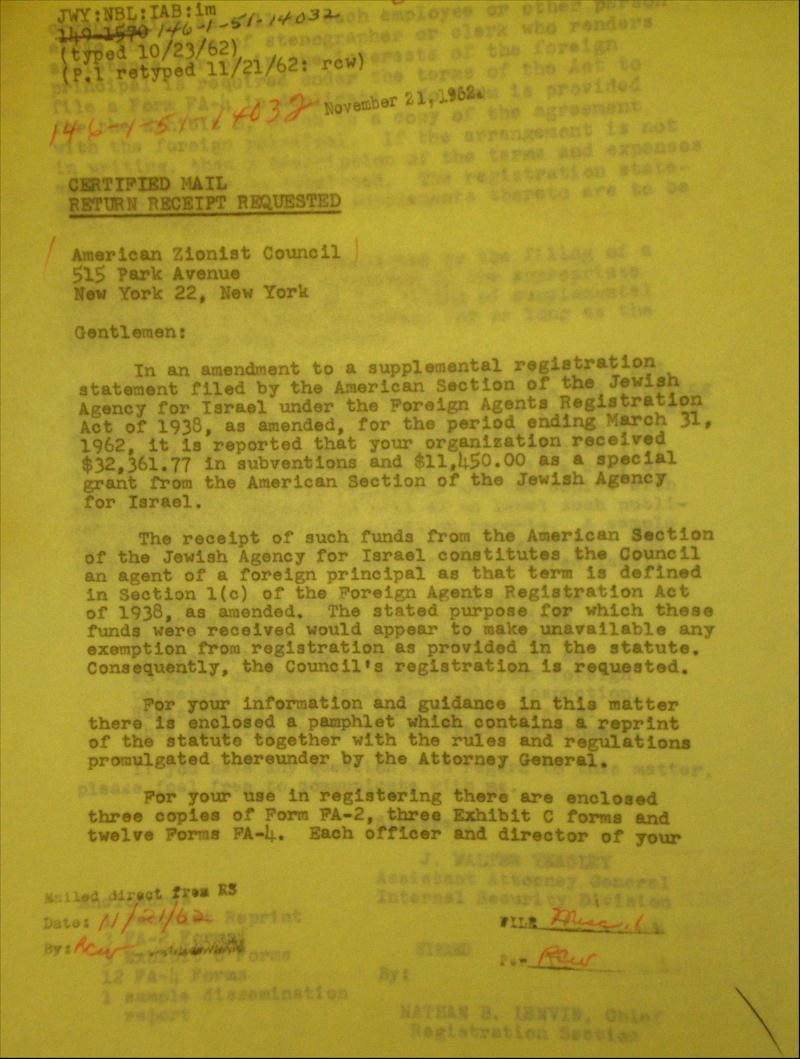
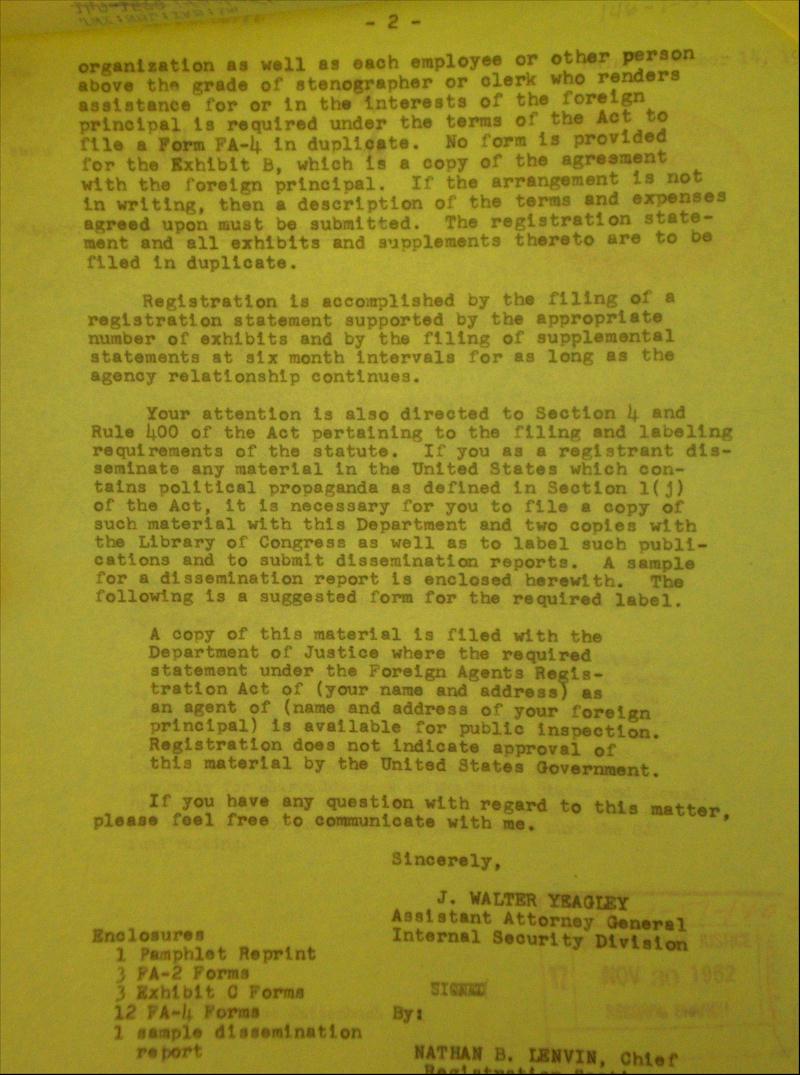
This was no ideological crusade. RFK was not anti-Israel—he had traveled to Palestine in 1948 as a young man and written sympathetically about the plight of Holocaust survivors. But he believed in sovereignty, in transparency, and in the rule of law. The integrity of the republic, in his mind, could not survive covert state-capture.
The AZC lawyered up.
4. AIPAC Emerges: Reorganization as Evasion
Rather than comply, the AZC executed a tactical transformation. It shut down as a formal organization and re-emerged under a new, more insidious name: the American Israel Public Affairs Committee—AIPAC.
AIPAC was structured with legal cunning. Unlike AZC, it claimed to operate as a purely domestic advocacy group, despite continuing the same functions, maintaining the same personnel, and pursuing the same goals. It divorced itself—on paper—from direct financial ties to Tel Aviv, laundering influence through foundations, “education” centers, and front groups.
In short: AIPAC was AZC reborn in the shadows. RFK had tried to register a ghost—and the ghost became a hydra.
5. The Political Response: Silence, Capitulation, Fear
The response in Washington was immediate: nothing.
No congressional hearings. No media coverage. No public debate.
What happened next was textbook psychological warfare: the DOJ’s case quietly stalled. Bureaucratic foot-dragging, political pressure, and interdepartmental “reassessment” strangled RFK’s initiative. Files were buried. Legal briefs left unsubmitted. The momentum collapsed.
Why?
Because what RFK had triggered was not a legal dispute—it was an ontological crisis. If AIPAC were officially declared a foreign agent, then every politician receiving its funds, every media outlet echoing its talking points, every defense contract linked to Israeli security policy, would become a potential case of subversion.
The state chose containment over confrontation. RFK was now radioactive.
6. 1963: The Kennedy Brothers, Dimona, and the Israeli Nuclear State
The deeper threat posed by RFK’s 1962 maneuver became clear when juxtaposed with JFK’s simultaneous standoff with Israeli Prime Minister David Ben-Gurion.
In 1963, JFK was demanding U.S. inspections of Israel’s Dimona nuclear facility. The CIA had confirmed Israel’s secret nuclear weapons program. JFK was adamant: if Israel wanted continued U.S. support, it must submit to inspections and cease proliferation.
“Israel would be on its own if it defied U.S. nuclear nonproliferation standards.” —JFK to Ben-Gurion, May 1963
Ben-Gurion resigned weeks later. JFK was assassinated six months after that. The inspections never happened.
By 1968, Israel had the bomb. RFK was running for president—and he still remembered what his brother tried to stop. His DOJ file on AZC was still sealed. He never spoke of it again in public.
But others remembered.
7. Fanon in Washington: Colonialism Reversed
Frantz Fanon argued that in a colonized society, the colonizer’s dominance depends on invisible infrastructure: a “non-being zone” where power operates without name, without form. The colonizer doesn’t rule merely by military force—but by making their presence unspeakable.
AIPAC is such a structure.
It does not need to be registered, because it does not officially exist as a foreign agent. It does not need to lobby openly, because it has preemptive consensus. It cannot be criticized without professional exile.
RFK’s attempt to drag this infrastructure into visibility was not simply a legal challenge—it was epistemological subversion. He tried to name what cannot be named.
And naming is the first revolutionary act.
8. Sirhan and the Manufactured Motive
When Sirhan Sirhan was arrested for the assassination of RFK in 1968, the motive offered by the media was immediate and airtight: Sirhan, a Palestinian, was furious at RFK’s “support for Israel.”
The evidence? A diary with hypnotic scribblings: “RFK must die… RFK must die… before June 5.” It was the anniversary of the Six-Day War.
But this explanation is a decoy.
RFK’s public statements on Israel were tepid, generic. What had been forgotten—buried—was his role in 1962. Sirhan’s narrative was too clean, too perfectly aligned with a nationalist revenge script.
What if Sirhan was not reacting to RFK’s support for Israel—but was being used to eliminate the one American politician who had dared to oppose its shadow sovereignty?
9. Dramatic Framework for Theatrical Adaptation
- Scene Setting: A dark, silent office in the DOJ, 1962. A single desk lamp. RFK and two aides. A file marked “AZC – FARA Inquiry.” The dialogue is whispered, urgent, laced with doubt.
- Character Shift: RFK begins the scene as a legal technician. He ends it as a hunted man, realizing he has crossed an invisible line.
- Chorus: Voices of media anchors echo in the background, repeating “RFK supported Israel… Sirhan was angry… open and shut…” like a Gregorian chant of gaslight.
10. Conclusion: The Unwritten Indictment
RFK’s push to classify the American Zionist Council as a foreign agent was the closest any American administration ever came to confronting the covert integration of Israeli strategic power into the architecture of U.S. governance.
It was not a policy initiative. It was an act of revolutionary sovereignty.
He failed.
The hydra survived, rebranded, untraceable. RFK was assassinated six years later. A Palestinian was blamed. The files were sealed. AIPAC rose. Congress became a subsidiary. Gaza became an open-air prison. Critique became criminalized.
And the American Republic became a simulation.
Source anchor appendix (Part III): the two pillars of this part are NOT in the collected source materials — verify externally before publication:
- AZC/AIPAC FARA registration attempt (§2–§5) → [EXTERNAL — needs sourcing]
- JFK–Dimona–Ben-Gurion standoff (§6) → [EXTERNAL — needs sourcing; collection "Dimona" hits are all Noguchi's co-author Joseph DiMona]
- Counterweight coverage that IS in the collected source materials: American Zionist donor grip on the 1968 race and RFK's Israel posture → {WJ-C06-¶003} · {WJ-C08-¶001} · {WJ-C08-¶003}; AIPAC in the 1980s AWACS fight → {CP-C09}
More from the Chomsky Analytical Desk
- The Unclosed Door — Visual Index 23 November 2026
- The World RFK Inherited 22 November 2026
- Robert Kennedy’s Political Awakening 22 November 2026
- Sirhan Sirhan – The Manufactured Assassin 22 November 2026