
The Unclosed Door · RFK series
Ballistics, Witnesses, and the Crime Scene That Couldn’t Exist
Part V of The Unclosed Door
1. Introduction: The Physics of the Impossible
In murder investigations, the body speaks. Wounds are syntax. Trajectories are grammar. Ballistics—the science of bullets and bone—offers a stubborn material language that resists ideological translation. In the assassination of Robert F. Kennedy, that language screamed one conclusion:
Sirhan Sirhan could not have fired the fatal shots.
This is not a theory. It is physics. It is forensics. It is geometry. And it is, above all, the silenced speech of a corpse trying to tell the truth.
2. The Fatal Wounds: Autopsy as Rebellion
The official autopsy, conducted by Dr. Thomas Noguchi, revealed that:
- RFK was shot four times.
- All bullets entered from behind.
- The fatal shot entered behind the right ear at a distance of less than 1.5 inches, with powder burns indicating a near-contact shot.
Sirhan, according to all eyewitnesses, never got closer than 3 to 5 feet—and was always in front of Kennedy.
This is not ambiguity. This is contradiction.
The coroner’s report was not speculative. It was specific, detailed, and consistent with the laws of physics. The LAPD, however, responded by trying to discredit Noguchi. When that failed, they simply ignored his findings.
They were not searching for the truth. They were administering a conclusion.
3. Gun Capacity and the Bullet Count
Sirhan’s weapon, a .22 caliber Iver Johnson revolver, held a maximum of 8 bullets.
The LAPD insisted only 8 shots were fired.
But:
- RFK was hit by 3 bullets.
- 5 bystanders were also shot.
- Several witnesses reported hearing more than 8 shots.
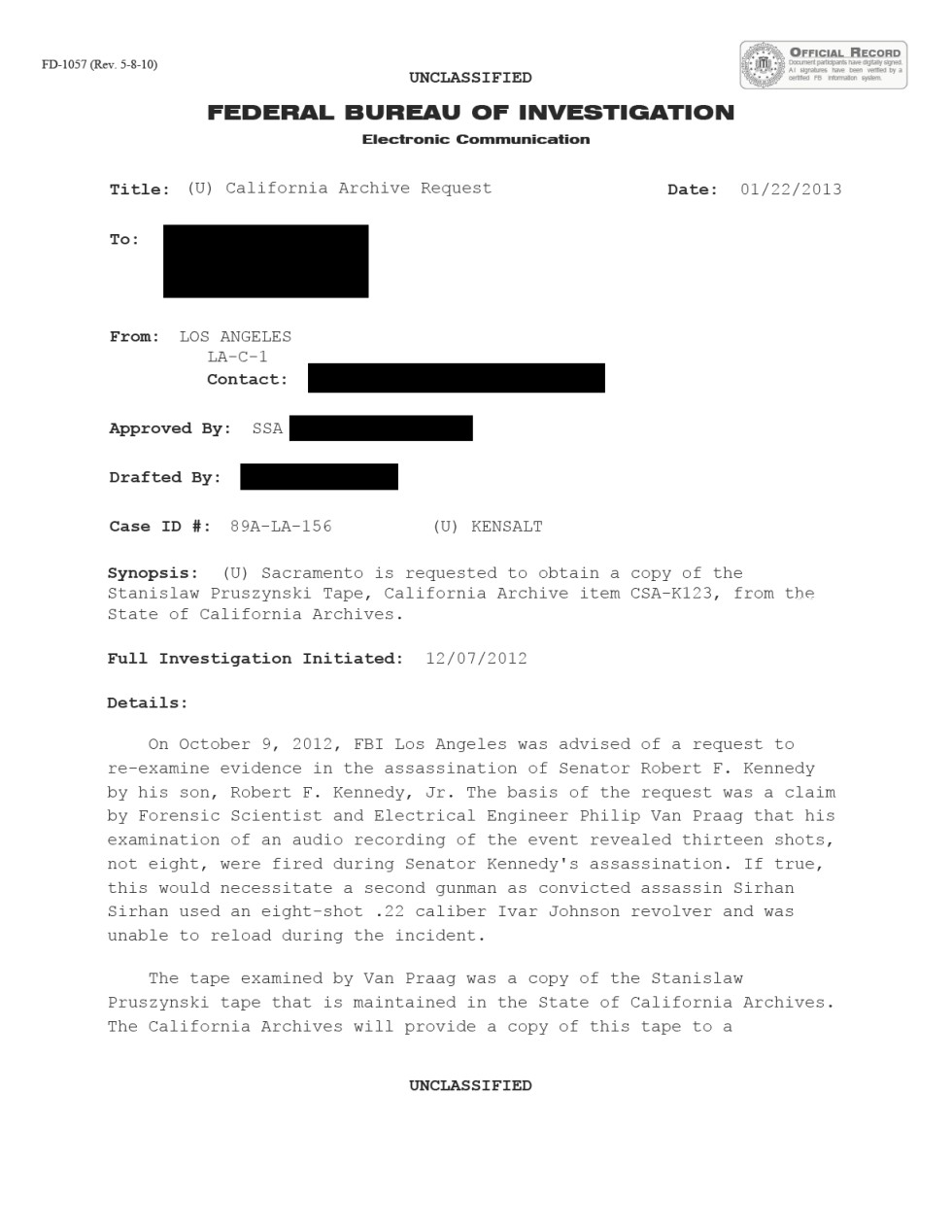
- Audio analysis of the Pruszynski recording conducted in the 2000s by forensic experts revealed at least 13 shots fired—some overlapping in time, indicating two guns.
Additionally:
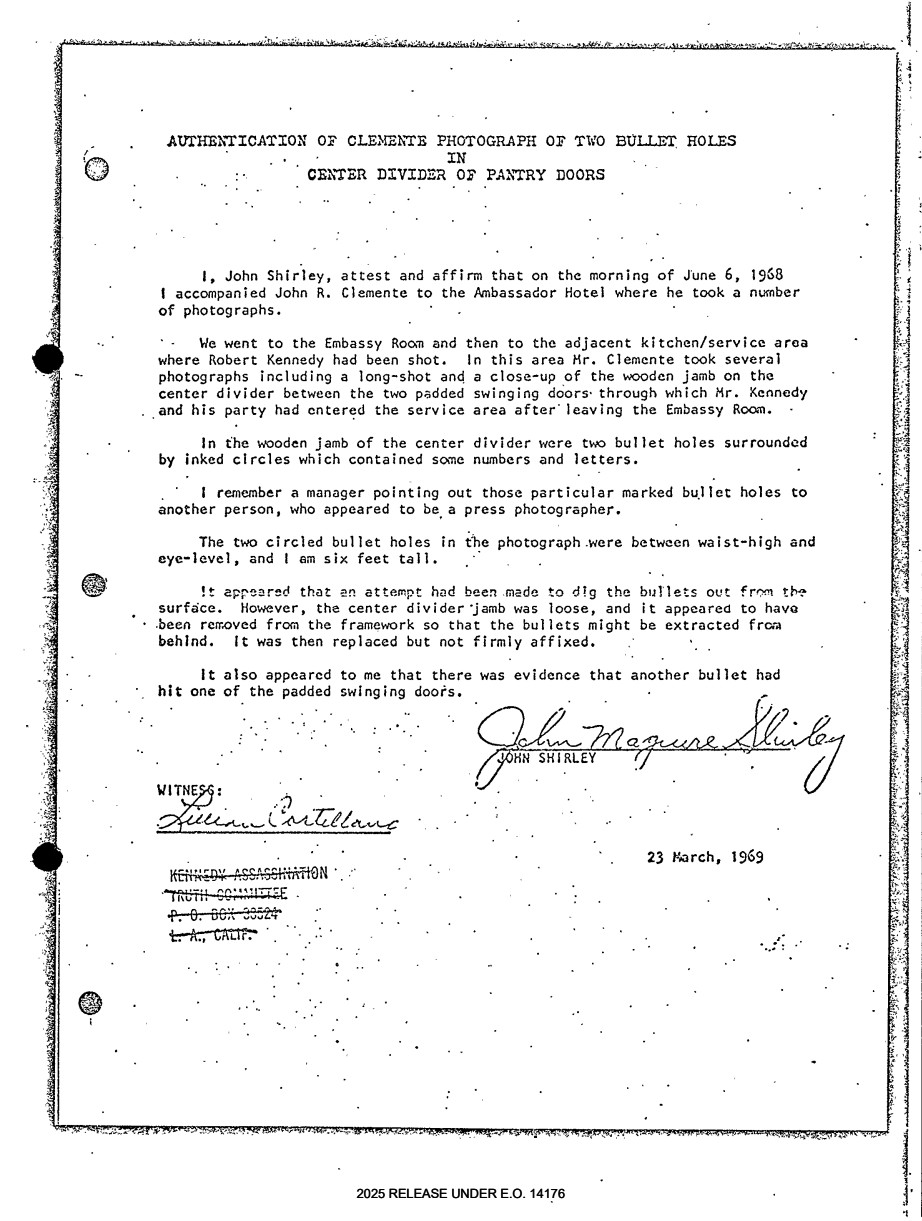
- LAPD photographs showed multiple bullet holes in the pantry walls, doorframes, and ceiling panels—far beyond 8.
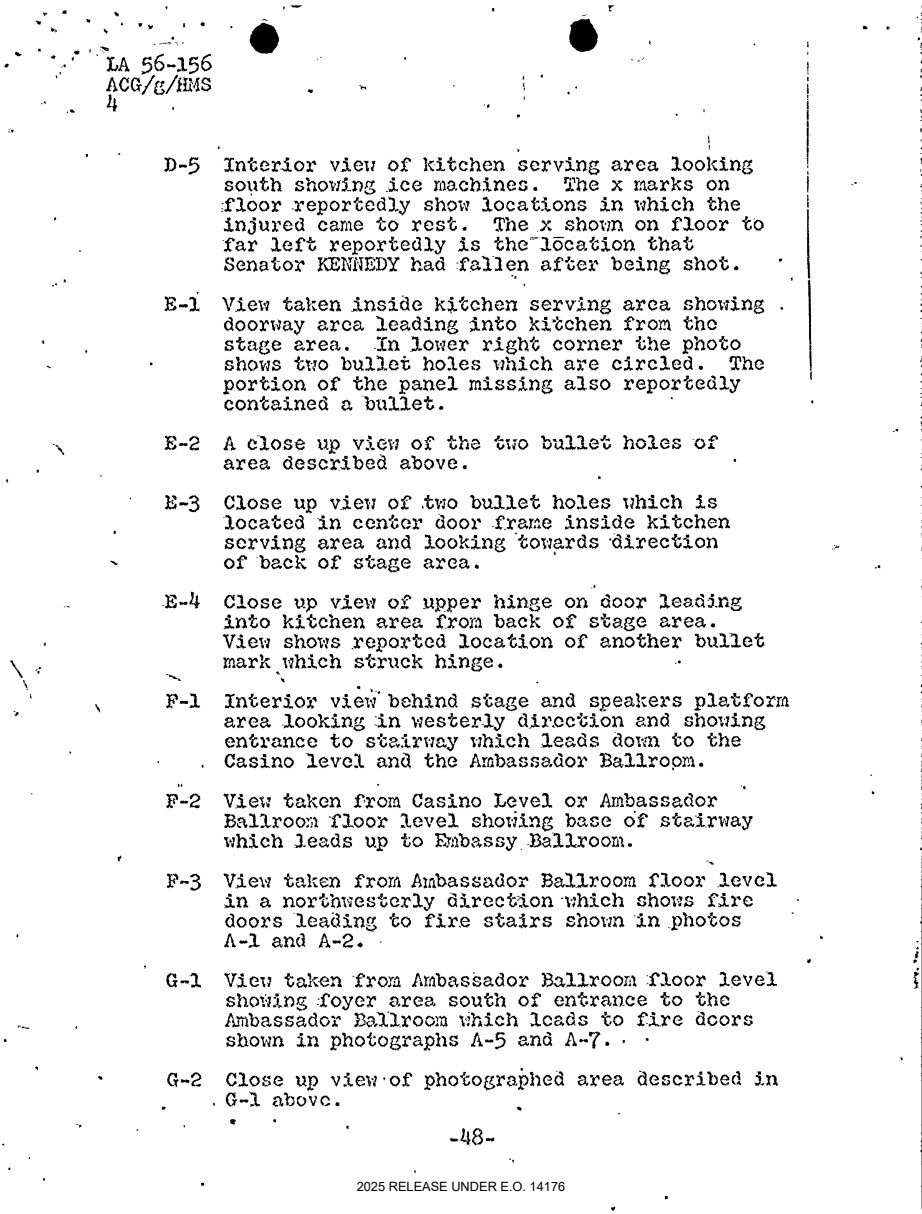
- These were later patched or destroyed without analysis.
- Evidence tags from the scene went missing. Chain of custody was broken.
The evidence of a second gunman was not weak. It was overwhelming. Which is why it had to disappear.
4. The Witnesses: Seeing What Must Not Be Seen
More than a dozen witnesses, including:
- Karl Uecker (RFK’s escort),
- Frank Burns (ABC soundman),
- Lisa Urso (volunteer campaign worker),
- Paul Schrade (who was shot himself),
…testified that Sirhan was never behind RFK. That the fatal shot must have come from someone closer, behind, perhaps even from within the security detail.
Paul Schrade would spend the next five decades demanding a reinvestigation—not to exonerate himself, but to clear Sirhan.
“Sirhan didn’t shoot me. And he didn’t shoot Bobby.”
—Paul Schrade, 2016 parole hearing
Schrade’s position, rooted in physical evidence and eyewitness coherence, has been ignored by both courts and media. The system cannot exonerate Sirhan—because doing so would indict itself.
5. The Security Guard: Thane Eugene Cesar
Standing directly behind Kennedy when the shots were fired was part-time security guard Thane Eugene Cesar. A registered gun owner with a known .22 caliber pistol.
Cesar:
- Initially lied about selling the gun before the shooting.
- Later admitted selling it after the assassination.
- Claimed it was at home the night of the murder—yet no alibi was ever verified.
No thorough ballistics test was ever conducted on his weapon. LAPD never subjected him to forensic interrogation. Years later, he fled to the Philippines, dying in 2019.
Cesar remains the most likely second shooter. But the media, parroting the “lone gunman” doctrine, continues to refer to him, if at all, as a “fringe theory.”
Yet his opportunity, angle, and proximity to RFK make him a vector of lethal potential.
6. Evidence Suppression and Destruction
LAPD’s Special Unit Senator (SUS)—tasked with the investigation—committed the following:
- Destroyed ceiling tiles with embedded bullets.
- Patched doorframes with visible entry holes.
- Lost or mislabeled bullets in evidence rooms.
- Issued a report that falsified distances between Sirhan and RFK.
The Pruszynski audio recording, which captured the actual shooting, was buried for decades and only rediscovered in 2004.
Why?
Because it showed that the official account violated not only logic—but sound.
This was not a failure of forensics. It was a conspiracy of omission.
7. Law Enforcement as Political Actor
The Los Angeles Police Department, like the Dallas PD before it in JFK’s assassination, acted less like an investigative body and more like an intelligence annex.
Notable overlaps:
- Close cooperation with the FBI, which had infiltrated RFK’s campaign with COINTELPRO agents.
- Immediate suppression of any suggestion of conspiracy.
- Selective leaking to compliant media outlets to discredit “dissenting” witnesses.
This transformation—from investigator to narrative manager—mirrors Foucault’s notion of the modern disciplinary institution: a body that defines truth not through inquiry, but through jurisdiction.
RFK’s assassination was not solved. It was adjudicated—by decree.
8. Dramatic Structure for Theatrical Adaptation
- Set Design: A split-pane crime scene: stage left, Sirhan frozen in a spotlight, his hand trembling with the pistol; stage right, RFK facing away from the audience, collapsing in slow motion.
- Choral Intervention: A rotating cast of witnesses, each repeating one phrase: “I saw it. I know what I saw. It wasn’t him.” Their voices are eventually drowned out by static.
- Projection: Ballistic diagrams, autopsy overlays, and forensic timelines flash behind the actors—rendering the science as visual indictment.
- Final Tableaux: The ghost of RFK and Sirhan face one another in silence. RFK reaches toward Sirhan, not in accusation—but in pity.
9. Conclusion: The Crime Scene as Sacred Rupture
The pantry of the Ambassador Hotel was not merely a site of death. It was a ritual chamber—a controlled environment where history could be redirected through sacrifice.
The body of Robert F. Kennedy did not lie.
His wounds spoke.
His path told the truth.
The angles whispered rebellion.
And in every patched wall, every lost bullet, every misfiled witness statement, we find not forensic ambiguity—but imperial necessity.
He was not merely killed.
He was edited.
Source anchor appendix (Part V): Noguchi autopsy → {LB-S14-¶039} · {MD-EPI-¶026}; 13 shots on the Pruszynski tape → {LB-S18-¶047} · tape history {TA-C11-¶001} · counter-expert {LB-S23-¶289}; witnesses (Uecker, Burns, Urso, Schrade) → {NR-C01} · {TA-C18-¶040}; Cesar (.22, sold gun, untested) → {NR-C06} · {WB-C06} · {TA-C04} · {SP-C01}; evidence destruction (ceiling panels, doorframes, 2,400 photos incinerated) → {LB-S17-¶072} · {LB-S16-¶611}
More from the Chomsky Analytical Desk
- The Unclosed Door — Visual Index 23 November 2026
- The World RFK Inherited 22 November 2026
- Robert Kennedy’s Political Awakening 22 November 2026
- 1962 – RFK, AIPAC, and the Foreign Agent That Never Was 22 November 2026