
The Unclosed Door · RFK series
Trauma Programming – MKUltra, Mind Control, and the Dissociative Design of Sirhan Sirhan
Part XIII of The Unclosed Door
1. Introduction: The Assassin Who Forgot
Sirhan Sirhan never remembered killing Robert F. Kennedy.
Not during his interrogation.
Not during his trial.
Not decades into his imprisonment.
This has been treated by courts, media, and the public as convenient amnesia—or as a sign of psychosis.
But what if it is neither?
What if it is real?
And what if that forgetfulness was not the result of mental illness—but of deliberate, scientifically induced dissociation?
To ask this question is to confront a reality darker than conspiracy: a state that does not simply kill, but engineers murder through trauma-based behavior modification.
2. MKUltra: The Blueprint for Behavior Control
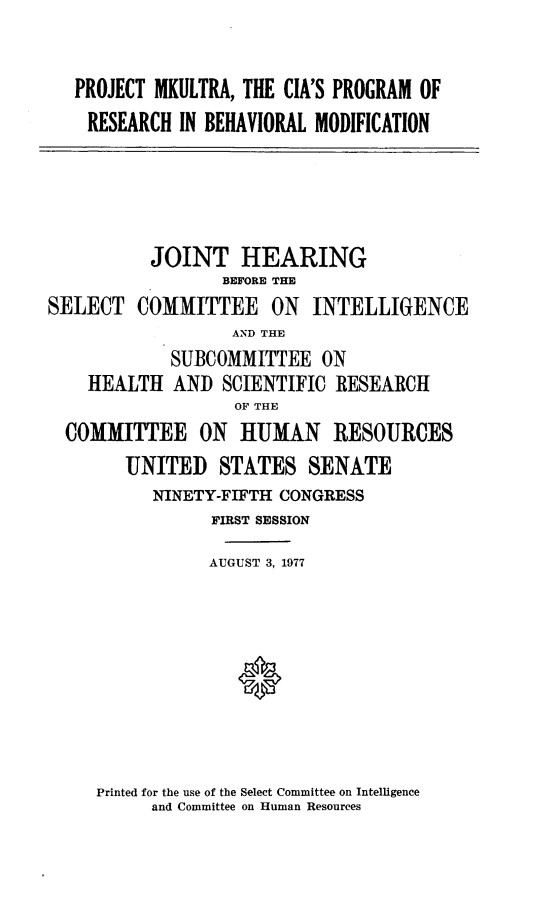
Between 1953 and 1973, the CIA ran Project MKUltra—a sprawling psychological warfare program dedicated to:
- Hypnosis
- Drug-induced dissociation
- Sensory deprivation
- Electroconvulsive conditioning
- Split-consciousness programming
The goal was explicit: to produce controllable human agents—“Manchurian Candidates”—who could perform actions under post-hypnotic suggestion, without conscious awareness.
Declassified files confirm:
- MKUltra had over 149 subprojects.
- Experiments were conducted on prisoners, psychiatric patients, students, and military personnel.
- The CIA’s Technical Services Division worked with universities and medical institutions to develop “amnesia protocols.”
The program was not theoretical.
It was operational.
And its final products were designed not just to act—but to forget.
3. Sirhan’s Dissociation: Symptom or Signal?
Sirhan displayed classic signs of dissociative identity fragmentation:
- Inability to remember the shooting.
- “Waking trances” induced by simple suggestion.
- Notebooks filled with automatic, repetitive writing:
“RFK must die… RFK must die… before June 5… RFK must die…”
Psychiatrists who examined Sirhan included:
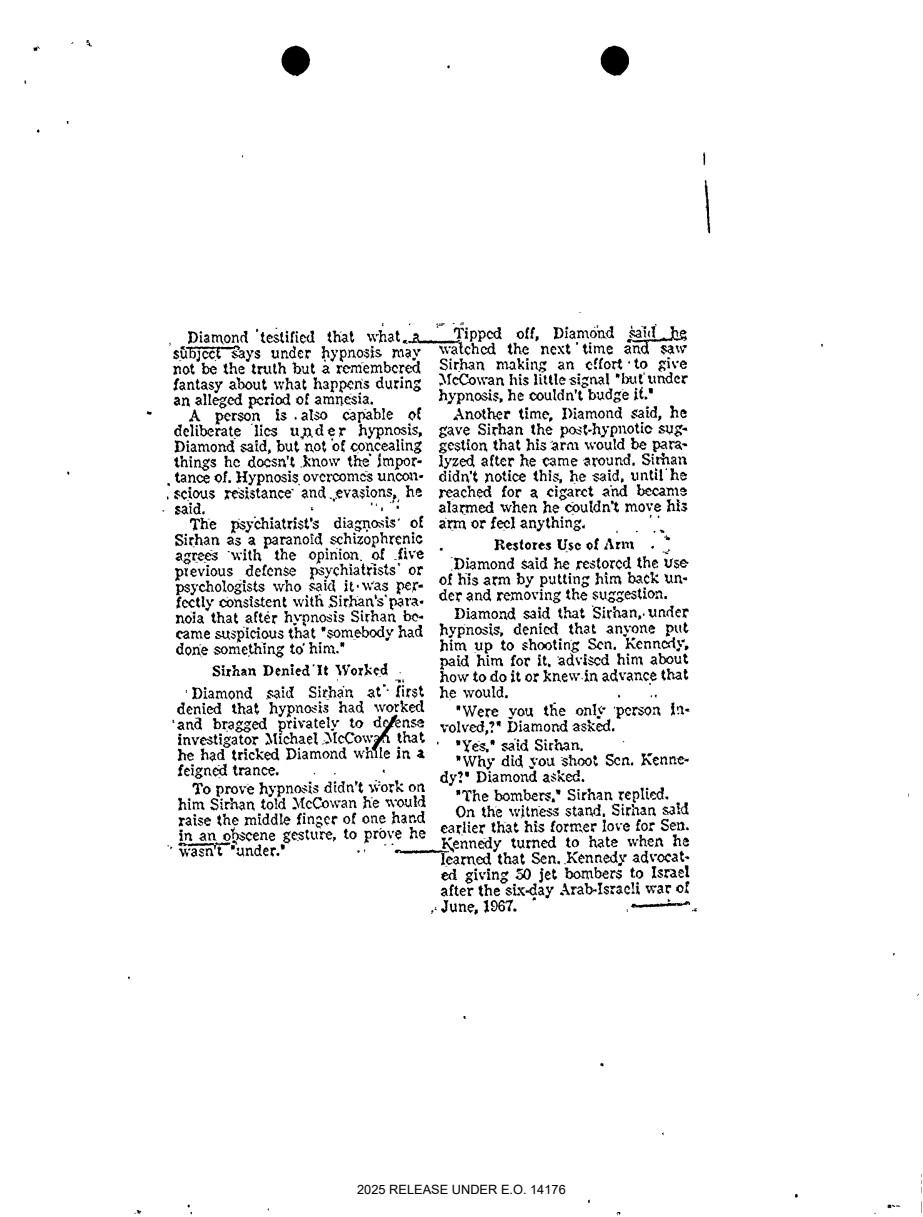
- Dr. Bernard Diamond: hypnosis expert, testified Sirhan could be hypnotized within seconds, and believed he acted under post-hypnotic compulsion.
- Dr. Eduard Simson-Kallas: identified split consciousness, with Sirhan alternating between affectless calm and emotional confusion.
- Dr. Daniel Brown (decades later): concluded Sirhan exhibited classic programming symptoms consistent with MKUltra-style trauma induction.
Brown’s summary:
“Sirhan’s amnesia, trance states, and vulnerability to hypnotic suggestion indicate he was likely subject to sophisticated psychological manipulation.”
Yet none of this was allowed at trial.
4. The Notebooks: Manufactured Pretext
Sirhan’s notebooks were seized by LAPD within hours of the assassination.
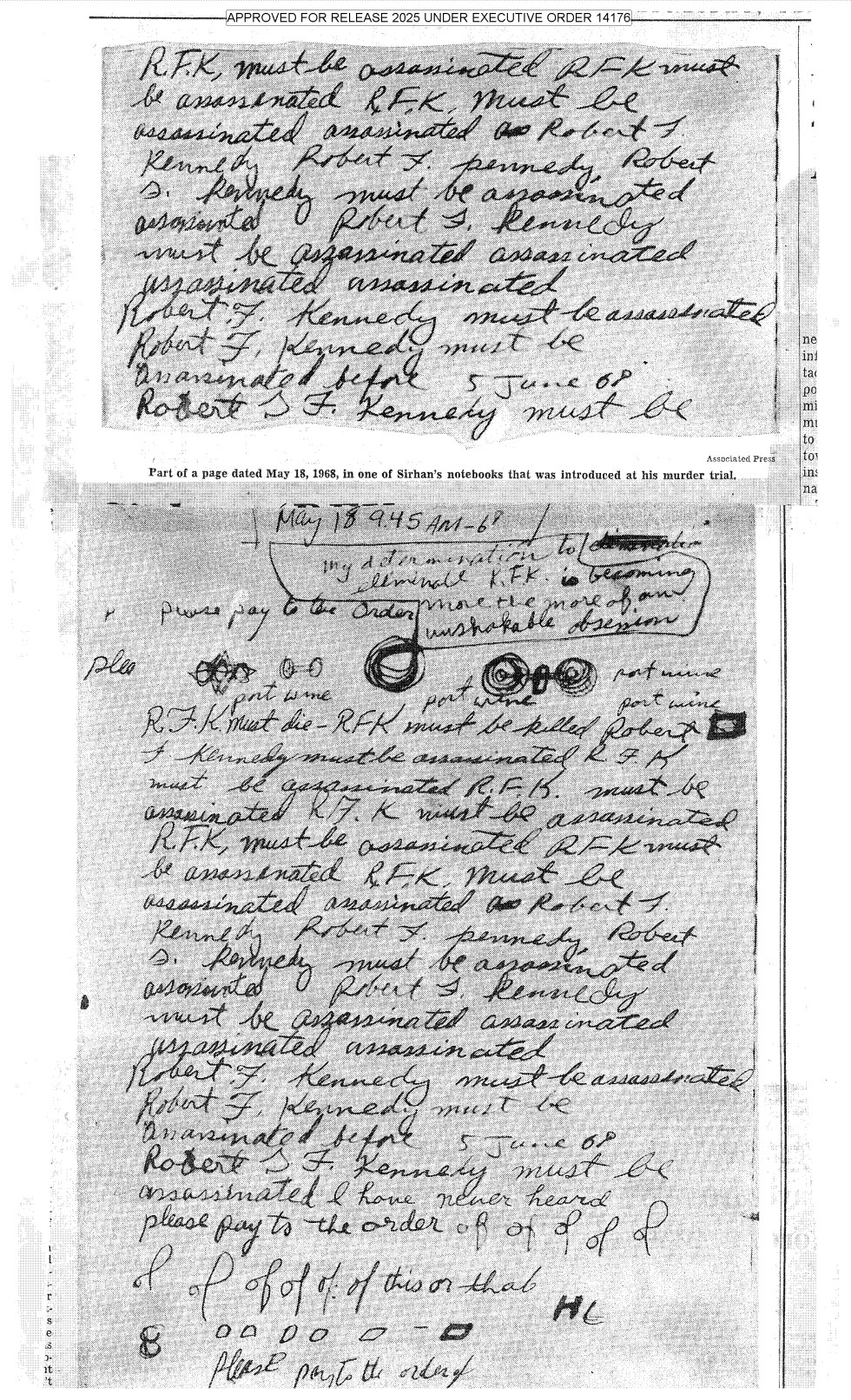
They contained:
- Repeated mantras: “RFK must die.”
- Obsessive date-fixation: June 5.
- Doodles, spirals, and fractured grammar.
- No political analysis, no coherent manifesto.
The handwriting bore characteristics of automatism—a dissociative phenomenon where the subject writes under subconscious influence.
Dr. Diamond demonstrated in court that Sirhan, under hypnosis, could:
- Write new phrases involuntarily.
- Forget writing them minutes later.
- Adopt aggressive postures, then become catatonic.
Yet the notebooks were treated as proof of premeditation, not manipulation.
No tests were done to determine if the handwriting was produced in altered states.
No independent graphology was presented.
No consideration was given to how a Palestinian immigrant with no operational access could pen the perfect prosecutorial exhibit.
They were evidence, yes—but evidence of programming, not intent.
5. The Handler Question: Who Constructed the Script?
In MKUltra training, the subject is never self-programmed. There is always a handler.
The protocol:
1. Subject is hypnotized, often under emotional distress or after trauma.
2. A “program” is implanted: a behavioral command with a trigger cue (phrase, sound, image).
3. A cover personality is created to prevent leakage of memory.
4. The real personality is kept “asleep” until the task is completed.
5. After action, the subject forgets everything.
Sirhan fits this architecture.
Witnesses before the assassination recall:
- A mysterious woman at the hotel—“the girl in the polka-dot dress”—who appeared to be guiding him.
- Sirhan having “a blank expression” and unresponsiveness.
- Reports of him being seen at gun ranges with strangers weeks prior.
After the shooting:
- He had no memory of reaching for the gun.
- He repeated, “They’ll never take me alive,” as if reciting a script.
- He said to police:
“I did it for my country.”
Then moments later:
“What did I do? I don’t remember anything.”
To this day, no full investigation has identified the individuals in Sirhan’s orbit during his “preparation” phase.
The question remains: who held the trigger for the man holding the gun?
6. The Hypnotic Assassination Template: Other Case Parallels
Sirhan is not unique.
CIA documents show:
- Subjects trained to kill under hypnosis as early as 1954.
- One experiment had a female subject fire a pistol at a researcher after a trigger phrase. She had no conscious memory of doing so.
- Techniques tested at McGill University (under Dr. Ewen Cameron) included “depatterning” and “psychic driving”—designed to erase identity and reprogram behavior.
Other suspicious “dissociative assassins” include:
- Mark David Chapman, who killed John Lennon and claimed “a voice told me to do it.”
- John Hinckley Jr., who shot Reagan and had deep psychological disturbances, with reported hypnotic susceptibility.
- James Holmes, the Aurora shooter, who claimed to be in a trance and had no motive or memory of the killings.
These cases form a pattern:
- Mass attention.
- Absurd or fragmentary motives.
- No investigation into dissociative or hypnotic states.
The Sirhan case is the prototype.
7. Legal Refusal: Why the Courts Cannot Admit Programming
Sirhan’s legal appeals have consistently been denied, despite:
- New audio evidence proving more shots than his gun could hold.
- Multiple psychological re-evaluations confirming dissociation.
- RFK Jr. and Paul Schrade publicly supporting his innocence.
Why?
Because to admit Sirhan was programmed would:
- Reopen the CIA’s domestic activities.
- Invalidate the entire trial.
- Expose the judiciary’s complicity in a show-trial.
- Reveal that the U.S. government developed tools of mind slavery.
It would also set precedent for other assassinations to be re-examined—not just RFK, but JFK, MLK, and beyond.
The law, designed to find guilt, is incapable of confronting constructed action.
8. Fanon and the Colonial Logic of Internal Control
Frantz Fanon wrote of colonial regimes that:
“They make the native speak in a voice that is not his own. They make him repeat the colonizer’s commands in his own tongue.”
Sirhan Sirhan, in this view, was not a man—but a mouthpiece. A ventriloquized act.
He did not kill RFK because he hated him.
He killed RFK because a system needed him to be the Palestinian assassin, the monster, the martyr-maker, the emotional closure.
His blank mind, far from discrediting the murder, is the most damning evidence.
Colonial power, when turned inward, does not need to convince.
It only needs to create performance.
9. Dramatic Rendering: The Mind as Battlefield
Set: A bare room. A chair, a mirror, a metronome.
Act I: Sirhan sits in the chair. A “doctor” reads from a file. Sirhan’s eyes glaze. The doctor says, “The target is RFK.” Sirhan nods.
Act II: Sirhan’s real self appears behind the mirror, pounding on the glass. No one hears him. He screams, “Stop! I don’t want this!”
Act III: A voice whispers, “RFK must die… before June 5.” Sirhan pulls the trigger. The mirror shatters.
Final Scene: Sirhan, alone, says: “I’m sorry. I don’t remember. Please… just tell me what happened.”
10. Conclusion: The Erased Self and the Echo of Truth
Sirhan Sirhan remains incarcerated. He is not imprisoned for what he did—but for what he represents:
- The state’s power to create guilt.
- The court’s refusal to confront manipulation.
- The media’s collusion in naming the assassin before the trial began.
RFK’s death was the death of a movement, a possibility, a sovereignty.
Sirhan’s life is the aftershock: a man broken, then buried, still breathing.
If we do not listen to the dissonance in his silence, we will never hear the signal in the noise.
And the machinery will continue—clean, bloodless, precise.
Until the next Sirhan is made.
Source anchor appendix (Part XIII): MKUltra/hypnosis — Sirhan's hypnotic susceptibility and trance re-enactment → {MD-C12}; Spiegel → {WB-C15-¶032} · {WB-C15-¶070}; notebooks/AMORC/mirror writing → {MD-C12-¶140} · {MD-C12-¶141} · {LB-S22-¶046} · {LB-S22-¶063} · {LB-S22-¶084} (Dr. William J. Bryan and his hypnosis machine also attested at {LB-S22-¶084})
More from the Chomsky Analytical Desk
- The Unclosed Door — Visual Index 23 November 2026
- The World RFK Inherited 22 November 2026
- Robert Kennedy’s Political Awakening 22 November 2026
- 1962 – RFK, AIPAC, and the Foreign Agent That Never Was 22 November 2026