
The Unclosed Door · RFK series
Thane Eugene Cesar and the Security Apparatus
Part XIV-A of The Unclosed Door
1. Introduction: The Man at the Elbow
Every account of the assassination must pass through the same physical fact: when the bullets came, they came from behind Robert Kennedy's right ear, from inches away. And the man standing there — holding Kennedy's right elbow in his left hand, guiding him through the crowd — was a twenty-six-year-old part-time security guard named Thane Eugene Cesar {WB-C01-¶054; NR-C06-¶007}.
The fatal wound's geometry and Cesar's position occupy the same space. Everything else about him — his politics, his gun, his shifting accounts of both — has been left for fifty-seven years in a file the system never opened.
This part opens it.
2. The Guard
Cesar was not a career protector. By day he worked at Lockheed Aircraft as what he called a plumbing-maintenance worker; by night he moonlighted as a uniformed guard for Ace Guard Service, hired by the Ambassador Hotel for crowd control {NR-C06-¶007}.
His assignment that evening was not the product of a plan anyone will own. William Gardner, the Ace supervisor, placed Cesar in what O'Sullivan calls "the killing zone" — with advance notice that Kennedy would pass through, positioned to guide him through the pantry {WB-C13-¶224}. Cesar himself would later emphasize how last-minute the assignment was — a point that cuts both ways, and one the defense of him leans on {WB-C13-¶225}.
Jack Merritt, a fellow guard, told him at a quarter to nine: "I got a funny feeling there's gonna be big trouble here tonight" {WB-C13-¶068}.
3. The Politics
Special Unit Senator's chief, Robert Houghton, would later assure the public there were no "right wingers" in the pantry {NR-C06-¶008}. The record makes a mockery of the assurance.
Cesar supported George Wallace for president — passing handbills, making donations {NR-C06-¶008; WB-C13-¶065}. He told Ted Charach in 1969 that the country was headed for a race war, "white against black," and that he was "fed up" {NR-C06-¶008}. Of Kennedy he said: "I definitely wouldn't have voted for Bobby Kennedy because he had the same ideas as John did… He literally gave it to the Commies, the minorities, the blacks" {WB-C13-¶065}.
Melanson, scrupulous as ever, cautions that right-wing ideology is not a smoking gun {NR-C06-¶007}. True. But motive, in a murder with no admitted murderer, is not decoration either. Cesar did not merely dislike the man at his elbow. He despised what the man represented.
4. The Gun Question
No bullets recovered from any victim were anything but .22 caliber. Therefore the only question that ever mattered about Thane Cesar's weapons was whether he carried a .22 in the pantry {NR-C06-¶024}.
The official answer was that he carried the .38 revolver required by Ace — Kranz was told his superiors "checked him out earlier in the evening" — though "there is no paperwork to support it," and as O'Sullivan notes, "Cesar could have swapped weapons at any time" {WB-C13-¶177}.
Cesar's accounts of what happened to his .38 afterward contradict themselves across interviews. He told Moldea in 1987 that he offered the gun to police immediately after the shooting and they declined to inspect it; no tape or document of that offer exists {NR-C06-¶023}. He told Kranz the gun was examined at Rampart station; the LAPD "orally verifies" this but has no documents, no officer's name, and the .38 was never seized or test-fired {WB-C13-¶180}.
And Cesar did own a .22. On that, everyone agrees — because Cesar admitted it. Everything else about that .22 changes with the telling {NR-C06-¶024}.
5. The Shifting Sale
Version one: he sold the .22 about a year before the assassination — October 1967, to a Lockheed colleague retiring to Arkansas {WB-C13-¶088}.
Version two, to investigators in 1971: he sold it "somewhere around" February 1968 — four months before the killing {WB-C13-¶108}.
Minutes later, version three: under questioning about Sergeant O'Steen's home interview, he volunteered — "I don't remember if I showed it to him, but I mentioned I had a gun similar to the one that was used that night" {WB-C13-¶109}. Years later he told Moldea he did, in fact, show the .22 to O'Steen that night, pulling it out to demonstrate how easily such a weapon could be concealed {WB-C13-¶112}.
Then the paper appeared. Jim Yoder — the Lockheed workmate — told Charach he bought Cesar's nine-shot Harrington & Richardson .22, serial number Y13332, for fifteen dollars. He produced the receipt. It is dated September 6, 1968 — three months after the assassination {WB-C13-¶114}.
District Attorney Busch had already told the press that Yoder had been contacted and Cesar's statement verified. Nobody had called Yoder at all {WB-C13-¶113}.
And Yoder remembered something else. Sometime "in June," he said, Cesar came to him "a little worried," saying he had gone "to the assistance of an officer" and had fired the gun — and that "there might be repercussions from that" {WB-C13-¶114}.
6. The Gun's Afterlife
The .22's subsequent history reads like the case in miniature. In October 1969 it was stolen from Yoder's home in a burglary. When the LAPD belatedly tried, five years later, to verify the burglary, they found the local sheriff's files had been purged {WB-C13-¶115}.
The gun itself surfaced only in the mid-nineties, when Charach's "Operation Tinker Toy" had it fished out of a lake in Blue Mountain, Arkansas {WB-C13-¶115}. By then, whatever a ballistics comparison might have settled had been deferred past every point of accountability.
7. The Polygraphs
In 1971, with Cesar's story visibly shifting across the interview record, the investigators themselves wrote the file that would protect him: "a polygraph examination would not add to the investigation… because Mr. Cesar answered all questions put to him in a thorough, straightforward and honest manner… The investigators never doubted Cesar's word" {WB-C13-¶112}.
In 1994, Dan Moldea finally arranged the polygraph the state had declined. Cesar passed — and in the same sittings confirmed the .22 story and recalled firing it "one time after the assassination," marveling at "how quick you could rap off eight shots" {WB-C13-¶089}.
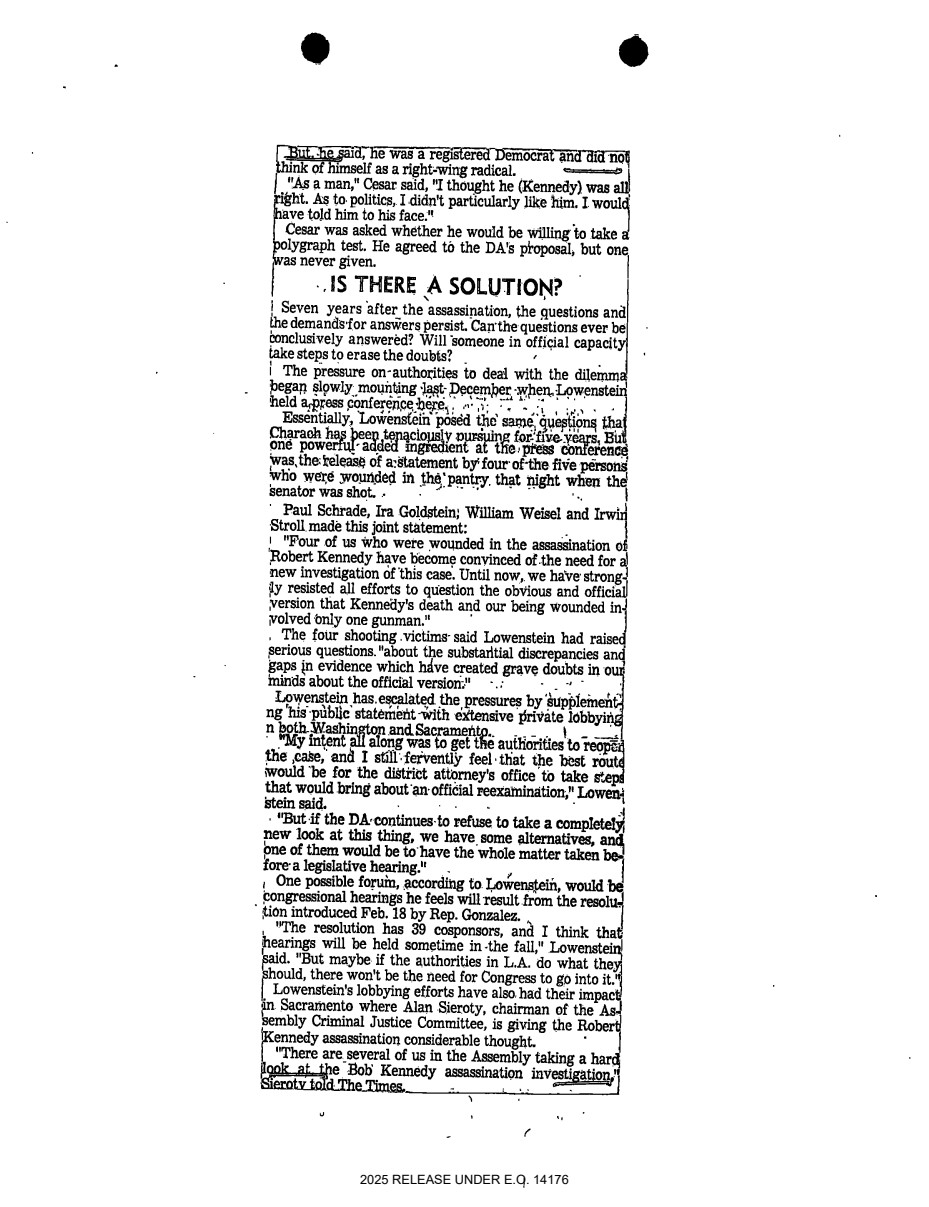
Asked by Kranz why he had not fired his gun to protect the senator, Cesar's answer was simple: "I was a coward. The moment I saw the gun fire, I hit the deck" {WB-C13-¶178}.
Kranz's own conclusion, written in 1977, is the most the system has ever conceded: "the LAPD should have seized the .38… good judgment required the LAPD to at least inspect and test the weapon beyond a cursory search" — which never took place {WB-C13-¶179}.
8. The Balance — and the Verdict of Geometry
The case for Cesar's innocence exists and must be stated, as O'Sullivan states it: no criminal record; a last-minute assignment he did not choose; voluntary cooperation with police afterward; willingness to take a polygraph; and the puzzle of why an assassin would sell the murder weapon and sign the receipt {WB-C13-¶225}.
The case against the process is stronger. No ballistics test on his weapons. No documents for the .38 examination. A DA's office that announced verification it had never performed. Investigators who wrote "we never doubted his word" into the record while his word changed three times in a single sitting. A key witness whose account of firing his own .22 for "emergency assistance" — with "repercussions" feared "sometime in June" — was never pursued {WB-C13-¶112; WB-C13-¶113; WB-C13-¶114}.
And beneath all of it, unmoved: the geometry. The fatal shot came from behind the right ear, at near-contact range. The man at the right elbow was Thane Eugene Cesar. The system that destroyed doorframes and incinerated photographs never once looked at him {WB-C13-¶224; LB-S17-¶072}.
9. Dramatic Schema
Set: A narrow corridor. A single overhead light. Cesar alone, cleaning a revolver the audience cannot calibrate — .38 or .22, the light never settles it.
Device: Each time he finishes a sentence about the gun, a receipt printer on a small table prints another date — October 1967, February 1968, June 1968, September 6, 1968 — the paper curling, accumulating, until it covers the floor.
Chorus: Investigators' voices, bureaucratic and serene: "We never doubted his word." Repeated each time the story changes, a little slower, a little lower.
Final image: Kennedy's ghost at the corridor's far end, his right hand raised to his right ear. He does not accuse. He simply stands where the bullet came from — the spot no investigator ever stood.
10. Conclusion: The Unasked Question
Thane Eugene Cesar is not the proven assassin. The collected source materials do not say that, and neither does this project.
What the record proves is different, and in its way worse: that the man occupying the exact position from which the fatal shot was fired — armed, ideologically hostile to his charge, contradictory about his weapons — was never treated as a suspect by the institutions whose duty was suspicion.
He was protected not by evidence but by process. The polygraph declined. The test never fired. The verification never made. The receipt never checked. The "repercussions" never asked about.
The question was never answered because it was never asked.
Anchor appendix (added 2026-11-21, verification pass): {WB-C01-¶054} · {NR-C06-¶007} · {NR-C06-¶008} · {NR-C06-¶022} · {NR-C06-¶023} · {NR-C06-¶024} · {WB-C13-¶065} · {WB-C13-¶068} · {WB-C13-¶088} · {WB-C13-¶089} · {WB-C13-¶108} · {WB-C13-¶109} · {WB-C13-¶112} · {WB-C13-¶113} · {WB-C13-¶114} · {WB-C13-¶115} · {WB-C13-¶177} · {WB-C13-¶178} · {WB-C13-¶179} · {WB-C13-¶180} · {WB-C13-¶224} · {WB-C13-¶225} · {LB-S17-¶072}. Full digest: the Thane Eugene Cesar source digest (841 anchored mentions, 10 books).
More from the Chomsky Analytical Desk
- The Unclosed Door — Visual Index 23 November 2026
- The World RFK Inherited 22 November 2026
- Robert Kennedy’s Political Awakening 22 November 2026
- 1962 – RFK, AIPAC, and the Foreign Agent That Never Was 22 November 2026