
The Unclosed Door · RFK series
Witnesses Forgotten – Paul Schrade, Nina Rhodes-Hughes, and the Silenced Survivors of the Truth
Part XV of The Unclosed Door
1. Introduction: The Surviving Wound
When a high-profile political figure is assassinated, we often focus on the death, the funeral, the mourning, and the myth. But what about those who were there—those who saw too much, who heard the gunshots not as abstraction but as proximity, who felt the explosion not in metaphor but in flesh?
And worse: what about those who realized the story being told about the event was not the event itself?
The witnesses to RFK’s assassination were not passive. They spoke. They gave statements. They testified.
And then they were made to disappear—not through death, but through narrative nullification.
In particular, two names stand out as emblematic of this process:
- Paul Schrade, union leader, RFK supporter, and one of the men shot that night.
- Nina Rhodes-Hughes, actress, activist, and witness to the acoustic impossibility of the lone gunman theory.
Their stories do not support the official account.
That is why we rarely hear them.
2. Paul Schrade: Wounded Body, Unyielding Mind
2.1 The Shooting
Paul Schrade was shot in the head during the same volley of gunfire that killed Robert F. Kennedy. He was standing just feet away from the senator in the Ambassador Hotel pantry when the shots rang out.
Unlike RFK, Schrade survived.
He was hospitalized. His skull fractured. His political idealism intact.
And then the narrative began to cohere—without him.
2.2 The Awakening
Schrade initially accepted the official story. Sirhan Sirhan was caught with the gun. Case closed.
But as details emerged—ballistic contradictions, witness suppression, physical impossibilities—Schrade began to investigate.
What he found appalled him:
- He had not been shot from the same direction as RFK.
- The bullet extracted from his skull could not be conclusively matched to Sirhan’s weapon.
- Evidence in LAPD custody had been mishandled, mislabeled, or destroyed.
Schrade became the only survivor of the shooting to publicly assert:
“Sirhan did not kill Robert Kennedy. He shot me. But he didn’t shoot the senator.”
This position, declared consistently from the 1970s onward, made him an anomaly: a victim who refused victimhood, who refused closure.
And for this, he was cast out.
3. Schrade’s Crusade: Demanding a New Investigation
Over the decades, Schrade became the moral conscience of the case.
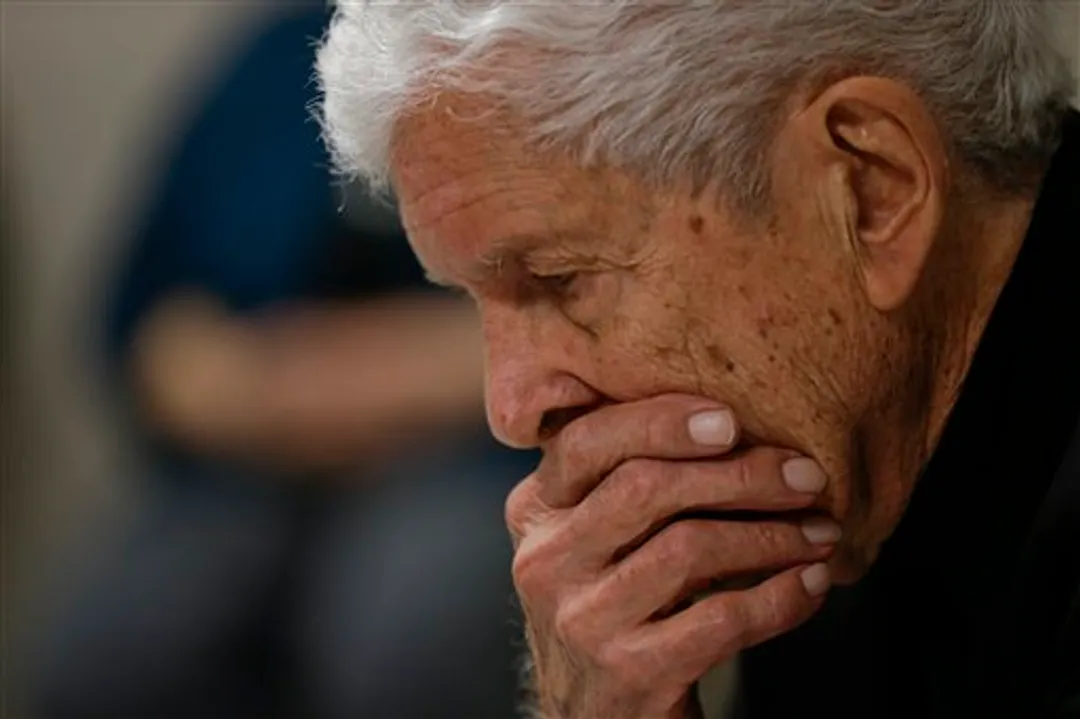
He:
- Testified at Sirhan’s parole hearings.
- Appeared in documentaries and independent investigations.
- Met with RFK Jr. to discuss reopening the case.
- Wrote to presidents, governors, and senators.
In 2016, at age 91, Schrade told Sirhan—face to face at a parole hearing:
“It was not your fault. You were used. You were a distraction for what really happened.”
Even then, Sirhan was denied parole.
Even then, no mainstream media outlet elevated Schrade’s plea.
Even then, the LAPD refused to reopen the case.
Schrade had broken a taboo: he had survived, and remembered too much.
And so, the system rendered him a nonentity—present, wounded, articulate, but illegible to the public record.
4. Nina Rhodes-Hughes: The Woman Who Heard More
4.1 The Witness
Nina Rhodes-Hughes stood in the kitchen passage of the Ambassador Hotel when RFK was gunned down.
She later told investigators:
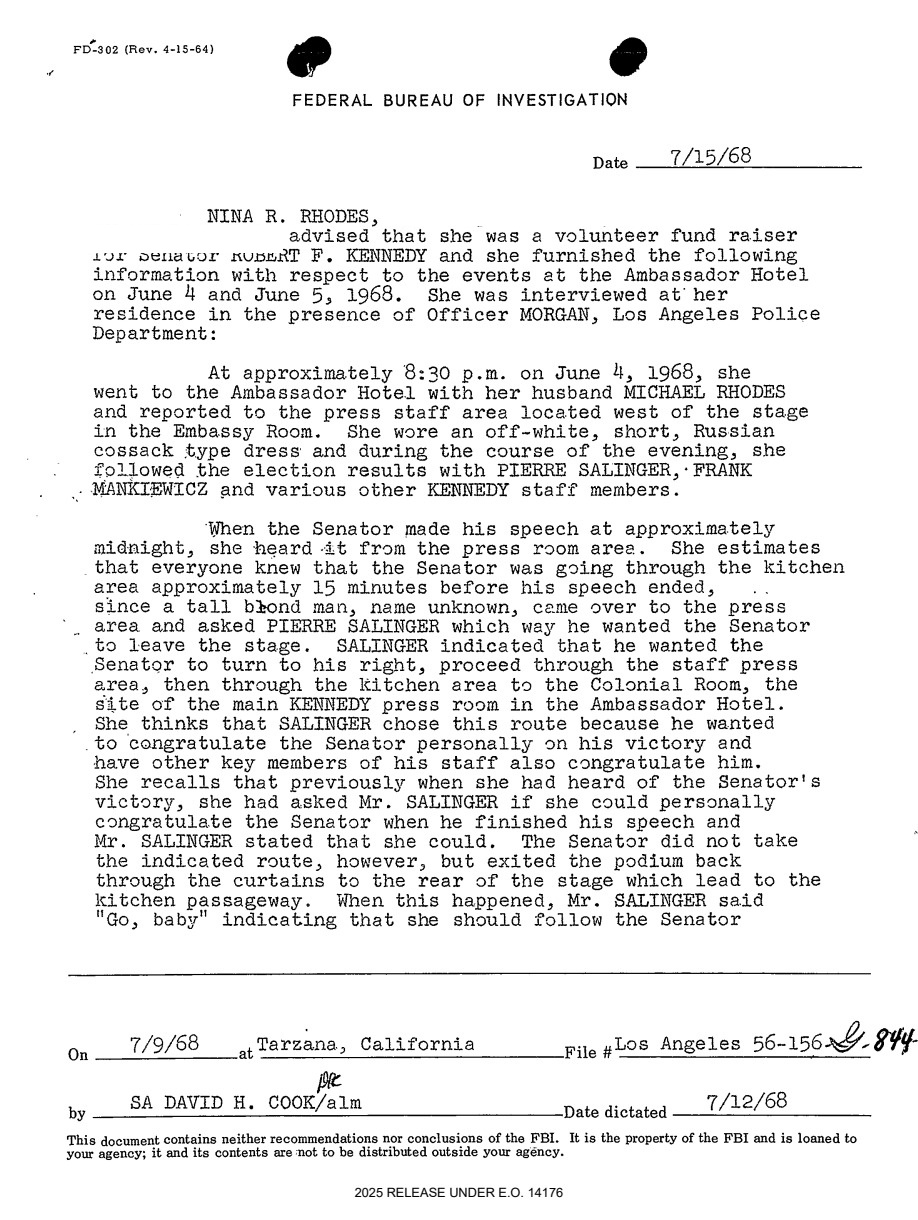
- She heard at least 12 to 14 shots.
- The shots came from different directions.
- The shooting sounded like it came from more than one weapon.
She later said:
“There were two guns, not one.”
But the official record listed only eight shots—all fired by Sirhan’s gun.
LAPD manipulated her statement to read that she heard “maybe eight shots.”
She did not discover this misrepresentation until decades later, when she saw her official transcript.
By then, the narrative had ossified.
4.2 Media Ridicule and Marginalization
When Rhodes-Hughes began speaking publicly in the 2010s, she was immediately subjected to:
- Skeptical interviews designed to discredit her memory.
- Editorial framing that cast her as confused or seeking attention.
- Exclusion from official commemorations of RFK’s legacy.
She was forced to repeat herself:
“I was there. I remember what I heard. They altered my testimony.”
Her status as a woman, a civilian, and an actress made her an easy target for gendered dismissal.
This is the epistemology of erasure:
- When a woman contradicts the state, her memory is reclassified as hysteria.
And so her truth became a liability, not a revelation.
5. Other Silenced Voices: A Tapestry of Suppression
Rhodes-Hughes and Schrade are not alone. Other suppressed witnesses include:
- Vincent DiPierro, who saw the polka-dot dress woman nudge Sirhan forward. He was pressured to alter his testimony.
- Frank Burns, ABC soundman, who corroborated the presence of multiple shooters.
- Evan Freed, photographer, who reported seeing multiple suspects behaving suspiciously.
- Don Schulman, CBS page, who reported multiple gunmen and was ignored.
Each of these individuals, when offering contradictory accounts, faced:
- LAPD discrediting.
- Media marginalization.
- Legal exclusion.
In total, over 20 witnesses contradicted the lone gunman theory.
Their reward?
Silence.
6. Why Witnesses Must Be Forgotten
The assassination of RFK was not merely about killing a man. It was about constructing a narrative immune to correction.
Witnesses who survive with inconvenient memories must be:
- Pressured into recanting.
- Dismissed as confused.
- Forgotten through omission.
This is a psychological warfare operation—not against the target, but against history itself.
To admit that Schrade is right is to:
- Admit the trial was a lie.
- Admit the investigation was a cover-up.
- Admit the state is not neutral—but complicit.
Therefore, forgetting is mandatory.
7. Fanon and the Colonized Witness
Frantz Fanon wrote of the colonized subject:
“He sees what he must not see. He speaks what he must not say. And so he is told: you are mistaken.”
In this case, the colonized are not only the oppressed. They are any citizen who sees through the veil.
The witness becomes dangerous not because they lie, but because they refuse to.
And so they are:
- Isolated.
- Pathologized.
- Sanitized out of the record.
This is epistemic violence—a colonization of perception itself.
8. Dramatic Construction: The Trial of the Witnesses
Set: A courtroom. But this time, the witnesses are on trial.
- Schrade sits in the box. The prosecutor says: “You were shot. That’s all. Don’t complicate it.”
- Rhodes-Hughes testifies. The judge says: “You heard echoes. Science proves nothing else.”
- DiPierro raises his voice. The bailiff drags him away.
The prosecutor turns to the audience:
“Ladies and gentlemen, we must protect the nation from those who remember too clearly.”
A spotlight remains on an empty chair.
RFK’s voice echoes:
“We must dare to think beyond what we are told.”
9. Conclusion: Memory as Resistance
The witnesses to RFK’s assassination are not dead.
They are alive—in body, in statement, in contradiction.
They are the ghosts the state cannot bury.
Their memories, scattered and persistent, are the cracks in the edifice of the official lie.
Each time Schrade speaks, or Rhodes-Hughes testifies, they reopen the wound—not to bleed, but to breathe.
To remember is political.
To survive is revolutionary.
And to speak—after being told for decades to forget—is the highest form of truth.
Source anchor appendix (Part XV): Schrade's crusade and 2016 parole → {TA-C18-¶040}; Nina Rhodes-Hughes (12–14 shots; FBI summary altered; shots from two directions) → {LB-S15-¶288} · {LB-S18-¶126} · {LB-S18-¶127} · {LB-S18-¶128}
More from the Chomsky Analytical Desk
- The Unclosed Door — Visual Index 23 November 2026
- The World RFK Inherited 22 November 2026
- Robert Kennedy’s Political Awakening 22 November 2026
- 1962 – RFK, AIPAC, and the Foreign Agent That Never Was 22 November 2026